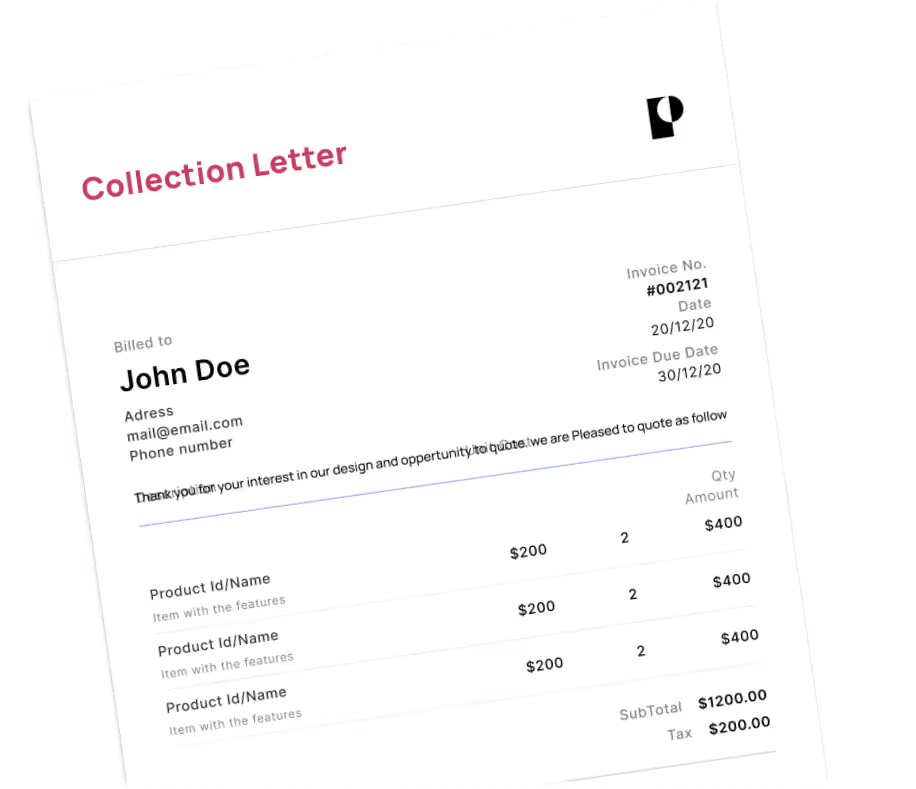
Agencia de recobro en Japón - Honorarios a éxito
Your Japanese claim is handled by Tanaka & Partners, LPC, the licensed Tokyo Legal Professional Corporation (bengoshi hojin) we work with. Debitura is the platform; the local attorneys do the regulated collection work.


Obtén asesoramiento experto gratis
Respuesta de un especialista en 24 horas.
¿Por qué elegir Debitura para el recobro de deudas en Japón?
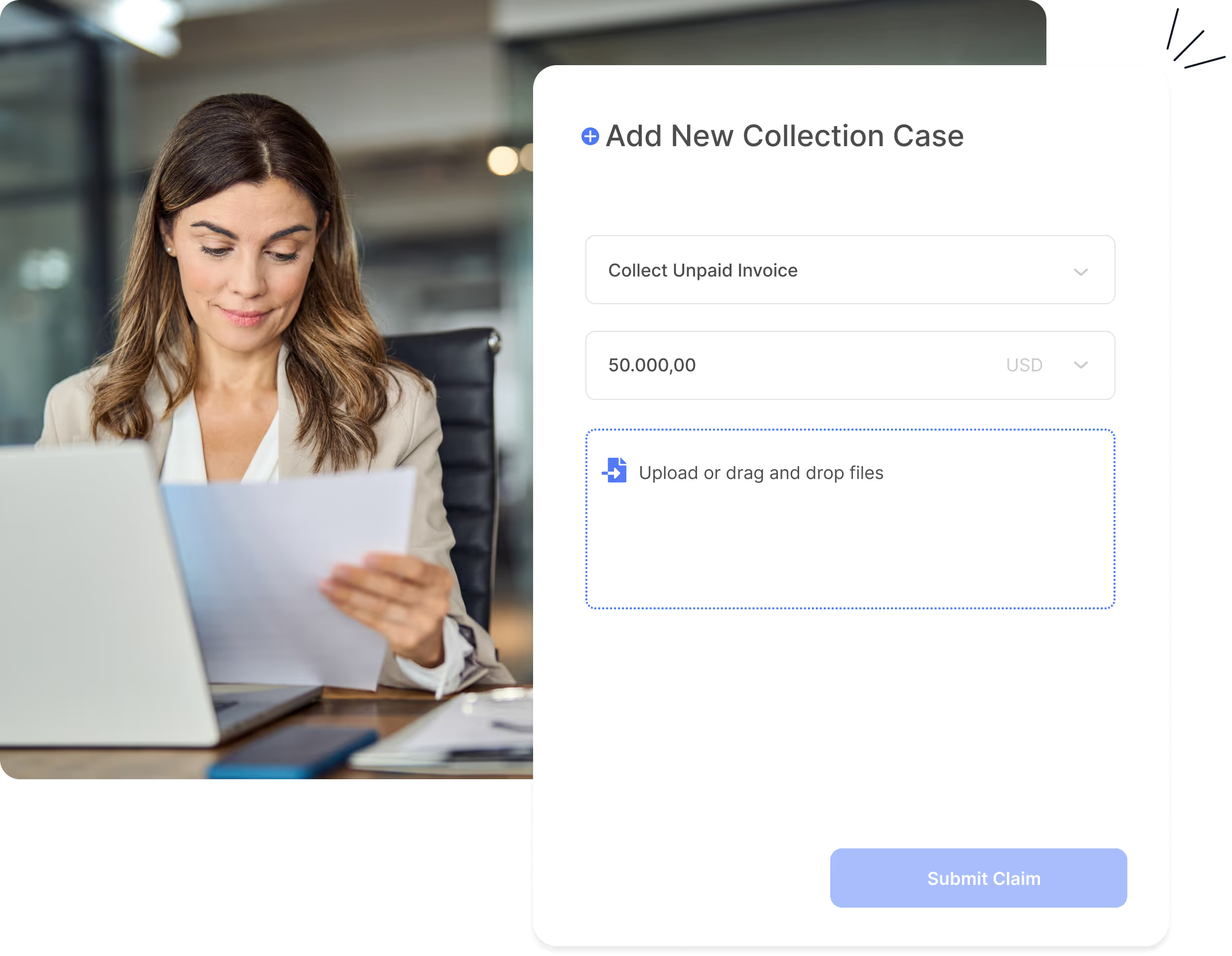
Get paid in Japan without paying anything up front
Debitura is a debt collection platform. You upload the claim, we route it to a licensed local partner, and you pay only when money is recovered. In Japan that partner is Tanaka & Partners, LPC, a Tokyo Legal Professional Corporation whose attorneys are admitted to the Tokyo and Ehime Bar Associations. That matters here: under the Attorneys Act, third-party collection of ordinary commercial debt in Japan is reserved to licensed attorneys, so a law firm is the only lawful local route for most trade claims.
- No Cure, No Pay: you pay a success fee only on what is recovered.
- Two minutes to submit: upload the invoice and the debtor details.
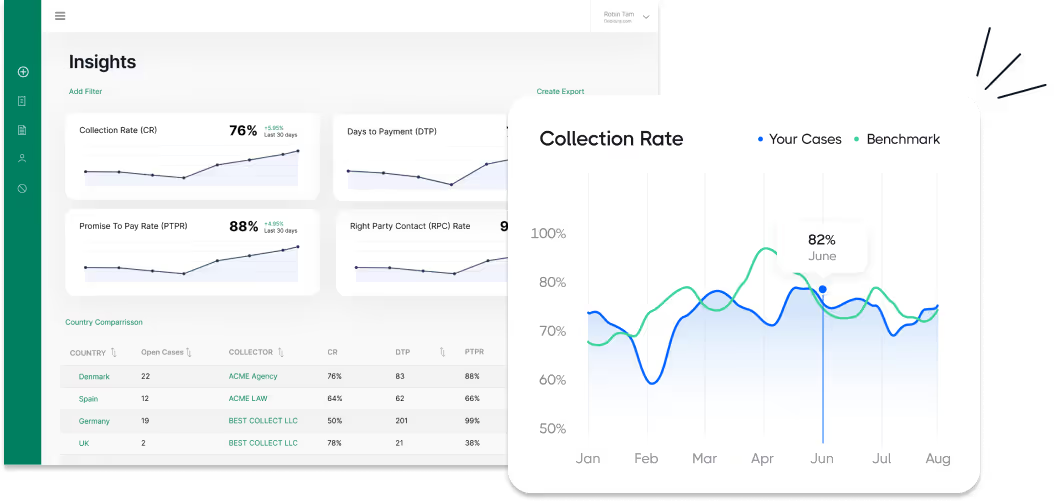
- One dashboard: follow every step, in English.
- Nothing escalates without your written approval.

Empiece a recobrar en Japón en tres pasos
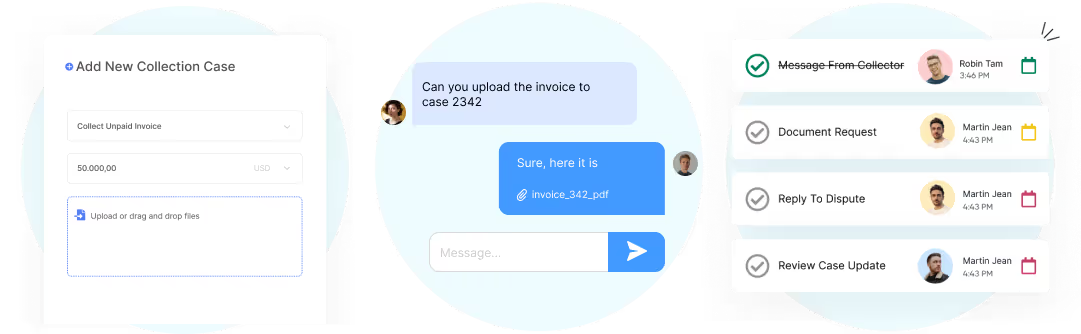
- Upload your claim: enter the debtor details and attach the invoice in our secure dashboard.
- We assign your case: Tanaka & Partners, LPC takes the claim and opens the amicable phase, normally a formal demand sent by content-certified mail (naiyo shomei yubin).
- Track and collect: follow progress in your dashboard and pay only when funds are recovered.
Already using SAP, Oracle, Microsoft Dynamics or another ERP? Connect through our API or Zapier for automated claim uploads and status syncs.

Precios transparentes y basados en el éxito
Con Debitura, solo paga si tenemos éxito. El recobro extrajudicial es con honorarios a éxito: un honorario de éxito deducido de los importes recuperados, facturado localmente por su socio. Las tarifas dependen del país del deudor, no del suyo.
- Deudores en Europa (UE, Islandia, Liechtenstein, Noruega, Reino Unido y Suiza): honorarios de éxito a partir del 6 % según el tamaño de la reclamación.
- Deudores en el resto del mundo: honorarios de éxito a partir del 7,5 % según el tamaño de la reclamación.
- Reclamaciones antiguas: se aplica un recargo para las reclamaciones con 12-24 meses de retraso y para las reclamaciones con más de 24 meses de antigüedad.
- Las Acciones judiciales son opcionales: usted aprueba presupuestos de precio fijo antes de cualquier gasto legal.
Consulte la página de Precios para ver la tabla completa de tarifas, u obtenga un presupuesto instantáneo al subir una reclamación.
¿Cómo funciona el cobro de deudas en Japón?
Debt collection in Japan starts with an amicable phase handled locally by Tanaka & Partners, LPC: reminders and a formal payment demand, aimed at full payment or a written instalment agreement. Most straightforward claims are resolved at this stage. If the debtor still does not pay, escalation is never automatic. Your partner assesses the legal route and you approve a quote before any court step.
Los cuatro pasos desde la factura impagada hasta el dinero recuperado
- Step 1 - Amicable collection: reminders, a formal payment demand and negotiation, handled locally by Tanaka & Partners, LPC. Most undisputed claims are resolved in this phase, without going to court.
- Paso 2 - Título ejecutivo: si el deudor sigue sin pagar, su socio evalúa la vía legal para obtener un título ejecutivo y usted aprueba un presupuesto de precio fijo antes de que se proceda.
- Step 3 - Enforcement: with a legal title, the court or a court execution officer can attach bank funds, receivables, movables and real estate until the claim is recovered.
- Step 4 - Insolvency: if the debtor turns out to be insolvent, your claim is notified to the court and any distributions are monitored on your behalf.
Every step is tracked in your dashboard, and nothing escalates without your approval. The full legal detail for Japan, timelines, costs, courts and enforcement, follows in the guide below.

Cobro de deudas en Japón - la guía completa de 2026
This guide explains debt collection in Japan for creditors and in-house counsel: which limitation period applies, which court hears your claim, how to obtain an enforceable title, and how enforcement and insolvency work. Every figure below is sourced from Japanese statutes or the Supreme Court of Japan.
En esta página:
Por qué puede confiar en esta guía
At Debitura, we uphold the highest standards of impartiality and precision to bring you comprehensive guides on international debt collection. Every guide is written from primary legal sources and reviewed by licensed local experts in the jurisdiction it covers.
¿Preguntas o comentarios? Envíenos un correo electrónico a contact@debitura.com ; actualizamos esta guía basándonos en sus aportaciones.
Debitura en cifras:
- 767 licensed partners - collection agencies and law firms in our network
- 180 countries covered - with cases handled in 174 of them
- 5,306 businesses registered with Debitura
- 33 days median time to first payment on European cases
Dirigido por expertos, validado localmente
Escrito por Lars Holdgaard, fundador de Debitura (+10 años en recobro de deudas B2B global). Cada página es revisada por los mejores abogados locales para garantizar la precisión legal y los pasos prácticos que puede utilizar.

Expertos locales colaboradores:
Última actualización:

Cobro de deudas en Japón - respuestas rápidas
Short, sourced answers to the questions creditors ask first about debt collection in Japan. The detail behind each answer follows in the steps below.
How long do I have to collect a debt in Japan?
Five years from the date you became aware the claim was payable, or ten years from the date it became payable, whichever expires first (Civil Code, art. 166(1)). The same rule applies to both commercial and consumer claims. Japan abolished its separate commercial limitation period in the reform that took effect on 1 April 2020: the old Commercial Code art. 522 five-year commercial prescription and the old short-term trade prescriptions in Civil Code arts. 170 to 174 were repealed, and the current Civil Code text records those articles as "Deleted". A claim arising from a contract concluded before 1 April 2020 still runs on the old rules.
| Claim type | Limitation period (Civil Code) |
|---|---|
| Ordinary commercial or consumer debt | 5 years subjective / 10 years objective (art. 166(1)) |
| Periodic payments, for example rent or instalments | 10 years subjective / 20 years objective (art. 168) |
| Claim confirmed by a final and binding judgment | 10 years from the judgment (art. 169) |
Can the clock be stopped or reset?
Yes, and the rules are precise. Filing suit, applying for a demand for payment, a court settlement or participation in bankruptcy proceedings pauses prescription until the proceeding ends, and if the right is confirmed by a final judgment a fresh ten-year period starts (Civil Code, art. 147). Enforcement measures pause it (art. 148). A provisional seizure pauses it for six months after it ends (art. 149). A simple out-of-court demand buys a six-month pause once only, and a second demand adds nothing (art. 150). A written agreement to hold discussions pauses it for up to a year at a time, capped at five years in total (art. 151). The debtor acknowledging the debt, for example by a part payment, resets the clock to a fresh full period (art. 152).
Which court hears my claim?
Claim value decides, not the type of debtor. A civil claim of JPY 1,400,000 or less is filed at first instance in a Summary Court; anything above that goes to a District Court (Supreme Court of Japan). Within the Summary Court there is a small claims action for money claims of JPY 600,000 or less, designed to finish in a single day's hearing, usable at most ten times a year per claimant at the same court.
What interest can I add?
Where the contract sets no rate, the Civil Code's statutory default rate applies (art. 404). That rate is variable, is reviewed every three years and was last confirmed at 3% per year in 2023. The 2020 reform replaced the previous split, 5% for civil obligations and 6% for commercial obligations, with this single rate for both business and consumer debtors. A contractually agreed rate takes precedence, subject to the Interest Rate Restriction Act's caps where the underlying claim is a loan.
What does it cost to sue, and can I recover my lawyer's fees?
Court filing fees follow a sliding scale tied to claim value under the Act on the Costs of Civil Proceedings and are paid by revenue stamp: a JPY 30,000,000 claim filed in a District Court carries a JPY 110,000 filing fee. Court costs are generally ordered against the losing party, but they do not include attorney's fees. For an ordinary money claim the Supreme Court has held that a creditor may not recover attorney's fees or collection costs as damages, because Civil Code art. 419 pegs default damages on a money obligation to the interest rate (Supreme Court decision, 11 October 1973).
What documents do I need?
The contract or purchase order, the unpaid invoice, proof of delivery or performance, any statement of account, and the correspondence chasing payment. For the demand stage, Japanese practice is to send the demand by content-certified mail (naiyo shomei yubin), which proves the date and the exact content of the demand and starts the six-month pause under Civil Code art. 150.
¿Quién hace qué en el cobro de deudas en Japón?
Japan is unusual: for ordinary commercial debt, third-party collection is a legal service reserved to licensed attorneys. Knowing who may lawfully act for you decides how a claim is run.
Attorneys and Legal Professional Corporations (bengoshi, bengoshi hojin)
A licensed attorney (bengoshi) or a Legal Professional Corporation is the only party that may collect ordinary trade debt in Japan for a fee as a business. The Attorneys Act (Act No. 205 of 1949), arts. 72 and 73, prohibits anyone other than a licensed attorney from providing legal services, including debt collection, for compensation. Only a bengoshi may conduct proceedings in a Japanese court; a foreign lawyer registered in Japan (gaikokuho jimu bengoshi) cannot appear in domestic court proceedings. This is why Debitura's Japanese partner is a law firm rather than a collection agency.
Licensed servicer companies
There is one narrow exception. The Act on Special Measures Concerning Claim Management and Collection Businesses, known as the Servicer Act (Law No. 126 of 1998, in force 1 February 1999), lets Ministry of Justice-licensed servicer companies collect "specified monetary claims". That category covers financial-institution loans and securitised receivables, not ordinary commercial trade debt. Licensing conditions are heavy: a stock company, capital of at least JPY 500 million, and an attorney on the board. So a servicer licence does not help a supplier chasing an unpaid invoice.
The courts and court execution officers
Enforcement is a state function. Against real estate and against claims such as bank deposits and receivables, enforcement is carried out by the court itself. Against movable property it is carried out by a court execution officer (shikkokan). There is no private bailiff profession in Japan.
Where Debitura fits
Debitura is the platform, not the collector. We verify your claim, route it to Tanaka & Partners, LPC in Tokyo, and keep the file, the correspondence and the status in one dashboard in English. The regulated work, the demand, the negotiation and any court step, is performed by the licensed local firm, and no escalation happens without your approval.
¿Qué leyes y tribunales se aplican al cobro de deudas en Japón?
Japanese debt recovery runs on four statutes and a four-tier court system. Naming them correctly matters, because the 2020 Civil Code reform moved several rules creditors still cite from the old law.
El sistema judicial en materia civil
Japan has four tiers: Summary Court, District Court, High Court and the Supreme Court. Jurisdiction at first instance turns on claim value: JPY 1,400,000 or less goes to a Summary Court, more than that to a District Court. Territorial jurisdiction normally follows the debtor's domicile or place of business. An appeal against a judgment must be filed within two weeks of service, and a judgment that is not appealed within that window becomes final and binding. Judgment must be rendered within two months of the close of hearings.
Legislación clave
- Civil Code (Minpo, Act No. 89 of 1896, reformed with effect from 1 April 2020) - obligations, contracts, prescription (arts. 145 to 169) and the statutory interest rate (art. 404).
- Code of Civil Procedure (Minji Soshoho, Act No. 109 of 1996) - litigation, jurisdiction, appeals, the small claims action, the demand for payment, and recognition of foreign judgments (art. 118).
- Civil Execution Act (Minji Shikkoho, Act No. 4 of 1979) - seizure and enforcement, including the third-party property-disclosure procedures in arts. 196 and 204 that took effect on 1 April 2020.
- Bankruptcy Act, Civil Rehabilitation Act and Corporate Reorganization Act - liquidation and the two restructuring routes.
- Attorneys Act, arts. 72 to 73, and the Servicer Act - who may lawfully collect a debt for a fee.
One limitation rule for business and consumer debtors
The reform that took effect on 1 April 2020 unified the limitation period. Before it, general civil claims ran ten years under the old Civil Code art. 167 while claims arising from commercial acts, in practice most business-to-business claims, ran only five years under the old Commercial Code art. 522. Both that commercial period and the short-term trade prescriptions in the old Civil Code arts. 170 to 174 were repealed, and every claim type now falls under the single art. 166(1) rule. The same reform replaced the 5% civil and 6% commercial interest rates with one statutory rate. Where a debtor-type distinction survives in Japan it is about conduct and licensing, not about time limits: registered moneylenders are subject to statutory restrictions on collection conduct under the Money Lending Business Act, which do not bind an ordinary trade creditor, and the Servicer Act exception is scoped to financial-institution debt.
Data protection
Handling debtor data is governed by the Act on the Protection of Personal Information (APPI), whose amended version took effect on 1 April 2022 and is enforced by the Personal Information Protection Commission. It has extraterritorial reach, so a foreign creditor instructing a Japanese firm is within scope.
Paso 1 - ¿Cómo funciona el cobro de deudas amistoso (extrajudicial) en Japón?
Amicable collection in Japan is a formal demand backed by an evidentiary paper trail, not an informal chase. There is no codified pre-action protocol; the near-universal practice is a demand letter sent by content-certified mail.
The demand letter and why the postal format matters
A demand is normally sent as content-certified mail (naiyo shomei yubin). The post office certifies both the date and the exact wording of what was sent, which gives the creditor proof of the demand if the claim later goes to court. It also has a legal effect on the clock: a simple out-of-court demand pauses prescription for six months under Civil Code art. 150, once only, so the pause is useful as a bridge to filing rather than as a way of postponing a decision indefinitely.
Typical sequence
| Fase | What happens |
|---|---|
| Claim intake | Debt, debtor identity and supporting documents verified; the correct corporate entity confirmed against its Corporate Number. |
| Primer contacto | Written demand in Japanese from the local firm, with a payment deadline and the statutory interest position stated. |
| Requerimiento formal | Demand by content-certified mail, creating proof of date and content and starting the art. 150 six-month pause. |
| Negociación | Payment in full, or a written instalment agreement. A part payment or any written acknowledgment resets the limitation clock in full under art. 152. |
| Decision point | If there is no payment or no workable arrangement, the file is assessed for a court route and you approve a quote. |
Judicial mediation as a middle route
Civil mediation (minji chotei) sits between negotiation and litigation. It is handled mostly by Summary Courts and run by a conciliation committee of a judge and two or more lay conciliation commissioners. It is worth knowing that a successful mediation record has the same effect as a final court judgment, so it produces an enforceable outcome without a trial.
Cuándo escalar el asunto
Escalate when the debtor stops responding, breaks an agreed instalment plan, disputes the claim on grounds that do not survive the documents, or when the limitation date is approaching and only a court step will renew it. Because a debtor's acknowledgment resets the clock and a bare demand does not, a long negotiation with no written acknowledgment is a limitation risk, not a neutral delay.
Paso 2 - ¿Cómo se obtiene un título ejecutivo en Japón?
Japan offers three routes to an enforceable title, and for undisputed invoices the document-only demand for payment is usually the fastest.
Demand for payment (shiharai tokusoku), the document-only route
The creditor files with the court clerk of the Summary Court with jurisdiction over the debtor's domicile. The clerk examines the documents only; there is no hearing and the debtor is not heard before the order issues. Once the order is served, the debtor has two weeks to object. If no objection is filed, the creditor may apply within 30 days for a declaration of provisional execution, and the order then becomes immediately enforceable. If the debtor objects at any point, the case converts automatically to ordinary litigation.
Small claims action (shogaku shoho), for money claims up to JPY 600,000
A small claims action is available only for money claims not exceeding JPY 600,000 and is designed to be concluded in a single day's trial. The defendant may object and force the case into ordinary proceedings. A claimant may use the procedure at most ten times a year at the same court, and a small claims judgment cannot be appealed to a District Court; the only challenge is an objection at the same Summary Court.
Procedimientos ordinarios
Ordinary litigation is the route for disputed claims. The forum follows claim value: JPY 1,400,000 or less in a Summary Court, above that in a District Court. Judgment must be rendered within two months of the close of hearings, and an appeal must be filed within two weeks of service.
| Vía | Ceiling and key deadline |
|---|---|
| Demand for payment | No value ceiling; 2 weeks for the debtor to object, then 30 days to seek provisional execution |
| Small claims action | JPY 600,000; one-day trial, max 10 uses per year per court |
| Ordinary proceedings, Summary Court | Up to JPY 1,400,000 |
| Ordinary proceedings, District Court | Above JPY 1,400,000 |
Más sobre los procedimientos judiciales en Japón
Securing assets before judgment
Provisional attachment (kari sashiosae) under the Civil Provisional Remedies Act freezes a specific asset of the debtor to secure future enforcement, before any judgment exists. It is the standard answer to a debtor who is likely to move funds. The court requires the applicant to post a security deposit, and Japanese practice puts that deposit at roughly 20% to 30% of the claim amount, which is the main commercial constraint on using it.
What a judgment is worth on the clock
A right determined by a final and binding judgment gets a fresh ten-year prescription period under Civil Code art. 169, even where the underlying claim originally ran on a shorter period. Enforcement measures themselves also pause prescription under art. 148.
Court costs and language
The filing fee follows a sliding scale tied to claim value under the Act on the Costs of Civil Proceedings and is paid by revenue stamp. Costs are generally ordered against the losing party, but the order covers court costs, not each side's attorney's fees. Proceedings are conducted in Japanese and require a bengoshi to appear.
Paso 3 - ¿Cómo funciona la Ejecución de sentencia en Japón?
Enforcement in Japan is carried out by the state, not by private bailiffs. With an enforceable title, the creditor asks a court, or a court execution officer, to exercise state power over the debtor's assets.
Who enforces what
The division is set by the Civil Execution Act. Enforcement against immovable property (real estate) and against claims, which includes bank deposits and trade receivables owed to the debtor, is carried out by the court. Enforcement against movable property is carried out by a court execution officer (shikkokan). Where the creditor holds a security interest such as a mortgage, the auction follows the same procedural mechanics as enforcement of a money claim.
| Asset | Who enforces |
|---|---|
| Real estate | The court, by compulsory auction |
| Bank deposits and receivables | The court, by attachment of the claim |
| Movable property | Court execution officer (shikkokan) |
| Secured assets under a mortgage | Auction for exercise of the security interest |
Finding the assets: the third-party disclosure procedure
The single most useful change for creditors in recent years took effect on 1 April 2020. A creditor holding an enforceable title can now obtain a court order compelling third parties to disclose the debtor's property: banks and financial institutions on deposits and securities, the land and building registry on real estate, and local government and pension authorities on the debtor's employer and wage claims. The procedure sits in the Civil Execution Act, arts. 196 and 204, which the Civil Code itself names when listing the events that pause prescription (art. 148(1)(iv)). Before this, a creditor with a judgment but no knowledge of where the debtor banked was often stuck.
Securing assets before you have a title
Provisional attachment (kari sashiosae) freezes an identified asset ahead of judgment and is the standard preservation tool where there is a risk the debtor will move funds. The court requires a security deposit from the applicant, in practice around 20% to 30% of the claim.
Non-monetary obligations
Where the obligation is not a payment, for example delivery or vacating premises, enforcement is either direct, carried out physically by a court execution officer, or indirect, by a court order requiring the debtor to pay a monetary penalty for continued non-performance.
The clock during enforcement
Enforcement measures pause prescription until they conclude (Civil Code, art. 148), and a claim confirmed by a final judgment carries a fresh ten-year period under art. 169. An active enforcement file is therefore not at risk of being time-barred while it runs.
Paso 4 - ¿Cómo afectan los procedimientos de insolvencia a la recuperación de deudas en Japón?
Where the debtor cannot pay at all, enforcement gives way to a collective procedure. Japan runs one liquidation route and two restructuring routes, and which one applies changes what a creditor can expect to recover and what the creditor has to do.
Bankruptcy (hasan): liquidation
Bankruptcy liquidates the debtor's assets and distributes the proceeds among creditors. It is available against any individual or juridical person, and is commenced on the petition of the debtor or of a creditor once the court finds the debtor generally and continuously unable to pay debts as they fall due, or insolvent on a balance-sheet basis. There is no fixed minimum debt threshold. On commencement the debtor loses control of its assets, which pass to a court-appointed bankruptcy trustee. Creditors must notify the court of their claims; the trustee investigates them, liquidates the estate and distributes the proceeds. If the estate is too small to fund any distribution the case is closed without one.
Discharge is not automatic
For an individual debtor, closing the bankruptcy does not by itself wipe out the remaining debts. The debtor must separately petition for discharge (menseki). The court hears creditors and the trustee, may refuse discharge on statutory grounds, and retains a discretion to grant it anyway on the whole circumstances. Once a discharge is final the debtor is released from the remaining pre-petition debts. For a creditor this is the point at which objecting, with evidence, has practical value.
Civil rehabilitation (minji saisei): restructuring with the debtor in control
Civil rehabilitation is open to any individual or juridical person at risk of bankruptcy, or in difficulty continuing in business after paying its debts. The debtor normally keeps control of its assets rather than losing them to a trustee, and proposes a plan that reduces the debt or reschedules repayment. The plan is approved at a creditors' meeting and confirmed by the court, and a supervisor then oversees its execution for three years.
Corporate reorganization (kaisha kosei): restructuring under a trustee
Corporate reorganization is available only to stock companies. It is the heavier route: the company loses control of its business and assets to a court-appointed trustee, who prepares the reorganization plan. The plan needs approval at a stakeholders' meeting of creditors, shareholders and any new investors, and then court confirmation.
Where a creditor ranks
Secured creditors stand outside the bankruptcy and enforce their security separately, which in practice puts them first. Beyond that, the estate pays common-benefit and procedural claims ahead of ordinary creditors, then priority claims, then general unsecured claims pro rata, with post-commencement interest and similar items ranking last. The internal ordering between the priority categories is technical and should be confirmed for a specific claim rather than assumed.
The lighter alternative
Special mediation (tokutei chotei) offers a mediation-based restructuring route for debtors in repayment difficulty, outside formal insolvency. It is run through the Summary Courts and can produce an enforceable settlement without opening a collective procedure.
Honorarios, intereses y quién paga qué en Japón
- Nuestros honorarios: a éxito - pague solo si cobramos (ver Precios).
- Tasas judiciales y de ejecución: se aplican tasas estatales solo si el expediente escala a acciones judiciales.
- Statutory debtor items: late-payment interest is added to the debt where the law allows.
- Quién se queda con qué: el principal recuperado es suyo; los costes e intereses legales siguen las normas locales.
Statutory interest
Where the contract fixes no rate, the Civil Code's statutory default rate applies (art. 404). It is variable, reviewed every three years, and was last confirmed at 3% per year in 2023. The 2020 reform replaced the old 5% civil and 6% commercial rates with this single rate for business and consumer debtors alike. If the underlying claim is a loan, agreed interest is additionally capped on a sliding scale by the Interest Rate Restriction Act.
Court costs and legal fees, the Japanese exception
Court costs are generally ordered against the losing party, but that order does not extend to attorney's fees, which each side bears itself. For an ordinary money claim the Supreme Court held on 11 October 1973 that a creditor cannot recover attorney's fees or collection costs as damages, because Civil Code art. 419 fixes default damages on a money obligation at the interest rate. Japan has no equivalent of the European flat recovery-cost compensation.
Tasas judiciales
Filing fees follow a sliding scale by claim value under the Act on the Costs of Civil Proceedings and are paid by revenue stamp. A JPY 30,000,000 claim filed in a District Court carries a JPY 110,000 filing fee.
Cross-border debt collection in Japan
A foreign creditor faces two distinct questions in Japan: how to serve documents on a Japanese debtor, and whether a judgment obtained at home can be enforced in Japan.
Service of documents
Japan is a Contracting State to the Hague Convention of 15 November 1965 on the Service Abroad of Judicial and Extrajudicial Documents in Civil or Commercial Matters, and its designated Central Authority is the Ministry of Foreign Affairs. Service through the Convention is reliable but slow, so build months rather than weeks into the timetable.
Recognition of a foreign judgment
A foreign civil or commercial judgment is recognised in Japan if five cumulative conditions under the Code of Civil Procedure, art. 118, are met: the judgment is final and binding; the foreign court had jurisdiction on standards Japan accepts; the losing party was properly served or appeared without objection; the judgment and the proceeding are not contrary to Japanese public policy; and there is reciprocity.
Enforcement requires a second step
Recognition is not enforcement. To enforce, the creditor must obtain a separate Japanese execution judgment under the Civil Execution Act, art. 24. The court does not re-open the merits, only the art. 118 conditions. In practice this commonly takes six months to a year, which often makes suing in Japan directly the faster route for a straightforward invoice claim.
Encuentre un abogado local de recobro de deudas
¿Necesita representación legal para un juicio? Comparta su expediente una sola vez y reciba hasta tres propuestas de abogados litigantes verificados. Gratis, rápido y sin compromiso.
- Especialistas verificados
- Presupuestos en 24 horas, sin comisiones ocultas
- Tarifas justas y prenegociadas

Tomimasu Law Office es un bufete de abogados de primer nivel en Kioto que ofrece servicios eficaces de cobro de deudas en Japón, fundado en 2021 e inscrito en el Colegio de Abogados de Kioto, lo que lo convierte en el socio ideal para la recuperación de deudas con una sólida trayectoria en la jurisdicción japonesa.
.webp)
.png)

.png)

Tanaka & Partners, LPC es un bufete de abogados líder en Japón que ofrece servicios eficaces de recobro de deudas sin riesgo, lo que posiciona a la firma como el socio de referencia para el recobro de deudas desde 2019, con un modelo de Honorarios a éxito, membresías de IACC y EuroCollectNet, y la asociación exclusiva con Debitura.
Preguntas frecuentes
Consulte nuestras preguntas frecuentes más comunes a continuación, o contáctenos directamente en contact@debitura.com si necesita ayuda con un expediente específico.
.svg)


.png)


.png)
.svg)
.svg)