Agencia de recobro en Turquía - Honorarios a éxito
Your claims are handled exclusively by ARS Consultancy, our licensed local partner for debt collection (alacak tahsilatı) in Turkey. Submit your claim in minutes, track progress in real time, and pay only when your money is recovered.


Obtén asesoramiento experto gratis
Respuesta de un especialista en 24 horas.
¿Por qué elegir Debitura para el recobro de deudas en Turquía?
Risk-free debt collection in Turkey
Debitura recovers unpaid invoices from debtors in Turkey through our platform: submit your claim, track it in real time, and pay only when money comes in. Debitura is the platform; the regulated collection work in Turkey is performed by our exclusive local partner, ARS Consultancy, an Istanbul-based agency and a member of FENCA, ECA and the League International for Creditors, where it holds a board seat.
- Sin riesgos: Pague solo cuando recuperemos su dinero.
- Configuración rápida: Envíe las facturas con unos pocos clics.
- Seguimiento en tiempo real: Supervise el progreso en vivo en un solo portal.
- Local expertise: Turkish professionals handle the demand, the icra dairesi filing and any court step.

Cómo empezar con el recobro de deudas en Turquía
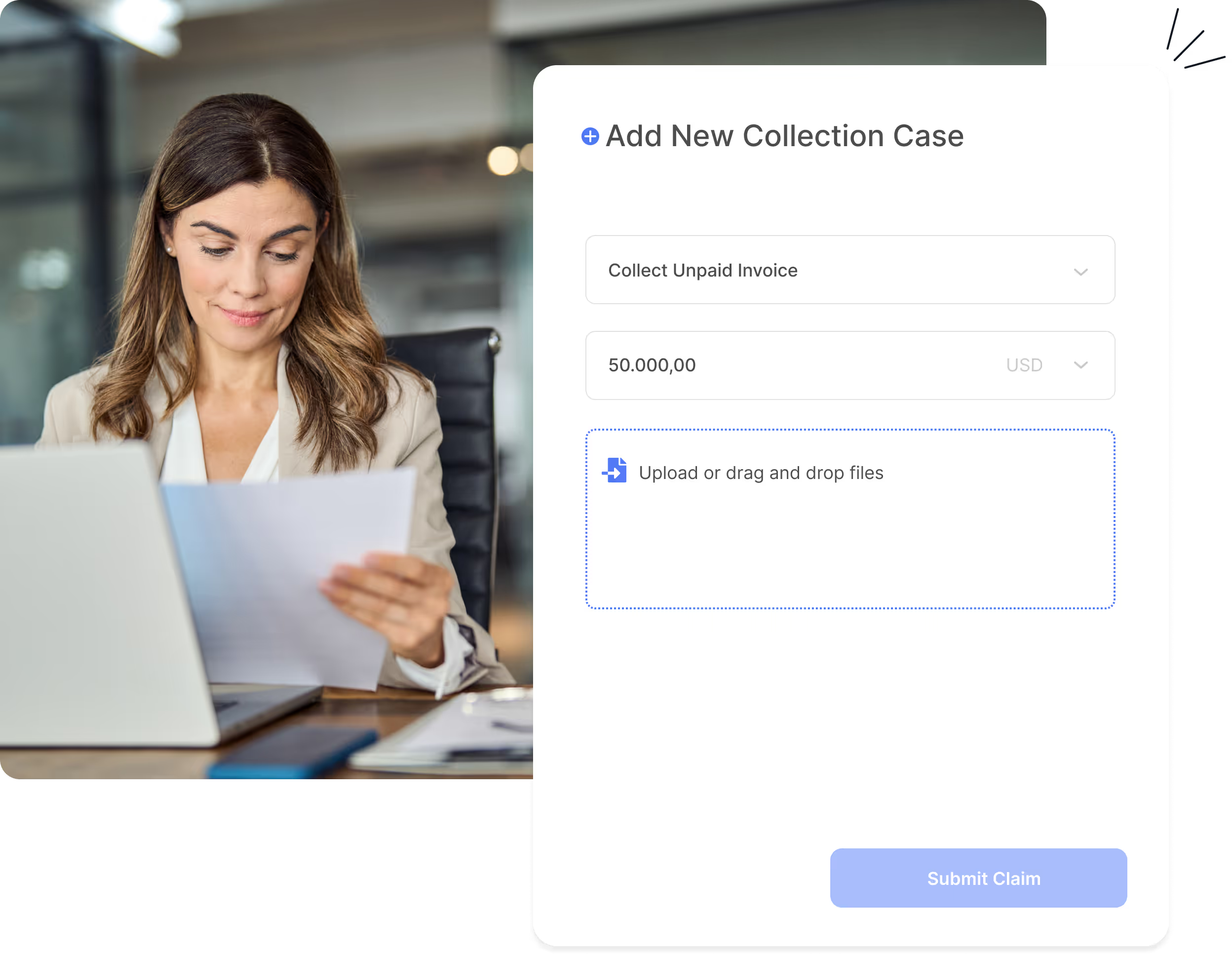
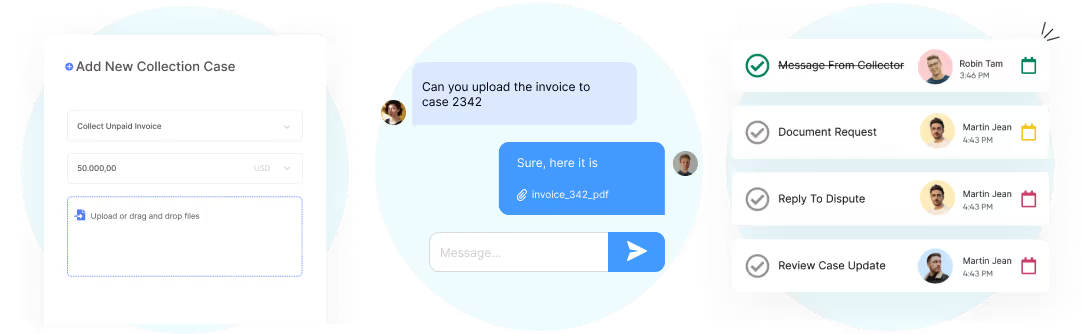
- Upload your claim via Debitura's dashboard in under 2 minutes, with the invoice details and debtor information.
- ARS Consultancy takes over and opens the amicable phase in Turkish, with a formal payment demand stating the statutory default interest.
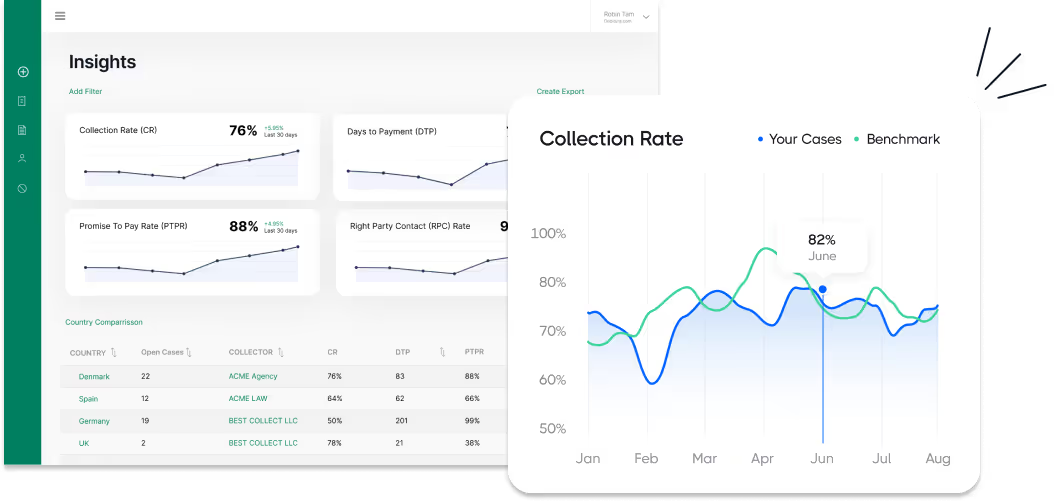
- Track progress in real time through your dashboard. If the claim needs to escalate to ilamsız icra or to court, you approve a quote first.
¿Ya utiliza un sistema ERP? Debitura se integra con las principales plataformas para una presentación de reclamaciones sin interrupciones.

Precios transparentes y basados en el éxito
Con Debitura, solo paga si tenemos éxito. El recobro extrajudicial es con honorarios a éxito: un honorario de éxito deducido de los importes recuperados, facturado localmente por su socio. Las tarifas dependen del país del deudor, no del suyo.
- Deudores en Europa (UE, Islandia, Liechtenstein, Noruega, Reino Unido y Suiza): honorarios de éxito a partir del 6 % según el tamaño de la reclamación.
- Deudores en el resto del mundo: honorarios de éxito a partir del 7,5 % según el tamaño de la reclamación.
- Reclamaciones antiguas: se aplica un recargo para las reclamaciones con 12-24 meses de retraso y para las reclamaciones con más de 24 meses de antigüedad.
- Las Acciones judiciales son opcionales: usted aprueba presupuestos de precio fijo antes de cualquier gasto legal.
Consulte la página de Precios para ver la tabla completa de tarifas, u obtenga un presupuesto instantáneo al subir una reclamación.
¿Cómo funciona el cobro de deudas en Turquía?
El cobro de deudas en Turquía comienza con una fase amistosa gestionada localmente por ARS Consultancy: recordatorios y una demanda formal de pago, con el objetivo de obtener el pago completo o un acuerdo de pago a plazos por escrito. La mayoría de las reclamaciones sencillas se resuelven en esta etapa. Si el deudor sigue sin pagar, la escalada nunca es automática: su socio evalúa la vía legal y usted aprueba un presupuesto antes de cualquier paso judicial.
Los cuatro pasos desde la factura impagada hasta el dinero recuperado
- Paso 1 - Cobro amistoso: recordatorios, una demanda formal de pago y negociación, gestionado localmente por ARS Consultancy. La mayoría de las reclamaciones no disputadas se resuelven en esta fase, sin recurrir a los tribunales.
- Paso 2 - Título ejecutivo: si el deudor sigue sin pagar, su socio evalúa la vía legal para obtener un título ejecutivo y usted aprueba un presupuesto de precio fijo antes de que se proceda.
- Paso 3 - Ejecución de sentencia: con un título legal, la autoridad de ejecución competente puede embargar salarios, fondos bancarios y otros activos hasta que se recupere la reclamación.
- Paso 4 - Insolvencia: si el deudor resulta ser insolvente, se presenta su prueba de crédito y se supervisan los repartos en su nombre.
Cada paso se registra en su panel de control, y nada escala sin su aprobación. Todos los detalles legales para Turquía —plazos, costes, tribunales y Ejecución de sentencia— se encuentran en la guía a continuación.

Cobro de deudas en Turquía — la guía completa 2026
Written for creditors, in-house counsel and finance teams recovering money from a debtor in Turkey (Türkiye), this guide sets out how debt collection in Turkey works end to end: the governing statutes and courts, who does what, the limitation and statutory-interest rules, the ilamsız icra route to an enforceable outcome, enforcement through the icra dairesi, and insolvency under the İcra ve İflas Kanunu.
En esta página:
Por qué puede confiar en esta guía
At Debitura, we uphold the highest standards of impartiality and precision to bring you comprehensive guides on international debt collection. Every guide is written from primary legal sources and reviewed by licensed local experts in the jurisdiction it covers.
¿Preguntas o comentarios? Envíenos un correo electrónico a contact@debitura.com ; actualizamos esta guía basándonos en sus aportaciones.
Debitura en cifras:
- 767 licensed partners - collection agencies and law firms in our network
- 180 countries covered - with cases handled in 174 of them
- 5,306 businesses registered with Debitura
- 33 days median time to first payment on European cases
Dirigido por expertos, validado localmente
Escrito por Lars Holdgaard, fundador de Debitura (+10 años en recobro de deudas B2B global). Cada página es revisada por los mejores abogados locales para garantizar la precisión legal y los pasos prácticos que puede utilizar.

Expertos locales colaboradores:
Última actualización:

Cobro de deudas en Turquía — respuestas rápidas
Debt collection in Turkey is unusual in one respect that shapes every recovery strategy: a creditor can open enforcement proceedings without a court judgment first. The headline rules are below.
How much does debt collection cost in Turkey?
Pre-legal collection is success-based (No Cure, No Pay), so the amicable phase costs you nothing unless money is recovered. Opening ilamsız icra (enforcement without a prior judgment) at the icra dairesi carries statutory filing and service costs, and a contested claim adds court costs and lawyer's fees. Turkey indexes its judicial monetary thresholds and fee items annually to the tax revaluation rate, set at 25.49% for 2026, so any figure quoted for a previous year is out of date; your partner quotes the current cost for your claim before you approve a legal step.
How long does debt collection take in Turkey?
The enforcement route moves quickly when the debtor does not object: the icra müdürü issues an ödeme emri (payment order) on the takip talebi, and the debtor has 7 days from service to pay or object. If the debtor objects in time, proceedings halt, and the creditor then has 1 year to bring an itirazın iptali (annulment of objection) action or, where the debt rests on a signed or notarised instrument, 6 months to apply for itirazın kesin kaldırılması (definitive removal of the objection). A fully contested claim runs through the Asliye Hukuk Mahkemesi with an istinaf appeal above it.
What is the limitation period for a debt in Turkey, and does it differ for consumers?
The general limitation period (zamanaşımı) is 10 years under Türk Borçlar Kanunu (the Turkish Code of Obligations, Law No. 6098) article 146, and 5 years under article 147 for six specific claim types: rent and other periodic payments, hotel and restaurant bills, small-scale retail and craft-work sales, partnership-internal claims, agency and commission claims, and most construction-contract claims. This framework applies to both commercial and consumer claims: Turkish law sets no separate limitation period for consumer debt. The Tüketicinin Korunması Hakkında Kanun (the Consumer Protection Law, Law No. 6502) contains only two limitation articles, article 12 (2 years for a defective good, 5 years for housing) and article 16 (2 years for a defective service), and both govern the consumer's claim against a seller rather than a creditor collecting a debt from a consumer. Article 147's shorter periods key off the type of claim, not the debtor's merchant or consumer status.
What statutory interest applies to a Turkish debt?
Turkey sets two different default rates, and here the commercial and consumer positions genuinely diverge. Where no contractual rate is agreed, commercial default interest between merchants follows Kanuni Faiz ve Temerrüt Faizine İlişkin Kanun (the Law on Statutory and Default Interest, Law No. 3095) article 2, which tracks the Central Bank of Turkey's avans (short-term advance) rate as at 31 December of the previous year when that is higher than the general rate; the TCMB avans rate has stood at 39.75% per annum since 20 December 2025. General and consumer default interest under article 1 of the same law is 24% per annum where no rate is agreed. Compound interest is banned outright in consumer transactions, even in default (Law No. 6502, article 4(7)), while Türk Ticaret Kanunu (the Turkish Commercial Code, Law No. 6102) article 8 permits it between merchants at intervals of at least three months.
| Tema | Regla |
|---|---|
| Limitation, general | 10 years (TBK art. 146). Same for commercial and consumer claims. |
| Limitation, special categories | 5 years for six claim types (TBK art. 147), by claim type not debtor type. |
| Default interest, B2B | TCMB avans rate, 39.75% p.a. since 20 December 2025 (Law 3095 art. 2). |
| Default interest, general and consumer | 24% p.a. where not agreed (Law 3095 art. 1). No compound interest. |
| Objection window | 7 days from service of the ödeme emri (IIK arts. 60 to 62). |
| Court jurisdiction | Asliye Hukuk Mahkemesi for money claims of any value (HMK art. 2). No small-claims split. |
What documents do I need to collect a debt in Turkey?
Ilamsız icra can be opened on the creditor's own statement, without filing the underlying documents at the outset, which is why the route is fast. What decides the case is what happens after an objection: a signed or notarised instrument (a promissory note, a signed acknowledgement, a notarised contract) unlocks the shorter 6-month itirazın kesin kaldırılması route, while an unsigned invoice trail leaves you with the 1-year itirazın iptali action. Assemble the contract, invoices, statement of account, proof of delivery and any signed acknowledgement before you start.
Which route should my claim take in Turkey?
Most claims start with ilamsız icra, because it puts a payment order in front of the debtor without a court case. If the debtor is a tacir (merchant) or otherwise subject to bankruptcy by special law, the iflas yolu (bankruptcy route) is also available and is often the stronger lever; against an ordinary consumer only haciz (attachment) is possible. A claim that is genuinely disputed on the merits belongs in an ordinary action before the Asliye Hukuk Mahkemesi, which hears money claims regardless of value.
¿Quién hace qué en el cobro de deudas en Turquía?
Recovery in Turkey involves a collection agency or law firm for the amicable phase, the icra dairesi for enforcement, and the civil courts when a claim is contested. Debitura is the platform that routes and tracks your claim; the regulated work in Turkey is performed by our licensed local partner, ARS Consultancy.
Collection agencies in Turkey
A collection agency manages the amicable phase: tracing and contacting the debtor, issuing a formal payment demand, negotiating settlement or an instalment plan, and documenting the outcome. Agencies register with the trade registry and operate as commercial companies; they cannot themselves compel payment, so their value lies in resolving the claim before the statutory machinery is needed and in preparing the file if it is.
The icra dairesi and the icra müdürü in Turkey
The icra dairesi (enforcement office) is the state body that actually enforces. On a takip talebi (enforcement request) the icra müdürü (enforcement director) issues the ödeme emri and, if no timely objection follows, proceeds to haciz (attachment) of the debtor's assets and their sale. Enforcement officers are court-attached public officials, not private bailiffs, and they act on the creditor's application under the İcra ve İflas Kanunu (the Enforcement and Bankruptcy Law, Law No. 2004).
Lawyers in Turkey
An avukat (lawyer) is needed once an objection has to be lifted, since itirazın iptali and itirazın kesin kaldırılması are court actions, and for any ordinary action or bankruptcy petition. For a foreign creditor, Turkish counsel is also the practical route to a valid power of attorney and to representation before the Asliye Hukuk Mahkemesi.
¿Qué leyes y tribunales se aplican al cobro de deudas en Turquía?
Turkish debt recovery runs on a codified civil-law system in which enforcement has its own statute and its own state offices, separate from the courts that decide disputes.
The civil court system in Turkey
Money claims are heard by the Asliye Hukuk Mahkemesi (Civil Court of First Instance), which has general jurisdiction over money and property claims regardless of value under Hukuk Muhakemeleri Kanunu (the Code of Civil Procedure, Law No. 6100) article 2. The Sulh Hukuk Mahkemesi (Civil Court of Peace) takes only the subject matters assigned to it by article 4, defined by subject matter rather than by amount. Turkey therefore has no monetary small-claims court for ordinary debt suits, which is a common misconception in cross-border planning. Above first instance sit the istinaf (regional appeal) and temyiz (cassation) levels; their monetary access thresholds are re-indexed each year to the tax revaluation rate, 25.49% for 2026, so confirm the current figure with counsel before relying on an appeal right.
Key legislation in Turkey
- Türk Borçlar Kanunu (the Turkish Code of Obligations, Law No. 6098): contract and debt, and the limitation regime in articles 146 to 158.
- İcra ve İflas Kanunu (the Enforcement and Bankruptcy Law, Law No. 2004): ilamsız icra, haciz, the iflas (bankruptcy) route and konkordato.
- Hukuk Muhakemeleri Kanunu (the Code of Civil Procedure, Law No. 6100): jurisdiction and civil procedure.
- Türk Ticaret Kanunu (the Turkish Commercial Code, Law No. 6102): merchant status and commercial interest rules.
- Kanuni Faiz ve Temerrüt Faizine İlişkin Kanun (the Law on Statutory and Default Interest, Law No. 3095): the statutory default rates.
- Milletlerarası Özel Hukuk ve Usul Hukuku Hakkında Kanun (the Private International Law and Procedure Act, MÖHUK, Law No. 5718): recognition and enforcement of foreign judgments.
Consumer protection in Turkish debt collection
Tüketicinin Korunması Hakkında Kanun (the Consumer Protection Law, Law No. 6502) does not change the limitation period for consumer debt, but it does change what a creditor may demand and when. A creditor may only accelerate a consumer instalment, credit or housing-finance debt and call in the full remaining balance after at least two consecutive missed instalments and at least 30 days' written notice (articles 19, 28 and 34). Compound interest is prohibited in all consumer transactions, including in default (article 4(7)). Neither protection has an equivalent for ordinary commercial debt between merchants, so a consumer file and a B2B file are worked to different timetables.
Paso 1 — ¿Cómo funciona el cobro de deudas amistoso (prejudicial) en Turquía?
Pre-legal collection in Turkey recovers an unpaid invoice without opening enforcement or court proceedings, through reminders, a formal payment demand and negotiation. It is worth doing properly, because a written acknowledgement of the debt, a part payment, an interest payment, a pledge or a guarantee all interrupt the limitation period under Türk Borçlar Kanunu articles 154 and 156, and a debt acknowledged in a signed instrument or confirmed by a court or arbitral award then carries a fresh 10-year period under article 158, whatever the original period was.
| Fase | Acción |
|---|---|
| Recordatorio | Invoice, due date and payment details, with the statutory default interest stated. |
| Requerimiento formal | States the sum, a deadline and the intention to open ilamsız icra. |
| Negociación | Settlement or instalment plan, ideally signed so it restarts limitation at 10 years. |
| Escalada | File a takip talebi at the icra dairesi, or a bankruptcy petition against a merchant. |
Extra rules when the debtor is a consumer in Turkey
A consumer file is worked to a different timetable. Under Tüketicinin Korunması Hakkında Kanun articles 19, 28 and 34, a creditor may only call in the full remaining balance of a consumer instalment, credit or housing-finance debt after at least two consecutive missed instalments and at least 30 days' written notice. Compound interest may not be charged in any consumer transaction, even in default (article 4(7)). Neither restriction applies to ordinary commercial debt between merchants, so acceleration against a business debtor follows the contract instead.
When to escalate in Turkey
Escalate when the demand lapses, the debtor disputes without substance, or the limitation period approaches. Because ilamsız icra needs no prior judgment, the practical threshold for escalating in Turkey is lower than in most jurisdictions: the question is usually whether the debtor is likely to object, not whether the claim is large enough to litigate.
Paso 2 — ¿Cómo se obtiene un título ejecutivo en Turquía?
Turkey lets a creditor start enforcement before obtaining a judgment. The ordinary starting point is therefore not a lawsuit but ilamsız icra, enforcement without a prior judgment, and a court case only becomes necessary if the debtor objects.
Ilamsız icra: enforcement without a judgment
The creditor files a takip talebi (enforcement request) directly with the icra dairesi (enforcement office); no court case is needed, and the request can be based on the creditor's own statement of the debt (İcra ve İflas Kanunu, article 58). The icra müdürü then issues an ödeme emri (payment order) and serves it on the debtor. From service, the debtor has 7 days to pay or to file an objection (articles 60 to 62). If no timely objection arrives, the proceeding becomes final and the creditor can move straight to haciz (attachment).
What happens if the debtor objects
A timely objection halts the proceeding, and the creditor must go to court to lift it. Two routes exist, and which one is open depends entirely on the paperwork:
| Vía | Deadline and requirement |
|---|---|
| Itirazın iptali (annulment of objection) | Within 1 year of the objection; an ordinary action on the merits. If the losing party acted in bad faith, the court may award denial-of-debt compensation of at least 20% of the claim. |
| Itirazın kesin kaldırılması (definitive removal) | Within 6 months; available only where the debt rests on a signed or notarised instrument. Faster and narrower. |
The ordinary action and the competent court in Turkey
A claim contested on the merits is heard by the Asliye Hukuk Mahkemesi, which takes money claims regardless of value under Hukuk Muhakemeleri Kanunu article 2. There is no monetary small-claims track for ordinary debt suits, and the Sulh Hukuk Mahkemesi is defined by subject matter rather than by amount (article 4). Above first instance sit istinaf and temyiz, whose monetary access thresholds are re-indexed annually to the tax revaluation rate (25.49% for 2026), so the current figures should be confirmed with counsel rather than taken from a previous year's table.
Paso 3 — ¿Cómo funciona la Ejecución de sentencia de deudas en Turquía?
Enforcement in Turkey is carried out by the icra dairesi, a state enforcement office attached to the courts, rather than by private bailiffs. It begins once the ödeme emri has become final, either because the debtor did not object within the 7-day window or because an objection has been lifted by the court.
Ways to enforce a claim in Turkey
- Haciz (attachment): the creditor asks the icra dairesi to attach the debtor's assets. Bank balances, receivables owed to the debtor by third parties, wages, movables and immovable property can all be reached.
- Sale: attached assets are sold under the enforcement office's supervision and the proceeds are applied to principal, interest and costs, with any surplus returned to the debtor.
- Protected assets: the İcra ve İflas Kanunu exempts assets a debtor needs for basic living and for their trade, and it caps how much of a salary may be attached, so a wage attachment yields a share of net pay rather than the whole.
- Iflas yolu (bankruptcy route): where the debtor is a tacir (merchant) or a person made subject to bankruptcy by a special law, the creditor may pursue bankruptcy instead of attachment (article 43). Against an ordinary consumer, only haciz is available, which makes the debtor's merchant status a strategic question at the outset rather than an afterthought.
The enforcement process in Turkey
The creditor applies to the icra dairesi with the finalised proceeding, the office investigates and attaches assets on the creditor's application, and the sale follows. Because the office acts on what the creditor asks it to attach, an application naming the debtor's known bank relationships, receivables or registered property moves faster than a general request, and asset research done during the amicable phase pays for itself here.
Paso 4 — ¿Cómo afectan los procedimientos de insolvencia al recobro de deudas en Turquía?
Where a debtor cannot pay at all, individual enforcement gives way to a collective procedure under the İcra ve İflas Kanunu. Two routes matter to a creditor: iflas (bankruptcy), which liquidates, and konkordato (composition with creditors), which restructures.
Who can be made bankrupt in Turkey
Bankruptcy is available only against a tacir (merchant) or a person made subject to bankruptcy by a special law (article 43). An ordinary consumer debtor cannot be made bankrupt, and can only be pursued through haciz. For a creditor, this makes the debtor's status the first question: against a company or a registered trader, the threat of a bankruptcy petition is often a stronger lever than attachment, because it puts the whole business at risk rather than one asset.
Konkordato (composition with creditors)
A debtor who cannot pay its debts as they fall due, or who is at risk of that, may petition the competent court for konkordato. The court grants an initial moratorium (mühlet) and appoints a concordat commissioner (komiser) to supervise the debtor and report on the proposal, and creditors are then called to consider it. The moratorium suspends individual enforcement, so a creditor who has attached assets should expect the process to pause. The precise length of the initial moratorium and its extensions are set by the statute and applied by the court, so confirm the current period with Turkish counsel before planning around it.
The creditor process and priority
In a bankruptcy, creditors register their claims with the estate and distribution follows a statutory ranking table (sıra cetveli) drawn up under the İcra ve İflas Kanunu. A rehinli (secured) creditor is satisfied first from the proceeds of the asset securing its claim; where that value falls short, the unpaid balance joins the unsecured creditors, who share what remains of the estate. Ordinary trade creditors therefore sit at the back of the queue and commonly recover only part of the debt, which is the practical argument for acting on a Turkish receivable while attachment is still available.
Fees, interest and who pays what in Turkey
- Nuestros honorarios: basados en el éxito, pague solo si cobramos (ver Precios).
- Enforcement and court fees: statutory enforcement and court fees apply only if the case escalates, and Turkey re-indexes its judicial fee items annually to the tax revaluation rate (25.49% for 2026). Your partner quotes the current cost before any step is taken.
- Statutory debtor items: default interest runs on the debt at the statutory rate where no rate is agreed, and a court may award denial-of-debt compensation of at least 20% of the claim against a party who objected in bad faith.
- Who keeps what: recovered principal is yours; interest and costs follow the contract, the statute and the court's or the enforcement office's order.
Statutory default interest in Turkey
Where the contract fixes no rate, Kanuni Faiz ve Temerrüt Faizine İlişkin Kanun (Law No. 3095) sets two different defaults. Commercial default interest between merchants follows article 2, tracking the Central Bank of Turkey's avans rate as at 31 December of the previous year when that is higher than the general rate; that rate has stood at 39.75% per annum since 20 December 2025. General and consumer default interest under article 1 is 24% per annum. Compound interest is available between merchants at intervals of at least three months (Türk Ticaret Kanunu article 8) and is prohibited outright in consumer transactions, even in default (Law No. 6502, article 4(7)).
Cross-border debt collection in Turkey
Turkey is not part of the EU judicial-cooperation area, so a foreign judgment is not automatically enforceable and there is no European Payment Order route into Turkey. A creditor holding a foreign judgment must apply for tenfiz (recognition and enforcement) before a Turkish court under Milletlerarası Özel Hukuk ve Usul Hukuku Hakkında Kanun (the Private International Law and Procedure Act, MÖHUK, Law No. 5718). Article 54(1)(a) makes reciprocity a condition: there must be a treaty between Turkey and the state where the judgment was given, or a statutory provision or established practice in that state permitting the enforcement of Turkish judgments. Because reciprocity turns on the particular country, check it before litigating abroad against a Turkish debtor. Where the debtor's assets are in Turkey, opening ilamsız icra directly in Turkey is often faster and cheaper than winning at home and then seeking tenfiz.
Encuentre un abogado local de recobro de deudas
¿Necesita representación legal para un juicio? Comparta su expediente una sola vez y reciba hasta tres propuestas de abogados litigantes verificados. Gratis, rápido y sin compromiso.
- Especialistas verificados
- Presupuestos en 24 horas, sin comisiones ocultas
- Tarifas justas y prenegociadas

Antroya Debt Collection & Law Office es un bufete de abogados de primer nivel en Sarıyer/Estambul que ofrece servicios eficaces de cobro de deudas en Turquía, fundado en 2005, que opera con el principio de "Si no hay resultado, no hay pago", con una tasa de éxito del 98% y galardones como el CLLA Bronze Champion.
.webp)
.png)

.png)

MGC Legal es un bufete de abogados de primer nivel en Estambul que ofrece servicios eficaces de cobro de deudas en Turquía, posicionándose como el socio de referencia para el cobro de deudas con una base en 2013, galardones como el de Bufete de Abogados del Año y presencia en 125 países.

Tenha Law Firm es un bufete de abogados de primer nivel en Estambul que ofrece servicios eficaces de cobro de deudas en Turquía, fundado en 2001, conocido por su cobro rápido y habilitado por la tecnología; miembro del Colegio de Abogados de Estambul, que presta servicios a clientes con estrategias a medida.

Bicak Law Firm es un bufete de abogados de primer nivel en Ankara que ofrece servicios eficaces de cobro de deudas en Turquía, posicionándose como el socio de referencia para el cobro de deudas desde 2002, con galardones como el Clutch Leader Award y la pertenencia a la International Law Firms Association, que presta servicios a países como Italia y España.

HERDEM Attorneys at Law es un bufete de abogados de primer nivel en Besiktas que ofrece servicios eficaces de cobro de deudas en Turquía, reconocido por su excelencia con galardones como el de Abogado Líder en Derecho Aeronáutico y su pertenencia a los Colegios de Abogados Internacional y Americano desde 2011.

ERGUR LAW FIRM es un bufete de abogados de primer nivel en Beylikdüzü que ofrece servicios eficaces de cobro de deudas en Turquía, fundado en 2006, y es reconocido por su enfoque centrado en el cliente, sus precios competitivos y su pertenencia al Colegio de Abogados de Estambul y a Birleşik Arabuluculuk Merkezi A.Ş.

Polat Hukuk Bürosu es un bufete de abogados de primer nivel en Kocasinan que ofrece servicios eficaces de cobro de deudas en Turquía, posicionándose como el socio de referencia para la recuperación de deudas desde 2010, con 25 abogados y miembro del Colegio de Abogados de Kayseri y de la Unión de Colegios de Abogados de Turquía.
Cebeci Bayram Law Firm es un bufete de abogados de primer nivel en Estambul que ofrece servicios eficaces de cobro de deudas en Turquía, posicionándose como el socio de referencia para la recuperación de deudas desde 2019, con tarifas competitivas y miembro del Colegio de Abogados de Estambul y de la Unión de Colegios de Abogados de Turquía.

SUNER LAW OFFICE es un bufete de abogados de primer nivel en Kuşadası que ofrece servicios eficaces de cobro de deudas en Turquía, posicionándose como el socio de referencia con una base en 2015, que presta servicios a clientes locales y extranjeros con soluciones legales innovadoras.
Guzeloglu Attorneys at Law es un bufete de abogados de primer nivel en Estambul que ofrece servicios eficaces de cobro de deudas en Turquía, fundado en 2015, y reconocido por sus soluciones innovadoras, su enfoque rentable y su pertenencia a la Unión de Colegios de Abogados de Turquía y al Colegio de Abogados de Estambul.

CBC Law Firm es un bufete de abogados de primer nivel en Besiktas que ofrece servicios eficaces de cobro de deudas en Turquía, reconocido por Chambers & Partners y The Legal 500, fundado en 2020 y que presta servicios a clientes en el Reino Unido, Estados Unidos, Canadá y otros países.

Gonen Law Office es un bufete de abogados de primer nivel en Etimesgut que ofrece servicios eficaces de cobro de deudas en Turquía, establecido en 1999, reconocido por su experiencia internacional y reconocido a través de prestigiosos premios y membresías, lo que lo convierte en el socio de referencia para la recuperación de deudas.

Kurucuk & Associates es un bufete de abogados de primer nivel en Estambul que ofrece servicios eficaces de cobro de deudas en Turquía, reconocido como el socio de referencia para la recuperación de deudas desde 2014, con galardones como el Premio del Gobierno de Turquía y miembro del Colegio de Abogados de Estambul, que presta servicios a clientes en 12 países.
Ateskan Law es un bufete de abogados de primer nivel en Bornova que ofrece servicios eficaces de cobro de deudas en Turquía, posicionándose como el socio de referencia para la recuperación de deudas con una fundación en 2017, miembro del Colegio de Abogados de İzmir y operaciones en once países europeos.
Preguntas frecuentes
Consulte nuestras preguntas frecuentes más comunes a continuación, o contáctenos directamente en contact@debitura.com si necesita ayuda con un expediente específico.
.svg)


.png)


.png)
.svg)
.svg)