Debt Collection Agency in Portugal - No Win, No Fee
Your claims are handled exclusively by Indebt, our licensed Portuguese debt collection partner (empresa de cobrança de dívidas) with 17+ years of expertise and APERC membership. Submit your claim in minutes, track progress in real time, and pay only when your money is recovered.


Get free expert advice
Response from a specialist within 24 hours.
Why Choose Debitura for Debt Collection in Portugal
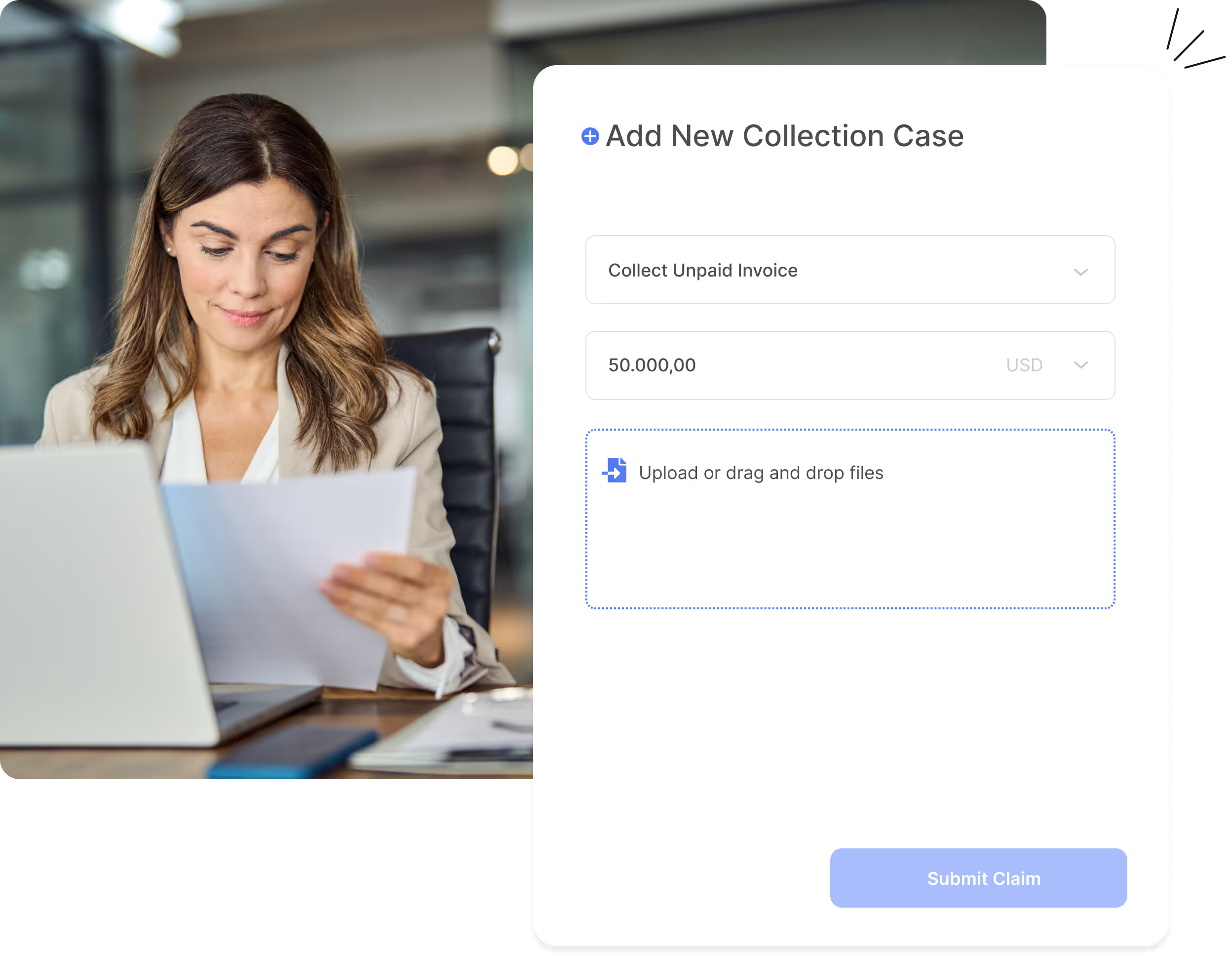
Fast, simple and risk-free debt collection in Portugal
Debitura recovers unpaid invoices from debtors in Portugal through our platform: submit your claim, and we assign it to a licensed local partner working on a No Cure, No Pay basis while you track progress in real time. Your case is handled by Indebt, a Lisbon-based debt collection agency with 17+ years of expertise, APERC membership, and recognition as Marca Recomendada 2025 for consumer satisfaction.
- Risk-free: Pay only when we recover your money.
- Quick setup: Submit invoices in a few clicks.
- Real-time tracking: Monitor progress live in one portal.
- Local expertise: Portuguese specialists handle your claims.

How to start your Portuguese debt collection
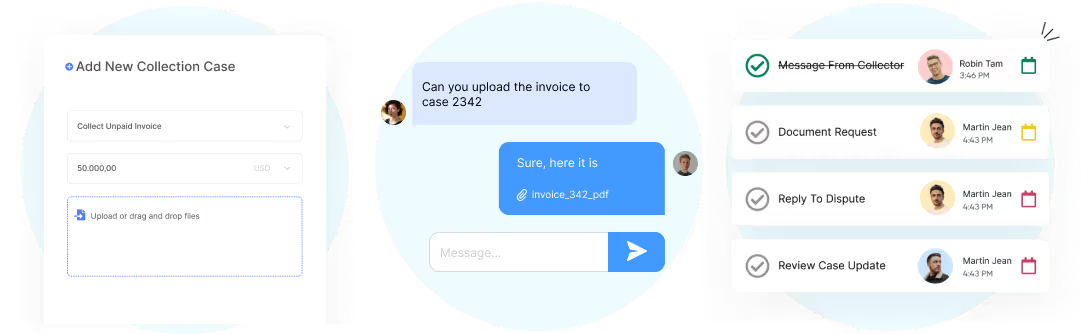
- Submit your claim: Upload your unpaid invoice via Debitura's dashboard, API, or ERP integration. Indebt receives the case instantly.
- Indebt contacts your debtor: Your Portuguese debtor receives professional contact in Portuguese within 48 hours.
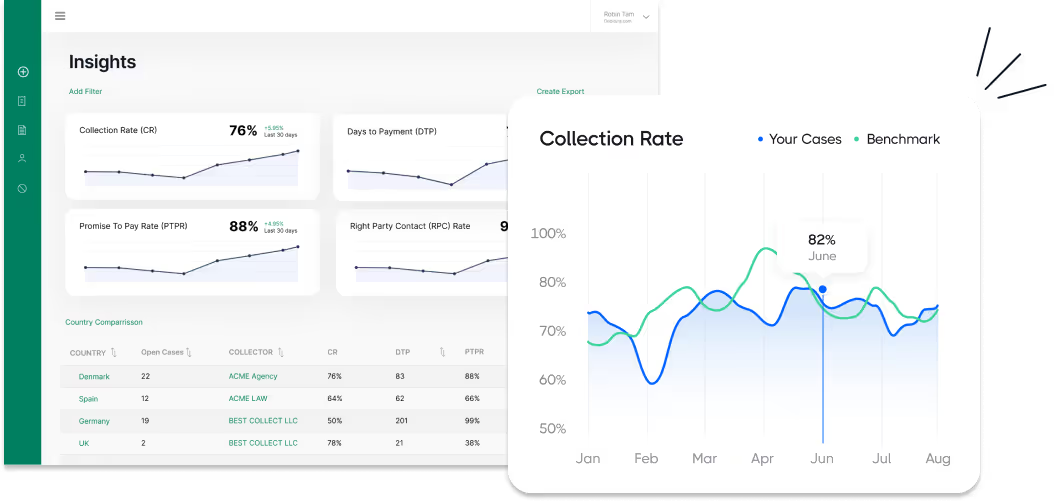
- Track and recover: Monitor real-time updates in your dashboard. Pay only when cash is recovered.
Already using SAP, Oracle, or Microsoft Dynamics? Our API and ERP integrations let you submit claims directly from your existing systems.

Transparent, success-based pricing
With Debitura you only pay when we succeed. Pre-legal collection is No Cure, No Pay: a success fee deducted from recovered amounts, invoiced locally by your partner. Fees depend on the debtor's country, not yours.
- Debtors in Europe (EU, Iceland, Liechtenstein, Norway, the UK and Switzerland): success fees from 6% depending on claim size.
- Debtors in the rest of the world: success fees from 7.5% depending on claim size.
- Older claims: a surcharge applies for claims 12–24 months overdue and for claims older than 24 months.
- Legal action is optional: you approve fixed-price quotes before any legal spend.
See the pricing page for the full fee schedule, or get an instant estimate when you upload a claim.
How does debt collection work in Portugal?
Debt collection in Portugal starts with an amicable phase handled locally by Indebt - Improve Debt Management, Lda: reminders and a formal demand for payment, aimed at full payment or a written acknowledgement of the debt. Most undisputed claims are resolved at this stage. If the debtor still does not pay, escalation is never automatic; your partner assesses the legal route, and you approve a fixed-price quote before any court step.
- Indebt achieves 80.6/100 satisfaction index with 100% resolution rate (Debitura).
- Fast-track Injunção resolves most uncontested claims in under 3 months.
- Legal escalation optional - you decide whether to proceed.
- Enforcement via Agente de Execução for asset seizure and wage garnishment.
The four steps from unpaid invoice to recovered cash
- Step 1, Amicable collection: reminders, a formal demand and negotiation, handled locally by Indebt - Improve Debt Management, Lda. Most undisputed claims are resolved here, without going to court.
- Step 2, Enforceable title: if the debtor still does not pay, your partner assesses the legal route to obtain an enforceable title, and you approve a fixed-price quote before anything proceeds.
- Step 3, Enforcement: with a title, the enforcement authorities can attach and sell assets, garnish bank accounts and wages, and take other measures until the claim is recovered.
- Step 4, Insolvency: if the debtor cannot pay, your proof of claim is filed in the insolvency process, and any distributions are monitored on your behalf.
Every step is tracked in your dashboard, and nothing escalates without your approval. The full legal detail for Portugal follows in the guide below.

Debt collection in Portugal - the complete 2026 guide
Built for overseas and domestic creditors, in-house counsel and finance teams, this guide sets out how debt collection in Portugal works end to end: the legal framework, who does what, limitation and late-payment interest rules, the order-for-payment route (injunção) to an enforceable title, enforcement (ação executiva), and insolvency under the CIRE.
On this page:
Why you can trust this guide
At Debitura, we uphold the highest standards of impartiality and precision to bring you comprehensive guides on international debt collection. Every guide is written from primary legal sources and reviewed by licensed local experts in the jurisdiction it covers.
Questions or feedback? Email us at contact@debitura.com , we update this guide based on your input.
Debitura By the Numbers:
- 767 licensed partners - collection agencies and law firms in our network
- 180 countries covered - with cases handled in 174 of them
- 5,306 businesses registered with Debitura
- 33 days median time to first payment on European cases
Expert-led, locally validated
Written by Lars Holdgaard, Founder of Debitura (+10 years in global B2B debt recovery). Every page is reviewed by top local attorneys to ensure legal accuracy and practical steps you can use.

Contributing local experts:
Last updated:

Debt collection in Portugal - quick answers
Debt collection in Portugal is comparatively fast for undisputed commercial debts: the electronic order-for-payment procedure (injunção, an application for a payment order) can produce an enforceable title in weeks, and EU law adds automatic late-payment protection for businesses.
How much does debt collection cost in Portugal?
Pre-legal collection is commonly success-based (No Cure, No Pay), so there is no upfront cost. The injunção itself carries a flat 51 euro court fee, regardless of claim value; the Julgados de Paz (Justice of the Peace courts, Portugal's small-claims forum) charge a flat 70 euro, reduced to 50 euro if the parties reach a mediated agreement. Contested litigation adds court fees (custas), lawyer fees and enforcement-agent fees, and the losing party is generally ordered to pay costs.
How long does debt collection take in Portugal?
The injunção can produce an enforceable title within a few weeks when the debtor does not oppose within the 15-day response window. If the debtor opposes, the matter converts to a declaratory action (ação declarativa) or, for smaller claims, an Ação Especial para Cumprimento de Obrigações Pecuniárias (AECOP, a special procedure for enforcing monetary obligations), which takes longer.
What are the limitation periods and interest rules in Portugal?
The ordinary limitation period is twenty years (Código Civil, the Portuguese Civil Code, article 309), and this is also the period that applies to an ordinary B2B invoice for goods or services the buyer uses in its own trade. A shorter two-year presumptive period (article 317) applies only where the buyer is not a merchant, or does not use the supply for its own business, such as a merchant selling to a non-merchant or a liberal-profession fee; five years applies to periodic obligations such as interest and rent (article 310). For commercial (B2B or B2G) transactions, late-payment interest under Decreto-Lei n.º 62/2013 accrues automatically at the European Central Bank main refinancing rate plus 8 percentage points, currently 10,40% for the second half of 2026, and the creditor may also claim a fixed 40 euro for recovery costs regardless of proof of further loss.
| Topic | Rule |
|---|---|
| Limitation (ordinary) | 20 years (Civil Code art. 309), incl. ordinary B2B invoice debt; 5 years for periodic obligations (art. 310); 2 years only for merchant-to-non-merchant sales and liberal-profession fees (art. 317). |
| B2B/B2G late-payment interest | ECB main refinancing rate + 8 percentage points, 10,40% in H2 2026 (Decreto-Lei n.º 62/2013). |
| Recovery costs | Fixed 40 euro plus reasonable documented costs. |
| Injunção value scope | No cap for commercial (B2B/B2G) claims; 15,000 euro cap for other contractual claims; 15 days for the debtor to pay or oppose. |
| Small-claims alternative | Julgados de Paz, up to 15,000 euro, 70 euro fee (50 euro if mediated). |
What documents do I need to collect a debt in Portugal?
Keep the contract or order, invoices and statement of account, proof of delivery or performance, and correspondence. The injunção is based on the creditor's own declaration of the debt, so these documents matter most if the debtor opposes and the case converts to a declaratory action.
Which route should my claim take in Portugal?
A commercial (B2B or B2G) money debt of any value usually suits the injunção (order for payment), which carries no value ceiling for commercial-transaction claims (Decreto-Lei n.º 62/2013, article 10.1); for smaller, non-commercial contractual claims, the Julgados de Paz (up to 15,000 euro) is a cheaper alternative, and its decisions are enforceable in the same way as a court judgment. A disputed claim proceeds as a declaratory action (ação declarativa) or, for smaller sums, AECOP. A cross-border EU claim can use the European Payment Order instead of the domestic injunção.
Who does what in Portugal debt collection?
Recovery in Portugal involves collection agencies for amicable work, lawyers for litigation, and enforcement agents for execution. Debitura supports you across all stages through Indebt - Improve Debt Management, Lda.
Collection agencies in Portugal
Agencies handle the pre-legal phase: demands, negotiation and settlement. Conduct must respect the consumer-protection rules in Lei n.º 24/96 and the unfair-commercial-practices rules in Decreto-Lei n.º 57/2008, enforced by ASAE (the Economic and Food Safety Authority): unwanted home visits after being told to leave, persistent unsolicited contact, and threats of legal action the collector cannot actually take are all prohibited.
Lawyers in Portugal
Lawyers (advogados) represent creditors in declaratory proceedings, file the injunção or AECOP where needed, and seek interim measures. For claims up to 5,000 euro under AECOP, a lawyer is not mandatory.
Courts and enforcement agents in Portugal
The injunção is processed centrally by the Balcão Nacional de Injunções (the National Payment Orders Office), created by Portaria n.º 220-A/2008. Small commercial claims up to 15,000 euro can instead go to a Julgado de Paz (Justice of the Peace court). Contested matters and larger claims go to the judicial courts (tribunais judiciais). Enforcement (ação executiva) is carried out by an agente de execução (enforcement agent, also called solicitador de execução), regulated under the Estatuto da Ordem dos Solicitadores e dos Agentes de Execução (OSAE's governing statute, Lei n.º 154/2015), under judicial supervision.
Which laws and courts apply to debt collection in Portugal?
Portuguese debt recovery runs on the Código de Processo Civil (the Code of Civil Procedure) and the Código Civil (the Civil Code), with EU late-payment and cross-border instruments layered on top.
The civil court system in Portugal
Portugal has 23 comarcas (judicial districts), in place since 1 September 2014 under Lei n.º 62/2013's judicial-map reform. Within each, the Instância Local hears civil claims up to 50,000 euro and the Instância Central Cível hears claims above that threshold, under Lei n.º 62/2013 (the Judicial Organisation Law). Appeals go to one of five Tribunais da Relação (Courts of Appeal: Coimbra, Évora, Guimarães, Lisboa and Porto) and, in limited cases, to the Supremo Tribunal de Justiça (the Supreme Court of Justice). The alçada (appeal-value threshold) is 5,000 euro for first-instance civil judgments and 30,000 euro for the Relação (Lei n.º 62/2013, article 44); below the first-instance alçada, no appeal is possible and a lawyer is not mandatory (Código de Processo Civil article 40). For claims up to 15,000 euro, creditors can alternatively use a Julgado de Paz (Justice of the Peace court), a simplified, lower-cost forum that excludes family, succession and labour matters and most adhesion-contract debts such as utilities; an appeal from a Julgado de Paz to the district court is only available where the value exceeds 2,500.01 euro. Insolvency is heard by the commerce divisions of the judicial courts.
Key legislation in Portugal
- Código de Processo Civil (Lei n.º 41/2013): governs the enforcement action (ação executiva) and civil procedure generally.
- Decreto-Lei n.º 269/98: the injunção (order-for-payment) regime.
- Código Civil (Decreto-Lei n.º 47344/66): limitation (article 309) and the substantive debt rules.
- Decreto-Lei n.º 62/2013: measures against late payment in commercial transactions.
- Código da Insolvência e da Recuperação de Empresas (CIRE, Decreto-Lei n.º 53/2004), amended by Lei n.º 9/2022: insolvency, restructuring and debt discharge.
Conduct and data protection in Portugal
Collection conduct must respect the consumer-protection rules of Lei n.º 24/96 and the unfair-commercial-practices regime of Decreto-Lei n.º 57/2008, both enforced by ASAE, and debtor data is protected by the EU General Data Protection Regulation and the national data-protection law. The Supremo Tribunal de Justiça sits above the Tribunais da Relação and mainly reviews points of law rather than reweighing the facts, so most debt-collection disputes are decided at first instance or on appeal.
Step 1 - How does amicable (pre-legal) debt collection work in Portugal?
Pre-legal collection recovers an unpaid invoice without a lawsuit, through reminders, a formal demand and negotiation. For commercial debts, late-payment interest under Decreto-Lei n.º 62/2013 accrues automatically once payment is overdue, currently 10,40% a year (the European Central Bank main refinancing rate plus 8 percentage points, for the second half of 2026), plus a fixed 40 euro recovery-cost compensation. The aim is full payment or a written acknowledgement of the debt.
| Stage | Action |
|---|---|
| Reminder | Invoice, due date and payment details. |
| Formal demand | States the sum, statutory late interest and a deadline. |
| Negotiation | Settlement or instalment plan, ideally acknowledged in writing. |
| Escalation | File an injunção or use a Julgado de Paz; a declaratory action if disputed. |
Conduct rules during amicable collection in Portugal
Consumer-protection law (Lei n.º 24/96) and the unfair-commercial-practices regime (Decreto-Lei n.º 57/2008) restrict collection conduct: no unwanted home visits once the debtor has asked the collector to leave, no persistent unsolicited contact intended to wear the debtor down, and no threats of legal action the collector does not actually intend or is not entitled to take. ASAE (the Economic and Food Safety Authority) enforces these rules.
When to escalate to court in Portugal
Escalate when the demand lapses, the debtor disputes without substance, or a limitation period approaches. A commercial debt of any value can go to the injunção; a smaller, non-commercial claim usually goes first to the Julgado de Paz.
Step 2 - How do you obtain an enforceable title in Portugal?
To enforce a debt you need a título executivo (enforceable title). For a commercial (B2B or B2G) money debt, Portugal's main route is the injunção, which carries no value ceiling for commercial-transaction claims (Decreto-Lei n.º 62/2013, article 10.1); a declaratory action, the AECOP procedure (for non-commercial contractual claims up to 15,000 euro) or the Julgados de Paz (up to 15,000 euro) are available for other claims.
The order-for-payment procedure (injunção)
The creditor files an injunção (Decreto-Lei n.º 269/98) electronically with the Balcão Nacional de Injunções (BNI, the National Payment Orders Office), and it is served on the debtor. For a commercial (B2B or B2G) transaction there is no value ceiling on the injunção (Decreto-Lei n.º 62/2013, article 10.1), and the filing fee is a flat 51 euro regardless of claim size. The debtor then has 15 days to pay or oppose (oposição). If the debtor does not oppose, the judicial secretary affixes a fórmula executória (enforceability formula), and the injunção becomes a título executivo without a court judgment ever being issued, under Código de Processo Civil article 703. If the debtor opposes, the matter converts to a declaratory action.
Declaratory and AECOP proceedings
Disputed claims proceed as a declaratory action (ação declarativa) before the judicial courts, ending in a judgment that is itself an enforceable title. For claims up to 15,000 euro that follow the ordinary declaratory route, the Ação Especial para Cumprimento de Obrigações Pecuniárias (AECOP, a special procedure for enforcing monetary obligations) applies, and a lawyer is not mandatory for claims up to 5,000 euro.
Determining the appropriate court in Portugal
The injunção is centralised nationally at the BNI; contested claims follow the ordinary rules of value and the defendant's domicile, splitting between the Instância Local (up to 50,000 euro) and the Instância Central Cível (above that threshold). Claims up to 15,000 euro can alternatively go to a Julgado de Paz. Mind the applicable limitation period throughout.
More on court proceedings in Portugal
European Payment Order and Small Claims
For cross-border EU claims, the European Payment Order and the European Small Claims Procedure are available alongside the domestic injunção; see cross-border debt collection in Portugal below.
Step 3 - How does debt enforcement work in Portugal?
With a título executivo, you enforce it through the ação executiva (enforcement action, Código de Processo Civil, Book IV), conducted by an agente de execução (enforcement agent) under judicial supervision. The creditor (exequente) files a requerimento executivo (enforcement petition) attaching the título executivo, and selects the measures that match the debtor's (executado) known assets.
Ways to enforce a claim in Portugal
- Attachment (penhora): the enforcement agent attaches the debtor's assets, including bank accounts and receivables, subject to a proportionality principle: some assets are protected regardless of value (article 736), some can only be seized if the debtor has no other suitable assets (article 737), and others, including wages, are seizable only above a protected threshold (article 738).
- Sale of assets: attached movable and immovable property is sold, typically by electronic auction, and the proceeds are applied to the debt.
- Wage garnishment: wages above the legally protected minimum can be attached on an ongoing basis until the claim, interest and costs are paid.
- Asset search: the enforcement agent consults public and financial databases (land registry, vehicle registry, bank and tax records) to locate the debtor's assets before choosing which measure to use.
The enforcement process in Portugal
The creditor files the enforcement action with the título executivo, the agente de execução attaches assets, and proceeds are applied first to the enforcement costs, then interest, then principal, with any surplus returned to the debtor. Enforcement generally moves faster against debtors with identifiable bank accounts or wages than against those whose only assets are real property, which requires a formal sale process. The agente de execução is regulated under the Estatuto da Ordem dos Solicitadores e dos Agentes de Execução (OSAE's governing statute, Lei n.º 154/2015), Portugal's professional body for solicitors and enforcement agents, and acts under the supervision of the court hearing the enforcement action.
Step 4 - How do insolvency procedures affect debt recovery in Portugal?
Where the debtor cannot pay, insolvency under the Código da Insolvência e da Recuperação de Empresas (CIRE, the Insolvency and Company Recovery Code, Decreto-Lei n.º 53/2004) becomes the collective route, and individual enforcement generally stops once it opens.
Opening insolvency and lodging your claim
A debtor is insolvent when unable to meet its due obligations (an illiquidity test), or, for a limited-liability company, when its liabilities manifestly exceed its assets (a balance-sheet test, CIRE article 3). Insolvency is declared by the court on the application of the debtor, who must file within 30 days of becoming aware of the situation (article 18), or of a creditor showing one of several statutory grounds, including a failed prior enforcement action for insufficient seizable assets, the debtor's flight or abandonment of its place of business, dissipation or ruinous liquidation of assets, breach of an approved insolvency or payment plan, and generalised non-payment for six months of tax, social-security or employment-related debts (article 20). An administrador da insolvência (insolvency administrator) is appointed; creditors must reclamar (lodge) their claims within the period fixed in the judgment, commonly 30 days.
Recovery instead of liquidation: the PER
A viable debtor in a difficult economic situation or facing imminent insolvency can instead use the Processo Especial de Revitalização (PER, the Special Revitalisation Process, CIRE articles 17-A to 17-J), negotiating a recovery plan with creditors under a provisional judicial administrator. Enforcement actions against the debtor are suspended while a PER negotiation is under way (article 17-E).
Outcomes and ranking of claims
The process leads to a recovery plan or to liquidation of the estate. Claims follow the graduação de créditos (ranking of claims, CIRE articles 47-48 and 174-177): garantidos (secured) first, then privilegiados (preferential), then comuns (ordinary, paid pro rata), and finally subordinados (subordinated, paid last from any surplus). Common unsecured trade creditors often recover only part of the debt.
Individual debtors: the exoneração do passivo restante
For individual (non-trader) debtors, the exoneração do passivo restante (discharge of remaining liabilities, CIRE articles 235-248) lets the debtor assign disposable income to a trustee during a cessão do rendimento disponível (income-assignment period). Lei n.º 9/2022 cut this period from five years to three, with a possible single three-year extension if the debtor breaches its conditions.
The insolvency process for creditors in Portugal
Lodge your claim within the deadline set in the judgment, with the contract, invoices and statement of account; monitor whether a PER or a straight insolvency applies; and weigh insolvency against the injunção, which is faster where the debtor is solvent but simply not paying. Companies that cannot be revitalised under a PER are typically liquidated and dissolved; individuals can pursue the exoneração do passivo restante after liquidation for a fresh start.
Fees, interest and who pays what in Portugal
- Our fee: success-based, No Cure, No Pay (see pricing).
- Court & enforcement fees: statutory court and enforcement fees apply only if the case escalates to legal action. The injunção carries a flat 51 euro court fee, regardless of claim value; the Julgados de Paz charge a flat 70 euro (50 euro if mediated); these are generally recoverable from the debtor if you win.
- Statutory debtor items: for a commercial (B2B/B2G) debt, late-payment interest at the European Central Bank main refinancing rate plus 8 percentage points (10,40% for the second half of 2026) and a fixed 40 euro for recovery costs (Decreto-Lei n.º 62/2013) can be added to the claim, regardless of proof of further loss. For non-commercial debts, the general statutory civil default rate applies instead (9,40% for the same period, Código Comercial article 102, section 3); both rates are republished twice yearly.
- Enforcement costs: the agente de execução's (enforcement agent's) fees are set by regulation and are generally recoverable from the debtor's assets alongside the principal.
- Who keeps what: recovered principal is yours; interest and costs follow the contract, the statute and the court's order.
Cross-border debt collection in Portugal
For a claim against a debtor elsewhere in the EU, the European Payment Order (Regulation 1896/2006) and the European Small Claims Procedure (Regulation 861/2007, for claims up to 5.000 euro) offer uniform routes, and a Portuguese judgment is recognised and enforced across member states under the Brussels I bis Regulation (1215/2012) without a separate exequatur.
European Payment Order applications against a Portuguese debtor are centralised at the Juízo Central Cível do Tribunal da Comarca do Porto (the Central Civil Court of the Porto District Court) and must be filed in Portuguese. European Small Claims Procedure cases are handled by the ordinary local and general civil courts, with fees of 102 euro for claims up to 2.000 euro and 204 euro for claims from 2.001 to 5.000 euro; appeals go to a Tribunal da Relação within 30 days.
Find a Local Debt Collection Lawyer
Need court-ready representation? Share your case once and receive up to three proposals from vetted litigation attorneys. Free, fast, and with no commitment.
- Verified specialists
- Quotes in 24 h, no hidden fees
- Fair, pre-negotiated rates

Le Droit Au Portugal is a premier law firm in Almada offering effective Debt Collection services in Portugal, positioning itself as the go-to partner for debt recovery with 19 years of expertise since 2004, specializing in commercial law and credit recovery.
Calçada & Associados is a premier law firm in Lisbon offering effective Debt Collection services in Portugal, positioning the firm as the go-to partner for debt recovery since 2015, with a reputation bolstered by industry accolades and professional memberships.
LEGACIS Law Office is a premier law firm in Lisbon offering effective Debt Collection services in Portugal, positioning itself as the go-to partner for debt recovery with over 20 years of experience, established in 2002, and recognized for its awards and memberships.
Indebt is a premier debt recovery agency in Portugal offering effective, risk-free debt collection services, positioning itself as the go-to partner for debt recovery since 2009, with accolades like Millennium Aplauso 2024 and memberships in APERC and FENCA; as an exclusive Debitura partner in Portugal, Indebt offers No Cure No Pay debt collection based on Debitura's risk-free standard terms and pricing.
.webp)
.png)

.png)
Frequently Asked Questions
Explore our most common FAQs below, or reach out directly at contact@debitura.com if you need help with a specific case.
.svg)


.png)


.png)
.svg)
.svg)