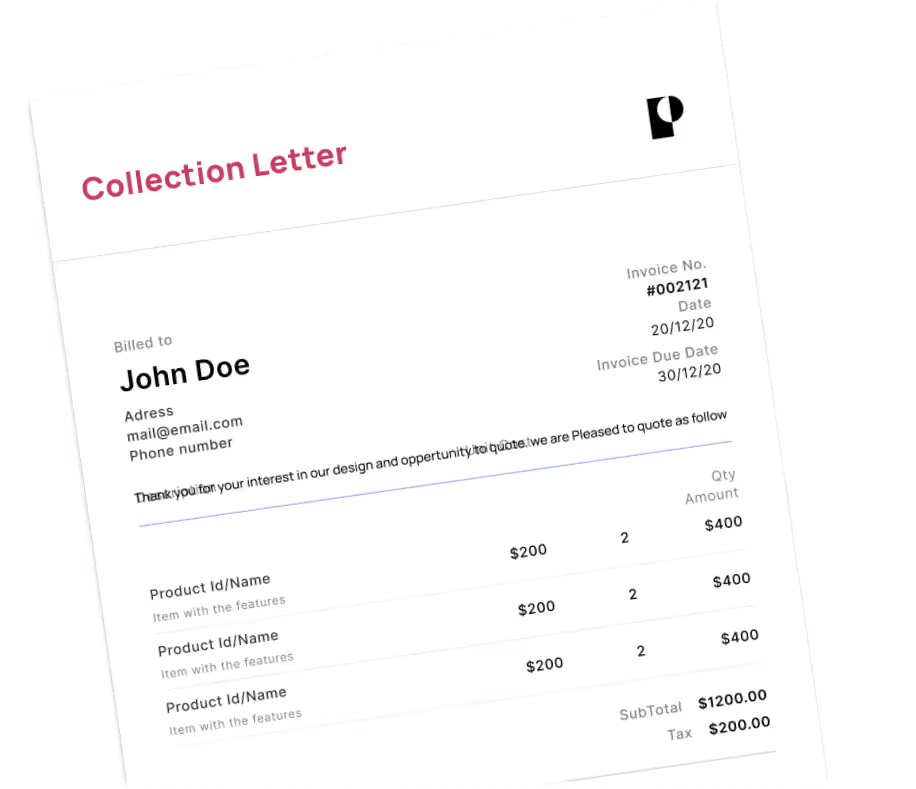
Debt Collection in Egypt: Fast, Compliant, and Risk-Free
Our 2026 guide for DIY debt collection in Egypt follows below, or upload your claim directly through Debitura's platform for swift recovery with zero upfront fees.


Obtén asesoramiento experto gratis
Respuesta de un especialista en 24 horas.
¿Por qué elegir Debitura para el cobro de deudas en Egipto?
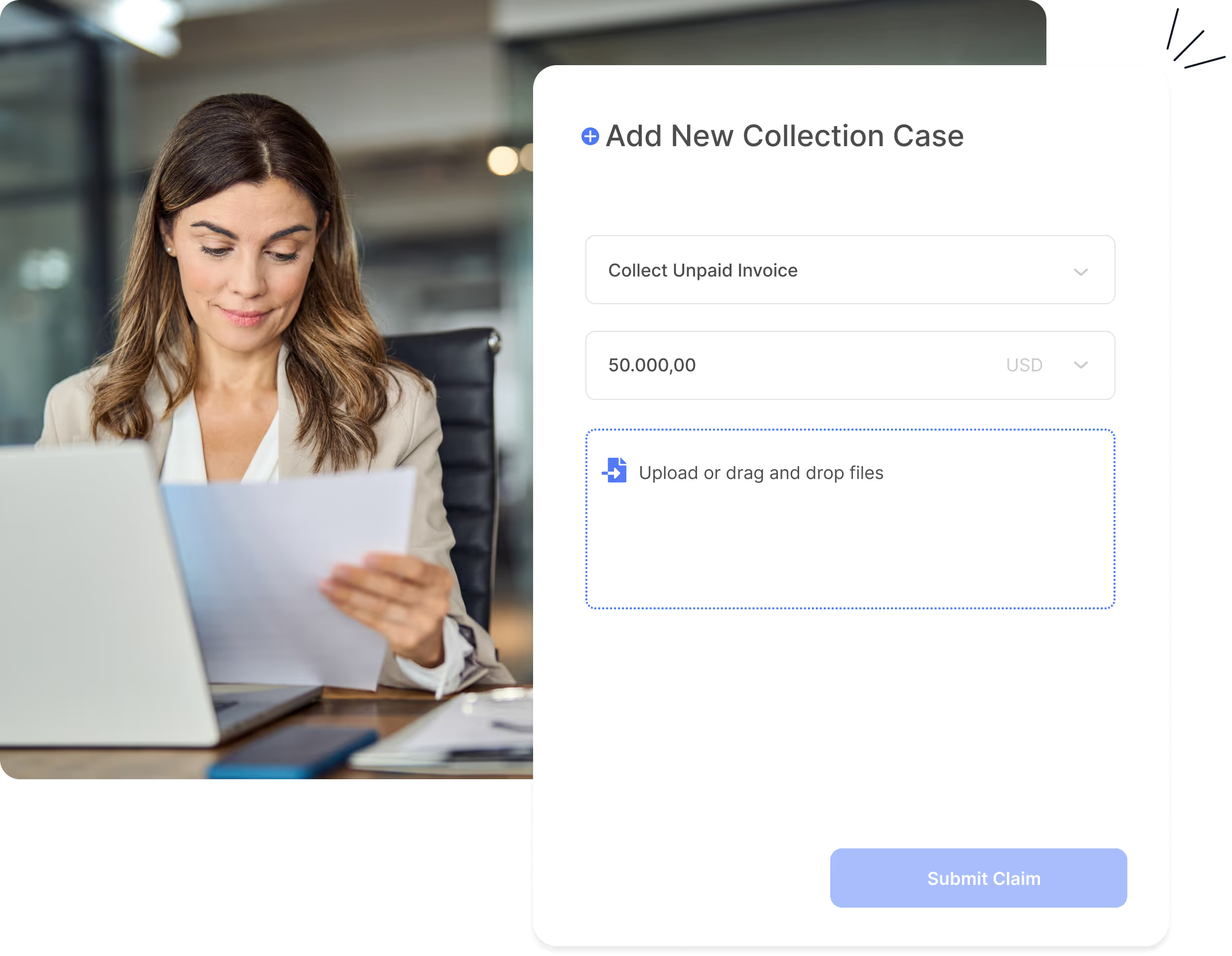
¿Necesita una Agencia de recobro en Egipto? Comience hoy mismo sin riesgo alguno
Facing challenges with debt collection in Egypt? Debitura connects you directly to RIME Information Bureau Ltd, our licensed partner for Egypt, within 24 hours - fully compliant with Egyptian laws and business practices.
- Sin resultados, sin honorarios: Cero costes iniciales; los honorarios de éxito se aplican solo si se logra la recuperación.
- Fast, Coordinated Action: Prompt handling aligned with Egypt's amicable recovery procedures.
- Regional Expertise: A specialist recovery team with experience across Egypt and the wider MENA region.
- Actualizaciones en tiempo real: Haga un seguimiento de sus expedientes sin esfuerzo en nuestro panel de control en vivo.

Empiece a recuperar sus expedientes en Egipto en cuestión de minutos
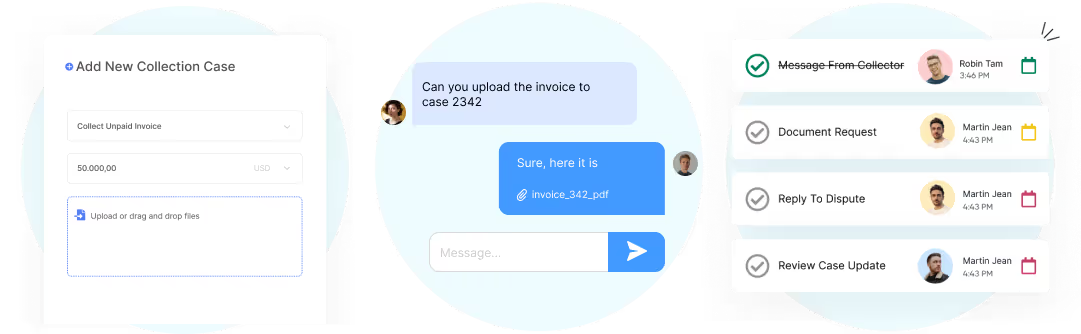
- Presente su crédito: Suba su factura impagada a través del panel de control de Debitura, la API REST o una integración ERP plug-and-play como Xero o QuickBooks. Añada documentos justificativos en unos pocos clics, sin papeleo ni costes de configuración.
- Collection begins: Your case is assigned to RIME Information Bureau Ltd, who starts amicable contact with the debtor on your behalf. If court action is ever needed later, you choose from fixed-price legal quotes before anything proceeds, so nothing is spent without your consent.
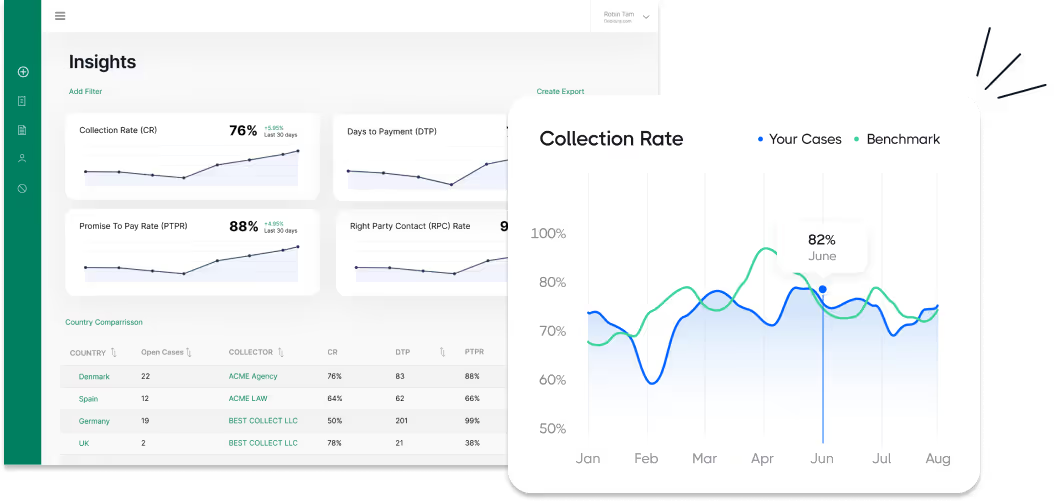
- Siga su expediente y reciba el pago: Siga cada actualización en tiempo real en su panel de control, desde el primer recordatorio hasta el pago final, con una notificación en cada hito. Los fondos recuperados se le remiten tan pronto como se hacen efectivos, y usted solo paga a éxito.

Precios transparentes y basados en el éxito
Con Debitura, solo paga si tenemos éxito. El recobro extrajudicial es con honorarios a éxito: un honorario de éxito deducido de los importes recuperados, facturado localmente por su socio. Las tarifas dependen del país del deudor, no del suyo.
- Deudores en Europa (UE, Islandia, Liechtenstein, Noruega, Reino Unido y Suiza): honorarios de éxito a partir del 6 % según el tamaño de la reclamación.
- Deudores en el resto del mundo: honorarios de éxito a partir del 7,5 % según el tamaño de la reclamación.
- Reclamaciones antiguas: se aplica un recargo para las reclamaciones con 12-24 meses de retraso y para las reclamaciones con más de 24 meses de antigüedad.
- Las Acciones judiciales son opcionales: usted aprueba presupuestos de precio fijo antes de cualquier gasto legal.
Consulte la página de Precios para ver la tabla completa de tarifas, u obtenga un presupuesto instantáneo al subir una reclamación.
¿Cómo funciona el cobro de deudas en Egipto?
Debt collection in Egypt begins with an amicable phase run by RIME Information Bureau Ltd, Debitura's exclusive partner for Egypt: a Cyprus-domiciled specialist covering Egypt and the wider MENA region (RIME is also Algeria's exclusive partner under the same cross-border model), rather than a firm with its own Cairo office. The team sends formal reminders and a demand letter aimed at full payment or a written instalment agreement. Most straightforward claims resolve at this stage. If the debtor still does not pay, escalation to court is a separate step you approve, never automatic.
Los cuatro pasos desde la factura impagada hasta el dinero recuperado
- Paso 1 - Gestión amistosa de cobro: recordatorios, una demanda de pago formal y negociación, gestionado localmente por un socio local y autorizado. La mayoría de los expedientes no disputados se resuelven en esta fase, sin necesidad de acudir a los tribunales.
- Paso 2 - Título ejecutivo: si el deudor sigue sin pagar, su socio evalúa la vía legal para obtener un título ejecutivo y usted aprueba un presupuesto de precio fijo antes de que se proceda.
- Paso 3 - Ejecución de sentencia: con un título legal, la autoridad de ejecución competente puede embargar salarios, fondos bancarios y otros activos hasta que se recupere la reclamación.
- Paso 4 - Insolvencia: si el deudor resulta ser insolvente, se presenta su prueba de crédito y se supervisan los repartos en su nombre.
Cada paso se rastrea en su panel de control, y nada escala sin su aprobación. Todos los detalles legales para Egipto —plazos, costes, tribunales y ejecución de sentencia— se encuentran en la guía a continuación.

Cobro de deudas en Egipto - la guía completa de 2026
This guide covers Egypt's debt-recovery process: the applicable law under the Civil Code and Commercial Code, the ordinary courts and specialised Economic Courts that hear claims, and the path from amicable contact to enforcement under the Code of Civil and Commercial Procedure (Law No. 13 of 1968).
En esta página:
Por qué puede confiar en esta guía
At Debitura, we uphold the highest standards of impartiality and precision to bring you comprehensive guides on international debt collection. Every guide is written from primary legal sources and reviewed by licensed local experts in the jurisdiction it covers.
¿Preguntas o comentarios? Envíenos un correo electrónico a contact@debitura.com ; actualizamos esta guía basándonos en sus aportaciones.
Debitura en cifras:
- 767 licensed partners - collection agencies and law firms in our network
- 180 countries covered - with cases handled in 174 of them
- 5,306 businesses registered with Debitura
- 33 days median time to first payment on European cases
Dirigido por expertos, validado localmente
Escrito por Lars Holdgaard, fundador de Debitura (+10 años en recobro de deudas B2B global). Cada página es revisada por los mejores abogados locales para garantizar la precisión legal y los pasos prácticos que puede utilizar.

Expertos locales colaboradores:
Última actualización:

Cobro de deudas en Egipto - respuestas rápidas
¿Cuánto cuesta el cobro de deudas en Egipto?
Debitura's fee is success-based, No Cure, No Pay (see pricing). If a claim escalates, attorney fees, court costs and bailiff execution costs apply, and statutory interest on a commercial debt follows the Central Bank of Egypt's policy rate under Commercial Code Article 50(3), capped at the amount of the principal debt under Article 64. Court filing fees and bailiff execution costs are not published in a single consolidated schedule and vary with claim value; your legal representative confirms current costs before any court step goes ahead.
¿Cuánto tiempo lleva el cobro de deudas en Egipto?
Timelines depend on how quickly the debtor engages during the amicable phase; if a claim escalates, litigation timelines depend on the court's caseload and the case's complexity. As historical context, the World Bank's last published Doing Business report (2020, the series was discontinued in 2021) ranked Egypt 166th of 190 economies for Enforcing Contracts, with an average of 1,010 days and a cost of 26.2% of the claim value - a past benchmark, not a current guarantee.
¿Cuál es el plazo de prescripción y la tasa de interés para las reclamaciones de deuda en Egipto?
Under Commercial Code Article 68, obligations between traders (B2B) prescribe seven years from the date they fall due, and a final court judgment on such an obligation prescribes after ten years. A separate, shorter prescription applies to liability-type (tort) claims arising from a commercial relationship: Article 67(5) sets three years from when the harmed party learns of the damage, capped at fifteen years from the date of the wrongful act - a distinct rule from the seven-year contractual prescription above. Consumer-facing and other civil claims fall under a separate, general Civil Code limitation period; confirm the exact figure with local counsel before relying on it. Interest on commercial debts tracks the Central Bank of Egypt's rate and is capped at the principal amount (Articles 50(3) and 64).
¿Qué documentos necesita para cobrar una deuda en Egipto?
Egyptian courts expect clear documentary evidence: the underlying contract, signed invoices or delivery receipts, and a formal notice (Inzar) to the debtor, typically issued by an Egyptian attorney before or alongside filing a claim. Where the underlying deal involved a promissory note or a post-dated cheque, these commercial instruments strengthen the claim further.
¿Qué tribunal maneja las reclamaciones de cobro de deudas en Egipto?
Commercial and financial disputes are often routed to the specialised Economic Courts (established under Law No. 120 of 2008, amended by Law No. 156 of 2024), while other civil claims go through the ordinary court system; claim size and type determine which tier hears a case, so confirm the current threshold before filing. Within the ordinary system, the Courts of First Instance include smaller-claims circuits for lower-value civil disputes, though the exact monetary cut-off between circuits is not publicly confirmed.
What happens if my debtor is insolvent in Egypt?
As historical context, the World Bank's final Doing Business report (2020) ranked Egypt 104th of 190 economies for Resolving Insolvency, with an average process length of 2.5 years, a cost of 22.0% of the estate, and a recovery rate of 23.3 cents on the dollar. Egypt's Restructuring, Preventive Composition and Bankruptcy Law (Law No. 11 of 2018) now gives a distressed debtor a restructuring or preventive-composition route through the Economic Courts before full bankruptcy; see Step 4 below for how this affects your claim.
| Dato clave | Egipto |
|---|---|
| B2B commercial limitation period | 7 years from due date; judgment prescribes after 10 years (Commercial Code Art. 68) |
| Liability/tort claim prescription | 3 years from discovery of harm, capped at 15 years from the act (Commercial Code Art. 67(5)) |
| Interest on commercial debts | Central Bank of Egypt policy rate; capped at the principal amount (Commercial Code Arts. 50(3), 64) |
| Vía de reclamación comercial | Economic Courts (Law 120/2008, amended by Law 156/2024) |
| Enforcing Contracts (World Bank, 2020, historical) | Rank 166/190; 1,010 days; 26.2% of claim value |
| Resolving Insolvency (World Bank, 2020, historical) | Rank 104/190; 2.5 years; 22.0% of estate; 23.3¢/$ recovery |
¿Quién hace qué en el cobro de deudas en Egipto?
Debt recovery in Egypt runs through a mix of specialist recovery partners, lawyers, the court system and, for insolvency matters, the courts rather than a financial regulator.
Debitura's partner in Egypt
A Debitura case for Egypt is handled by RIME Information Bureau Ltd, our exclusive partner for the market: a Cyprus-domiciled specialist covering Egypt and the wider MENA region. RIME manages amicable contact with the debtor and coordinates any escalation to court.
Courts, including the Economic Courts
Commercial and financial disputes are often heard by the specialised Economic Courts (Law No. 120 of 2008, amended by Law No. 156 of 2024), while other civil matters proceed through the ordinary Courts of First Instance, Courts of Appeal and the Court of Cassation.
Abogados
Lawyers draft the formal notice (Inzar), represent creditors in negotiations and in court, and are required for legal representation in ordinary proceedings under the Code of Civil and Commercial Procedure (Law No. 13 of 1968).
The Financial Regulatory Authority (FRA)
Egypt's FRA regulates non-bank financial markets, covering the capital market, futures exchanges, insurance, mortgage finance, financial leasing, factoring and securitisation, but its remit does not extend to bankruptcy or insolvency administration; insolvency cases run through the courts under Law No. 11 of 2018.
The Consumer Protection Authority
Created under Title 3 of the Consumer Protection Law (Law No. 181 of 2018), this authority investigates consumer complaints, can file civil suits, and can impose precautionary measures such as suspending the sale of a product pending a court decision. It prohibits misleading behaviour by suppliers and voids contract clauses that attempt to bypass a supplier's duties, but it has no debt-collection-specific enforcement role and applies only where the debtor is a private consumer.
No dedicated debt-collection regulator
No Egypt-specific statute equivalent to an EU-style Fair Debt Collection Practices Act was found. Amicable-phase conduct instead rests on general Civil Code good-faith principles, together with the Consumer Protection Law's misleading-practice ban where the debtor is a private consumer rather than a business.
¿Qué leyes y tribunales se aplican al cobro de deudas en Egipto?
Debt collection in Egypt sits within a civil-law system built on the Civil Code and the Commercial Code, with disputes heard by a combination of ordinary and specialised courts.
Egypt's civil court structure
Debt claims are heard through a tiered court system: Courts of First Instance handle initial civil and commercial cases; Courts of Appeal review lower-court decisions; the Court of Cassation is the highest court for civil matters. The Courts of First Instance also include smaller-claims circuits for lower-value civil matters, though the exact monetary threshold separating these tiers is not publicly confirmed. Specialised Economic Courts (established under Law No. 120 of 2008, amended by Law No. 156 of 2024, which entered into force 11 July 2024) handle company, investment, banking, capital-markets and other commercial disputes, including many debt claims. Claim size and type determine which tier a case is heard in; confirm the current thresholds before filing.
Key legislation governing debt collection in Egypt
The Civil Code (Law No. 131 of 1948, promulgated 16 July 1948 and in force from 15 October 1949) sets the general framework for contractual obligations, torts and remedies. The Commercial Code (Law No. 17 of 1999, in force since 1 October 1999) governs commercial transactions, including the limitation period, interest rules and prescription of judgments between traders. It also sets a separate, shorter prescription for liability-type (tort) claims: three years from when the harmed party learns of the damage, capped at fifteen years from the wrongful act (Article 67(5)), distinct from the seven-year rule for ordinary trader obligations (Article 68). The Code of Civil and Commercial Procedure (Law No. 13 of 1968, issued 7 May 1968) governs litigation and the enforcement of judgments.
Company and investment legislation
Many commercial debtors operate as companies formed under the Companies Law (Law No. 159 of 1981) or, where foreign investment is involved, under the Investment Law (Law No. 72 of 2017). These statutes govern corporate form and investment incentives rather than debt collection itself, but they sit behind the corporate debtors a creditor is most likely to pursue.
Protección de los consumidores y de los datos
The Consumer Protection Law (Law No. 181 of 2018) established a Consumer Protection Authority, which can investigate complaints, take legal action and impose precautionary measures. It does not contain debt-collection-specific conduct rules; general consumer-protection principles apply, but no dedicated collections code was found in the primary sources reviewed.
Paso 1 - ¿Cómo funciona el cobro amistoso (pre-legal) de deudas en Egipto?
In Egypt, amicable recovery is the standard first step: it is faster, cheaper and preserves the business relationship, before any legal proceedings under the Civil and Commercial Procedures Law become necessary.
How amicable debt collection works in Egypt
Formal notice (Inzar): the process typically opens with a formal Arabic-language notice, drafted by an Egyptian attorney, setting out the amount owed and a deadline to pay.
Negotiation: your partner, RIME Information Bureau Ltd, pursues direct contact with the debtor to agree full payment or a written instalment plan.
Commercial instruments: where the underlying relationship involved a promissory note or post-dated cheque, these instruments can support the negotiation and, if unresolved, the later legal route.
Conduct standard: no Egypt-specific debt-collection-conduct statute exists; amicable contact instead operates under general Civil Code good-faith principles and, where the debtor is a private consumer rather than a business, the Consumer Protection Law's ban on misleading practices.
Escalation: if the debtor still does not respond or pay, the case is assessed for the legal route; you approve a fixed-price quote before anything proceeds, so escalation is never automatic.
| Typical Debitura workflow | What happens |
|---|---|
| Día 0 | Claim submitted; case assigned to RIME Information Bureau Ltd |
| Day 0-7 | Formal Inzar notice sent to the debtor |
| Day 7-30 | Negotiation window; debtor responds or a payment plan is agreed |
| Día 30-60 | Follow-up and, where needed, a further demand |
| Día 60-90 | If still unpaid, the case is assessed for the legal route and you receive a fixed-price quote |
These stages describe Debitura's typical workflow rather than a statutory deadline; actual timing depends on the debtor's response.
Paso 2 - ¿Cómo se obtiene un título ejecutivo en Egipto?
If amicable collection does not resolve the claim, the next step is a court judgment (an enforceable title) under the Code of Civil and Commercial Procedure (Law No. 13 of 1968).
Which court hears the claim
Commercial and financial disputes are often routed to the specialised Economic Courts (Law No. 120 of 2008, amended by Law No. 156 of 2024), while other civil claims proceed through the ordinary Courts of First Instance. Claim size and type determine which tier hears a case; confirm the current threshold before filing rather than assuming a fixed cut-off. Within the ordinary courts, lower-value civil claims may fall to smaller-claims circuits inside the Courts of First Instance, though the specific monetary cut-off is not publicly confirmed.
What the process looks like
The creditor files a claim supported by documentary evidence (the underlying contract, invoices or delivery receipts, and the formal notice already sent to the debtor). The court holds hearings, and legal representation is generally required. Once satisfied, the court issues a judgment ordering the debtor to pay.
Choosing the right legal basis
A straightforward unpaid commercial invoice prescribes under the Commercial Code's seven-year rule for obligations between traders (Article 68). Where the claim instead rests on a liability or tort theory arising from the same commercial relationship, a separate three-year prescription applies, capped at fifteen years from the wrongful act (Article 67(5)) - a distinction your legal representative should confirm before filing.
Más sobre los procedimientos judiciales en Egipto
Egypt's judicial tradition
Egypt's civil procedure reflects a civil-law tradition, and cases can move from the Court of First Instance through the Courts of Appeal up to the Court of Cassation, Egypt's highest civil court, if a party appeals.
Practical considerations
As illustrative, order-of-magnitude context, the World Bank's final Doing Business report (2020, before the series was discontinued in 2021) put the average time to obtain and enforce a judgment through Egypt's courts at 1,010 days, at a cost of 26.2% of the claim's value - a historical benchmark, not a guarantee for any individual case. Given the potential length of Egyptian court proceedings, creditors should keep clear records of every interaction and rely on experienced local legal representation to manage the process end to end. Once a judgment is issued, it becomes the enforceable title that carries the case into Step 3.
Paso 3 - ¿Cómo funciona la Ejecución de sentencia en Egipto?
Once a court issues a final judgment, the creditor can move to enforcement under the Code of Civil and Commercial Procedure (Law No. 13 of 1968, issued 7 May 1968).
The general enforcement process
The judgment creditor applies to an execution (enforcement) judge at the Court of First Instance, who directs a court bailiff to carry out enforcement measures against the debtor. Egyptian legal practice refers to this court-appointed bailiff by the transliterated term mohdir, the officer responsible for formally serving judgments and carrying out enforcement measures on the ground. The bailiff formally serves the judgment on the debtor before any seizure step proceeds, giving the debtor an opportunity to comply voluntarily.
- Bailiff-led execution: the mohdir serves the judgment and carries out enforcement steps such as asset seizure and wage garnishment.
- Asset seizure: movable and immovable assets can be identified, seized and sold, typically through public auction, to satisfy the debt.
- Wage garnishment: a portion of the debtor's income can be redirected to the creditor, subject to protections for the debtor's basic needs.
- Debtor protections: debtors can contest enforcement measures before the execution judge, and certain essential assets are protected from seizure.
Working with your legal representative
As historical, order-of-magnitude context, the World Bank's final Doing Business report (2020, discontinued in 2021) put the average time to enforce a contract through Egypt's courts, including this enforcement stage, at 1,010 days, at a cost of 26.2% of the claim's value - a pre-2021 benchmark, not a guarantee for any individual case today. Because enforcement is a court-supervised process, creditors typically instruct a local attorney to liaise with the execution judge and mohdir on their behalf, track each enforcement step, and respond to any debtor challenge. Exact enforcement timelines and fees are not standardised in the sources reviewed for this guide; confirm current figures with your legal representative once a case reaches this stage.
Paso 4 - ¿Cómo afectan los procedimientos de insolvencia a la recuperación de deudas en Egipto?
Insolvency in Egypt is governed by the Restructuring, Preventive Composition and Bankruptcy Law (Law No. 11 of 2018), which replaced the earlier Commercial Code bankruptcy provisions with a modernised framework built around restructuring and preventive composition ahead of full bankruptcy.
How the framework is structured
The 2018 law gives a distressed debtor more than one route through the Economic Courts: a restructuring track and a preventive-composition track, both intended to keep a viable business operating and its creditors better off than an immediate liquidation would leave them. Liquidation remains available as a later stage where restructuring or composition is not possible or does not succeed. Insolvency is not administered by Egypt's Financial Regulatory Authority (FRA), whose remit covers non-bank financial-market segments such as capital markets, insurance and leasing rather than bankruptcy administration; Law No. 11 of 2018 proceedings instead run entirely through the court system.
Filing thresholds, the exact priority order between creditor classes, and discharge timelines are not fully documented in the primary sources reviewed for this guide; confirm current detail with local insolvency counsel before relying on it rather than assuming a fixed figure.
Which businesses this applies to
Distressed debtors are commonly companies formed under the Companies Law (Law No. 159 of 1981) or, where foreign investment is involved, operating under the Investment Law (Law No. 72 of 2017). Law No. 11 of 2018 governs the bankruptcy and restructuring process itself rather than corporate form, so a debtor's company type does not change which insolvency track applies.
Qué significa esto para los acreedores
If your debtor enters an insolvency proceeding, your claim moves into that collective process rather than being pursued through individual enforcement against the debtor's assets. In practice this means submitting proof of the claim within the process the court has opened, and any recovery then depends on the debtor's remaining assets, the track chosen (restructuring, composition or liquidation), and the proceeding's outcome rather than on individual creditor action.
As historical context, the World Bank's last published Doing Business report (2020, discontinued in 2021) ranked Egypt 104th of 190 economies for Resolving Insolvency, with an average process length of 2.5 years, a cost of 22.0% of the estate, and a recovery rate of 23.3 cents on the dollar - a past benchmark from before the 2018 law's full effect, not a current guarantee.
Honorarios, intereses y quién paga qué en Egipto
- Nuestros honorarios: basados en el éxito, pague solo si cobramos (ver Precios).
- Court & enforcement fees: attorney fees, court costs and bailiff execution costs for asset seizure or wage garnishment apply only if the case escalates to the Economic Courts or ordinary proceedings under the Civil and Commercial Procedures Law No. 13 of 1968. Egypt does not publish a single consolidated schedule of court filing or bailiff fees; ask your legal representative for a current quote once a case is assessed for the legal route.
- Statutory debtor items: under the Commercial Code, interest on a commercial debt follows the Central Bank of Egypt's policy rate rather than a fixed percentage (Article 50(3)), and total recoverable interest is capped at the amount of the principal debt (Article 64). This cap applies regardless of whether the claim resolves amicably, before the Economic Courts, or through ordinary proceedings.
- Distribución de lo recuperado: el principal recuperado es suyo; los intereses y costes se rigen por el contrato, la ley y la orden judicial.
Encuentre un abogado local de recobro de deudas
¿Necesita representación legal para un juicio? Comparta su expediente una sola vez y reciba hasta tres propuestas de abogados litigantes verificados. Gratis, rápido y sin compromiso.
- Especialistas verificados
- Presupuestos en 24 horas, sin comisiones ocultas
- Tarifas justas y prenegociadas
El bufete de abogados egipcio es un destacado bufete en El Cairo que ofrece servicios eficaces de cobro de deudas en Egipto, posicionándose como el socio de referencia para la recuperación de deudas. Fue fundado en el año 2000 y es miembro de la Asociación de Abogados Europeos y Eurojuris International.
.webp)
.png)

.png)

Andersen Egipto es un destacado bufete de abogados en El Cairo que ofrece servicios eficaces de cobro de deudas en Egipto, reconocido por su experiencia desde 1986 y galardonado con premios como The Lawyers Global Annual Global Legal Awards 2024, a la vez que presta servicios a clientes a nivel internacional a través de la red de Andersen Global.
Al Bedeawi & Partners Law Office es un destacado bufete de abogados en El Cairo que ofrece servicios eficaces de cobro de deudas en Egipto, posicionándose como el socio de referencia para la recuperación de deudas desde 2008, con una reputación respaldada por galardones del sector y prestigiosas membresías.

Sadany & Khalifa es un destacado bufete de abogados en Nasr City que ofrece servicios eficaces de cobro de deudas en Egipto, posicionándose como el socio de referencia para la recuperación de deudas desde 2017, con membresías en los colegios de abogados egipcio e internacional y operaciones en Arabia Saudí.

H&Z Law Firm es un destacado bufete de abogados en El Cairo que ofrece servicios eficaces de cobro de deudas en Egipto, posicionándose como el socio de referencia para la recuperación de deudas. Fue fundado en 2020 y cuenta con una reputación reforzada por premios y membresías.

Al-Tarek Law Firm es un destacado bufete de abogados en El Cairo que ofrece servicios eficaces de cobro de deudas en Egipto, posicionándose como el socio de referencia para la recuperación de deudas con 40 años de experiencia, una licencia del Colegio de Abogados de Egipto y operaciones que abarcan Egipto, los EAU y Qatar.

Essam Salem Law Firm es un destacado bufete de abogados en Obour City que ofrece servicios eficaces de cobro de deudas en Egipto, fundado en 1998 y reconocido por su compromiso profesional y ético, que presta servicios a clientes en todos los tribunales egipcios con un equipo de 38 personas.
Ali & Co es un destacado bufete de abogados en El Cairo que ofrece servicios eficaces de cobro de deudas en Egipto, reconocido por su litigación estratégica y su experiencia en arbitraje, fundado en 2014, con galardones como el de Bufete del Año – Arbitraje y membresías en Chambers & Partners y la Asociación Africana de Arbitraje.

Emara & Soliman International Law Firm es un bufete de abogados líder en El Cairo que ofrece servicios eficaces de cobro de deudas en Egipto, posicionándose como el socio de referencia para la recuperación de deudas con presencia en más de 30 países desde su fundación en 2018.

Tahoun Law Firm es un bufete de abogados líder en El Cairo que ofrece servicios eficaces de cobro de deudas en Egipto, posicionándose como el socio de referencia para la recuperación de deudas con más de 30 años de experiencia, conocimientos especializados galardonados y miembro de la International Society of Primerus Law Firms.

Elayouby & Awadallah es un bufete de abogados líder en El Cairo que ofrece servicios eficaces de cobro de deudas en Egipto, reconocido como el bufete del año en control de fusiones y miembro de The Legal 500 e IFLR1000 desde 2015.

Dash Law for Advocacy and Legal Consultations es un bufete de abogados líder en El Cairo que ofrece servicios eficaces de cobro de deudas en Egipto, establecido en 1985 con más de 40 abogados especializados, que también presta servicios en los EAU y los EE. UU., y miembro del Colegio de Abogados de Egipto.

Andersen en Egipto es un destacado bufete de abogados en El Cairo que ofrece servicios eficaces de recobro de deudas en Egipto, reconocido por su experiencia legal desde 2018; el bufete es miembro de Andersen Global, sirviendo a clientes en 170 países, y cuenta con reconocimientos de ITR World Tax y The Lawyers Global.

RIME Information Bureau Ltd es una agencia líder en recobro de deudas en Nicosia que ofrece servicios efectivos de recobro de deudas en Chipre, posicionándose como el socio de referencia para el recobro de deudas desde 1986, con operaciones en 14 países y membresías en LIC, FENCA y FEBIS.
Preguntas frecuentes
Consulte nuestras preguntas frecuentes más comunes a continuación, o contáctenos directamente en contact@debitura.com si necesita ayuda con un expediente específico.
.svg)


.png)


.png)
.svg)
.svg)