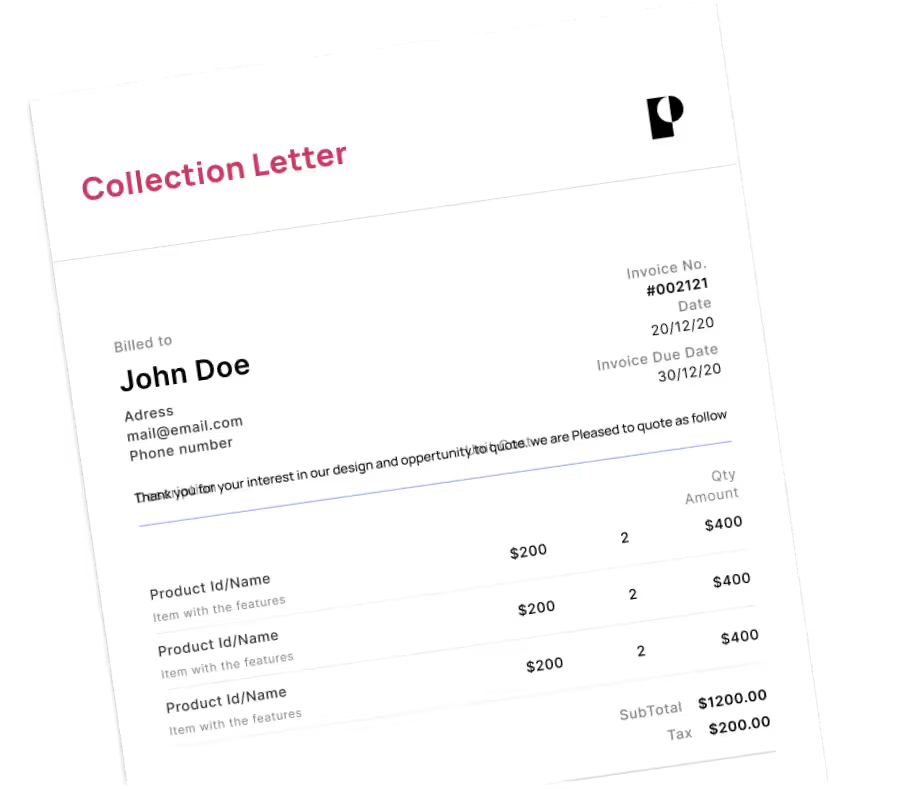
Debt Collection Agency in Saudi Arabia: No Win, No Fee
Need a debt collection agency in Saudi Arabia? For unpaid invoices from business customers in Saudi Arabia, we match your case to a vetted partner covering Saudi Arabia under one contract, and you only pay when money is recovered.


Questions about your case?
Write to us, we reply by email.

Why choose Debitura for debt collection in Saudi Arabia


Comece a recuperar seus créditos na Arábia Saudita em minutos
- Submit your claim: Upload your unpaid invoice in the dashboard. Import by CSV or connect QuickBooks Online, Zoho Books, Stripe or KashFlow, or use Zapier, the REST API or our MCP server. Add supporting documents in a few clicks, with no paperwork and no setup fees.
- Local collection begins: Your case is assigned to SADAD Aman Debt Collections Services LLC, who starts amicable contact with the debtor on your behalf. If court action is ever needed later, you approve a legal quote before anything proceeds, so nothing is spent without your consent.
- Track and get paid: Follow every update in real time on your dashboard, from the first reminder to the final payment, with a notification at each milestone. Your partner pays out your share within 30 business days, with a statement, and you only pay on success.

Preços transparentes e baseados no sucesso
With Debitura you pay a success fee only when money is recovered. Pre-legal collection is No Cure, No Pay: a success fee deducted from recovered amounts, invoiced locally by your partner. Fees depend on the debtor's country, not yours.
- Devedores na Europa (UE, Islândia, Liechtenstein, Noruega, Reino Unido e Suíça): Comissões de sucesso a partir de 6%, dependendo do valor do crédito.
- Devedores no resto do mundo: Comissões de sucesso a partir de 7,5%, dependendo do valor do crédito.
- Older claims: a surcharge applies for claims 12 to 24 months overdue and for claims older than 24 months.
- Legal action is optional: you approve a legal quote, with court costs stated separately, before any legal spend.
Consulte a página de preços para a tabela completa de taxas, ou obtenha uma estimativa instantânea ao enviar um pedido de cobrança.
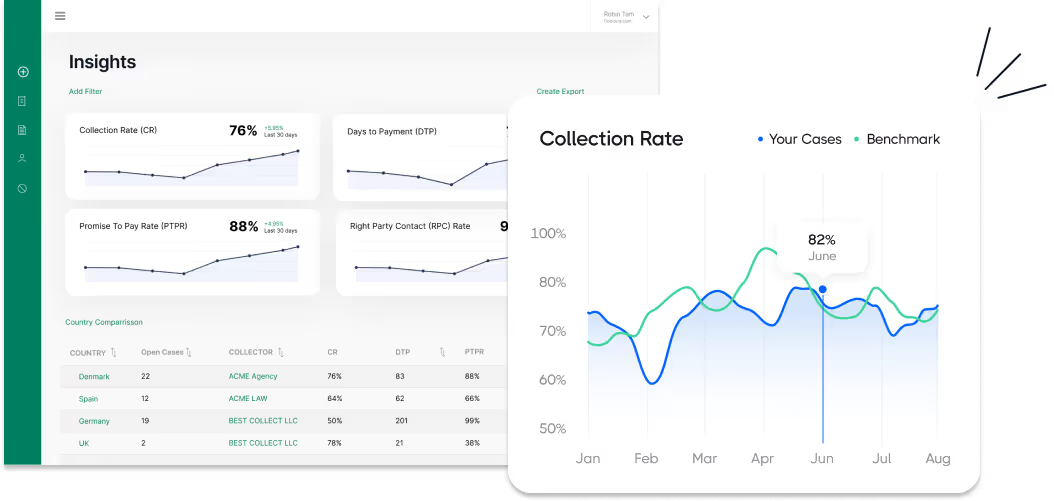
Como funciona a cobrança de dívidas na Arábia Saudita?
Debt collection in Saudi Arabia starts with an amicable phase run by a vetted partner covering Saudi Arabia, SADAD Aman Debt Collections Services LLC. The partner sends reminders and a formal payment demand, aiming for full payment or a written instalment agreement. Most straightforward claims settle at this stage. If the debtor still does not pay, escalation to court follows as a separate, approved step, never automatic.
Os quatro passos da fatura não paga ao dinheiro recuperado
- Amicable collection: reminders, a formal payment demand and negotiation, handled by a vetted partner covering Saudi Arabia. Most undisputed claims are resolved in this phase, without going to court.
- Enforceable title: if the debtor still does not pay, your partner assesses the legal route to obtain an enforceable title and you approve a legal quote, with court costs stated separately, before anything proceeds.
- Enforcement: with a legal title, the competent enforcement authority can attach wages, bank funds and other assets until the claim is recovered.
- Insolvency: if the debtor turns out to be insolvent, recovery depends on the local insolvency proceedings and is often uncertain. Any step in those proceedings is quoted separately and only starts if you accept.
Cada etapa é rastreada em seu painel, e nada é escalado sem a sua aprovação. Todos os detalhes legais para a Arábia Saudita - prazos, custos, tribunais e Execução - seguem no guia abaixo.
Cobrança de dívidas na Arábia Saudita - o guia completo de 2026
This guide explains how debt collection works in Saudi Arabia: the amicable phase, the courts and legal routes, enforcement, and insolvency, with the fees and timelines a creditor can expect at each step.
Nesta página:
Por que você pode confiar neste guia
Written from primary legal sources and reviewed by licensed local experts in this jurisdiction.
Perguntas ou feedback? Envie-nos um e-mail para contact@debitura.com , atualizamos este guia com base na sua contribuição.
Debitura em Números:
- 180 countries covered - each case handled by a local partner
- More than 5,000 businesses registered with Debitura
- 33 days median time to first payment on European cases
About the author
Written by Lars Holdgaard, Founder of Debitura (+10 years in global B2B debt recovery).

Especialistas locais contribuintes:
Última atualização:

Cobrança de dívidas na Arábia Saudita - respostas rápidas
Quanto custa cobrar uma dívida na Arábia Saudita?
As custas judiciais são fixadas em 5% do valor do crédito, limitadas a SAR 1.000.000 para uma ação judicial completa e SAR 10.000 para outras petições judiciais, sob o Sistema de Custas Judiciais criado pelo Decreto Real M/16. A taxa é reembolsada integralmente se o requerente vencer, ou se o Processo for resolvido ou o requerente desistir antes da primeira audiência, e um requerente pode contestar uma avaliação de custas judiciais em até 15 dias após a notificação.
Quanto tempo leva um Processo de cobrança de dívidas na Arábia Saudita?
A via mais rápida, uma Ordem de Satisfação de Dívida para uma dívida escrita incontestável, deve ser decidida pelo Tribunal Comercial em até 10 dias após a petição. Uma ação judicial contestada comum não tem duração média oficial publicada, embora as sentenças de primeira instância se tornem apeláveis em até 30 dias após a entrega, e as sentenças para valores de até SAR 50.000 não são apeláveis, o que encurta o caminho para a Execução.
Qual é o prazo de prescrição para créditos de dívida na Arábia Saudita?
Commercial Court claims are time-barred after 5 years from when the claim arose (Commercial Courts Law Article 24), unless the debtor acknowledges the claim or the claimant shows an acceptable justification for the delay. General civil claims carry a 10-year default limitation period under the 2023 Civil Transactions Law, with shorter periods for specific categories: 3 years, capped at 10, for tort or unjust enrichment, 1 year for a merchant's claim on supplied goods, and 180 days for warranty-defect claims.
Posso cobrar juros por atraso no pagamento na Arábia Saudita?
No statutory late-payment interest rate exists in Saudi Arabia: Civil Transactions Law Article 385 voids any clause that increases a loan repayment as compensation for delay, reflecting the Sharia prohibition on riba. A creditor instead pursues a compensatory delay-damages claim for actual, foreseeable, mitigated loss caused by the late payment; well-drafted liquidated-damages clauses are generally enforced as written.
Quais documentos preciso para cobrar uma dívida na Arábia Saudita?
Um crédito comercial exige uma demanda pré-judicial por escrito enviada pelo menos 15 dias antes de uma ação judicial comum, ou 5 dias antes de uma petição de Ordem de Satisfação de Dívida, além de uma declaração de crédito listando os detalhes das partes e os fundamentos do crédito. As petições são feitas eletronicamente através do portal Najiz do Ministério da Justiça, e provas escritas ou eletrônicas, como faturas, contratos e registros de pagamento, apoiam o crédito.
Qual via legal devo usar para cobrar uma dívida na Arábia Saudita?
Créditos contra um comerciante que excedam SAR 100.000 vão para o Tribunal Comercial; uma dívida escrita, vencida e de valor fixo pode, em vez disso, usar a Ordem de Satisfação de Dívida de via rápida, decidida em até 10 dias. Um credor que já possua um instrumento de Execução, como um cheque ou reconhecimento notarial, pode ir diretamente ao Tribunal de Execução sem uma nova ação judicial, tornando-o o caminho mais rápido quando um estiver disponível.
| Via | Melhor para | Prazo típico |
|---|---|---|
| Execução direta | Cheque existente, escritura pública ou sentença judicial | Apresentado diretamente no Tribunal de Execução |
| Ordem de Satisfação da Dívida | Dívida escrita, vencida e de valor fixo | Decisão em 10 dias |
| Ação comercial ordinária | Dívidas contestadas ou créditos sem prova escrita | Nenhuma média oficial publicada |
Quem faz o quê na cobrança de dívidas na Arábia Saudita?
Debt collection agencies handle the amicable phase first.
A licensed collection partner, such as SADAD Aman Debt Collections Services LLC, contacts the debtor for reminders and a formal payment demand, seeking a voluntary settlement or instalment plan before any court step.
The partner and a lawyer remain distinct roles if a case escalates.
The amicable partner does not represent the creditor in court. If negotiation fails, a separately engaged lawyer handles filing and advocacy under Saudi procedural rules, keeping the two functions, and their fees, separate.
Lawyers take over once the amicable phase stalls.
A lawyer files the claim before the competent court: General Courts for smaller or non-commercial matters, or the specialized Commercial Courts for contract claims against a merchant exceeding SAR 100,000. The lawyer represents the creditor through to judgment.
The Execution Court enforces judgments once a title exists.
An Execution Judge handles asset tracing, bank-account freezes and travel bans against a judgment debtor under the 2012 Enforcement Law (Royal Decree M/53), the law still in force today. A new Enforcement Law (Royal Decree M/237, issued 1 May 2026) has been adopted but does not take effect until 28 October 2026; three narrow carve-outs of the 2012 law survive even after that date.
Quais leis e tribunais se aplicam à cobrança de dívidas na Arábia Saudita?
Five statutes govern most commercial debt claims.
The Civil Transactions Law (effective 16 December 2023) sets the general rules on contracts, obligations, damages and limitation. The Law of Commercial Courts (Royal Decree M/93, in force since 16 June 2020) governs commercial court structure and procedure, alongside the general Law of Civil Procedures. The Bankruptcy Law (Royal Decree M/50, 14 February 2018) covers insolvency, and the Law of Judicial Costs (approved 2021) sets court fees.
Commercial claims are time-barred after 5 years.
Under Commercial Courts Law Article 24, a commercial claim expires 5 years from the date of the underlying incident, unless the debtor acknowledges the claim or the claimant shows an acceptable justification for the delay. A transitional filing deadline for pre-16-June-2020 claims, around 5 May 2025, has already passed.
General civil claims carry a 10-year default limitation.
The 2023 Civil Transactions Law sets a 10-year default period for civil claims, with shorter special periods: 3 years, capped at 10, for tort or unjust enrichment, 1 year for a merchant's claim on supplied goods, and 180 days for warranty-defect claims. Filing suit, even in the wrong court, or a debtor's acknowledgment resets or tolls the clock.
Two court tracks share jurisdiction over debt claims.
General (Sharia) courts under the Ministry of Justice handle civil, family, labor and residual matters, while the specialized Commercial Courts, created by the 2020 law, take merchant-vs-merchant disputes and contract claims against a merchant exceeding SAR 100,000. Commercial judgments up to SAR 50,000 are generally non-appealable, and single-judge circuits handle summary or urgent petitions.
Which court hears smaller commercial claims is not fully documented.
Contract claims against a merchant at or below the SAR 100,000 Commercial Court threshold appear to fall to the General Courts under their residual jurisdiction, though this was not expressly confirmed in primary sources this round. No dedicated "Small Claims Court" by that name was found in the framework reviewed.
Passo 1 - Como funciona a cobrança extrajudicial (pré-legal) de dívidas na Arábia Saudita?
A vetted partner covering Saudi Arabia runs the amicable phase before any court step.
SADAD Aman Debt Collections Services LLC contacts the debtor with reminders and a formal payment demand, seeking full payment or a written instalment agreement. Most straightforward claims settle here without escalating to court.
Commercial Courts Law builds mediation into the pre-litigation stage.
Certain categories of commercial dispute, set by regulation, go through mandatory mediation capped at 30 days before a lawsuit can proceed. Parties can also opt into mediation earlier, and a court-recorded settlement becomes directly enforceable. The precise list of dispute categories subject to mandatory mediation is set by implementing regulation and was not fully catalogued this round.
SAMA maintains a separate conduct rulebook for bank and finance-company collections.
SAMA (the Saudi Central Bank) keeps a dedicated debt-collection rulebook chapter governing communication with consumers for banks and licensed finance companies, though its detailed contact-hours and licensing provisions were not independently verified this round.
Escalation to court is a separate, approved step, never automatic.
If the debtor still does not pay after the amicable phase, moving to a lawsuit or a direct enforcement filing is a deliberate decision, taken only once negotiation has been tried.
Passo 2 - Como se obtém um título executivo na Arábia Saudita?
The claim's value and nature decide which court hears it.
A contract claim against a merchant exceeding SAR 100,000 goes to the specialized Commercial Courts; other civil and lower-value claims fall to the General Courts. A creditor already holding an enforcement instrument, such as a cheque or a notarized acknowledgment, can file directly at the Enforcement Court without a fresh lawsuit.
A written, fixed-sum debt can use the fast-track Debt Satisfaction Order.
The Commercial Court must decide an undisputed Debt Satisfaction Order petition within 10 days of filing. An ordinary contested lawsuit has no official average duration published, though judgments become appealable within 30 days and amounts up to SAR 50,000 are not appealable at all.
Ordinary proceedings require a formal claim and legal representation.
A commercial claim needs a written pre-filing demand, sent at least 15 days before an ordinary lawsuit or 5 days before a Debt Satisfaction Order petition, plus a statement of claim filed electronically through the Ministry of Justice's Najiz portal. Legal representation is standard practice for contested commercial litigation.
Mais sobre processos judiciais na Arábia Saudita
A first-instance judgment becomes appealable within 30 days of delivery. The losing party generally bears the judicial costs, and a 25% surcharge applies to costs if the losing party pursues a further appeal.
Filing the claim itself carries the same judicial fee described above: 5% of the claim value, capped at SAR 1,000,000, refunded in full if the claimant wins or if the case settles before the first hearing.
Passo 3 - Como funciona a execução de dívidas na Arábia Saudita?
The 2012 Enforcement Law (Royal Decree M/53) still governs enforcement today.
An Execution Judge at the Execution Court handles enforcement of a judgment or other enforceable title, such as the judgment, cheque, or notarized acknowledgment described in Step 2: tracing the debtor's assets, freezing bank accounts, and imposing a travel ban against the judgment debtor. This is the operative regime as of 21 July 2026.
A new Enforcement Law has been adopted but is not yet in force.
A new Enforcement Law (Royal Decree M/237, issued 1 May 2026) has been adopted but does not take effect until 28 October 2026; until then, the 2012 Enforcement Law (Royal Decree M/53) governs enforcement, including three narrow carve-outs of the old law that survive even after the new law takes effect. For a creditor with a case today, this means enforcement proceeds under the 2012 framework, not the eventual 2026 tools.
From 28 October 2026, the new law widens enforcement tools.
Once in force, the new law introduces 8 defined enforceable-instrument categories, mandatory asset disclosure, a tiered travel-ban regime capped at 6 years in aggregate, daily fines and imprisonment for sustained non-compliance, and authorizes private-sector-outsourced enforcement functions. None of these mechanics apply before 28 October 2026.
Current-regime specifics beyond this are not independently confirmed.
This round's research corroborates the 2012 Enforcement Law's operative mechanics only through secondary-source contrast with the new law, not through independently verified primary text, so this guide states the current regime processually rather than asserting further detail.
Passo 4 - Como os procedimentos de insolvência afetam a recuperação de dívidas na Arábia Saudita?
The 2018 Bankruptcy Law offers five distinct procedures.
A debtor can pursue Protective Settlement, the Financial Restructuring Procedure, Liquidation, Administrative Liquidation, or, for debts under SAR 2,000,000, the Small Debtor Chapter. Jurisdiction sits with the Commercial Courts in Jeddah, Riyadh and Dammam. Insolvency becomes the relevant route when enforcement under Step 3 finds no recoverable assets against the debtor.
Creditors are paid in a fixed 9-tier order.
- Procedural and administrative costs of the case.
- Secured creditors, up to the value of their security.
- Post-commencement financing granted during the procedure.
- A series of intermediate tiers for employee wages and family-expense claims.
- General unsecured debt.
- Tax and other government dues, ranked last.
The law sets nine tiers in total; the exact split within the wage and family-expense group was not itemized in the sources reviewed this round.
A creditor must file a proof of claim to be considered.
Once a bankruptcy or restructuring case opens, a creditor submits its claim with supporting evidence, such as contracts and invoices, to the administering court so the debt is counted in the relevant tier and any distribution.
The procedure chosen affects how much a creditor recovers and when.
Protective Settlement and the Financial Restructuring Procedure aim to keep a viable business operating while it repays creditors over time, while Liquidation and Administrative Liquidation wind up the debtor's estate and distribute proceeds according to the 9-tier priority above. The Small Debtor Chapter offers a faster, lighter process for debts under SAR 2,000,000.
Taxas, juros e quem paga o quê na Arábia Saudita
- Our fee: success-based, No Cure, No Pay (see pricing).
- Taxas judiciais e de Execução: taxas estatais aplicam-se apenas se o Processo escalar para Ação judicial.
- Statutory debtor items: Saudi courts do not award interest on commercial debts; a riba-based prohibition voids any pre-agreed interest clause. A creditor can instead claim compensatory delay-damages for actual, foreseeable loss caused by the late payment.
- Legal basis: Civil Transactions Law Article 385 voids any clause increasing a loan repayment as a penalty for delay. Well-drafted liquidated-damages clauses are, however, generally enforced as written.
- Who keeps what: recovered principal is yours; any court-awarded delay-damages follow the judgment.
Cross-border debt collection in Saudi Arabia
Saudi Arabia recognizes foreign arbitral awards under the New York Convention.
Saudi Arabia acceded to the New York Convention on 19 April 1994, in force since 18 July 1994, so a foreign arbitral award made in another contracting state can be recognized and enforced in Saudi Arabia under the Convention's framework.
Foreign court judgments rely on separate reciprocity arrangements.
Enforcing a foreign court judgment, as opposed to an arbitral award, works mainly through regional reciprocity frameworks reported to cover roughly 20 Arab League states and separately around 5 other GCC states, though not all of these arrangements are fully reciprocal; this detail rests on a secondary source and was not independently verified this round.
Partners in our network
These firms are partners in our network for this country. Open a profile to learn more about each one. If court action is needed on your case, your partner sends a quote on the platform; nothing starts until you accept it.
- Especialistas verificados
- Nothing starts until you accept the quote
- Taxas justas e pré-negociadas

A Advogada Deena AlQumaish Attorney & Law Consultancy é um escritório de advocacia de primeira linha em Manama, que oferece serviços eficazes de Cobrança de Dívidas no Bahrein, reconhecido pelos seus 14 anos de experiência, filiação na Ordem dos Advogados do Bahrein e amplo alcance regional e internacional.



Fahad Al Tamimi Law Firm é um escritório de advocacia de primeira linha em Dammam, que oferece serviços eficazes de Cobrança de Dívidas na Arábia Saudita, conhecido pela sua orientação jurídica estratégica desde 2007, com prémios da MEA Business Awards e filiações na Ordem dos Advogados da Arábia Saudita e na Debitura.
A NCS MENA é uma agência de recuperação de dívidas de primeira linha em Manama, que oferece serviços eficazes de Cobrança de Dívidas no Reino do Bahrein, estabelecida em 1993, atendendo a mais de 80 países e membro da IACC, FENCA e BIIA.


O Tebyan Law Firm é um escritório de advocacia de referência em Jeddah, que oferece serviços eficazes de cobrança de dívidas na Arábia Saudita, posicionando-se como o parceiro ideal para a recuperação de dívidas, com uma fundação em 2010, membro da Ordem dos Advogados da Arábia Saudita e serviços para clientes internacionais.

A Legal Representation Solutions é um escritório de advocacia de referência em Riyadh, que oferece serviços eficazes de cobrança de dívidas na Arábia Saudita, posicionando-se como o parceiro ideal para a recuperação de dívidas desde 2016, atendendo o Golfo Arábico e um membro orgulhoso da Ordem dos Advogados da Arábia Saudita.

Alghanim Law Firm is a premier law firm in Riyadh offering effective Debt Collection services in Saudi Arabia, positioning itself as the go-to partner for debt recovery, founded in 2018 and a member of the Saudi Bar Association.

O Edrak Law Firm é um escritório de advocacia de referência em Riyadh, que oferece serviços eficazes de cobrança de dívidas no Reino da Arábia Saudita, posicionando-se como o parceiro ideal para a recuperação de dívidas com uma fundação em 2020, alinhado com a Visão Saudita 2030 e reconhecido pelo Ministério da Justiça.

A Al Suwaiket & Al Busaiyes Lawyers and Legal Consultants Co. é um escritório de advocacia de referência em Al Khobar, que oferece serviços eficazes de cobrança de dívidas na Arábia Saudita, estabelecido em 2006 e reconhecido pela International Bar Association e pelo Saudi Center for Commercial Arbitration.

A Aman Debt Collection Company é uma agência de recuperação de dívidas de referência em Dammam, que oferece serviços eficazes de cobrança de dívidas na Arábia Saudita, reconhecida como um parceiro confiável desde 2008, atendendo a Arábia Saudita, Bahrein, Kuwait e os Emirados Árabes Unidos com experiência premiada e excelência estratégica.

A SAAR Debt Collection é uma agência líder em recuperação de crédito em Riade, oferecendo serviços eficazes de recuperação de crédito na Arábia Saudita, reconhecida por suas parcerias globais, fundada em 2018, com filiação na Associação Internacional de Cobradores Comerciais, e atendendo tanto mercados locais quanto internacionais.
Perguntas Frequentes
Explore nossas FAQs mais comuns abaixo, ou entre em contato diretamente em contact@debitura.com se precisar de ajuda com um Processo específico.