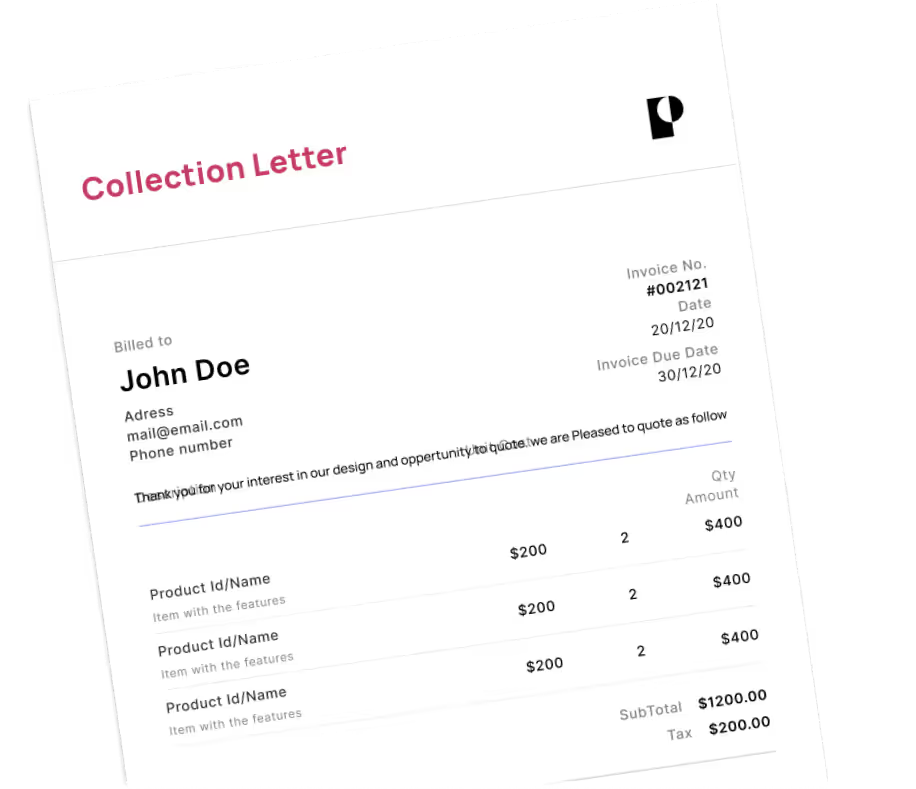
Debt Collection Agency in West Virginia - No Cure, No Pay
Your West Virginia claim is handled by a licensed local collection partner, matched to your case and benchmarked on performance. All actions follow West Virginia law, and you track everything in one dashboard. Prefer to learn first? Read our West Virginia debt collection guide.


Get free expert advice
Response from a specialist within 24 hours.
Why Choose Debitura for Debt Collection in West Virginia?
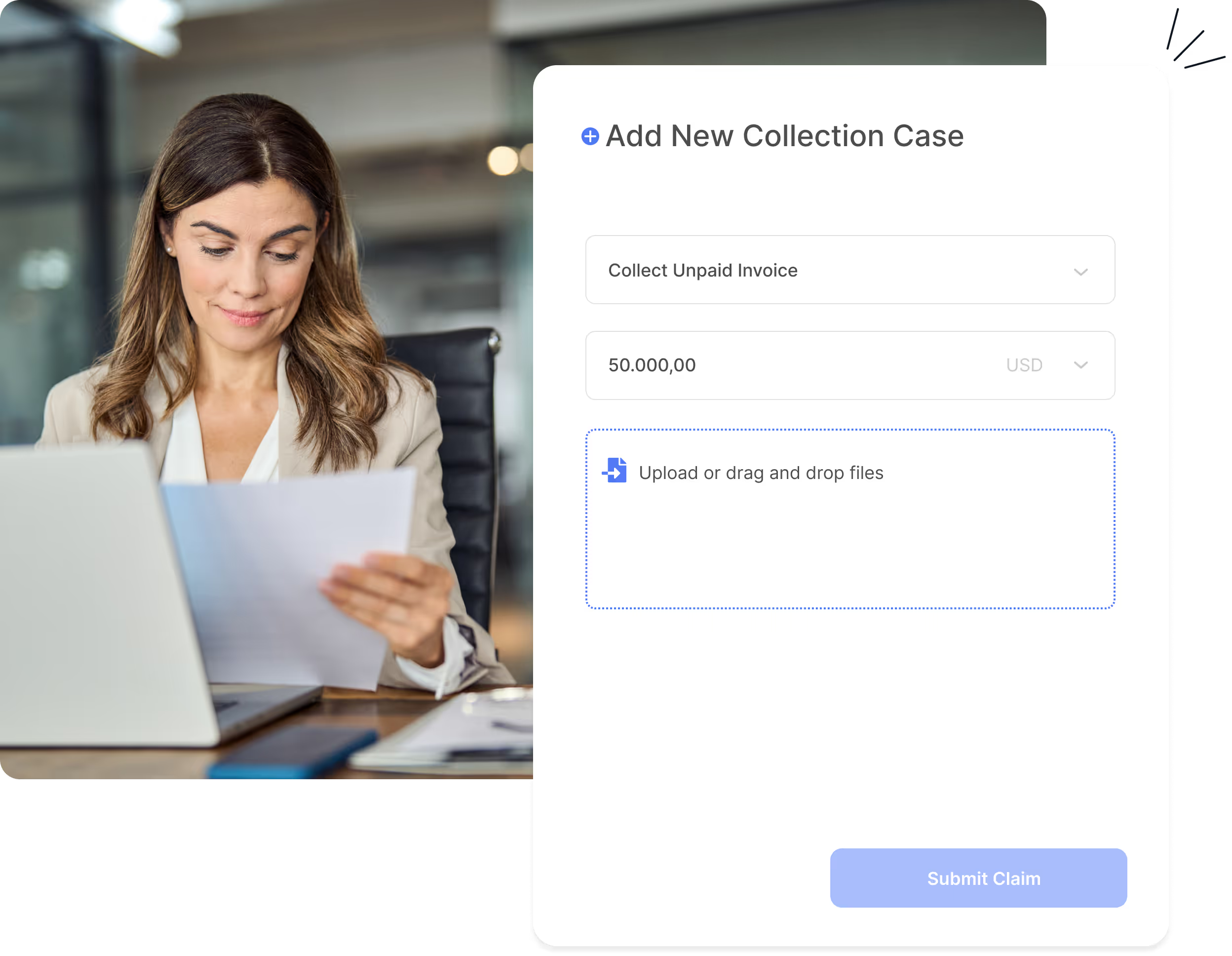
Fast, simple and risk-free debt collection in West Virginia
Debitura recovers unpaid invoices from debtors in West Virginia through our platform: submit your claim, and it is routed to the best-matching licensed partner working on a No Cure, No Pay basis while you track progress in real time. Your West Virginia panel includes Debt Recovery Resources, registered with the Texas Secretary of State (Reg. #0802087763) and a member of CLLA and ACA International; Direct Recovery Associates, licensed by the California Department of Financial Protection and Innovation (DFPI Lic. #10186-99) and collecting commercial debt since 1992; and Aaron Bryant Stewart & Cross, a member of ACA International operating under CFPB, FTC and Ohio Attorney General oversight.
- Risk-free: Pay only when we recover your money.
- Quick setup: Submit invoices in a few clicks.
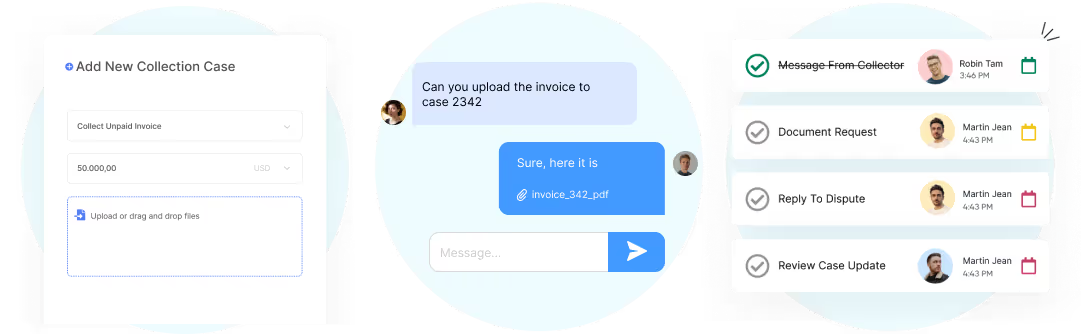
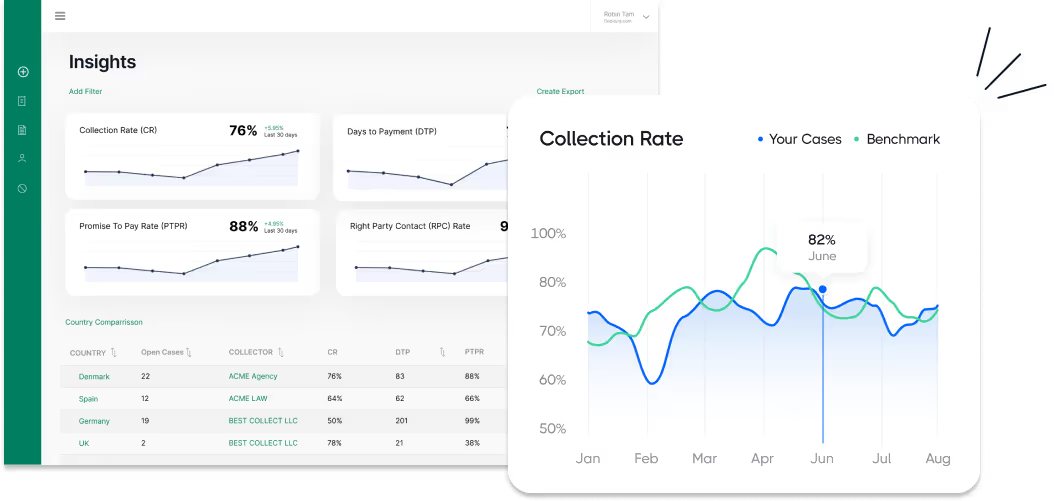
- Real-time tracking: Monitor progress live in one portal.
- Local compliance: Collection agencies in West Virginia must hold a business franchise registration certificate and a $5,000 surety bond under W. Va. Code § 47-16-4, and follow the West Virginia Consumer Credit and Protection Act (W. Va. Code Ch. 46A) and the FDCPA.

Start recovering your West Virginia claims in 2 minutes
- Submit your claim - Upload the unpaid invoice and supporting documents in minutes through our secure portal.
- Local collection begins - Your case is routed to a West Virginia panel partner, who contacts the debtor directly; if the amicable phase does not resolve it, claims up to $20,000 can proceed in West Virginia Magistrate Court.
- Get paid - Once the debtor pays, funds are forwarded to you promptly, and you track every step on your dashboard.

Transparent, success-based pricing
With Debitura you only pay when we succeed. Pre-legal collection is No Cure, No Pay: a success fee deducted from recovered amounts, invoiced locally by your partner. Fees depend on the debtor's country, not yours.
- Debtors in Europe (EU, Iceland, Liechtenstein, Norway, the UK and Switzerland): success fees from 6% depending on claim size.
- Debtors in the rest of the world: success fees from 7.5% depending on claim size.
- Older claims: a surcharge applies for claims 12–24 months overdue and for claims older than 24 months.
- Legal action is optional: you approve fixed-price quotes before any legal spend.
See the pricing page for the full fee schedule, or get an instant estimate when you upload a claim.
How does debt collection work in West Virginia?
Debt collection in West Virginia starts with an amicable phase: a licensed local partner contacts the debtor directly to negotiate payment, and Debitura never escalates automatically. If the debtor does not respond, claims up to $20,000 can be filed in West Virginia Magistrate Court, West Virginia's small-claims-level forum, while larger or more complex claims go to Circuit Court. Before any court filing, Debitura provides a fixed-price quote for you to approve, so you always know the cost before proceeding.
- Submit in 2 minutes: Upload your invoice and we start working the case immediately.
- No Cure, No Pay: You only pay a success fee when we recover your money.
- You stay in control: Nothing escalates to court without your approval.
- Get paid: Recovered funds are forwarded to you as soon as the debtor pays.
The four steps from unpaid invoice to recovered cash
- Amicable collection - Your West Virginia partner contacts the debtor and negotiates payment without court involvement.
- Enforceable title - If unresolved, we help you obtain a judgment via West Virginia Magistrate Court (claims up to $20,000) or Circuit Court.
- Enforcement - Once you hold a judgment, it can be enforced in West Virginia through a suggestee execution (wage garnishment capped at 20% of disposable earnings), a suggestion (garnishment of bank accounts or third-party debts), or a judgment lien on real estate.
- Insolvency monitoring - If the debtor files for bankruptcy, your partner monitors the federal case and files a proof of claim on your behalf.
Want the full legal detail behind each step? Read our complete West Virginia debt collection guide below.
Our local debt collection partners
Debitura is a platform, not a single agency: your case is routed to the licensed collection partner best matched to your claim type, debtor profile and industry. We benchmark our partners on recovery rate, speed and client rating, and underperformers are replaced
- Verified specialists
- Quotes in 24 h, no hidden fees
- Fair, pre-negotiated rates
Direct Recovery Associates, Inc. is a premier debt recovery agency in Agoura Hills offering effective Debt Collection services in the United States, founded in 1992, with a global reach and performance-based billing, ensuring high recovery rates and client satisfaction.
See full partner profile.webp)
.png)

.png)

Aaron Bryant Stewart & Cross is a premier debt recovery agency in the United States offering effective risk-free Debt Collection services, established in 2006 and serving North America and select international markets, as the exclusive Debitura partner in the U.S., providing No Cure No Pay collections based on Debitura's risk-free standard terms and pricing, and is a member of ACA International.
See full partner profile
Debt Recovery Resources is a premier debt recovery agency in the United States offering effective risk-free debt collection services, recognized as a Top 10 Debt Collection Agency in 2022 and a member of the CLLA, exclusively partnering with Debitura for No Cure No Pay solutions.
See full partner profileDebt collection in West Virginia - the complete 2026 guide
This guide is for creditors - businesses and individuals owed money by a debtor in West Virginia - who want to recover unpaid invoices, loans or other claims. It covers West Virginia's statute of limitations, the licensing and bonding rules for collection agencies, the court system, wage garnishment and judgment enforcement, and how a claim is priced.
What we will cover:
Why you can trust this guide
At Debitura, we uphold the highest standards of impartiality and precision to bring you comprehensive guides on international debt collection. Every guide is written from primary legal sources and reviewed by licensed local experts in the jurisdiction it covers.
Questions or feedback? Email us at contact@debitura.com , we update this guide based on your input.
Debitura By the Numbers:
- 767 licensed partners — collection agencies and law firms in our network
- 180 countries covered — with cases handled in 174 of them
- 5,306 businesses registered with Debitura
- 33 days median time to first payment on European cases
Expert-led, locally validated
Written by Lars Holdgaard, Founder of Debitura (+10 years in global B2B debt recovery). Every page is reviewed by top local attorneys to ensure legal accuracy and practical steps you can use.

Contributing local experts:
Last updated:

Debt collection in West Virginia - quick answers
| Question | Answer |
|---|---|
| Main route | Demand letter → amicable collection → Magistrate Court (claims up to $20,000) or Circuit Court → post-judgment enforcement |
| Statute of limitations | 10 years for signed written contracts, 5 years for oral/implied contracts and open accounts (W. Va. Code § 55-2-6) |
| Late-payment interest | 6% per year with no written contract, up to 8% by written contract (W. Va. Code § 47-6-5); judgment interest is 6.25% for 2026 (§ 56-6-31) |
| Small claims | Magistrate Court hears claims up to $20,000 (W. Va. Code § 50-2-1); filing fee $30 to $50 (§ 50-3-1) |
| Wage garnishment | Capped at 20% of disposable earnings via suggestee execution, stricter than the federal 25% rule (W. Va. Code § 38-5A-3) |
| Court & enforcement fees | Only if the case escalates to legal |
| Our fee | Success fee only - No Cure, No Pay |
How much does debt collection cost in West Virginia?
With Debitura you pay a success fee only on amounts actually recovered, with no upfront or monthly costs; the exact rate depends on your claim, see our pricing. Court fees apply only if the case escalates to legal: West Virginia Magistrate Court charges a filing fee of $30 to $50 depending on the amount sought, plus $5 per enforcement service such as a suggestion or suggestee execution (W. Va. Code § 50-3-1). These state fees are advanced by the creditor.
How long does debt collection take in West Virginia?
Most undisputed commercial claims are resolved during the amicable phase without any court filing. If escalation is needed, Magistrate Court is the faster route for claims up to $20,000, while Circuit Court handles larger or more complex disputes and takes longer. Enforcement timing after judgment depends on locating the debtor's non-exempt wages or property.
What are the limitation and interest rules in West Virginia?
West Virginia's statute of limitations is 10 years for a signed written contract, whether or not it is under seal, and 5 years for an oral or implied contract, an open account, or a promissory note payable at a definite time (W. Va. Code §§ 55-2-6, 46-3-118(a)). A written promise or acknowledgment signed by the debtor restarts the period; partial payment alone does not (§ 55-2-8). Without a written contract, interest accrues at the 6% legal rate, and parties may contract for up to 8% (§ 47-6-5); judgment interest is set annually - 6.25% for judgments entered in 2026, per the West Virginia Supreme Court's Administrative Office (§ 56-6-31).
What documents do I need to collect a debt in West Virginia?
You will typically need the original invoice or contract, proof of delivery of goods or services, any written communication with the debtor, and a signed acknowledgment if the debt is older and you are relying on a revived limitation period (W. Va. Code § 55-2-8). Our platform guides you through uploading these documents when you submit your claim.
Which route should my claim take?
Claims up to $20,000 can generally be filed in West Virginia Magistrate Court, the state's small-claims-level forum, where attorneys are optional (W. Va. Code § 50-2-1). Larger claims, or claims requiring more complex procedure, go to Circuit Court. Your assigned partner determines the right venue once the amicable phase concludes.
Who does what in West Virginia debt collection?
Collection agencies in West Virginia
West Virginia collection agencies must hold a business franchise registration certificate, which serves as their collection-agency license, and file a continuing $5,000 surety bond with the State Tax Commissioner before operating (W. Va. Code § 47-16-4); a license is required for the principal office and every branch, and the agency must maintain an office within West Virginia. This licensing and bonding requirement applies to collection generally, regardless of whether the debtor is a consumer or a business. Separately, the West Virginia Consumer Credit and Protection Act (WVCCPA, W. Va. Code Ch. 46A) regulates collection practices and prohibited conduct, but only when the debtor is a consumer; purely commercial (B2B) collection is not governed by the WVCCPA's practice rules and instead follows general contract and civil-procedure law. Debitura collects both consumer (B2C) and commercial (B2B) claims in West Virginia, and our panel partners hold the required license and bond to operate either way. There is no dedicated public licensee lookup for West Virginia collection agencies; registration runs through the West Virginia State Tax Department's business-registration system.
West Virginia courts and enforcement officers
Magistrate Court (W. Va. Code Ch. 50) is West Virginia's small-claims-level court, hearing civil claims up to $20,000; Circuit Court (Ch. 51) is the court of general jurisdiction for larger or more complex claims. Post-judgment enforcement runs through the circuit clerk's office via a writ of execution, a suggestion (garnishment of bank accounts or third-party debts), or a suggestee execution (wage garnishment).
Debt-collection attorneys in West Virginia
An attorney is allowed but not required for either party in Magistrate Court, though corporations may also appear through a designated agent since House Bill 2761 (2025). Circuit Court proceedings generally call for attorney representation given the greater procedural complexity.
Regulators
Debt-collection agencies are licensed and bonded through the West Virginia State Tax Commissioner's office (W. Va. Code § 47-16-4), and consumer-facing collection practices fall under the West Virginia Consumer Credit and Protection Act (Ch. 46A). Federal collectors are additionally subject to the FDCPA (15 U.S.C. § 1692 et seq.).
Which laws and courts apply to debt collection in West Virginia?
Key legislation in West Virginia
The West Virginia Consumer Credit and Protection Act (W. Va. Code Ch. 46A) governs debt-collection practices toward consumer debtors, while the Collection Agency licensing law (Ch. 47, Art. 16) requires the business franchise registration certificate and bond described above. The federal Fair Debt Collection Practices Act (15 U.S.C. § 1692 et seq.) applies to third-party collectors nationwide. A 2026 bill, HB 4382, would have required collection agencies to give debtors 30 days' notice before a wage garnishment; it passed the House 91-1 but died in the Senate Judiciary Committee when the legislature adjourned, so no pre-garnishment notice requirement is currently in effect. House Bill 2761 (2025) raised Magistrate Court's civil jurisdiction from $10,000 to $20,000, effective April 25, 2025 (§ 50-2-1).
Civil court system in West Virginia
West Virginia's civil courts are Magistrate Court (claims up to $20,000, Ch. 50) and Circuit Court (general jurisdiction, larger and more complex claims, Ch. 51). There is no separate small claims court - Magistrate Court fills that role.
Consumer protection
When the debtor is a consumer, the WVCCPA (Ch. 46A) restricts collection conduct such as harassment or false representations, in addition to the federal FDCPA. Commercial (B2B) claims are not subject to the WVCCPA's practice restrictions and are instead governed by the parties' contract and general civil law.
Step 1 - How does amicable (pre-legal) debt collection work in West Virginia?
Your West Virginia panel partner begins with a demand letter and direct outreach to the debtor, aiming to resolve the claim without court involvement. West Virginia's statute of limitations runs 10 years for signed written contracts and 5 years for oral or implied contracts, open accounts, and promissory notes payable at a definite time (W. Va. Code §§ 55-2-6, 46-3-118(a)). The clock can only be restarted by a new written promise or acknowledgment signed by the debtor (§ 55-2-8) - partial payment alone does not revive it, so we track any signed acknowledgment carefully.
When to escalate to court in West Virginia
If the debtor does not respond or refuses to pay during the amicable phase, and your partner confirms the debt is collectible, your case can escalate to West Virginia Magistrate Court (claims up to $20,000) or Circuit Court for larger claims. You approve a fixed-price quote before any court filing.
Step 2 - How do you obtain an enforceable title in West Virginia?
Fast-track option: Magistrate Court
| Limit | Filing fee | Corporate filing | Attorney |
|---|---|---|---|
| $20,000 (exclusive of interest and costs), W. Va. Code § 50-2-1 | $30 to $50 depending on the amount sought, plus $5 per enforcement service, § 50-3-1 | Corporations and LLCs may sue in Magistrate Court, appearing through an agent or attorney (§ 50-2-1, as clarified by HB 2761 (2025)) | Allowed but not required for either party |
Ordinary proceedings in West Virginia
Claims above $20,000, or those requiring more complex procedure, are filed in Circuit Court, West Virginia's court of general civil jurisdiction (Ch. 51). Circuit Court follows standard civil procedure, including pleadings, discovery and, where the case remains contested, trial.
Determining the appropriate court
Your assigned partner determines the correct court based on the claim amount and complexity - generally Magistrate Court up to $20,000, and Circuit Court above that limit or for disputed, complex claims.
Step 3 - How does debt enforcement work in West Virginia?
Ways to enforce a claim in West Virginia
Once you hold a judgment, West Virginia offers several enforcement tools: a suggestee execution garnishes the debtor's wages, capped at 20% of disposable earnings - stricter than the federal 25% rule - and only if disposable earnings exceed 50 times the federal minimum hourly wage per week (W. Va. Code § 38-5A-3); a suggestion garnishes money or property held by a third party, such as a bank; and a judgment lien attaches to the debtor's real estate (Ch. 38, Art. 3). Only one execution is satisfied at a time, with junior executions paid in priority order.
How to collect a judgment in West Virginia
An execution may be issued within 10 years of the judgment date, and successive executions - or an action or scire facias to revive the judgment - can extend enforcement in further 10-year cycles (W. Va. Code § 38-3-18). Recording the judgment creates a lien on the debtor's real estate, giving you a claim against any property they own or acquire in West Virginia.
Step 4 - How do insolvency procedures work in West Virginia?
If a West Virginia debtor files for bankruptcy, the case moves to federal court under the U.S. Bankruptcy Code - the same framework nationwide. Your partner monitors the filing and submits a proof of claim on your behalf so your claim is represented in any distribution to creditors.
Fees, interest and who pays what in West Virginia
Debitura charges a success fee only when your claim is recovered - No Cure, No Pay, with no upfront cost.
Court fees - only if the case escalates to legal
Magistrate Court filing fees range from $30 to $50 depending on the amount sought, plus $5 per enforcement service such as a suggestion or suggestee execution (W. Va. Code § 50-3-1). These fees apply only if the case escalates to legal, and are generally advanced by the creditor.
Interest and late fees the debtor owes
Without a written contract, West Virginia's legal interest rate is 6% per year; parties may contract in writing for up to 8% (W. Va. Code § 47-6-5) - contracting above that voids the interest entirely and exposes the debtor to a penalty of four times the interest agreed, minimum $100 (§ 47-6-6). Judgment interest is fixed annually at 2 percentage points above the Fifth Federal Reserve District's secondary discount rate, floored at 4% and capped at 9%; the rate for judgments entered in 2026 is 6.25%, set January 2, 2026 by the West Virginia Supreme Court's Administrative Office (§ 56-6-31). West Virginia sets no general statutory cap on B2B late-payment fees - these are governed by the parties' contract, since the WVCCPA's fee rules apply only to consumer transactions.
Collecting a West Virginia debt from out of state or abroad
West Virginia has adopted the Uniform Enforcement of Foreign Judgments Act (W. Va. Code Ch. 55, Art. 14), so an authenticated judgment from another US state can be filed with a West Virginia circuit clerk and enforced as if it were a West Virginia judgment. For claims against a debtor located abroad, Debitura's international partner network spans 183 countries, and your West Virginia panel partner coordinates venue and enforcement strategy with the local team handling the debtor's jurisdiction.
Frequently Asked Questions
Explore our most common FAQs below, or reach out directly at contact@debitura.com if you need help with a specific case.
.svg)
Need debt recovery beyond West Virginia?
Explore our North America debt-collection hub for country-by-country playbooks.
For coast-to-coast coverage in the US, see the U.S. debt-collection overview.
.png)
.avif)
.avif)
.avif)
.avif)
.avif)
.avif)
.avif)

.avif)
.svg%20(1).avif)

.avif)






.svg.avif)




.avif)
.avif)

.avif)
.avif)



.avif)



.svg.avif)

.avif)

.avif)
.avif)
.avif)
.avif)
.avif)
.avif)
.avif)
.avif)
.avif)
.avif)
.avif)
.svg)