Commercial Collection Agency in Florida
Your Florida claim is handled by a licensed local collection partner, matched to your case and benchmarked on performance. All actions follow Florida law, and you track everything in one dashboard. Prefer to learn first? Read our Florida debt collection guide.


Questions about your case?
Write to us, we reply by email.
Our local debt collection partners
Debitura is a platform, not a single agency: your case is routed to the licensed collection partner best matched to your claim type, debtor profile and industry. After that, we follow their results on our platform: how much they collect, how fast they respond and how clients rate them.
- Verified specialists
- Fee shown before you submit
- Fair, pre-negotiated rates
Direct Recovery Associates, Inc. is a premier debt recovery agency in Agoura Hills offering effective Debt Collection services in the United States, founded in 1992, with a global reach and performance-based billing, ensuring client satisfaction.
See full partner profile.webp)
.png)

.png)

Aaron Bryant Stewart & Cross is a premier debt recovery agency in the United States offering effective No Cure No Pay Debt Collection services, established in 2006 and serving North America and select international markets, as a Debitura partner in the U.S., providing collections based on Debitura's No Cure, No Pay standard terms and pricing, and is a member of ACA International.
See full partner profile
Debt Recovery Resources is a premier debt recovery agency in the United States offering effective debt collection services, a member of the CLLA, partnering with Debitura for No Cure No Pay solutions.
See full partner profileWhy choose Debitura for debt collection in Florida?
Debt collection in Florida, matched to a local partner
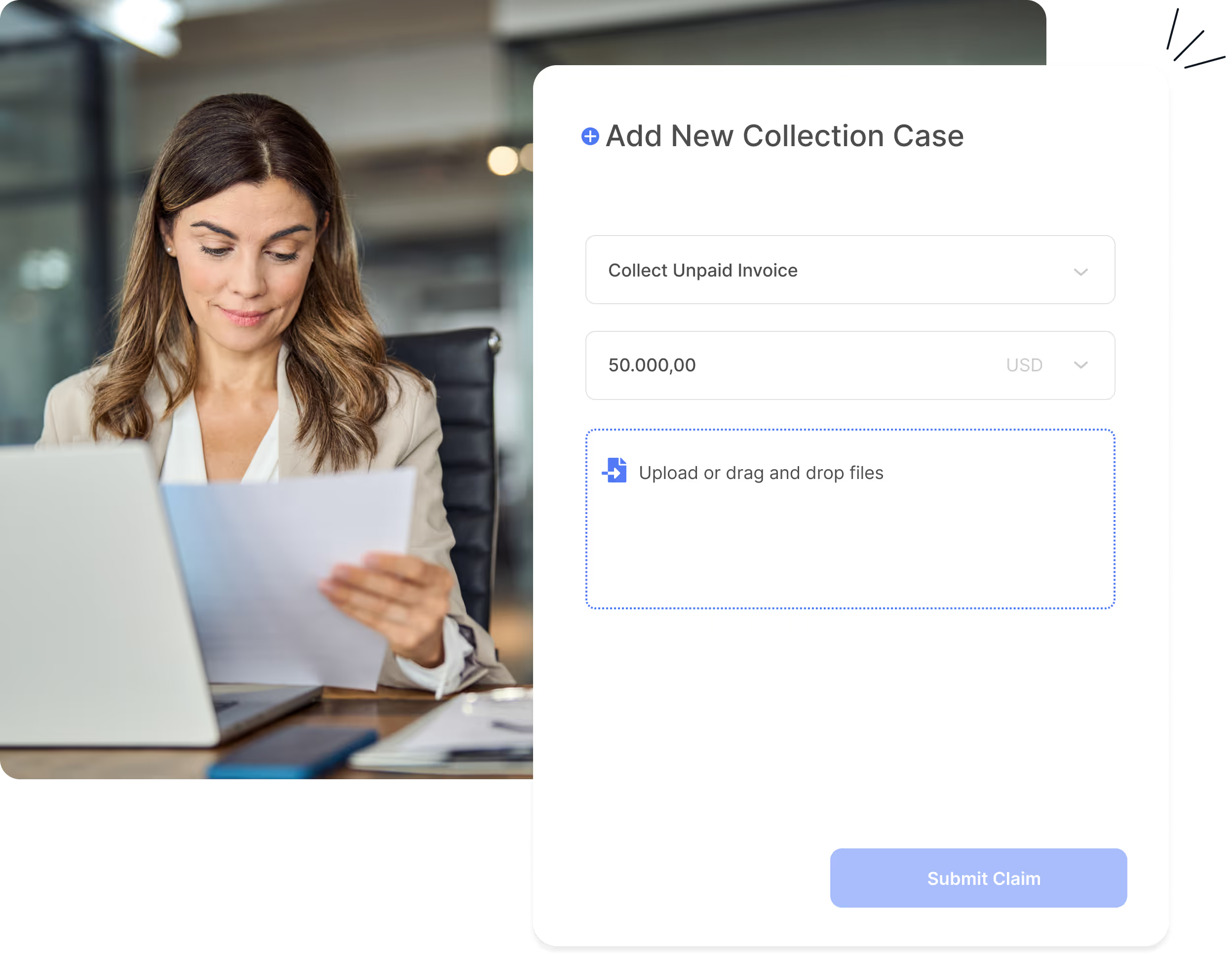
Debitura recovers unpaid invoices from debtors in Florida through our platform: submit your claim, and we assign it to the best-matching licensed partner working on a No Cure, No Pay basis while you track progress in real time. Your Florida panel includes Debt Recovery Resources (Texas Secretary of State Reg. #0802087763, member of CLLA and ACA International), Direct Recovery Associates (California DFPI Lic. #10186-99, collecting commercial debt since 1992) and Aaron Bryant Stewart & Cross (member of ACA International).
- No Cure, No Pay: Pay only when we recover your money.
- Quick setup: Submit invoices in a few clicks.
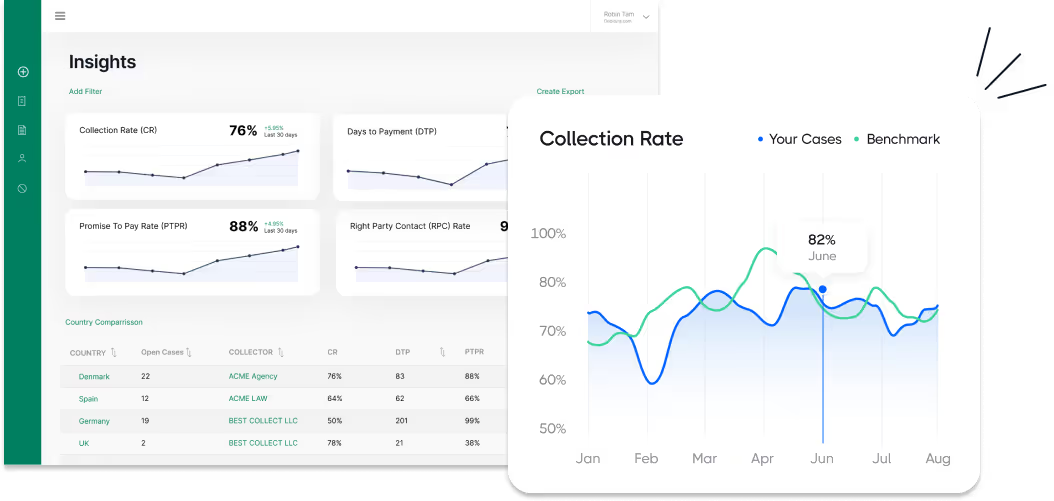
- Real-time tracking: Monitor progress live in one portal.
- Local compliance: Collection follows the Florida Consumer Collection Practices Act (Fla. Stat. Ch. 559, Part VI) and the FDCPA.
Start recovering your Florida claims in 2 minutes
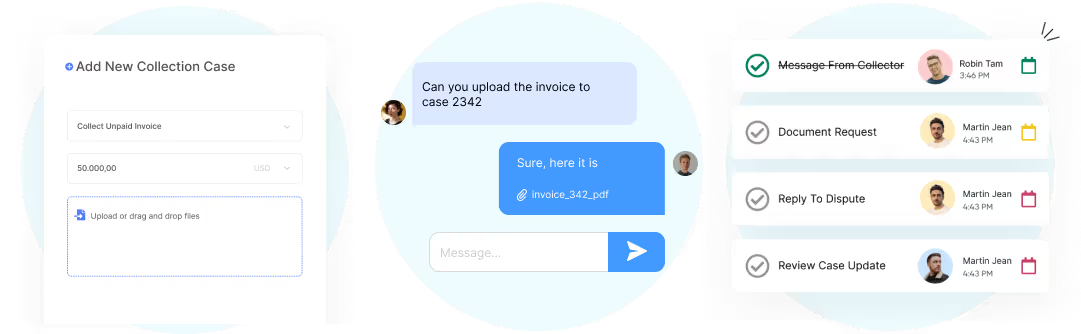
- Submit your claim: Upload unpaid invoices in the dashboard. Import by CSV or connect QuickBooks Online, Zoho Books, Stripe or KashFlow, or use Zapier, the REST API or our MCP server.
- Local collection begins: We assign your case to the best-matching partner on your Florida panel: Debt Recovery Resources, Direct Recovery Associates or Aaron Bryant Stewart & Cross, who opens the amicable phase with your debtor. If court action is required, typically in County Court for claims up to $8,000, you approve a legal quote, with court costs stated separately, before anything proceeds.
- Get paid: Funds are remitted on recovery. If escalation is needed, only legal steps you have approved in a quote move forward.
Transparent, success-based pricing
With Debitura you only pay when we succeed. Pre-legal collection is No Cure, No Pay: a success fee deducted from recovered amounts, invoiced locally by your partner. Fees depend on the debtor's country, not yours.
- Debtors in Europe (EU, Iceland, Liechtenstein, Norway, the UK and Switzerland): success fees from 6% depending on claim size.
- Debtors in the rest of the world: success fees from 7.5% depending on claim size. On a $10,000 invoice to a US business, under 12 months overdue, the success fee is 15% ($1,500), shown before you submit. Minimum claim: $500. No fee if nothing is recovered.
- Older claims: a surcharge applies for claims 12 to 24 months overdue and for claims older than 24 months.
- Legal action is optional: you approve a legal quote, with court costs stated separately, before any legal spend.
See the pricing page for the full fee schedule, or get an instant estimate when you upload a claim.
How does debt collection work in Florida?
Debt collection in Florida starts with an amicable phase: your case is handled by your assigned partner, which issues demands and pursues payment or a written acknowledgment of the debt. Most undisputed commercial claims are resolved at this stage. If the debtor still does not pay, escalation is never automatic; your partner assesses the legal route (typically County Court for claims up to $8,000, or Circuit Court above), and you approve a legal quote before any court step.
- Submit in 2 minutes: upload unpaid invoices in the dashboard. Import by CSV or connect QuickBooks Online, Zoho Books, Stripe or KashFlow, or use Zapier, the REST API or our MCP server.
- No Cure, No Pay: pre-legal collection is success-based, with no setup fees or subscriptions.
- You stay in control: legal escalation only happens after you approve a legal quote.
- Get paid: recovered funds are remitted to you; fees are deducted on success only.
The four steps from unpaid invoice to recovered cash
- Amicable collection: demands and negotiation handled by your Florida panel partner. Most undisputed claims resolve here, without going to court.
- Enforceable title: if the debtor does not pay, your partner assesses the legal route, and you approve a legal quote, with court costs stated separately, before anything proceeds.
- Enforcement: with a judgment, creditors can use a writ of garnishment against wages or bank accounts, subject to Florida's head-of-family wage exemption, plus writs of execution on non-exempt property.
- Insolvency: if the debtor cannot pay, your proof of claim is filed in the insolvency process and distributions are monitored on your behalf.
Every step is tracked in your dashboard, and nothing escalates without your approval. The full legal detail for Florida - timelines, costs, courts and enforcement - follows in the guide below.
Debt collection in Florida - the complete 2026 guide
For in-house counsel, finance teams and out-of-state creditors, this Florida guide covers 2026 debt recovery end-to-end - costs, timelines, limitation and interest, court routes, and post-judgment enforcement - plus step-by-step tools and compact tables to act correctly, fast.
What we will cover:
Why you can trust this guide
Written from primary legal sources and reviewed by licensed local experts in this jurisdiction.
Questions or feedback? Email us at contact@debitura.com , we update this guide based on your input.
Debitura By the Numbers:
- 180 countries covered - each case handled by a local partner
- More than 5,000 businesses registered with Debitura
- 33 days median time to first payment on European cases
About the author
Written by Lars Holdgaard, Founder of Debitura (+10 years in global B2B debt recovery).

Contributing local experts:
Last updated:

Debt collection in Florida - quick answers
| Question | Answer |
|---|---|
| Main route | Demand letter → amicable collection → County Court (up to $8,000) or Circuit Court → post-judgment enforcement |
| Statute of limitations | 5 years for written contracts (Fla. Stat. §95.11(2)(b)); 4 years for oral agreements or open accounts (§95.11(3)(j)) |
| Late-payment interest | Rate set quarterly by the Florida CFO (Fla. Stat. §55.03); 8.06% per annum effective April 1, 2026 |
| Small claims | County Court hears claims up to $8,000, excluding costs, interest and attorney fees (Fla. Stat. §34.01); filing fee $55 to $300 |
| Wage garnishment | Head-of-family earnings of $750/week or less are fully exempt (Fla. Stat. §222.11); above that, written consent is required |
| Court & enforcement fees | State fees apply only if the case escalates to legal |
| Our fee | Success fee only - No Cure, No Pay |
How much does debt collection cost in Florida?
With Debitura you pay a success fee only on amounts actually recovered, with no upfront or monthly costs; the exact rate depends on your claim, see our pricing. Court fees apply only if the case escalates to legal: the County Court filing fee is $55 to $300 depending on the claim amount (Fla. Stat. §28.241), and enforcement costs vary by county. These state fees are advanced by the creditor and can generally be recovered as court costs if you prevail.
How long does debt collection take in Florida?
Most undisputed commercial claims are resolved in the amicable phase without court involvement. If escalation is needed, County Court small claims is the fastest judicial route, while contested Circuit Court cases take substantially longer. Enforcement timing depends on locating non-exempt assets, since Florida's head-of-family exemption shields many debtors' wages.
What are the limitation and interest rules in Florida?
The statute of limitations is 5 years for written contracts (Fla. Stat. §95.11(2)(b)) and 4 years for oral agreements or open accounts (§95.11(3)(j)); a written, signed acknowledgment restarts the period (§95.04). Interest on judgments and, by common-law rule, on liquidated claims from the date due, follows the rate the Florida CFO sets quarterly under §55.03, currently 8.06% per annum effective April 1, 2026; contracts may set a higher rate up to the 18% usury ceiling (§687.02).
What documents do I need to collect a debt in Florida?
Assemble the contract or purchase order, the invoice(s), delivery or proof-of-service records, an account statement, your demand letters and reminders, and any written acknowledgment or payment agreement. If you are represented, add a power of attorney.
Which route should my claim take?
Claims up to $8,000 belong in County Court's small-claims process, where a business can generally appear through an officer or employee, though some counties require an attorney for corporations. Larger or more complex claims go to Circuit Court. With Debitura, escalation only happens after you approve a legal quote.
Who does what in Florida debt collection?
Debt collection agencies in Florida
Florida requires registration rather than licensing: a consumer collection agency must register with the Office of Financial Regulation (OFR) before collecting consumer debts, for a $200 fee (Fla. Stat. §559.553), while a commercial collection agency registers under §559.545 and must file a $50,000 surety bond. Registrations can be verified through OFR's online Division of Consumer Finance services.
Florida courts and enforcement officers
County Court hears small claims up to $8,000; Circuit Court hears larger and more complex cases. After judgment, sheriffs execute writs of execution and writs of garnishment, and creditors record a certified copy of the judgment in the county official records to create a real-property lien (Fla. Stat. §55.10).
Debt-collection attorneys in Florida
Attorneys are allowed but not required in small claims; if either side retains one, the opposing party gains full formal discovery rights. Some counties require corporations to appear through counsel. Attorneys handle Circuit Court litigation above the small-claims limit.
Regulators
The Office of Financial Regulation registers and supervises consumer and commercial collection agencies; the Florida Attorney General's Department of Legal Affairs shares enforcement of the FCCPA, alongside a private right of action under §559.77.
Which laws and courts apply to debt collection in Florida?
Key legislation in Florida
Debt collection in Florida is governed by the Florida Consumer Collection Practices Act (Fla. Stat. Ch. 559, Part VI), which applies alongside the federal FDCPA; unlike the FDCPA, key FCCPA conduct rules reach any person collecting a consumer debt, including original creditors. A separate Part V governs commercial collection-agency registration. Recent change: CS/SB 232, effective 2025-07-01, amended §559.72(17) so the FCCPA's 9 p.m. to 8 a.m. quiet-hours restriction now applies only to phone calls, not email.
Civil court system in Florida
County Court hears small claims up to $8,000 under the Florida Small Claims Rules and general civil claims up to $50,000; Circuit Court hears larger and more complex civil cases.
Consumer protection
A private right of action exists under Fla. Stat. §559.77; suing on or misrepresenting the enforceability of time-barred consumer debt can itself violate the FCCPA and FDCPA. The OFR and the Attorney General share enforcement.
Step 1 - How does amicable (pre-legal) debt collection work in Florida?
Amicable collection in Florida is handled by your assigned panel partner, which contacts the debtor with formal demands and pursues payment, a payment agreement, or a written acknowledgment of the debt. Most undisputed commercial claims resolve in this phase without court involvement. A written, signed acknowledgment of the debt restarts the limitation period (Fla. Stat. §95.04); Florida case law also widely recognizes that a voluntary partial payment restarts it.
When to escalate to court in Florida
Escalation is never automatic. It becomes relevant when the debtor is unresponsive, disputes the claim without merit, or the claim is approaching the limitation deadline. Your partner assesses the legal route and you approve a legal quote before any court step.
Step 2 - How do you obtain an enforceable title in Florida?
Fast-track option: County Court small claims
Small claims in Florida are heard in County Court under the Florida Small Claims Rules (Fla. Sm. Cl. R. 7.010 et seq.).
| Florida County Court - Small Claims | |
|---|---|
| Claim limit | $8,000, excluding costs, interest and attorney fees (Fla. Stat. §34.01) |
| Filing fee | Tiered: $55 (up to $100) to $300 (up to $8,000) (§28.241) |
| Business claimants | Yes; some counties require corporations to appear through an attorney |
| Attorney rules | Allowed, not required; if one side retains counsel, the other gains full discovery rights |
Ordinary proceedings in Florida
Claims above $8,000, or complex and contested cases, are heard in County Court's general civil division (up to $50,000) or Circuit Court above that. With Debitura, nothing is filed without your approval of a legal quote.
Determining the appropriate court
The route is determined by the amount in controversy, the complexity of the dispute, and venue rules under Florida civil procedure.
Step 3 - How does debt enforcement work in Florida?
Ways to enforce a claim in Florida
With a judgment, creditors can use a writ of garnishment against wages or bank accounts (Fla. Stat. Ch. 77) and a writ of execution against non-exempt personal property. Florida's head-of-family exemption shields wages heavily: earnings of $750 per week or less for a head of family are fully exempt (§222.11), and earnings above that cannot be garnished without the debtor's written agreement; non-head-of-family debtors fall under the federal 25% cap. Florida also has a broad constitutional homestead exemption (Fla. Const. Art. X, §4).
How to collect a judgment in Florida
A Florida judgment can be enforced for 20 years (Fla. Stat. §95.11(1)); a certified copy recorded in the county official records creates a real-property lien for an initial 10 years, extendable for another 10 by re-recording (§55.10). A personal-property judgment lien is created by filing a judgment lien certificate with the Florida Department of State, valid 5 years and renewable once (§§55.202-55.209).
Step 4 - How do insolvency procedures work in Florida?
Business insolvency is governed by the federal Bankruptcy Code, with Chapter 7 liquidation and Chapter 11 reorganization as the main routes. Once a bankruptcy is filed, the automatic stay halts individual collection actions, and recovery runs through the insolvency estate: your proof of claim is filed in the process and distributions follow the statutory priority order. Your Florida panel partner files the claim and monitors distributions on your behalf, so nothing is lost for lack of follow-up.
Fees, interest and who pays what in Florida
Debitura's pre-legal collection in Florida is success-based - No Cure, No Pay, with no setup fees or subscriptions.
Court and enforcement fees - only if the case escalates to legal
State fees apply only if the case escalates to legal. The County Court filing fee is $55 to $300 depending on the claim amount (Fla. Stat. §28.241), and enforcement costs vary by county. These fees are advanced by the creditor and can generally be recovered as court costs if you prevail.
Interest and late fees the debtor owes - from the amicable phase
Florida sets the legal and post-judgment interest rate quarterly under Fla. Stat. §55.03; the rate is 8.06% per annum effective April 1, 2026, and resets each quarter, so always confirm the current figure before quoting one. Contracts may set a higher rate up to the 18% usury ceiling on obligations up to $500,000 (§687.02); above $500,000, the ceiling does not apply (§687.03). Florida sets no general statutory cap on commercial late-payment fees; the contract governs.
Collecting a Florida debt from out of state or abroad
Creditors outside Florida can enforce sister-state judgments in Florida under the Uniform Enforcement of Foreign Judgments Act (Fla. Stat. §§55.501-55.509), and new suits are generally filed in the county connected to the debtor or the obligation. Out-of-state and international creditors work through the same Florida panel: your case is routed to the licensed partner best matched to your claim, with the same No Cure, No Pay terms, and cross-border cases draw on Debitura's network across 180 countries.
Frequently Asked Questions
Explore our most common FAQs below, or reach out directly at contact@debitura.com if you need help with a specific case.
.svg)
Need debt recovery beyond Florida?
Explore our North America debt-collection hub for country-by-country playbooks.
For coast-to-coast coverage in the US, see the U.S. debt-collection overview.
.png)
.avif)
.avif)
.avif)
.avif)
.avif)
.avif)
.avif)

.svg%20(1).avif)

.avif)






.svg.avif)




.avif)
.avif)

.avif)
.avif)



.avif)



.svg.avif)

.avif)

.avif)
.avif)
.avif)
.avif)
.avif)
.avif)
.avif)
.avif)
.avif)
.avif)
.avif)
.svg)