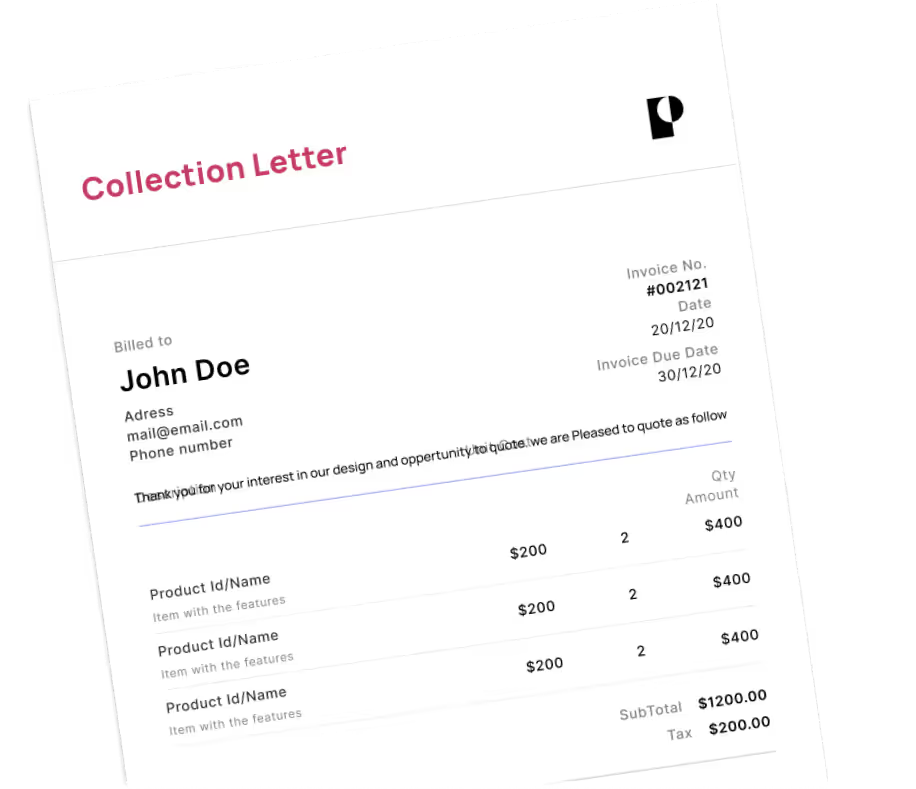
Debt Collection Agency in New York - No Cure, No Pay
Your New York claim is handled by a licensed local collection partner, matched to your case and benchmarked on performance. All actions follow New York law, and you track everything in one dashboard. Prefer to learn first? Read our New York debt collection guide.


Get free expert advice
Response from a specialist within 24 hours.
Why Choose Debitura for Debt Collection in New York?
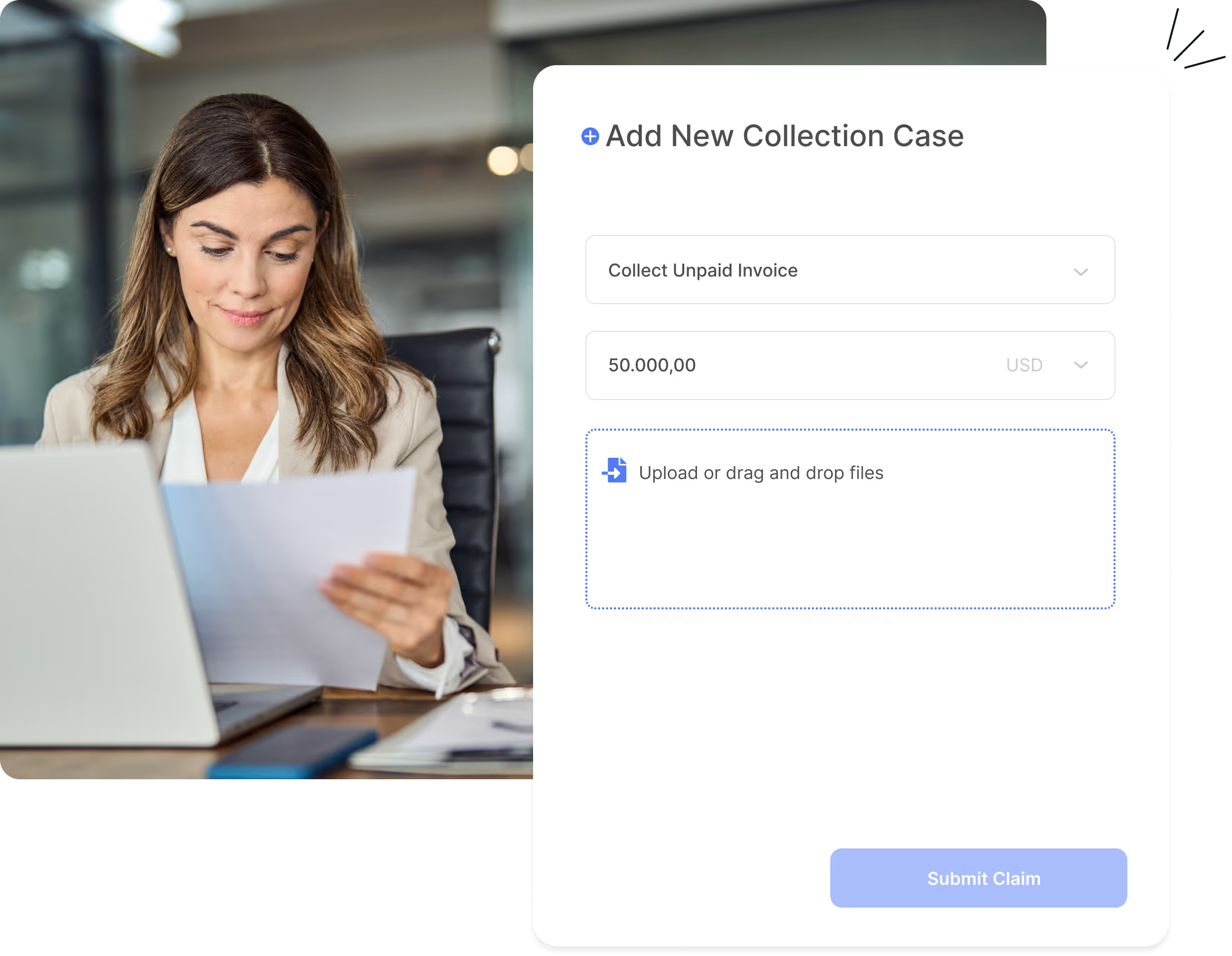
Fast, simple and risk-free debt collection in New York
Debitura recovers unpaid invoices from debtors in New York through our platform: submit your claim, and we assign it to the best-matching licensed partner working on a No Cure, No Pay basis while you track progress in real time. Your New York panel includes Debt Recovery Resources (Texas Secretary of State Reg. #0802087763, member of CLLA and ACA International), Direct Recovery Associates (California DFPI Lic. #10186-99, collecting commercial debt since 1992) and Aaron Bryant Stewart & Cross (member of ACA International).
- Risk-free: Pay only when we recover your money.
- Quick setup: Submit invoices in a few clicks.
- Real-time tracking: Monitor progress live in one portal.
- Local compliance: Collection follows New York's debt-collection rules (23 NYCRR Part 1) and the FDCPA.
Start recovering your New York claims in 2 minutes
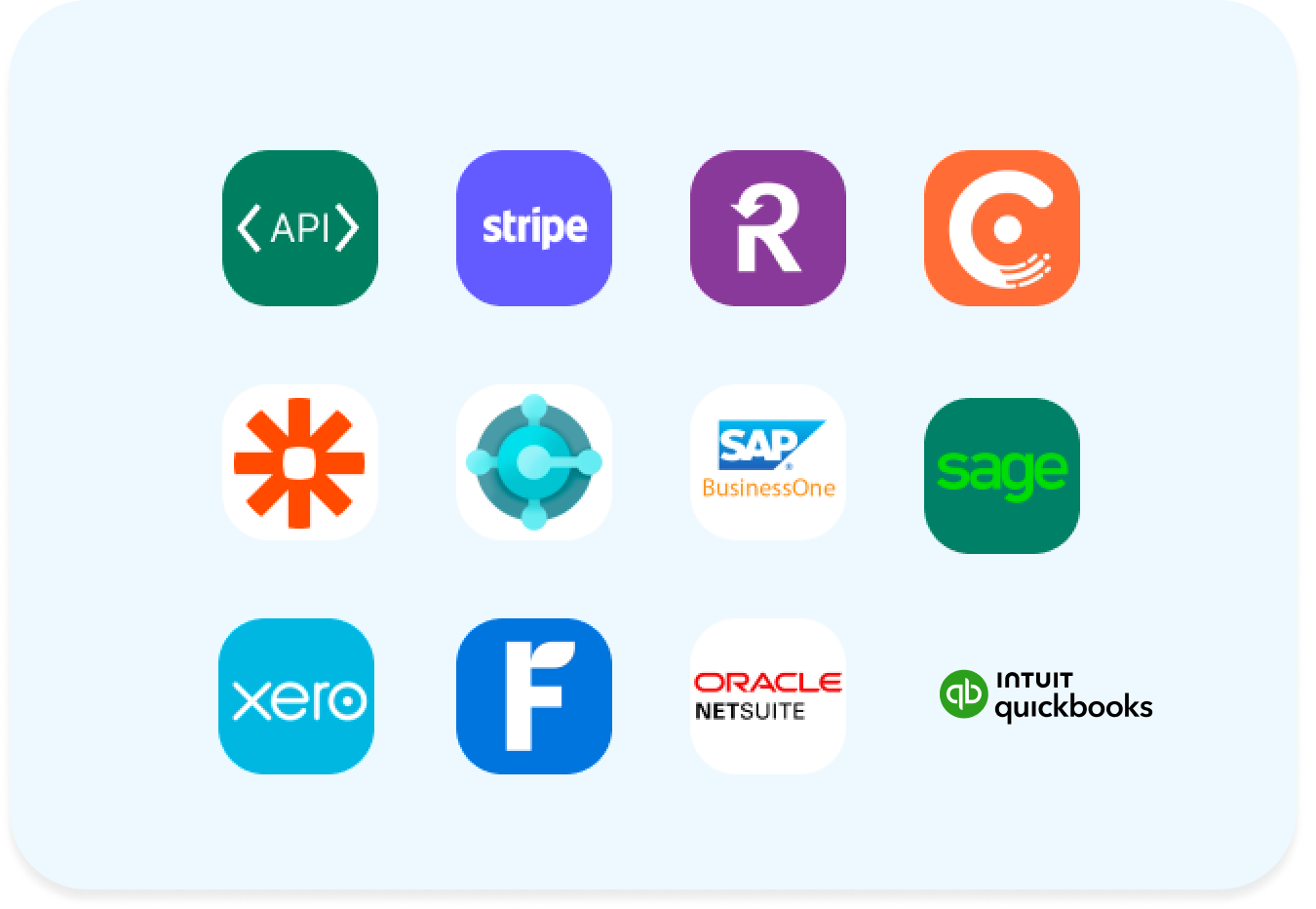
- Submit your claim: Upload unpaid invoices via the dashboard, REST API, or plug-and-play integrations such as QuickBooks and Xero.
- Local collection begins: We assign your case to the best-matching partner on your New York panel: Debt Recovery Resources, Direct Recovery Associates or Aaron Bryant Stewart & Cross, who opens the amicable phase with your debtor. If court action is required, you choose 1-3 fixed-price legal quotes, typically in the Commercial Claims Part for claims up to $10,000 in New York City, before anything proceeds.
- Get paid: Funds are remitted on recovery. If escalation is needed, only pre-approved, fixed-price legal steps move forward.
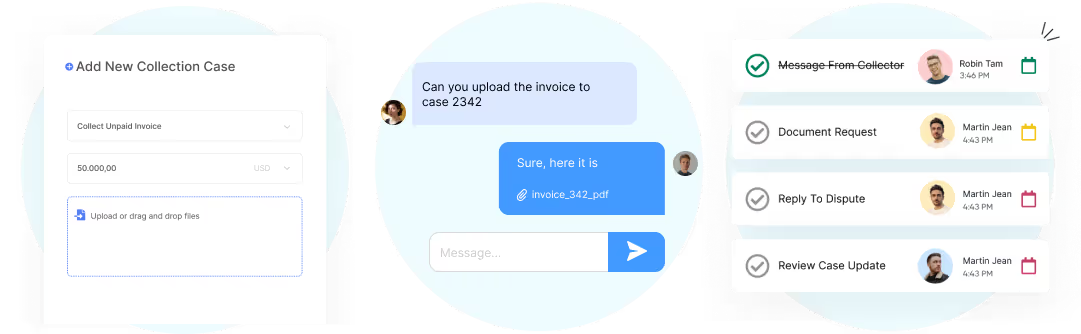

Transparent, success-based pricing
With Debitura you only pay when we succeed. Pre-legal collection is No Cure, No Pay: a success fee deducted from recovered amounts, invoiced locally by your partner. Fees depend on the debtor's country, not yours.
- Debtors in Europe (EU, Iceland, Liechtenstein, Norway, the UK and Switzerland): success fees from 6% depending on claim size.
- Debtors in the rest of the world: success fees from 7.5% depending on claim size.
- Older claims: a surcharge applies for claims 12–24 months overdue and for claims older than 24 months.
- Legal action is optional: you approve fixed-price quotes before any legal spend.
See the pricing page for the full fee schedule, or get an instant estimate when you upload a claim.
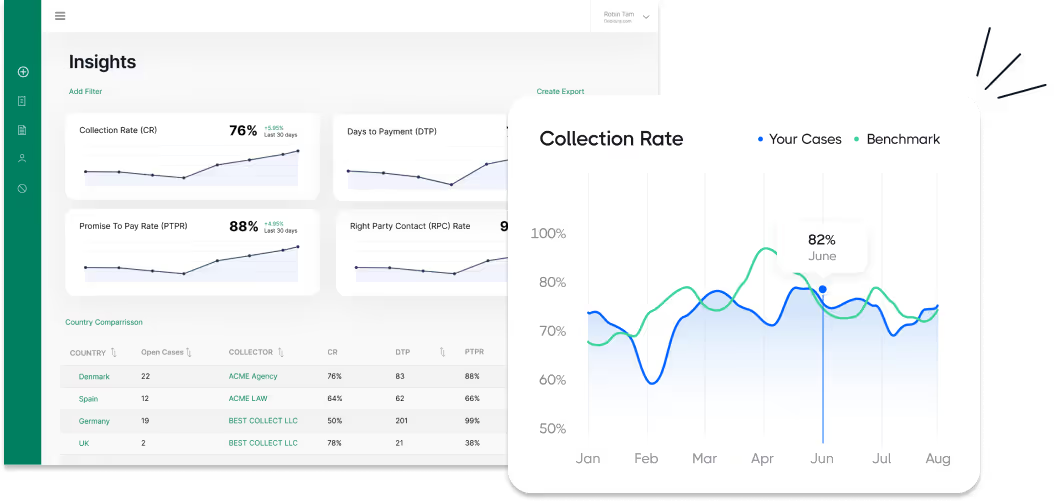
How does debt collection work in New York?
Debt collection in New York starts with an amicable phase: your case is handled by your assigned partner, which issues demands and pursues payment or a written acknowledgment of the debt. Most undisputed commercial claims are resolved at this stage. If the debtor still does not pay, escalation is never automatic; your partner assesses the legal route (typically the Commercial Claims Part for claims up to $10,000 in New York City, or Supreme Court above), and you approve a fixed-price quote before any court step.
- Submit in 2 minutes: upload unpaid invoices via the dashboard, REST API or ERP integrations.
- No Cure, No Pay: pre-legal collection is success-based, with no setup fees or subscriptions.
- You stay in control: legal escalation only happens after you approve a fixed-price quote.
- Get paid: recovered funds are remitted to you; fees are deducted on success only.
The four steps from unpaid invoice to recovered cash
- Step 1, Amicable collection: demands and negotiation handled by your New York panel partner. Most undisputed claims resolve here, without going to court.
- Step 2, Enforceable title: if the debtor does not pay, your partner assesses the legal route, and you approve a fixed-price quote before anything proceeds.
- Step 3, Enforcement: with a judgment, creditors can use an income execution against wages, capped at 10% of gross income, plus a restraining notice and levy against bank accounts.
- Step 4, Insolvency: if the debtor cannot pay, your proof of claim is filed in the insolvency process and distributions are monitored on your behalf.
Every step is tracked in your dashboard, and nothing escalates without your approval. The full legal detail for New York - timelines, costs, courts and enforcement - follows in the guide below.
Our local debt collection partners
Debitura is a platform, not a single agency: your case is routed to the licensed collection partner best matched to your claim type, debtor profile and industry. We benchmark our partners on recovery rate, speed and client rating, and underperformers are replaced
- Verified specialists
- Quotes in 24 h, no hidden fees
- Fair, pre-negotiated rates
Direct Recovery Associates, Inc. is a premier debt recovery agency in Agoura Hills offering effective Debt Collection services in the United States, founded in 1992, with a global reach and performance-based billing, ensuring high recovery rates and client satisfaction.
See full partner profile.webp)
.png)

.png)

Aaron Bryant Stewart & Cross is a premier debt recovery agency in the United States offering effective risk-free Debt Collection services, established in 2006 and serving North America and select international markets, as the exclusive Debitura partner in the U.S., providing No Cure No Pay collections based on Debitura's risk-free standard terms and pricing, and is a member of ACA International.
See full partner profile
Debt Recovery Resources is a premier debt recovery agency in the United States offering effective risk-free debt collection services, recognized as a Top 10 Debt Collection Agency in 2022 and a member of the CLLA, exclusively partnering with Debitura for No Cure No Pay solutions.
See full partner profileDebt collection in New York - the complete 2026 guide
For in-house counsel, finance teams and out-of-state creditors, this New York guide covers 2026 debt recovery end-to-end - costs, timelines, limitation and interest, court routes, and post-judgment enforcement - plus step-by-step tools and compact tables to act correctly, fast.
What we will cover:
Why you can trust this guide
At Debitura, we uphold the highest standards of impartiality and precision to bring you comprehensive guides on international debt collection. Every guide is written from primary legal sources and reviewed by licensed local experts in the jurisdiction it covers.
Questions or feedback? Email us at contact@debitura.com , we update this guide based on your input.
Debitura By the Numbers:
- 767 licensed partners - collection agencies and law firms in our network
- 180 countries covered - with cases handled in 174 of them
- 5,306 businesses registered with Debitura
- 33 days median time to first payment on European cases
Expert-led, locally validated
Written by Lars Holdgaard, Founder of Debitura (+10 years in global B2B debt recovery). Every page is reviewed by top local attorneys to ensure legal accuracy and practical steps you can use.

Contributing local experts:
Last updated:

Debt collection in New York - quick answers
| Question | Answer |
|---|---|
| Main route | Demand letter → amicable collection → Commercial Claims Part (up to $10,000 in NYC) or Supreme Court → post-judgment enforcement |
| Statute of limitations | 6 years for commercial/B2B contracts (N.Y. C.P.L.R. §213(2)); 3 years for consumer debt, with no revival after expiry (§214-i) |
| Late-payment interest | 9% per year absent an agreed rate (N.Y. C.P.L.R. §5004(a)); 2% on consumer-debt judgments against natural persons |
| Small claims | NYC Commercial Claims Part hears corporate claims up to $10,000; filing fee $25 plus postage |
| Wage garnishment | Income execution up to 10% of gross income, limited by a minimum-wage-based exemption floor (N.Y. C.P.L.R. §5231) |
| Court & enforcement fees | State fees apply only if the case escalates to legal |
| Our fee | Success fee only - No Cure, No Pay |
How much does debt collection cost in New York?
With Debitura you pay a success fee only on amounts actually recovered, with no upfront or monthly costs; the exact rate depends on your claim, see our pricing. Court fees apply only if the case escalates to legal: the NYC Commercial Claims Part filing fee is about $25 plus postage, and enforcement costs vary by county. These state fees are advanced by the creditor and can generally be recovered as court costs if you prevail.
How long does debt collection take in New York?
Most undisputed commercial claims are resolved in the amicable phase without court involvement. If escalation is needed, the Commercial Claims Part is the fastest judicial route for corporate claimants, while contested Supreme Court cases take substantially longer. Enforcement timing depends on locating non-exempt wages or assets.
What are the limitation and interest rules in New York?
The statute of limitations is 6 years for a commercial contract or open account (N.Y. C.P.L.R. §213(2)); consumer credit transactions carry a 3-year period with no revival by payment or acknowledgment once it expires (§214-i). For commercial debt, a written, signed acknowledgment restarts the clock (N.Y. Gen. Oblig. Law §17-101). Without an agreed rate, interest runs at 9% per year (§5004(a)); consumer-debt judgments against natural persons carry 2% instead, and contracts may set a rate up to the 16% civil usury cap.
What documents do I need to collect a debt in New York?
Assemble the contract or purchase order, the invoice(s), delivery or proof-of-service records, an account statement, your demand letters and reminders, and any written acknowledgment or payment agreement. If you are represented, add a power of attorney.
Which route should my claim take?
Corporate claims up to $10,000 in New York City belong in the Commercial Claims Part of NYC Civil Court, where a corporation may file directly. Larger or more complex claims go to Supreme Court. With Debitura, escalation only happens after you approve a fixed-price quote.
Who does what in New York debt collection?
Debt collection agencies in New York
New York has no statewide collector license today. An agency collecting from New York City residents must hold the NYC Department of Consumer and Worker Protection's Debt Collection Agency license (NYC Admin Code §20-489, 2-year term), verifiable through the DCWP's license checklist and lookup. A statewide DFS consumer-debt-collector license, proposed as Banking Law Article VII (bill S4271/A5537), remains in the Senate Finance Committee and is not yet law; if enacted, its licensing core would take effect January 1, 2027. Third-party collectors and debt buyers reaching New Yorkers are separately subject to DFS conduct rules under 23 NYCRR Part 1.
New York courts and enforcement officers
The Commercial Claims Part of NYC Civil Court hears corporate claims up to $10,000; Supreme Court hears larger and more complex cases. After judgment, sheriffs and marshals enforce income executions and levies, and a docketed judgment binds the debtor's real property in the county (N.Y. C.P.L.R. §5203).
Debt-collection attorneys in New York
Attorneys are allowed but not required in the Commercial Claims Part. Attorneys handle Supreme Court litigation above the small-claims limit and contested or disputed claims.
Regulators
The Department of Financial Services regulates third-party collectors and debt buyers; the NYC Department of Consumer and Worker Protection licenses collection agencies reaching NYC residents; the New York Attorney General also enforces consumer-protection law.
Which laws and courts apply to debt collection in New York?
Key legislation in New York
Debt collection in New York is shaped by the federal FDCPA and, for third-party collectors and debt buyers, by DFS regulation 23 NYCRR Part 1; a creditor collecting its own commercial receivable sits largely outside both, governed by contract law and the CPLR. Recent developments: the 2022 Consumer Credit Fairness Act cut the consumer-debt statute of limitations to 3 years and barred reviving a time-barred consumer debt (N.Y. C.P.L.R. §214-i), and NYC's Department of Consumer and Worker Protection adopted an overhaul of its debt-collection rules with an April 1, 2025 effective date; secondary reporting notes parts of the package have faced legal challenge, so verify the current status of specific provisions before relying on them.
Civil court system in New York
NYC Civil Court's Commercial Claims Part hears corporate claims up to $10,000; Supreme Court is New York's trial court of unlimited civil jurisdiction and hears larger claims. Outside New York City, City Courts and Town or Village Justice Courts hear smaller claims at lower dollar limits.
Consumer protection
DFS's 23 NYCRR Part 1 imposes conduct rules on third-party collectors and debt buyers reaching New York consumers; the New York Attorney General enforces consumer-protection law alongside DFS and NYC DCWP.
Step 1 - How does amicable (pre-legal) debt collection work in New York?
Amicable collection in New York is handled by your assigned panel partner, which contacts the debtor with formal demands and pursues payment, a payment agreement, or a written acknowledgment of the debt. Most undisputed commercial claims resolve in this phase without court involvement. For commercial debt, a written, signed acknowledgment restarts the limitation period (N.Y. Gen. Oblig. Law §17-101); for consumer debt, the clock cannot be restarted once the 3-year period has expired (N.Y. C.P.L.R. §214-i).
When to escalate to court in New York
Escalation is never automatic. It becomes relevant when the debtor is unresponsive, disputes the claim without merit, or the claim is approaching the limitation deadline. Your partner assesses the legal route and you approve a fixed-price quote before any court step.
Step 2 - How do you obtain an enforceable title in New York?
Fast-track option: NYC Commercial Claims Part
Corporate small claims in New York City are heard in the Commercial Claims Part of NYC Civil Court.
| NYC Civil Court - Commercial Claims Part | |
|---|---|
| Claim limit | $10,000 |
| Filing fee | About $25 plus postage |
| Business claimants | Yes; a corporation, partnership or association may file directly |
| Attorney rules | Allowed, not required |
Ordinary proceedings in New York
Claims above $10,000, or complex and contested cases, are heard in Supreme Court, New York's general trial court of unlimited civil jurisdiction. With Debitura, nothing is filed without your approval of a fixed-price quote.
Determining the appropriate court
The route is determined by the amount in controversy, the complexity of the dispute, and whether the claim falls inside or outside New York City, since City Courts and Town or Village Justice Courts apply lower dollar limits outside the five boroughs.
Step 3 - How does debt enforcement work in New York?
Ways to enforce a claim in New York
With a judgment, creditors can use an income execution against wages, taking installments of up to 10% of the debtor's gross income, though nothing may be withheld unless disposable earnings exceed a minimum-wage-based floor and the withheld amount cannot exceed 25% of disposable earnings (N.Y. C.P.L.R. §5231); New York's higher state minimum wage raises that protected floor above the federal baseline. Bank accounts can be frozen with a restraining notice and levy (§5222, §5232), subject to a $2,500 exemption for recently direct-deposited exempt payments such as Social Security (§5205(l)).
How to collect a judgment in New York
A New York money judgment is presumed paid after 20 years unless a written acknowledgment or payment restarts the clock (N.Y. C.P.L.R. §211(b)); the automatic real-property lien from docketing the judgment lasts 10 years and can be extended by court order (§5203).
Step 4 - How do insolvency procedures work in New York?
Business insolvency is governed by the federal Bankruptcy Code, with Chapter 7 liquidation and Chapter 11 reorganization as the main routes. Once a bankruptcy is filed, the automatic stay halts individual collection actions, and recovery runs through the insolvency estate: your proof of claim is filed in the process and distributions follow the statutory priority order. Your New York panel partner files the claim and monitors distributions on your behalf, so nothing is lost for lack of follow-up.
Fees, interest and who pays what in New York
Debitura's pre-legal collection in New York is success-based - No Cure, No Pay, with no setup fees or subscriptions.
Court and enforcement fees - only if the case escalates to legal
State fees apply only if the case escalates to legal. The NYC Commercial Claims Part filing fee is about $25 plus postage, and enforcement costs vary by county. These fees are advanced by the creditor and can generally be recovered as court costs if you prevail.
Interest and late fees the debtor owes - from the amicable phase
Without an agreed rate, New York allows 9% per year (N.Y. C.P.L.R. §5004(a)); a judgment on consumer debt against a natural person instead carries 2% per year. Contracts may set a higher rate up to the 16% civil usury cap (N.Y. Gen. Oblig. Law §5-501(1); Banking Law §14-a(1)); rates above 25% risk criminal usury (N.Y. Penal Law §190.40). New York sets no general statutory cap on commercial late-payment fees; the contract governs.
Collecting a New York debt from out of state or abroad
Creditors outside New York can enforce most sister-state judgments under Article 54 of the CPLR, New York's Uniform Enforcement of Foreign Judgments Act, though default judgments and confession-of-judgment judgments are excluded and must instead be enforced through a plenary action (N.Y. C.P.L.R. §5401). Out-of-state and international creditors work through the same New York panel: your case is routed to the licensed partner best matched to your claim, with the same No Cure, No Pay terms, and cross-border cases draw on Debitura's network across 183 countries.
Frequently Asked Questions
Explore our most common FAQs below, or reach out directly at contact@debitura.com if you need help with a specific case.
.svg)
Need debt recovery beyond New York?
Explore our North America debt-collection hub for country-by-country playbooks.
For coast-to-coast coverage in the US, see the U.S. debt-collection overview.
Neighboring states: New Jersey · Connecticut
.png)
.avif)
.avif)
.avif)
.avif)
.avif)
.avif)
.avif)

.avif)
.svg%20(1).avif)

.avif)






.svg.avif)




.avif)
.avif)

.avif)
.avif)



.avif)



.svg.avif)

.avif)

.avif)
.avif)
.avif)
.avif)
.avif)
.avif)
.avif)
.avif)
.avif)
.avif)
.avif)
.svg)