Debt Collection Agency in India: No Win, No Fee
Need a debt collection agency in India? Your claims are handled by GCS Management Solutions, our registered Indian debt recovery partner (rin vasuli) with 16+ years of expertise.


Questions about your case?
Write to us, we reply by email.

Why choose Debitura for debt collection in India
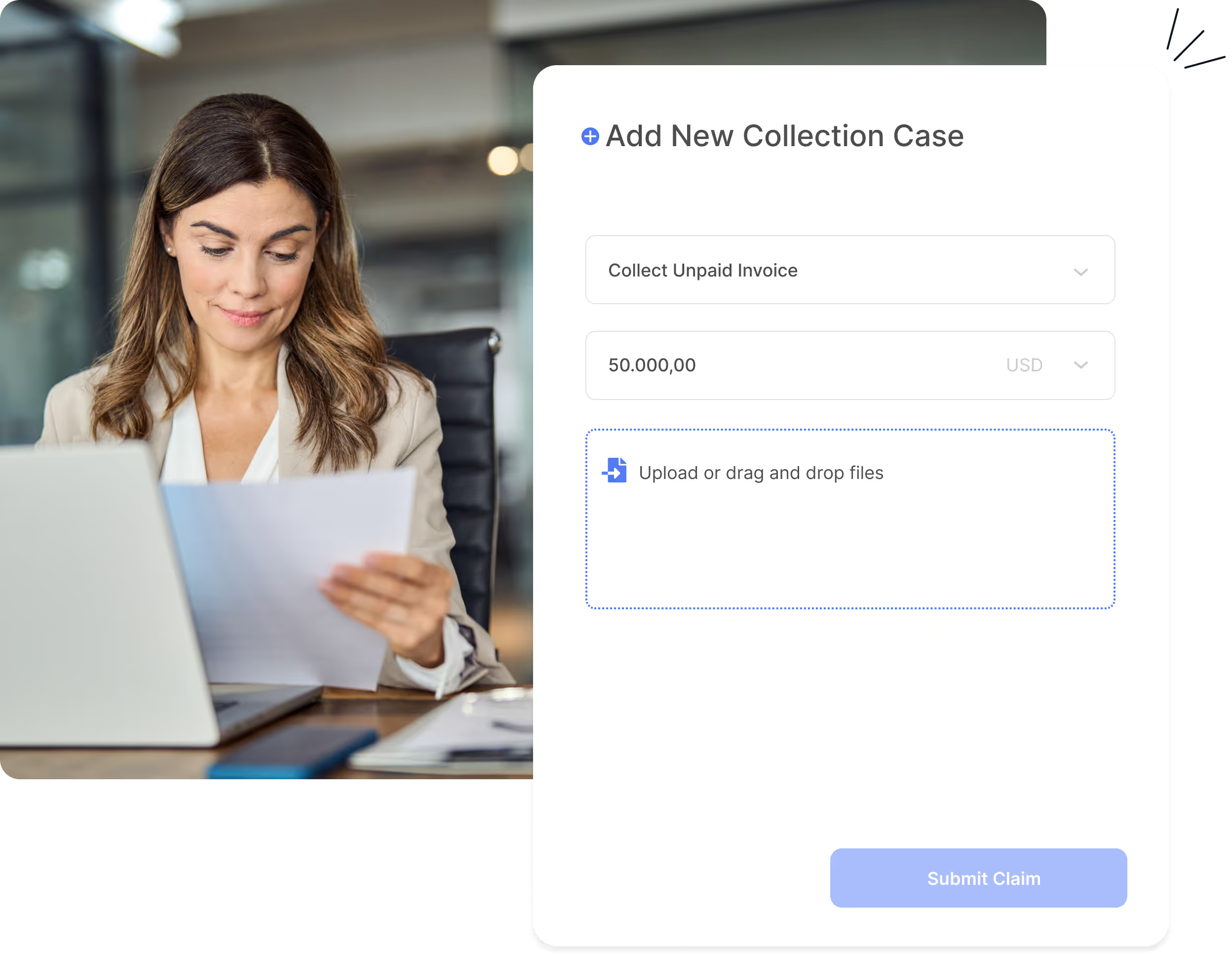

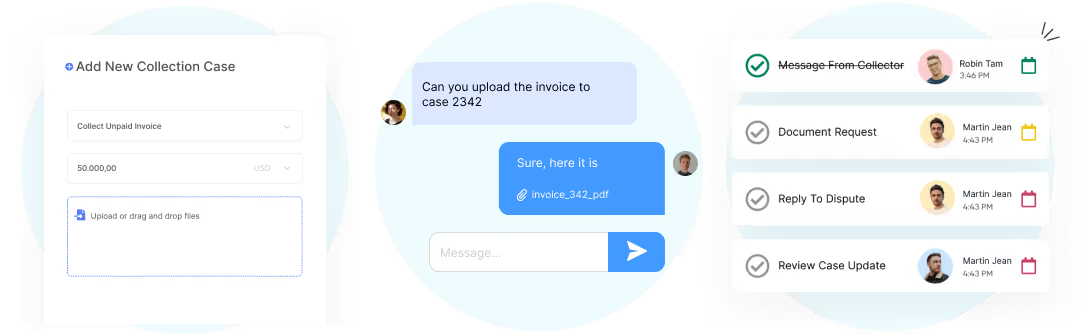
Empiece a recuperar sus deudas indias en tres pasos
- Suba su reclamación: Introduzca los datos del deudor y suba las facturas a través de nuestro portal seguro. Tarda unos 2 minutos.
- We take over: Your assigned Indian partner contacts your debtor using local expertise and language.
- Reciba el pago: Los fondos recuperados se transfieren directamente a su cuenta. Solo paga nuestros honorarios de éxito cuando cobramos.
Already using accounting software or an ERP? Import by CSV or connect QuickBooks Online, Zoho Books, Stripe or KashFlow, or use Zapier, the REST API or our MCP server.
Precios transparentes y basados en el éxito
With Debitura you pay a success fee only when money is recovered. Pre-legal collection is No Cure, No Pay: a success fee deducted from recovered amounts, invoiced locally by your partner. Fees depend on the debtor's country, not yours.
- Deudores en Europa (UE, Islandia, Liechtenstein, Noruega, Reino Unido y Suiza): honorarios de éxito a partir del 6 % según el tamaño de la reclamación.
- Deudores en el resto del mundo: honorarios de éxito a partir del 7,5 % según el tamaño de la reclamación.
- Older claims: a surcharge applies for claims 12 to 24 months overdue and for claims older than 24 months.
- Acciones judiciales Es opcional: usted debe aprobar un presupuesto legal, en el que las costas judiciales se indiquen por separado, antes de que se incurra en ningún gasto legal.
Consulte la página de Precios para ver la tabla completa de tarifas, u obtenga un presupuesto instantáneo al subir una reclamación.
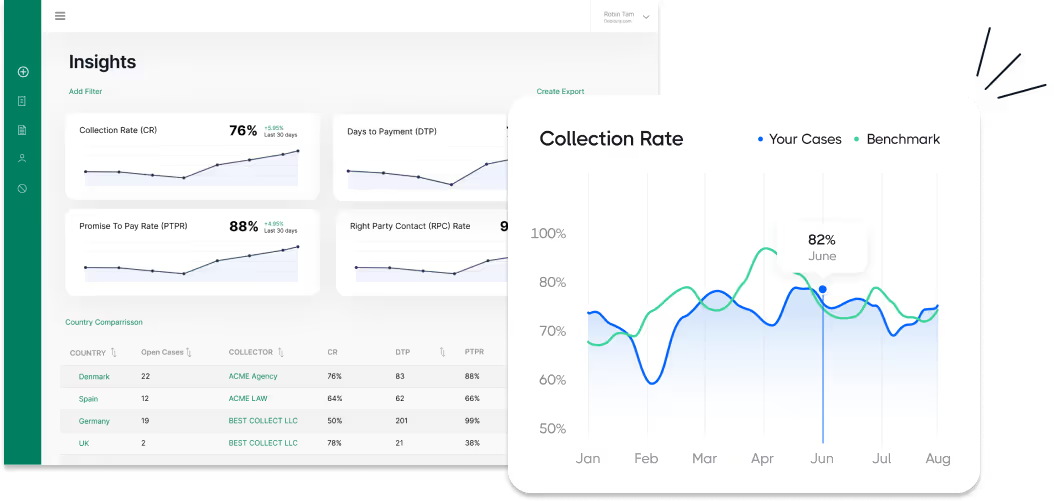
¿Cómo funciona el cobro de deudas en India?
Debt collection in India starts with an amicable phase handled locally by your assigned partner, GCS Management Solutions or Golden Red Credit Solutions: reminders and a formal demand for payment, aimed at full payment or a written acknowledgement of the debt. Most undisputed claims are resolved at this stage. If the debtor still does not pay, escalation is never automatic; your partner assesses the legal route, and you approve a legal quote before any court step.
- La mayoría de las deudas se resuelven en un plazo de 30 a 60 días mediante el cobro amistoso.
- Plazo de prescripción de 3 años para reclamaciones contractuales según la Ley de Prescripción de la India de 1963.
- Escalada opcional a Demanda Sumaria (Orden 37 del Código de Procedimiento Civil) para una recuperación acelerada.
- Ejecución de sentencia mediante embargo judicial y venta de activos.
Los cuatro pasos desde la factura impagada hasta el dinero recuperado
- Amicable collection: reminders, a formal demand and negotiation, handled locally by your assigned Indian partner. Most undisputed claims are resolved here, without going to court.
- Enforceable title: if the debtor still does not pay, your partner assesses the legal route to obtain a court decree, and you approve a legal quote, with court costs stated separately, before anything proceeds.
- Enforcement: with a decree, the court's execution machinery can attach and sell property, garnish bank accounts and other debts, and in limited cases arrest the debtor until the claim is recovered.
- Insolvency: if the debtor is a company that cannot pay, your proof of claim is filed in the insolvency process, and any distributions are monitored on your behalf.
Cada paso se sigue en su panel de control y nada escala sin su aprobación. Los detalles legales completos para India, que cubren plazos, costes, tribunales y ejecución de sentencia, se encuentran en la guía a continuación.
Cobro de deudas en India - la guía completa de 2026
El cobro de deudas en India (también buscado como recuperación de pagos o recuperación de dinero) se presenta aquí de principio a fin para acreedores extranjeros y nacionales, asesores jurídicos internos y equipos financieros: el marco legal, quién hace qué, las normas de prescripción e intereses, las protecciones especiales para pequeños proveedores, las vías para obtener una resolución judicial, la ejecución de sentencia bajo el Código de Procedimiento Civil y el concurso de acreedores corporativo bajo el Código de Insolvencia y Concurso de Acreedores.
En esta página:
Por qué puede confiar en esta guía
Written from primary legal sources and reviewed by licensed local experts in this jurisdiction.
¿Preguntas o comentarios? Envíenos un correo electrónico a contact@debitura.com ; actualizamos esta guía basándonos en sus aportaciones.
Debitura en cifras:
- Cobertura en 180 países: cada Expediente está gestionado por un socio local
- Más de 5.000 empresas inscritas en Debitura
- 33 días: tiempo medio hasta el primer pago en los casos europeos
Sobre nosotros el autor
Escrito por Lars Holdgaard, fundador de Debitura (con más de 10 años de experiencia en el cobro de deudas B2B a nivel internacional).

Expertos locales colaboradores:
Última actualización:

Cobro de deudas en India - respuestas rápidas
Ya sea que lo llame cobro de deudas, recuperación de pagos o recuperación de dinero, la vía correcta en India depende del tamaño y la naturaleza de la deuda y del deudor. Las reglas principales se detallan a continuación.
¿Cuánto cuestan los costes del recobro de deudas en India?
Pre-legal collection is commonly success-based (No Cure, No Pay), so the creditor pays only on recovery. Court action is separate: the creditor advances an ad valorem court fee set by the relevant state's own Court Fees Act, 1870 schedule, plus advocate fees; under Section 35 of the Code of Civil Procedure the court has discretion to award costs to the successful party.
¿Cuánto tiempo tarda el cobro de deudas en India?
Amicable recovery of an undisputed debt typically runs a few weeks to a couple of months. A summary suit on a written debt is faster than an ordinary suit because the defendant must first obtain leave to defend. A delayed-payment reference by a registered micro or small supplier to the state facilitation council is to be decided within 90 days, and corporate insolvency should ordinarily complete within 330 days.
¿Cuáles son los plazos de prescripción y las normas de interés en India?
A suit to recover a contract or simple money debt must generally be filed within three years of the due date (Limitation Act, 1963, Schedule Part I, Article 1). A written, signed acknowledgement of the debt made before the period expires (Section 18) or a part-payment (Section 19) starts a fresh three-year period. A court decree is enforceable for twelve years (Article 136). Pre-decree interest runs at the contractual rate or the court's discretion under Section 34 of the Code of Civil Procedure; post-decree interest is capped at 6% a year unless the debt arises from a commercial transaction, where it can run higher. Registered micro and small suppliers have a stronger statutory entitlement (see below).
| Tema | Regla |
|---|---|
| Deuda contractual / de dinero | 3 years from the due date; resets on a written, signed acknowledgement or part-payment. |
| Ejecución de una sentencia | 12 years from the date the decree becomes enforceable. |
| Pre-decree interest | Tipo contractual, o a discreción del tribunal (CPC art. 34). |
| Micro / pequeño proveedor | Payment within 45 days; on delay, compound interest at 3x the RBI-notified bank rate (MSMED Act, 2006, ss.15-16). |
| Cheque sin fondos | Statutory notice within 30 days of dishonour; complaint under s.138 Negotiable Instruments Act, 1881. |
Is there a faster route for small suppliers in India?
Yes. A registered micro or small enterprise can refer a delayed-payment dispute to its state Micro and Small Enterprises Facilitation Council (the MSEFC), which is to decide the reference within 90 days and whose award is enforceable like a decree.
¿Qué documentos necesito para cobrar una deuda en India?
Assemble the contract or purchase order, the unpaid invoices and statement of account, proof of delivery or performance, all correspondence, and any written acknowledgement of the debt or dishonoured cheque. For a company creditor, evidence of authority to act is expected in formal proceedings.
¿Qué vía debe seguir mi reclamación en India?
An undisputed debt on a written contract, bill of exchange or promissory note suits a summary suit (Order XXXVII, Code of Civil Procedure). A registered small supplier chasing a delayed payment can use the MSEFC route. A commercial dispute at or above the specified value (a national floor of ₹3,00,000, which some states notify higher) goes to a Commercial Court after mandatory pre-institution mediation. Where a company cannot pay an operational debt currently applied at ₹1 crore or more, the Insolvency and Bankruptcy Code route before the National Company Law Tribunal is available; see Step 4 for the 2026 reform to this Code, parts of which are still working through implementation.
¿Quién hace qué en el cobro de deudas en India?
Recovery in India involves collection agencies for amicable work, advocates for court and tribunal proceedings, and the courts' own execution machinery for enforcement. Debitura supports you across all stages through its two exclusive Indian partners, GCS Management Solutions and Golden Red Credit Solutions.
Agencias de cobro de deudas en India
Agencies handle the pre-legal, extrajudicial phase: contacting the debtor, issuing demands and negotiating settlement. There is no dedicated national licensing regime for business-to-business collection agencies; recovery agents acting for banks and non-banking financial companies must follow the Reserve Bank of India's Fair Practices Code, which governs regulated lenders' own loan recovery rather than general commercial trade-debt collection.
Advocates in India
Los abogados, inscritos conforme a la Advocates Act, 1961, representan a los acreedores en los tribunales civiles y mercantiles y ante el National Company Law Tribunal. Redactan y presentan demandas, solicitan embargos provisionales, llevan a cabo ejecuciones y actúan en solicitudes de Concurso de acreedores. La representación legal es necesaria para la mayoría de los procedimientos formales.
Courts, tribunals and the facilitation council in India
The civil and commercial courts issue and execute money decrees; execution under Order XXI carries out attachment, sale and garnishee orders through court officers. The National Company Law Tribunal is the adjudicating authority for corporate insolvency under the Insolvency and Bankruptcy Code, and the Micro and Small Enterprises Facilitation Council handles registered small-supplier delayed-payment disputes. Debts Recovery Tribunals under the Recovery of Debts and Bankruptcy Act, 1993 exist mainly for banks' and NBFCs' own secured lending recovery, not typical unsecured B2B trade debt.
¿Qué leyes y tribunales se aplican al cobro de deudas en India?
El cobro de deudas en India se rige por un sistema de procedimiento civil codificado, complementado por legislación sobre tribunales mercantiles, prescripción, pequeños proveedores, Concurso de acreedores y títulos negociables.
El sistema judicial civil en India
Money claims are filed in the District or City Civil Courts by pecuniary and territorial jurisdiction; the exact pecuniary threshold for Small Causes Courts varies by state and should be confirmed locally. Commercial disputes of a "Specified Value" (a national floor of ₹3,00,000, which a State Government may notify higher for its High Court) are heard by Commercial Courts and the Commercial Divisions of the High Courts under the Commercial Courts Act, 2015 (as amended 2018, and further reformed procedurally in 2026). Corporate insolvency is decided by the National Company Law Tribunal, and small-supplier delayed-payment disputes go to the Micro and Small Enterprises Facilitation Council.
Legislación clave en India
- Code of Civil Procedure, 1908: el proceso de demanda, los juicios sumarios (Order XXXVII) y la ejecución de sentencias (Order XXI).
- Limitation Act, 1963: la prescripción de tres años para deudas contractuales y de doce años para ejecutar una sentencia.
- Commercial Courts Act, 2015: tribunales especializados y mediación pre-judicial obligatoria para disputas comerciales.
- Micro, Small and Medium Enterprises Development Act, 2006 (the MSMED Act): protected payment terms and interest for registered micro and small suppliers.
- Insolvency and Bankruptcy Code, 2016, as substantially amended by the Insolvency and Bankruptcy Code (Amendment) Act, 2026 (assented 6 April 2026, most provisions in force from 26 May 2026): corporate insolvency initiated by operational and financial creditors, now with further reforms still working through implementation - see Step 4.
- Negotiable Instruments Act, 1881: incluyendo la Sección 138 para cheques sin fondos.
- Indian Contract Act, 1872: the substantive contract and debt rules.
Normas de conducta y protección de datos en India
Recovery agents of regulated lenders must follow the Reserve Bank of India's Fair Practices Code; harassment, threats and criminal intimidation are prohibited under the general criminal law. Handling of debtor personal data is governed by the Digital Personal Data Protection Act, 2023 and its 2025 Rules, which are in a phased compliance period running into 2026 and 2027.
Paso 1 - ¿Cómo funciona el cobro amistoso (pre-judicial) de deudas en India?
Pre-legal collection means recovering an unpaid invoice without going to court, through reminders, a formal demand and negotiation. The aim is full payment or a written acknowledgement of the debt plus an instalment plan. A written, signed acknowledgement is valuable because, made before limitation expires, it restarts the three-year clock. Where the debt is evidenced by a dishonoured cheque, a statutory notice under Section 138 of the Negotiable Instruments Act, served within 30 days of dishonour, is a strong lever.
Cronología del cobro amistoso
| Fase | Acción |
|---|---|
| Primeros recordatorios | Factura, fecha de vencimiento y detalles de pago; confirmar la recepción de la deuda. |
| Demanda formal / aviso legal | A demand stating the sum, a deadline and the intent to sue. |
| Negociación | Acuerdo o plan de pagos a plazos, idealmente con un reconocimiento escrito. |
| Entrega del expediente | Si no se paga, un expediente completo de pruebas se entrega al abogado para presentar una demanda. |
A statutory route for small suppliers: the MSEFC
A registered micro or small supplier can refer a delayed payment to its state Micro and Small Enterprises Facilitation Council, filed online through the MSME Samadhaan portal; the council attempts conciliation and, failing that, arbitration, and must decide the reference within 90 days.
Cuándo recurrir a los tribunales en India
Recurra a los tribunales cuando una demanda formal caduque, el deudor objete sin fundamento, el plazo de prescripción se acerque o los activos parezcan estar en riesgo. Prepare el contrato, las facturas, la prueba de entrega, el estado de cuenta y el cálculo de intereses para el abogado.
Paso 2 - ¿Cómo se obtiene un título ejecutivo en India?
To enforce a debt you need a court decree or an award that carries the force of one. India offers a fast-track court route for clear written debts, an ordinary route for disputed claims, and a statutory settlement route for small suppliers.
Juicio sumario (Orden XXXVII)
A summary suit under Order XXXVII of the Code of Civil Procedure is available for debts based on a written contract, a bill of exchange or a promissory note. The defendant cannot defend as of right; it must apply for leave to defend within 30 days of summons, so undisputed claims move to judgment faster than in an ordinary suit.
Juicio ordinario y Tribunales de lo Mercantil
Disputed or complex claims proceed as an ordinary civil suit. A commercial dispute of a "Specified Value" (a national floor of ₹3,00,000, higher where a state has notified a higher figure) is filed in a Commercial Court, and, unless urgent interim relief is sought, the claimant must first complete pre-institution mediation under Section 12A of the Commercial Courts Act, 2015.
An award that counts as a decree
An award of the Micro and Small Enterprises Facilitation Council, for a registered small supplier's delayed payment, is enforceable in the same way as a civil-court decree, and offers a faster, lower-cost route to an enforceable title than a full suit.
Determinación del tribunal competente en India
El tribunal se elige según el valor de la reclamación (jurisdicción pecuniaria) y el lugar de residencia del demandado o donde surgió la causa de la acción (jurisdicción territorial). Es esencial presentar la demanda dentro del plazo de prescripción de tres años.
Más sobre los procedimientos judiciales en India
Denuncias por cheques sin fondos
Where payment was by a cheque that bounced, a complaint under Section 138 of the Negotiable Instruments Act can run alongside the civil suit for the debt: after the 30-day demand notice, the drawer has 15 days to pay, and, if unpaid, a criminal complaint must be filed within one month. Conviction carries imprisonment of up to two years, a fine of up to twice the cheque amount, or both.
Arbitraje
Si el contrato contiene una cláusula de arbitraje, la disputa se resuelve mediante arbitraje conforme a la Ley de Arbitraje y Conciliación de 1996, y el laudo resultante se ejecuta como una sentencia.
Paso 3 - ¿Cómo funciona la ejecución de deudas en India?
Una vez que se tiene una sentencia, se ejecuta mediante procedimientos de ejecución conforme a la Orden XXI del Código de Procedimiento Civil. El acreedor elige las medidas que se ajustan a los activos conocidos del deudor, y una sentencia sigue siendo ejecutable durante doce años.
Formas de ejecutar una reclamación en India
| Método | Para qué sirve |
|---|---|
| Attachment and sale of property | The court attaches the debtor's movable or immovable property and sells it, applying the proceeds to the decree. |
| Garnishee order | Money a third party owes the debtor, including bank balances, is attached and paid to the creditor directly. |
| Appointment of a receiver | The court appoints a receiver to manage and realise the debtor's property on the creditor's behalf. |
| Arrest and detention | In limited circumstances, and subject to statutory safeguards, the judgment debtor may be arrested and detained. |
Attachment and sale suits a debtor with identifiable property. A garnishee order is faster when the debtor's bank accounts or receivables are known. A receiver fits more complex assets that need active management, such as a running business. Arrest and detention is a measure of last resort, applied only where the court is satisfied the debtor can pay but refuses to.
El proceso de ejecución de deudas en India
If a corporate debtor cannot satisfy the decree through these measures, corporate insolvency proceedings become the more effective route (see Step 4) rather than continued execution against a company with no realisable assets.
The creditor files an execution petition in the court that passed the decree, or to which it is transferred, identifies the debtor's assets, and applies for the chosen measure. Sale proceeds are applied to principal, interest and costs, with any surplus returned to the debtor. A decree of a superior court of a notified "reciprocating territory" (such as the United Kingdom, the United Arab Emirates and Singapore) can be executed directly in India under Section 44A of the Code of Civil Procedure, without a fresh suit.
Paso 4 - ¿Cómo afectan los procedimientos de insolvencia a la recuperación de deudas en India?
Cuando el deudor es una empresa que no puede pagar, la insolvencia corporativa bajo el Código de Insolvencia y Quiebra de 2016 se convierte en la vía colectiva. Es un proceso con plazos definidos y supervisado por un tribunal, y la ejecución individual generalmente se suspende una vez que comienza.
The 2026 reform - what is confirmed and what is still unresolved
The Insolvency and Bankruptcy Code (Amendment) Act, 2026 received Presidential assent on 6 April 2026, and a government notification brought most of its provisions into force from 26 May 2026. Its headline additions - a Creditor-Initiated Insolvency Resolution Process letting financial creditors holding 51% or more of the debt start resolution outside court, and a Group Insolvency framework - are reported to still be awaiting a separate commencement notification, so this guide does not treat either as live. The figures below (the minimum default, the resolution timeline and the liquidation priority order) are the pre-amendment figures; no source confirms the 2026 Act has changed them, but this should be checked against the current consolidated Code before relying on it for a borderline case.
Inicio de la insolvencia como acreedor operativo
An unpaid trade creditor is an "operational creditor". It first serves a demand notice under Section 8 of the Code; if the debt is not paid or genuinely disputed within 10 days, it may apply under Section 9 to the National Company Law Tribunal to begin the Corporate Insolvency Resolution Process. The minimum default currently applied is ₹1 crore (raised from a statutory base of ₹1 lakh by notification dated 24 March 2020).
El proceso y los posibles resultados
The Corporate Insolvency Resolution Process is time-bound: it should ordinarily complete within 180 days, extendable to a mandatory outer limit of 330 days. A resolution professional takes control of the company, creditors submit their claims, and a committee of creditors votes on a resolution plan; if none is approved in time, the company goes into liquidation.
How liquidation proceeds are distributed
If the company is liquidated, Section 53 of the Code sets a statutory order of priority, often called the waterfall. Each class is paid in full before the next class receives anything.
| Priority | Who is paid |
|---|---|
| 1 | Insolvency resolution and liquidation costs |
| 2 | Workmen's dues (24 months) and secured creditors who relinquish their security |
| 3 | Other employees' dues (12 months) |
| 4 | Unsecured financial creditors |
| 5 | Government dues (2 years) and any remaining secured creditors' claims |
| 6 | Any other debts, including an unsecured operational creditor's claim |
| 7 | Preference shareholders, then equity shareholders |
An unpaid trade creditor is typically an unsecured operational creditor, which ranks below secured creditors and employees in this order, so full recovery in liquidation is not guaranteed. A resolution plan that keeps the company trading often recovers more for creditors than liquidation does.
El proceso de insolvencia para acreedores en India
Presente su prueba de reclamación al profesional de la resolución antes de la fecha límite establecida, junto con el contrato, las facturas y el estado de cuenta; supervise el comité de acreedores y las distribuciones; y, antes de iniciar la insolvencia, evalúela frente a una demanda directa. La insolvencia es para una incapacidad genuina de pago, no para la negativa de un deudor solvente.
Honorarios, intereses y quién paga qué en India
- Our fee: success-based, No Cure, No Pay. Fees depend on the debtor's country, not yours; for a debtor in India (outside Europe), rates start from 7.5%. See pricing for the full schedule.
- Court and advocate fees: apply only if the case escalates to legal action. The court fee is ad valorem, set by the relevant state's own Court Fees Act, 1870 as locally amended, and advocate fees are not fixed nationally; the court has discretion to award costs to the successful party under Section 35 of the Code of Civil Procedure.
- Statutory debtor items: pre- and post-decree interest follows the contract, or the court's discretion under Section 34 (post-decree interest capped at 6% a year for non-commercial debts, and can exceed that for a commercial transaction). A registered micro or small supplier must be paid within 45 days of acceptance under the MSMED Act, 2006; on delay, compound interest at three times the RBI-notified bank rate applies automatically.
- Distribución de lo recuperado: el principal recuperado es suyo; los intereses y costes se rigen por el contrato, la ley y la orden judicial.
Cobro de deudas transfronterizo en India
Una sentencia de pago de un tribunal superior de un país notificado como "territorio recíproco" (por ejemplo, el Reino Unido, los Emiratos Árabes Unidos y Singapur) puede ejecutarse directamente en India, presentando una copia certificada para su ejecución según la Sección 44A del Código de Procedimiento Civil, como si fuera una sentencia india.
A judgment from a country that is not a reciprocating territory cannot be executed directly. The creditor must file a fresh suit in India on the foreign judgment, which is treated as conclusive under Section 13 of the Code of Civil Procedure unless one of the recognised exceptions applies. India is not an EU or EEA member, so no EU cross-border recognition mechanism applies here.
Partners in our network
These firms are partners in our network for this country. Open a profile to learn more about each one. If court action is needed on your case, your partner sends a quote on the platform; nothing starts until you accept it.
- Especialistas verificados
- No se pone nada en marcha hasta que aceptes el presupuesto.
- Tarifas justas y prenegociadas
Moneyguard Solutions LLP es una agencia líder en recobro de deudas en Surat que ofrece servicios eficaces de recobro de deudas en la India, posicionándose como el socio de referencia para el recobro de deudas con experiencia en el sector desde 2021 y reconocida por sus Soluciones innovadoras y su pertenencia a asociaciones de prestigio.



Legal Thirst Associates es un bufete de abogados líder en Rohtak que ofrece servicios eficaces de cobro de deudas en la India. Fundado en 1993, cuenta con el reconocimiento del Consejo de Abogados de Punjab y Haryana y es miembro de la Asociación de Abogados de la India, prestando servicios a reclamaciones de gran valor en todo el país.

India International Law Firm es un bufete de abogados líder en Bengaluru que ofrece servicios eficaces de cobro de deudas en la India, posicionándose como el socio de referencia para la recuperación de deudas con una base en 2002, la pertenencia a la Asociación de Abogados del Tribunal Supremo y una red global de asociados.

The Indian Lawyer & Allied Services es un bufete de abogados líder en Nueva Delhi que ofrece servicios eficaces de cobro de deudas en la India, reconocido por su experiencia desde 2011, con galardones como el Premio a la Mujer Emprendedora 2022 y miembro de la Asociación de Abogados Europeos.

Srivastava & Associates es un bufete de abogados líder en Nueva Delhi que ofrece servicios eficaces de cobro de deudas en la India, reconocido como el socio de referencia para la recuperación de deudas desde 1972, con presencia en más de 10 ciudades y experiencia especializada en sectores clave de la industria.

Lex Protector LLP es un bufete de abogados líder en Bhubaneswar que ofrece servicios eficaces de cobro de deudas en la India, fundado en 2018, reconocido por su experiencia y considerado un líder en el sector.
MAARUTI SERVICES is a premier debt recovery agency in Vadodara offering effective Debt Collection services in India, established in 2023 with a success rate exceeding 95% according to the agency, recognized for its award-winning strategies and membership affiliations, serving corporate clients with excellence.

Pratyusha Financial Services es una agencia líder en recobro de deudas en Sundargarh que ofrece servicios eficaces de recobro de deudas en la India, fundada en 2023, que se asocia con bancos e instituciones financieras no bancarias para ofrecer Soluciones personalizadas e impulsar la inclusión financiera en todo el país.

HNR LEGAL es un bufete de abogados líder en Pune que ofrece servicios eficaces de cobro de deudas en India, posicionándose como el socio de referencia para la recuperación de deudas gracias a su base de conocimientos e integridad. Fue fundado en 2014 y tiene oficinas en Bombay y Tokio.

Chirag Shah & Co. es un bufete de abogados líder en Bombay que ofrece servicios eficaces de cobro de deudas en India, posicionándose como el socio de referencia para la recuperación de deudas con una sólida trayectoria desde 2008 y reconocido por sus premios y membresías.

Attorneys Desk es un bufete de abogados líder en Navi Mumbai que ofrece servicios eficaces de cobro de deudas en India, fundado en 2015 y reconocido por su membresía en el Colegio de Abogados de Maharashtra y Goa y en la Asociación del Tribunal de Recuperación de Deudas.

Ferry Dhiman & Co. es un bufete de abogados líder que ofrece servicios eficaces de cobro de deudas en IN, posicionándose como el socio de referencia para la recuperación de deudas desde 2001, con una sólida reputación en derecho corporativo y fiscal, respaldada por prestigiosos premios y membresías.

Golden Red Credit Solutions is a premier debt recovery agency in India offering effective debt collection services, positioning itself as the go-to partner for debt recovery since 2011, leveraging a No Cure No Pay model as a Debitura partner in India.

Maxim Credit Management Services es una agencia líder en recuperación de deudas en Nueva Delhi que ofrece servicios eficaces de cobro de deudas en India, reconocida por su modelo de no éxito, no cobro desde 2010, prestando servicios en los mercados asiáticos e internacionalmente a través de una red global de socios.
Preguntas frecuentes
Consulte nuestras preguntas frecuentes más comunes a continuación, o contáctenos directamente en contact@debitura.com si necesita ayuda con un expediente específico.