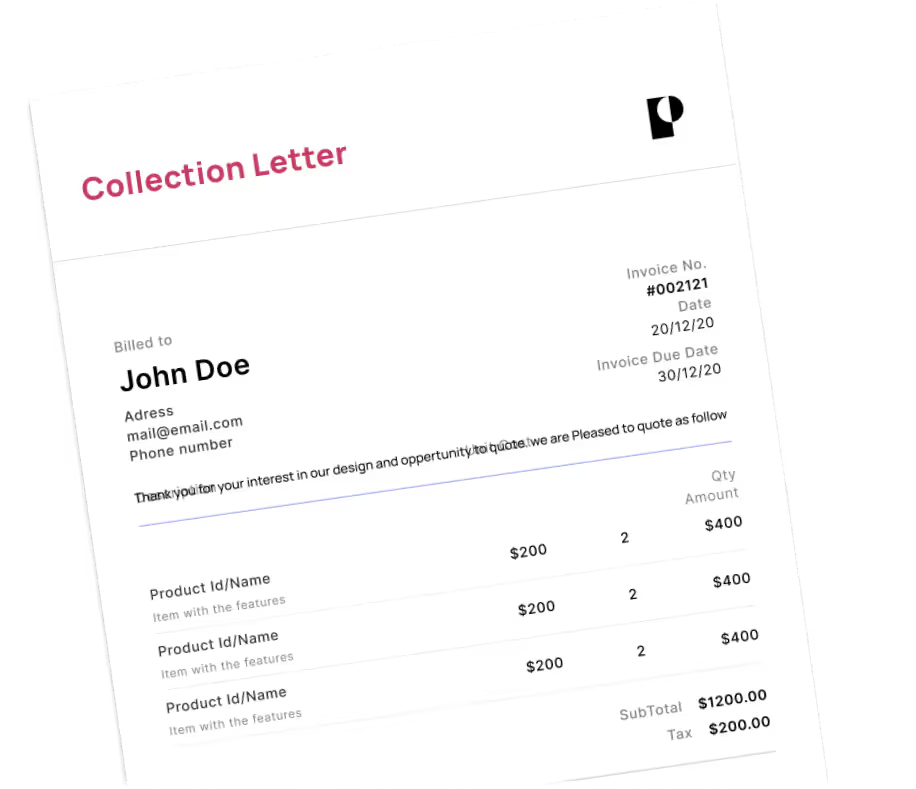
Agencia de recobro en Singapur
Your claim in Singapore is handled by UPPER CLASS COLLECTIONS (SIN) PTE. LTD, a licensed debt collection business under the Debt Collection Act 2022. All actions happen locally and are tracked in your Debitura dashboard. No upfront fees. Prefer to learn first? Read the Singapore debt collection guide below.


Obtén asesoramiento experto gratis
Respuesta de un especialista en 24 horas.
Why Choose Debitura for Debt Collection in Singapore
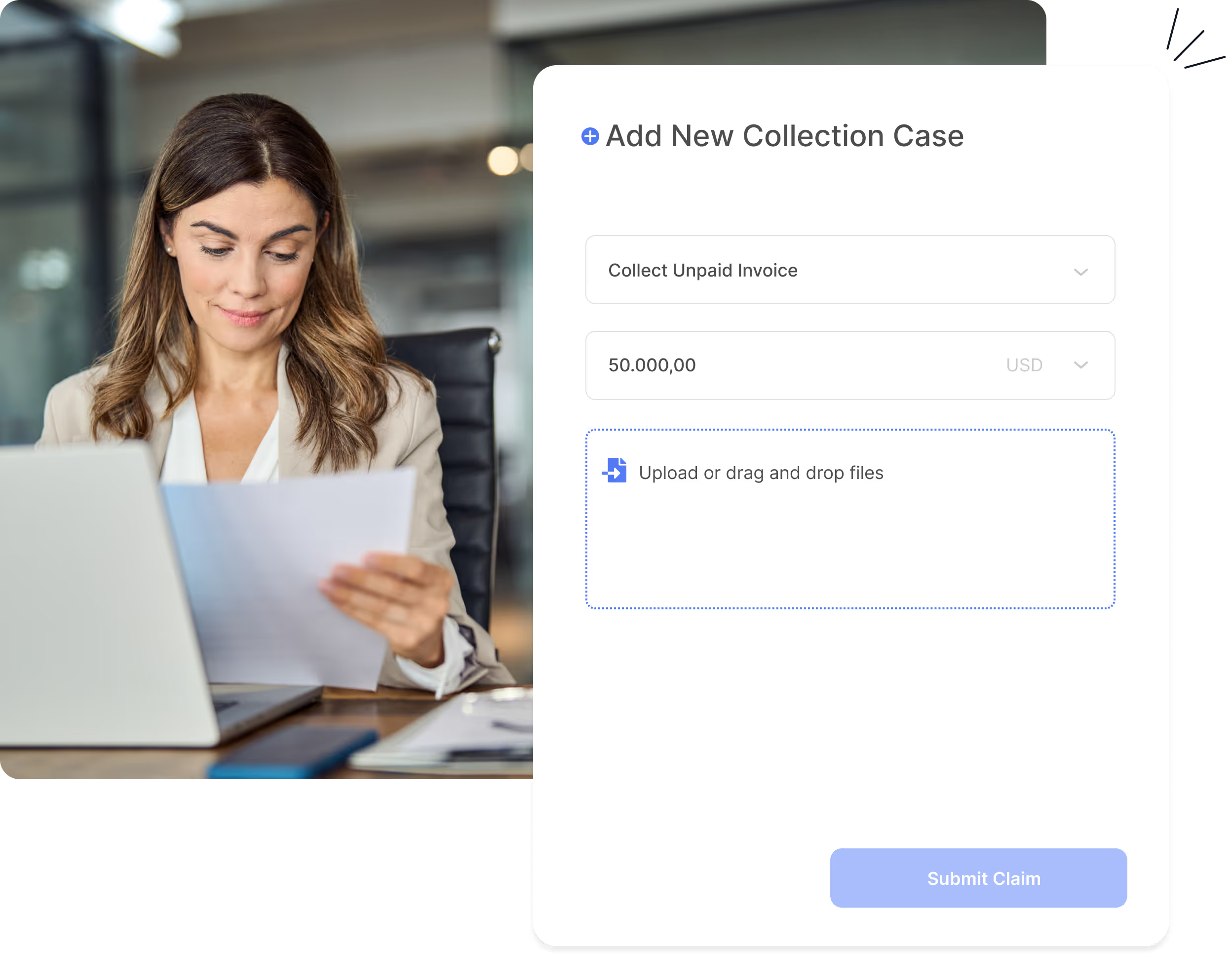
Recobro de deudas rápido, sencillo y sin riesgo en Singapur
Debitura is a global, tech-enabled collections platform working with locally licensed agencies and law firms in 183 countries. In Singapore, your case is handled by UPPER CLASS COLLECTIONS (SIN) PTE. LTD, a debt collection business licensed under Singapore's Debt Collection Act 2022.
- Precios sin riesgo: No hay honorarios a menos que tengamos éxito.
- Quick setup: Submit your claim in a few clicks.
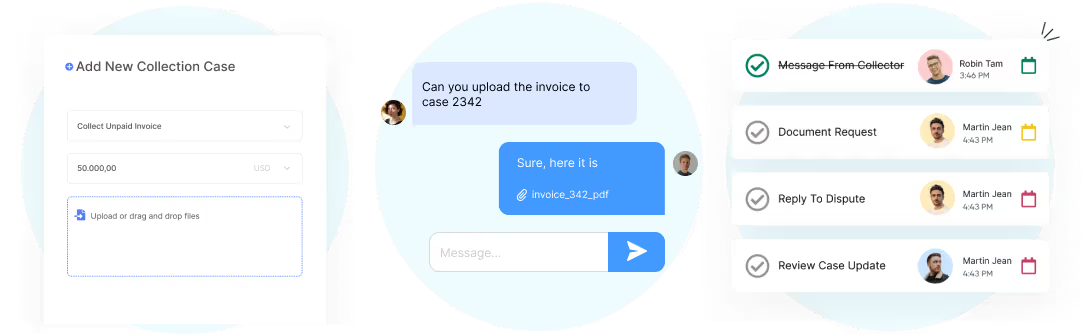
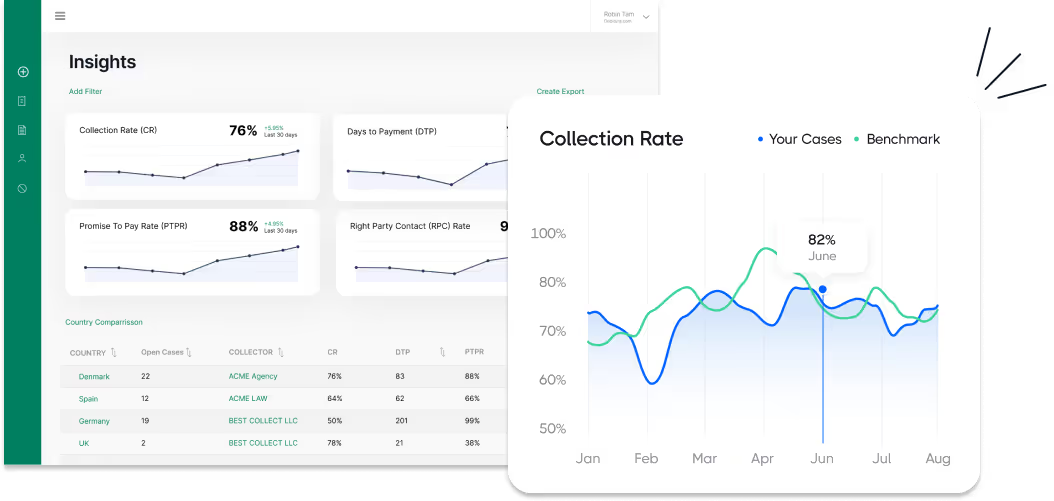
- Real-time tracking: Live status, actions and payments in one portal.
- Compliance: Actions follow the Debt Collection Act 2022 and the Personal Data Protection Act 2012.

Start recovering your Singapore claims in 2 minutes
- Submit your claim: Upload your unpaid invoice via the dashboard, REST API, or a CSV import.
- Local collection begins: We assign the case to UPPER CLASS COLLECTIONS (SIN) PTE. LTD, which contacts the debtor directly. If court action is required, you choose from 1-3 fixed-price legal quotes, for example a Small Claims Tribunals filing or a State Courts claim, before anything proceeds.
- Get paid: Funds are remitted on recovery. If legal action is chosen, you approve the fixed-price quote first, no spend without consent.

Precios transparentes y basados en el éxito
Con Debitura, solo paga si tenemos éxito. El recobro extrajudicial es con honorarios a éxito: un honorario de éxito deducido de los importes recuperados, facturado localmente por su socio. Las tarifas dependen del país del deudor, no del suyo.
- Deudores en Europa (UE, Islandia, Liechtenstein, Noruega, Reino Unido y Suiza): honorarios de éxito a partir del 6 % según el tamaño de la reclamación.
- Deudores en el resto del mundo: honorarios de éxito a partir del 7,5 % según el tamaño de la reclamación.
- Reclamaciones antiguas: se aplica un recargo para las reclamaciones con 12-24 meses de retraso y para las reclamaciones con más de 24 meses de antigüedad.
- Las Acciones judiciales son opcionales: usted aprueba presupuestos de precio fijo antes de cualquier gasto legal.
Consulte la página de Precios para ver la tabla completa de tarifas, u obtenga un presupuesto instantáneo al subir una reclamación.
¿Cómo funciona el cobro de deudas en Singapur?
Debt collection in Singapore starts with an amicable phase handled locally by UPPER CLASS COLLECTIONS (SIN) PTE. LTD: reminders and a formal payment demand aimed at full payment or a signed instalment agreement. Most undisputed claims are resolved at this stage, without going to court. If the debtor still does not pay, escalation is never automatic - your partner assesses the legal route and you approve a fixed-price quote before any court step.
- Submit in 2 minutes: upload your unpaid invoice via the dashboard, REST API or CSV import.
- Local action fast: your licensed local partner contacts the debtor directly.
- No Cure, No Pay: pre-legal collection is success-based, with no setup fees or subscriptions.
- Usted mantiene el control: el Inicio de acciones judiciales nunca es automático; solo ocurre después de que usted apruebe un presupuesto de precio fijo.
- Reciba su pago: los fondos recuperados se le remiten; los honorarios se deducen solo si hay éxito.
Los cuatro pasos desde la factura impagada hasta el dinero recuperado
- Paso 1 - Cobro amistoso: recordatorios, una demanda formal de pago y negociación, gestionado localmente por UPPER CLASS COLLECTIONS (SIN) PTE. LTD. La mayoría de las reclamaciones no disputadas se resuelven en esta fase, sin necesidad de recurrir a los tribunales.
- Step 2 - Enforceable title: if the debtor still does not pay, your partner assesses the legal route to obtain an enforceable title, and you approve a fixed-price quote before anything proceeds.
- Step 3 - Enforcement: with a legal title, the competent enforcement process can attach bank funds and other assets until the claim is recovered.
- Paso 4 - Insolvencia: si el deudor resulta ser insolvente, se presenta su prueba de crédito y se supervisan los repartos en su nombre.
Cada paso se registra en su panel de control, y nada escala sin su aprobación. Todos los detalles legales para Singapur — plazos, costes, tribunales y ejecución de sentencia — se encuentran en la guía a continuación.

Cobro de deudas en Singapur - la guía completa de 2026
This is a practical debt collection Singapore guide for creditors, in-house counsel and finance teams. It covers the Debt Collection Act 2022 licensing regime, court routes by claim size, costs and interest, enforcement and insolvency, with sourced figures throughout.
En esta página:
Por qué puede confiar en esta guía
At Debitura, we uphold the highest standards of impartiality and precision to bring you comprehensive guides on international debt collection. Every guide is written from primary legal sources and reviewed by licensed local experts in the jurisdiction it covers.
¿Preguntas o comentarios? Envíenos un correo electrónico a contact@debitura.com ; actualizamos esta guía basándonos en sus aportaciones.
Debitura en cifras:
- 767 licensed partners - collection agencies and law firms in our network
- 180 countries covered - with cases handled in 174 of them
- 5,306 businesses registered with Debitura
- 33 days median time to first payment on European cases
Dirigido por expertos, validado localmente
Escrito por Lars Holdgaard, fundador de Debitura (+10 años en recobro de deudas B2B global). Cada página es revisada por los mejores abogados locales para garantizar la precisión legal y los pasos prácticos que puede utilizar.

Expertos locales colaboradores:
Última actualización:

Cobro de deudas en Singapur - respuestas rápidas
Debt collection in Singapore moves through an amicable phase, then a court process sized to the claim value, then enforcement or insolvency if the debtor cannot or will not pay. Since 1 December 2023, a debt collection business or individual collector must hold a licence under the Debt Collection Act 2022.
¿Cuánto cuesta el recobro de deudas en Singapur?
Pre-legal collection through Debitura runs on a No Cure, No Pay basis, so court and tribunal fees apply only if a claim escalates. Filing an originating claim in the District Court costs S$150, plus S$20 to file the statement of claim, and Small Claims Tribunals fees are tiered from S$10 up to 3% of the claim value.
| Elemento | Fee |
|---|---|
| Small Claims Tribunals filing | S$10 to 3% of claim, tiered by size and consumer status |
| District Court originating claim | S$150 |
| District Court statement of claim | S$20 |
What is the time limit to sue for an unpaid debt in Singapore?
A creditor must bring a contract or tort claim within six years of the date the cause of action accrued (Limitation Act 1959, s.6(1)(a)). A written, signed acknowledgment of the debt, or a part payment, resets this six-year clock (ss.26-27) - a verbal promise to pay does not.
Which court hears a debt claim in Singapore?
Singapore routes a debt claim by value: the Small Claims Tribunals up to S$20,000 (S$30,000 with signed consent), the Magistrate's Court up to S$60,000, the District Court from S$60,000 to S$250,000, and the General Division of the High Court above S$250,000.
| Forum | Claim value |
|---|---|
| Tribunales para Juicios verbales | Up to S$20,000 (S$30,000 with consent) |
| Magistrate's Court | Up to S$60,000 |
| District Court | S$60,000 to S$250,000 |
| General Division of the High Court | Above S$250,000 |
Who is allowed to collect a debt in Singapore?
Since 1 December 2023 (compliance mandatory from 1 March 2024), a debt collection business or individual debt collector operating in Singapore must hold a licence under the Debt Collection Act 2022, administered by a Licensing Officer appointed within the Singapore Police Force. Operating without one risks a fine of up to S$20,000 or 2 years' imprisonment for a first offence, rising to S$20,000-S$100,000 or 5 years for a repeat offence. Regulated lawyers, licensed insolvency practitioners, the Official Assignee and accountants are excluded from the licensing requirement.
What interest applies to an unpaid debt in Singapore?
Absent a contractual interest rate, a Singapore judgment carries simple interest of 5.33% a year from the date of judgment until payment (State Courts Practice Directions 2021, Part X). Singapore has no general statutory late-payment-interest act, so late-payment interest otherwise depends on the underlying contract.
What documents do I need to collect a debt in Singapore?
Bring a clean evidence bundle: the contract or agreed terms, invoices and proof of delivery, a statement of account, and any demand letters already sent. A signed acknowledgment or part-payment record is especially valuable, since it is what resets the six-year limitation clock.
¿Qué vía debe seguir mi reclamación?
| Situation | Likely route |
|---|---|
| Undisputed, up to S$20,000 (S$30,000 by consent) | Small Claims Tribunals, no lawyers needed |
| Undisputed or disputed, S$20,001 to S$60,000 | Magistrate's Court |
| S$60,001 to S$250,000 | District Court |
| Above S$250,000 | General Division of the High Court |
¿Quién hace qué en el cobro de deudas en Singapur?
Licensed debt collection agencies in Singapore
- Role: pre-legal contact, reminders, negotiated settlements and payment plans.
- Licensing: since 1 December 2023, a debt collection business must hold a licence under the Debt Collection Act 2022, issued by a Police-appointed Licensing Officer; operating without one risks a fine of up to S$20,000 or 2 years' imprisonment for a first offence.
- Conduct: licensees must ensure their collectors comply with the Protection from Harassment Act 2014 and section 10(3) of the Penal Code 1871.
- Escalate when: the debtor does not respond, disputes the debt, or the final demand deadline passes without payment.
- Debitura's advantage: Debitura places your case with UPPER CLASS COLLECTIONS (SIN) PTE. LTD, a Debt Collection Act-licensed local partner, and tracks every action in your dashboard.
Courts and enforcement in Singapore
- Role: the Small Claims Tribunals, the State Courts (Magistrate's and District) and the General Division of the High Court issue judgment; the State Courts' enforcement process then executes it (Writ of Seizure and Sale, garnishee proceedings, examination of judgment debtor).
- Scope: Small Claims Tribunals to S$20,000 (S$30,000 by consent); Magistrate's Court to S$60,000; District Court S$60,000-S$250,000; High Court above S$250,000.
- Fees: a District Court originating claim costs S$150 plus S$20 to file the statement of claim; Small Claims Tribunals fees run from S$10 to 3% of the claim, tiered by consumer status.
- Instruct when: the debt is undisputed and a title is needed, or a title has already been obtained and known assets exist to enforce against.
Debt collection lawyers in Singapore
- Role: file and serve a disputed or high-value claim, represent the creditor at hearings, and act on enforcement applications.
- When to engage: the debtor disputes the claim, the claim exceeds the Small Claims Tribunals limit, or the case needs a Writ of Seizure and Sale, a garnishee order, or an examination of judgment debtor.
- Debitura's advantage: Debitura's platform gives you 1-3 fixed-price legal quotes before any escalation, so you approve costs upfront.
¿Qué leyes y tribunales se aplican al cobro de deudas en Singapur?
Singapore routes a debt claim through one of four forums depending on its value, all sitting under the courts' simplified civil process, the Rules of Court 2021, in force since 1 April 2022. Case management conferences before a judge aim to narrow or resolve a dispute before it reaches trial.
Sistema judicial civil en Singapur
- Small Claims Tribunals: up to S$20,000, or S$30,000 with a signed Memorandum of Consent; no lawyers are permitted (Small Claims Tribunals Act 1984).
- Magistrate's Court: claims up to S$60,000.
- District Court: claims from S$60,000 to S$250,000 (State Courts Act 1970).
- General Division of the High Court: claims above S$250,000, with the State Courts able to hear road-traffic and industrial-accident personal-injury claims up to S$500,000.
- Procedure: civil claims proceed via an originating claim under the Rules of Court 2021.
Key legislation for debt collection in Singapore
- Limitation Act 1959: sets the six-year limitation period for contract and tort claims (s.6(1)(a)), reset by a written, signed acknowledgment or part payment (ss.26-27).
- State Courts Act 1970: sets the Magistrate's and District Court civil jurisdiction limits.
- Rules of Court 2021: governs civil procedure, service and filing since 1 April 2022.
- Debt Collection Act 2022: licenses debt collection businesses and individual collectors, in force since 1 December 2023, with compliance mandatory from 1 March 2024.
- Insolvency, Restructuring and Dissolution Act 2018: governs corporate winding-up and personal bankruptcy.
Consumer and data protection in Singapore
- Applies to: pre-legal outreach and case handling by agencies, creditors and lawyers alike.
- You must: follow the Personal Data Protection Act 2012 (No. 26 of 2012), administered by the Personal Data Protection Commission (PDPC), when tracing and contacting a debtor.
- You should not: harass or threaten a debtor; this is a criminal offence under the Protection from Harassment Act 2014 and section 10(3) of the Penal Code 1871, independently of any licensing breach.
- Debt Collection Act 2022 licensees: must specifically ensure their collectors comply with both of the above conduct laws.
Paso 1 - ¿Cómo funciona el cobro de deudas amistoso (prejudicial) en Singapur?
Amicable collection resolves an unpaid invoice without going to court, through reminders, a formal payment demand and negotiation. The goal is full payment or a written, signed instalment agreement; a signed acknowledgment or part payment also resets the six-year limitation clock under the Limitation Act 1959 (ss.26-27). Keep every communication documented and set clear deadlines.
- Case criteria: undisputed and not time-barred.
- Statute of limitations: six years from accrual, reset by a written, signed acknowledgment or part payment.
- Goal: full payment, or a signed acknowledgment with an instalment plan.
- Key actor: the creditor or its licensed local collection partner.
A typical amicable collection cadence (Day 0-90)
| Día | Acción | Qué incluir | Next step |
|---|---|---|---|
| 0 | Primer recordatorio | Invoice, due date, payment options | Await response |
| 14 | Formal payment demand | Sum due, 7-14 day deadline | Pay, agree a plan, or prepare to escalate |
| 30-45 | Negociación | Instalment terms, written acknowledgment | Plan firmado o incumplimiento |
| 60-90 | Final notice | Settlement cutoff, warning of legal action | File if unpaid or disputed |
Because the six-year clock only resets on a signed acknowledgment or a part payment, not a verbal promise, ask for written confirmation whenever a debtor agrees to pay.
When to escalate beyond amicable collection in Singapore
- The debtor misses the final demand deadline.
- The debtor disputes the debt or its amount.
- The six-year limitation period is approaching.
- Assets may be moved or dissipated.
Once you escalate, your partner assesses whether the claim fits the Small Claims Tribunals or the State Courts, and you approve a fixed-price quote before anything proceeds.
Paso 2 - ¿Cómo se obtiene un título ejecutivo en Singapur?
A creditor obtains an enforceable title by filing a civil claim once amicable collection fails or the debtor disputes the debt. The Rules of Court 2021, in force since 1 April 2022, govern the process through a simplified originating claim, and case management conferences aim to resolve or narrow the dispute before trial.
¿Se impugna la reclamación?
- Undisputed - use the Small Claims Tribunals if within its limit, or file for a default judgment in the Magistrate's or District Court.
- Disputed - file promptly in the competent State Court or High Court; do not linger in the amicable phase as the limitation clock keeps running.
What counts as a legal title in Singapore?
- Qualifies: a court judgment, a Small Claims Tribunals Order of Tribunal, or a consent judgment.
- Not a title: a signed acknowledgment or part payment - strong evidence, but not itself directly enforceable.
Small Claims Tribunals: the fast, no-lawyers track
- Suited to: straightforward consumer and small B2B claims.
- Limit: S$20,000, or S$30,000 with a signed Memorandum of Consent from both parties.
- Process: parties represent themselves; no lawyers are permitted.
- Cost: filing fees run from S$10 for a consumer claim up to 3% of the claim value for a larger non-consumer claim.
State Courts and High Court: the ordinary track
- Magistrate's Court: claims up to S$60,000.
- District Court: claims from S$60,000 to S$250,000; filing an originating claim costs S$150, plus S$20 to file the statement of claim.
- General Division of the High Court: claims above S$250,000.
- Process: an originating claim, service on the debtor, and, if undefended, a default judgment; a defended claim proceeds to case management and, if needed, trial.
More on court proceedings in Singapore
Singapore's civil courts are split by claim value rather than subject matter, so filing in the right forum from the outset avoids a costly transfer. One exception applies to personal-injury claims arising from road-traffic or industrial accidents: these may be heard in the State Courts up to S$500,000, above the usual S$250,000 High Court threshold, keeping more injury claims out of the High Court's general docket.
Paso 3 - ¿Cómo funciona la ejecución de deudas en Singapur?
A creditor can enforce only once a court or tribunal has issued an enforceable title. Singapore's State Courts execute a judgment through a defined set of enforcement mechanisms, matched to the assets the debtor holds.
- Goal: recover the sum owed via court-authorised measures using a valid title.
- Actors: the creditor, the debtor, the court's enforcement process, and sometimes a bank or other third party.
- Prerequisite: a valid, enforceable title, proper service, and action within time limits.
- Costs: a court filing fee, generally advanced by the creditor.
Ways to enforce a judgment in Singapore
- Writ of Seizure and Sale: authorises the seizure and sale of the debtor's movable or immovable property to satisfy the debt.
- Garnishee proceedings: the court orders a third party, commonly the debtor's bank, to pay the judgment creditor money it owes the debtor.
- Examination of judgment debtor: the creditor can apply to examine the debtor under oath to uncover assets for further enforcement.
- Writ of possession: recovers possession of property.
- Writ of delivery: recovers specific movable goods.
- Committal proceedings: address a debtor's non-compliance with a court order to perform a specific act.
- Registration of a foreign judgment: a foreign money judgment can be registered with the Singapore courts before it is enforced.
Choosing the right enforcement route
Match the mechanism to visible assets: a Writ of Seizure and Sale for movable or immovable property, garnishee proceedings where the debtor holds a bank account, and an examination of judgment debtor when the creditor cannot yet identify recoverable assets. Enforcement fees are generally the judgment creditor's own upfront cost and are not automatically recovered from the debtor.
The enforcement process in Singapore
- Confirm the title is valid and within time, and that debtor details are current.
- Choose the enforcement mechanism that matches the debtor's known assets.
- File the application with the court and pay the applicable fee.
- The court executes the writ or order; third parties such as banks must comply.
- Proceeds are applied to the principal, interest and costs, and any surplus is returned.
Paso 4 - ¿Cómo afectan los procedimientos de insolvencia a la recuperación de deudas en Singapur?
Corporate winding-up and personal bankruptcy in Singapore both fall under the Insolvency, Restructuring and Dissolution Act 2018 (IRDA). Once a company or individual is insolvent, a creditor's recovery options shift from individual court action to a collective, court-supervised process.
- Goal: maximise recovery through a collective, court-supervised estate process.
- Key actors: the court, the liquidator or Official Assignee, and the creditors as a group.
- Effect on enforcement: individual lawsuits and enforcement steps are generally paused once the proceeding opens.
Corporate winding-up in Singapore
- Statutory demand threshold: a company is presumed unable to pay its debts, opening the door to a winding-up petition, if it fails to satisfy a statutory demand for a debt over S$15,000 within the prescribed period (IRDA, s.125(2)(a)). The threshold was raised from S$10,000.
- Effect on individual claims: once winding-up begins, individual lawsuits and enforcement steps against the company are generally paused; a creditor instead lodges a claim with the liquidator.
Personal bankruptcy in Singapore
- Threshold: a creditor must be owed at least S$15,000, alone or together with other creditors, to file a bankruptcy application against an individual debtor. During the COVID-19 pandemic this threshold was temporarily raised to S$60,000 (20 April to 20 October 2020) before reverting to S$15,000.
- Effect on individual claims: once bankruptcy opens, the creditor's remedy is to prove the debt in the bankruptcy rather than continue separate court action.
Why insolvency changes the recovery process
Recovery through insolvency is collective: once winding-up or bankruptcy opens, the estate's assets are pooled and distributed among creditors under IRDA's priority rules, rather than on a first-to-enforce basis. A creditor that already holds a court judgment does not automatically jump the queue; it must still lodge a claim like any other creditor, which is why Debitura tracks the filing deadline and required documents in your dashboard.
The creditor process during insolvency in Singapore
- Confirm the type of proceeding, and note the court, case number and appointed liquidator or Official Assignee.
- Pause any individual enforcement steps once the proceeding opens.
- Lodge a proof of debt with the liquidator or Official Assignee, supported by the contract, invoices and a statement of account.
- Monitor creditor meetings and any distributions as the estate is realised.
Honorarios, intereses y quién asume los costes en Singapur
Our fee: pre-legal collection in Singapore runs on No Cure, No Pay, a success fee deducted only from what is recovered (see pricing).
Court and enforcement fees - only if the case escalates to legal action
These are state fees, not partner charges; you advance them, and enforcement costs are generally your own upfront cost rather than an amount automatically recovered from the debtor.
| Elemento | Fee |
|---|---|
| Small Claims Tribunals filing | S$10 to 3% of the claim, tiered by size and consumer status |
| District Court originating claim | S$150 |
| District Court statement of claim | S$20 |
Statutory items the debtor may owe
Absent a contractual interest rate, Singapore courts award simple post-judgment interest of 5.33% a year from judgment until payment (State Courts Practice Directions 2021, Part X). Singapore has no general statutory late-payment-interest act, so interest otherwise depends on the underlying contract.
Who keeps what: the recovered principal is yours; statutory court fees and judgment interest follow the rules above.
Encuentre un abogado local de recobro de deudas
¿Necesita representación legal para un juicio? Comparta su expediente una sola vez y reciba hasta tres propuestas de abogados litigantes verificados. Gratis, rápido y sin compromiso.
- Especialistas verificados
- Presupuestos en 24 horas, sin comisiones ocultas
- Tarifas justas y prenegociadas

Lions Chambers LLC es un bufete de abogados líder en Singapur que ofrece servicios eficaces de cobro de deudas en Singapur, posicionándose como el socio de referencia para la recuperación de deudas desde 2021 con un enfoque centrado en el cliente y Soluciones rentables.
.webp)
.png)

.png)

PDLegal LLC es un bufete de abogados líder en Singapur que ofrece servicios eficaces de cobro de deudas en Singapur, establecido en 2017, reconocido por Chambers & Partners, y que presta servicios a clientes en todo el sudeste asiático, con membresías en la Law Society of Singapore y la Singapore Academy of Law.

OTP Law Corporation es un bufete de abogados líder en Singapur que ofrece servicios eficaces de recobro de deudas en Singapur. Fundado en 1991, cuenta con 88 años de experiencia legal combinada y es reconocido por su alta tasa de éxito en acuerdos ADR, superior al 90%.

Silvester Legal LLC es un bufete de abogados líder en Singapur que ofrece servicios eficaces de recobro de deudas en Singapur, reconocido como socio de referencia para el recobro de deudas desde 2018, con galardones como The Straits Times Best Law Firms 2025 y miembro de Global Advisory Experts.

Derrick Soh Law Corporation es un bufete de abogados líder en Singapur que ofrece servicios eficaces de recobro de deudas en Singapur, reconocido como uno de los mejores bufetes de abogados de Singapur en 2024 y 2025, con un equipo que cuenta con 12 años de experiencia combinada y tarifas horarias competitivas.

Jenny Lai and Company es un bufete de abogados líder en Singapur que ofrece servicios eficaces de recobro de deudas en Singapur, fundado en 1995, reconocido con premios Pro Bono SG y miembro de The Law Society of Singapore, que presta servicios a clientes en varios países.

Upper Class Collections Pte Ltd es una agencia de recobro líder en Australia que ofrece servicios eficaces de recobro de deudas sin riesgo, de confianza desde 2006, con operaciones en toda la ASEAN, y socio exclusivo de Debitura que ofrece honorarios a éxito basados en las condiciones estándar sin riesgo de Debitura; miembro de TCM Group e IACC.
Preguntas frecuentes
Consulte nuestras preguntas frecuentes más comunes a continuación, o contáctenos directamente en contact@debitura.com si necesita ayuda con un expediente específico.
.svg)


.png)


.png)
.svg)
.svg)