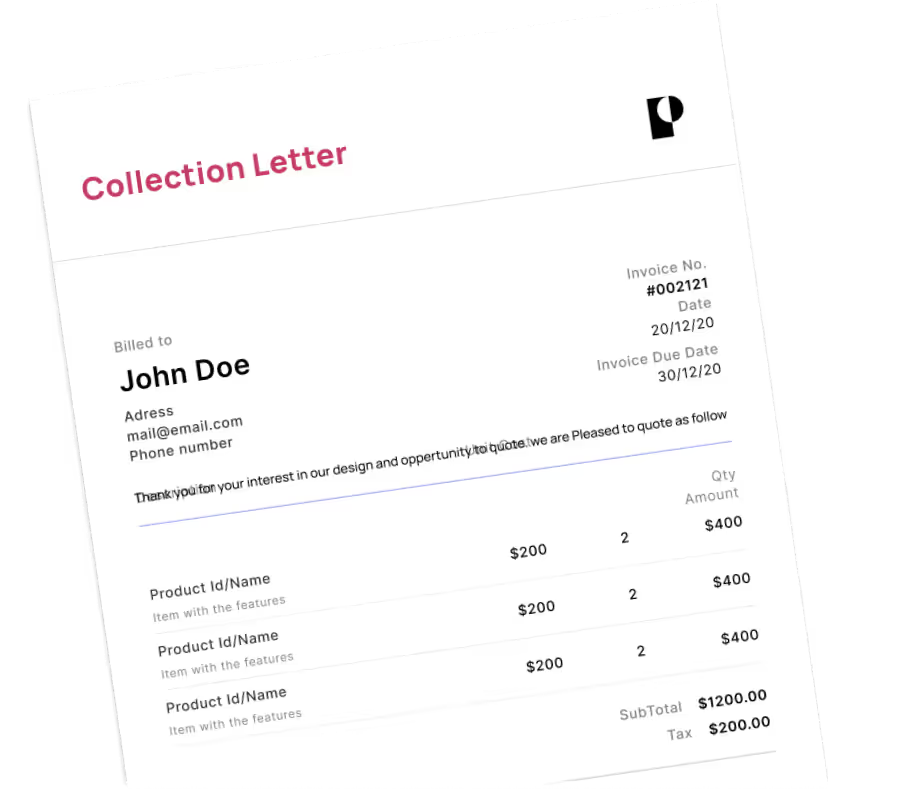
Empresa de cobrança de dívidas em Hong Kong
Your claims are handled by DebtFix, our collection partner in Wan Chai, Hong Kong. Submit your claim in minutes, track progress in real time, and pay only when we recover your money.


Obter aconselhamento especializado grátis
Resposta de um especialista em 24 horas.
Porquê escolher a Debitura para a cobrança de dívidas em Hong Kong
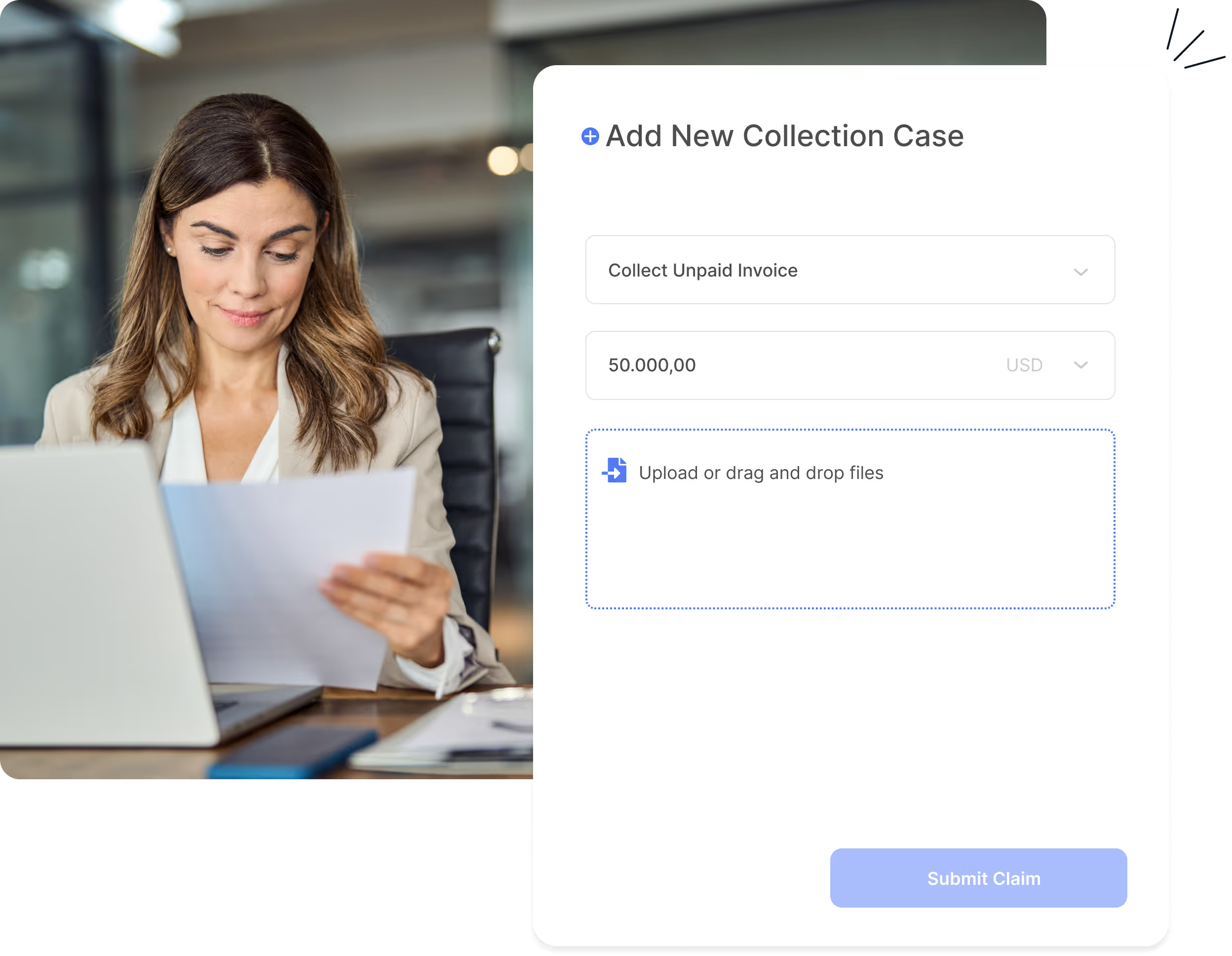
Fast, simple and risk-free debt collection in Hong Kong
Debitura recovers unpaid invoices from debtors in Hong Kong through our platform: submit your claim, and we assign it to a local partner who works it on a No Cure, No Pay basis while you track progress in real time. Your case is handled by DebtFix, a Hong Kong collection agency based in Wan Chai that works alongside local law firms when a claim has to go to court.
- Sem risco: Pague apenas quando recuperarmos o seu dinheiro.
- Configuração rápida: Envie faturas com apenas alguns cliques.
- Monitorização em tempo real: Acompanhe o progresso ao vivo num único portal.
- Local handling: Cantonese, Mandarin and English contact with the debtor.

Start recovering your Hong Kong claims in 2 minutes
- Submit your claim: Upload the unpaid invoice and supporting documents through the dashboard, the REST API, or a plug-and-play ERP integration such as Xero.
- Local collection begins: Your case is assigned to DebtFix, who contacts the debtor in Cantonese, Mandarin or English and works towards payment or a written settlement.
- Track and get paid: Follow every update in real time. If court action is needed, you choose from fixed-price legal quotes before anything proceeds. Recovered funds are remitted to you on clearance.
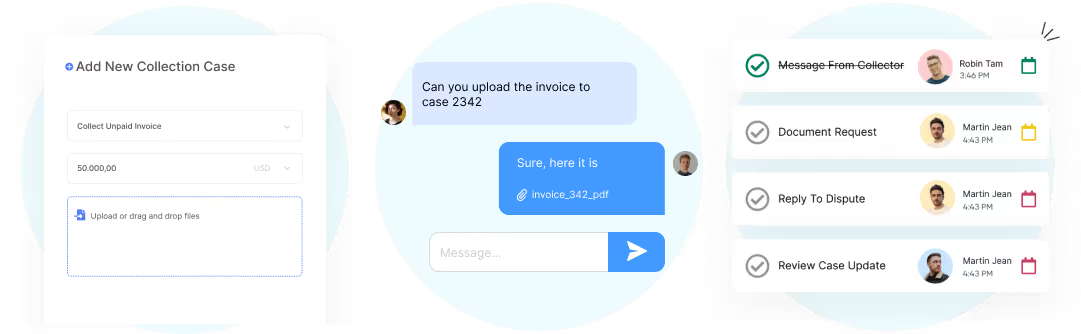

Preços transparentes e baseados no sucesso
Com a Debitura, você só paga se tivermos sucesso. A cobrança pré-judicial funciona no modelo 'sem sucesso, sem honorários': uma Comissão de sucesso é deduzida dos valores recuperados, faturada localmente pelo seu parceiro. As taxas dependem do país do devedor, não do seu.
- Devedores na Europa (UE, Islândia, Liechtenstein, Noruega, Reino Unido e Suíça): Comissões de sucesso a partir de 6%, dependendo do valor do crédito.
- Devedores no resto do mundo: Comissões de sucesso a partir de 7,5%, dependendo do valor do crédito.
- Créditos mais antigos: uma sobretaxa é aplicada para créditos com 12 a 24 meses de atraso e para créditos com mais de 24 meses.
- Ação judicial é opcional: você aprova orçamentos de preço fixo antes de qualquer gasto judicial.
Consulte a página de preços para a tabela completa de taxas, ou obtenha uma estimativa instantânea ao enviar um pedido de cobrança.
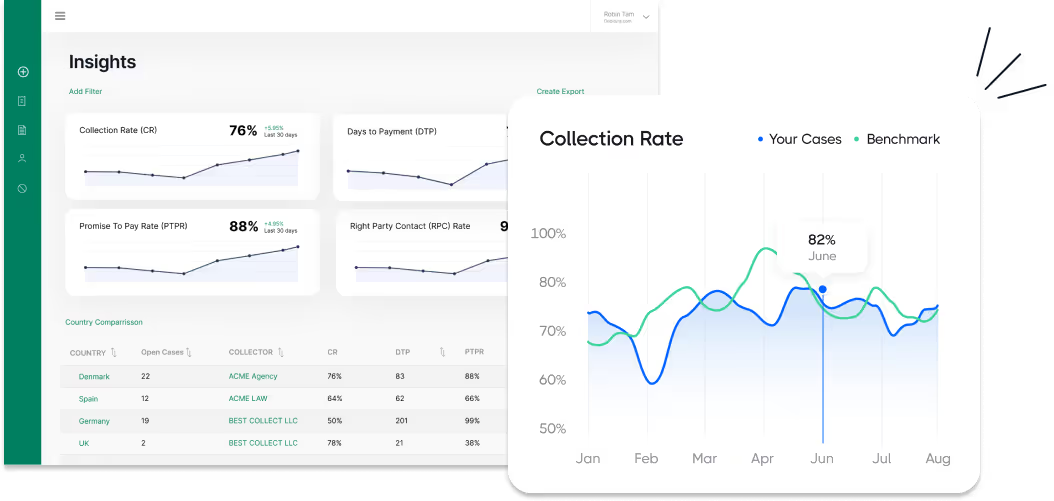
Como funciona a cobrança de dívidas em Hong Kong?
Debt collection in Hong Kong starts with an amicable phase handled locally by DebtFix: reminders and a formal payment demand, aimed at full payment or a written acknowledgement of the debt plus an instalment plan. Most undisputed claims are resolved at this stage. If the debtor still does not pay, escalation is never automatic; your partner assesses the court route and you approve a fixed-price quote before any court step.
- Most undisputed debts resolve in the amicable phase, without a hearing.
- Six-year limitation on a simple contract debt, for business and consumer debtors alike.
- Court forum set by value: Small Claims Tribunal up to HK$75,000, then District Court, then Court of First Instance.
- Enforcement by the Bailiff through writs of execution, garnishee orders and charging orders.
Os quatro passos da fatura não paga ao dinheiro recuperado
- Etapa 1 - Cobrança amigável: lembretes, uma notificação formal de pagamento e negociação, tratados localmente pela DebtFix. A maioria dos pedidos de cobrança incontestáveis é resolvida nesta fase, sem necessidade de ir a tribunal.
- Etapa 2 - Título executivo: se o devedor ainda não pagar, o seu parceiro avalia a via judicial para obter um título executivo e você aprova um orçamento de preço fixo antes que qualquer procedimento avance.
- Etapa 3 - Execução: com um título judicial, a autoridade de execução competente pode penhorar salários, fundos bancários e outros bens até que o pedido de cobrança seja recuperado.
- Etapa 4 - Insolvência: se o devedor se revelar insolvente, a sua prova de crédito é apresentada e quaisquer distribuições são monitorizadas em seu nome.
Cada etapa é acompanhada no seu painel de controlo, e nada avança sem a sua aprovação. Os detalhes legais completos para Hong Kong - prazos, custos, tribunais e execução - seguem no guia abaixo.

Cobrança de dívidas em Hong Kong - o guia completo de 2026
This guide sets out debt collection in Hong Kong end to end for overseas and local creditors, in-house counsel and finance teams: the limitation rules, which court hears your claim, how a judgment is obtained, how the Bailiff enforces it, and what happens if the debtor becomes insolvent. Hong Kong has no administrative payment-order procedure, so the court route matters from the start.
Nesta página:
Por que você pode confiar neste guia
At Debitura, we uphold the highest standards of impartiality and precision to bring you comprehensive guides on international debt collection. Every guide is written from primary legal sources and reviewed by licensed local experts in the jurisdiction it covers.
Perguntas ou feedback? Envie-nos um e-mail para contact@debitura.com , atualizamos este guia com base na sua contribuição.
Debitura em Números:
- 767 licensed partners - collection agencies and law firms in our network
- 180 countries covered - with cases handled in 174 of them
- 5,306 businesses registered with Debitura
- 33 days median time to first payment on European cases
Liderado por especialistas, validado localmente
Escrito por Lars Holdgaard, Fundador da Debitura (+10 anos em recuperação global de dívidas B2B). Cada página é revista por advogados locais de topo para garantir a precisão legal e passos práticos que pode utilizar.

Especialistas locais contribuintes:
Última atualização:

Cobrança de dívidas em Hong Kong - respostas rápidas
Debt collection in Hong Kong is court-led once the amicable phase fails: there is no administrative order-for-payment procedure, so a creditor sues in the Small Claims Tribunal, the District Court or the Court of First Instance and then enforces the judgment through the Bailiff. The headline rules are below.
Quanto custa a recuperação de crédito em Hong Kong?
Pre-legal collection is commonly success-based (No Cure, No Pay), so the creditor pays only on recovery, and the fee depends on the debtor's country rather than yours. Court costs are separate and arise only if the case escalates: filing fees are fixed by the court fee rules, no lawyer's costs are recoverable in the Small Claims Tribunal because representation is not allowed there, and a creditor's bankruptcy petition against an individual carries a deposit of HK$11,250 to the Official Receiver plus a HK$1,045 court fee.
| Item | Posição |
|---|---|
| Cobrança extrajudicial | Success-based; paid by the creditor out of the recovery. |
| Small Claims Tribunal | Filing fee only. Legal representation is not allowed, so no lawyer's costs are recoverable. |
| District Court / Court of First Instance | Filing fee plus lawyer's fees; the court may order the losing party to pay assessed costs. |
| Creditor's bankruptcy petition | HK$11,250 deposit to the Official Receiver plus a HK$1,045 court fee. |
Which court hears my debt claim in Hong Kong?
The forum is set by the amount claimed. The Small Claims Tribunal hears monetary claims not exceeding HK$75,000, the District Court hears claims over HK$75,000 and up to HK$3,000,000, and anything larger goes to the Court of First Instance of the High Court.
| Forum | Money claims |
|---|---|
| Small Claims Tribunal | Up to HK$75,000; informal, no legal representation. |
| District Court | Over HK$75,000 up to HK$3,000,000 (equity jurisdiction to HK$3,000,000, or HK$7,000,000 for land). |
| Court of First Instance | Above the District Court limit; no upper ceiling. |
How long do I have to sue on a debt in Hong Kong?
An action on a simple contract debt must be brought within six years of the date the cause of action accrued (section 4(1)(a), Limitation Ordinance, Cap. 347). Hong Kong sets limitation by the cause of action (contract, tort, deed, land), not by the status of the parties, so the same six-year period applies to a business debtor and a consumer debtor and there is no separate B2B or B2C limitation regime. The period starts again if the debtor gives a signed written acknowledgement of the debt or makes a part payment (section 23).
| Tópico | Regra |
|---|---|
| Simple contract debt (B2B and B2C) | 6 years from accrual (s.4(1)(a), Limitation Ordinance, Cap. 347). |
| What sets the period | The cause of action, not business or consumer status. No consumer-specific debt limitation statute exists. |
| Restarting the clock | A signed written acknowledgement or a part payment (s.23). |
| Dívida judicial | Enforceable for a further statutory period; leave of the court is needed for an older judgment. |
What interest can I add to a Hong Kong debt?
Interest on a judgment debt runs at the rate fixed periodically by the Chief Justice under section 49(1) of the High Court Ordinance (Cap. 4), which is 8.000% per year with effect from 1 July 2026. Interest for the period before judgment follows the contract where the parties agreed a rate; where they did not, the courts conventionally award prime plus 1%. Lending by licensed money lenders is separately regulated, including interest ceilings, under the Money Lenders Ordinance (Cap. 163).
Que documentos preciso para cobrar uma dívida em Hong Kong?
Assemble the contract or credit terms, the unpaid invoices and statement of account, proof of delivery or performance, the payment history, and all correspondence with the debtor, together with a Companies Registry extract or identity details for the debtor. The Small Claims Tribunal expects original documents at the hearing, and any signed written acknowledgement or part payment is worth keeping because it restarts the limitation period.
Quem faz o quê na cobrança de dívidas em Hong Kong?
Recovery in Hong Kong involves collection agencies for the amicable phase, solicitors for the court phase, and the Judiciary's Bailiff for enforcement. Debitura supports you across all stages through DebtFix.
Debt collection agencies in Hong Kong
Agencies handle the pre-legal, out-of-court phase: tracing the debtor, issuing reminders and demands, and negotiating settlement or an instalment plan. There is no dedicated licensing statute for debt collection agencies in Hong Kong. The Law Reform Commission recommended one, including a debtor-harassment offence, in its 2002 report on the regulation of debt collection practices, but it was never enacted. Agencies therefore operate under the general criminal and privacy law, and under the conduct standards their clients' own regulators impose, for example the Hong Kong Monetary Authority's guidance for banks. An agency cannot seize assets; only the court and the Bailiff can.
Solicitors in Hong Kong
Solicitors take the claim to court, obtain judgment and drive enforcement. Representation is not permitted in the Small Claims Tribunal, so a lawyer becomes relevant once the claim exceeds HK$75,000, once the debtor raises a defence, or where urgent or cross-border remedies are needed. In the District Court and the Court of First Instance the court may order the losing party to pay the winner's assessed costs.
The Bailiff in Hong Kong
The Judiciary's Bailiff is the enforcement officer. Acting on a judgment, the Bailiff executes writs of execution against the debtor's goods, serves court orders and conducts sales. The Bailiff does not trace assets, so the creditor decides which remedy to pursue against which asset, and the court supervises the process.
Que leis e tribunais se aplicam à cobrança de dívidas em Hong Kong?
Hong Kong is a common-law jurisdiction. A debt claim runs on the Limitation Ordinance for the deadline, the court rules for procedure, the High Court Ordinance for judgment interest and enforcement, and the Bankruptcy and winding-up ordinances for insolvency. Data handling is governed by the Personal Data (Privacy) Ordinance.
The civil court system in Hong Kong
Money claims are heard at first instance by the Small Claims Tribunal (up to HK$75,000), the District Court (over HK$75,000 up to HK$3,000,000) or the Court of First Instance of the High Court above that. The District Court's equity jurisdiction runs to HK$3,000,000, and to HK$7,000,000 in land matters. Appeals from the District Court and the Court of First Instance lie to the Court of Appeal. The Small Claims Tribunal is deliberately informal: it deals with the claim without legal representation, which keeps small recoveries proportionate.
Key legislation in Hong Kong
- Limitation Ordinance (Cap. 347): six years to sue on a simple contract debt (s.4(1)(a)); the period restarts on a signed acknowledgement or part payment (s.23).
- High Court Ordinance (Cap. 4): judgment interest at the rate the Chief Justice fixes from time to time (s.49(1)).
- Bankruptcy Ordinance (Cap. 6): personal bankruptcy, including the creditor's petition and discharge.
- Companies (Winding Up and Miscellaneous Provisions) Ordinance (Cap. 32): corporate winding up and the order in which creditors are paid.
- Foreign Judgments (Reciprocal Enforcement) Ordinance (Cap. 319) and the Mainland judgment regimes in Cap. 597 and Cap. 645: recognising and enforcing judgments from outside Hong Kong.
- Money Lenders Ordinance (Cap. 163): licensing and interest regulation for money lenders, relevant when the underlying debt is a loan.
Consumer and data protection in Hong Kong
There is no consumer-credit collection statute and no debt-collection licence, so conduct is policed through general law. The Personal Data (Privacy) Ordinance governs how a debtor's personal data may be collected, used, secured and retained, and the Privacy Commissioner's Code of Practice on Consumer Credit Data applies to consumer-credit information. Collection contact must be accurate about the sum owed, must not harass the debtor, and must not disclose the debt to unrelated third parties. Where the creditor is a bank, the Hong Kong Monetary Authority's guidance on debt collection applies in addition.
Etapa 1 - Como funciona a cobrança de dívidas amigável (pré-judicial) em Hong Kong?
Pre-legal collection means recovering an unpaid invoice without going to court, through reminders, a formal demand and negotiation. The aim is full payment, or a signed written acknowledgement of the debt plus an instalment plan. The acknowledgement is worth pursuing for its own sake: under section 23 of the Limitation Ordinance (Cap. 347), a signed written acknowledgement or a part payment restarts the six-year limitation period.
Cronograma de cobrança amigável
| Fase | Ação |
|---|---|
| Primeiro lembrete | State the invoice, the due date and the amount, and ask the debtor to confirm the debt. |
| Segundo lembrete | Restate the balance, open a window for any dispute, and give a named contact. |
| Notificação formal | Set out the full sum, a deadline, and the intention to sue if it is not met. |
| Negociação | Settlement or an instalment plan, ideally with a signed written acknowledgement. |
| Encaminhamento | If unpaid, the evidence bundle passes to a solicitor to file in the competent court. |
What the debtor can be asked to pay
Late-payment interest before judgment is only recoverable where the contract provides for it, or at the court's discretion once proceedings begin, so a contractual interest clause is worth checking before the first reminder. Collection costs are recoverable from the debtor only where the contract allows it. Statutory judgment interest applies once a judgment exists (see the fees section below).
When to escalate to court in Hong Kong
Escalate when the formal demand goes unanswered, the debtor raises a dispute without substance, the six-year limitation period is approaching, or assets look likely to be moved. Prepare the contract, the invoices, proof of delivery or performance, the statement of account and the interest calculation, because the same bundle supports both a Small Claims Tribunal hearing and a higher-court claim. Handle the debtor's data in line with the Personal Data (Privacy) Ordinance throughout.
Etapa 2 - Como se obtém um título executivo em Hong Kong?
Hong Kong has no administrative order-for-payment procedure, so an enforceable title means a judgment or order of a court. Which court, and how fast, depends on the value of the claim and on whether the debtor defends it.
Small Claims Tribunal (up to HK$75,000)
The Small Claims Tribunal hears monetary claims not exceeding HK$75,000, including consumer claims and ordinary debts. It is informal and legal representation is not allowed, so the parties present their own case. That keeps the cost of a small recovery proportionate, but it also means no lawyer's costs are recoverable from the debtor.
District Court and Court of First Instance
Claims over HK$75,000 and up to HK$3,000,000 are brought in the District Court; larger claims go to the Court of First Instance. Proceedings start with a writ and statement of claim under the court rules. Where the debtor files no defence, the creditor can enter judgment in default. Where a defence is filed but discloses no genuine triable issue, the creditor can apply for summary judgment on affidavit evidence. Only a genuinely disputed claim goes to a full trial, with pleadings, discovery, witness evidence and a hearing.
Costs and their recovery
The creditor advances the court fee and its own legal fees. In the District Court and the Court of First Instance costs generally follow the event, so a successful creditor can usually recover its court fee and a proportion of its legal fees as assessed party-and-party costs, though recovery of legal fees is normally partial rather than complete. A foreign creditor may be ordered to give security for costs.
Mais sobre processos judiciais em Hong Kong
Choosing the right forum
The value of the claim sets the forum, but check for an exclusive jurisdiction clause or an arbitration clause in the contract first, because either can take the dispute out of the ordinary courts. Service on a defendant outside Hong Kong requires the court's leave.
Why the title matters
Filing stops the limitation clock, and a judgment converts the debt into a title the Bailiff can enforce, unlocking writs of execution, garnishee orders and charging orders. It also fixes the judgment interest rate that runs until payment.
Etapa 3 - Como funciona a execução de dívidas em Hong Kong?
Enforcement requires a valid judgment or order. With one in hand, the creditor chooses the remedy that matches the debtor's known assets and applies to the court; the Judiciary's Bailiff executes against goods, while garnishee and charging orders are made by the court and served on third parties. Enforcing an older judgment requires the court's leave.
Ways to enforce a claim in Hong Kong
- Writ of Fieri Facias (writ of execution): the Bailiff attends the debtor's premises, seizes goods and sells them, applying the proceeds to the judgment debt.
- Garnishee proceedings: a third party who owes the debtor money, typically a bank holding the debtor's account, is ordered to pay the creditor instead. The order is made first provisionally (nisi) and then made absolute.
- Charging order: both the Court of First Instance and the District Court can impose a charge over the debtor's land, shares or other securities, which can then be realised through a court-ordered sale.
- Examination of the judgment debtor: where the debtor's assets are unknown, the court can require the debtor to attend and answer questions about them on oath.
The enforcement process in Hong Kong
- Check the title: confirm the judgment is final and correctly served, and bring the interest and costs calculation up to date.
- Locate the assets: use public registry searches and, where needed, an examination of the judgment debtor.
- Match remedy to asset: goods point to a writ of execution, a bank account or trade receivable to garnishee proceedings, land or securities to a charging order.
- File and serve: lodge the application with the court, pay the fee and any Bailiff deposit, and serve as the rules require. In garnishee proceedings the third party is served before the debtor.
- Execution: the Bailiff levies against goods, or the third party pays over the attached funds once the order is made absolute.
- Apply the proceeds: sums recovered are applied to the principal, interest and enforcement costs, and any surplus is returned to the debtor.
- If nothing is recovered: repeat with fresh information if the debtor's position improves, or consider a bankruptcy or winding-up petition where the claim justifies it.
Passo 4 - Como os procedimentos de insolvência afetam a recuperação de crédito em Hong Kong?
Once a bankruptcy or winding-up order is made, individual enforcement gives way to a collective process: the estate is realised by a trustee or liquidator and creditors are paid in the statutory order. Personal bankruptcy runs under the Bankruptcy Ordinance (Cap. 6) and corporate winding up under the Companies (Winding Up and Miscellaneous Provisions) Ordinance (Cap. 32).
Bankruptcy of an individual debtor
A creditor can present a bankruptcy petition where the debtor owes an unsecured debt of at least HK$10,000 (section 6, Bankruptcy Ordinance). The petition carries a deposit of HK$11,250 to the Official Receiver plus a HK$1,045 court fee, which the creditor advances. A first-time bankrupt is automatically discharged after four years, and a repeat bankrupt after five years, so a creditor who intends to rely on bankruptcy pressure should act rather than wait.
Winding up a corporate debtor and the order of payment
On a winding up, the company's assets are realised and distributed in a fixed statutory order: first the costs of realisation, the petition and the liquidator; then preferential creditors, sharing pro rata, which includes tax and employee wages and entitlements; then holders of floating charges; then ordinary unsecured creditors, sharing pro rata; and finally shareholders if anything remains.
| Rank | Who is paid |
|---|---|
| 1 | Costs of realisation, the petition and the liquidator. |
| 2 | Preferential creditors, pro rata (tax, employee wages and entitlements). |
| 3 | Floating-charge holders. |
| 4 | Ordinary unsecured creditors, pro rata. |
| 5 | Shareholders. |
The creditor process in Hong Kong
- Identify the procedure: establish whether the debtor is in bankruptcy or winding up, and who the Official Receiver, trustee or liquidator is.
- Stop individual action: do not start or continue enforcement once the order is made; the court's leave is needed.
- Lodge a proof of debt by the date the trustee or liquidator fixes, attaching the contract, invoices, statement of account, interest and costs calculation, and details of any security.
- Take part: attend or vote at creditors' meetings and consider joining a creditors' committee, which gives visibility over realisations and fees.
- Track distributions: dividends are paid as assets are realised and in the statutory order, so an ordinary unsecured creditor should expect a partial recovery at best.
Because an unsecured claim ranks near the bottom, obtaining a judgment and enforcing it against identified assets is usually the better route while the debtor is still trading.
Taxas, juros e quem paga o quê em Hong Kong
- A nossa taxa: baseada no sucesso, sem recuperação, sem pagamento (ver preços).
- Court & enforcement fees: court filing fees, Bailiff fees and deposits, and lawyer's fees apply only if the case escalates to court or enforcement. A creditor's bankruptcy petition against an individual carries a deposit of HK$11,250 to the Official Receiver plus a HK$1,045 court fee.
- Statutory debtor items: interest on a judgment debt runs at the rate the Chief Justice fixes under section 49(1) of the High Court Ordinance (Cap. 4), currently 8.000% per year with effect from 1 July 2026. Interest before judgment follows the contract, or the court's discretion where no rate was agreed, for which the conventional award is prime plus 1%.
- Quem fica com o quê: o capital recuperado é seu; os juros e os custos seguem o contrato, a lei e a decisão do tribunal.
Cost shifting in Hong Kong
Costs generally follow the event in the District Court and the Court of First Instance, so a successful creditor can add court-awarded party-and-party costs to the claim, usually recovering the court fee in full and part of its legal fees. This does not apply in the Small Claims Tribunal, where legal representation is not allowed and no lawyer's costs are recoverable.
Cross-border debt collection in Hong Kong
A judgment obtained outside Hong Kong is not directly enforceable there; it has to be recognised first. Under the Foreign Judgments (Reciprocal Enforcement) Ordinance (Cap. 319), a money judgment from one of the 15 designated jurisdictions can be registered in the Court of First Instance and then enforced as if it were a Hong Kong judgment. A judgment from a jurisdiction outside that list is not registrable, and the creditor instead brings a fresh action in Hong Kong on the judgment debt.
Judgments from Mainland China have their own regimes. The older arrangement, in force since 1 August 2008 (Cap. 597), covers judgments given under an exclusive choice-of-court agreement. The broader arrangement in Cap. 645, in force since 29 January 2024, removed that requirement and applies to a wider range of civil and commercial judgments in both directions.
Encontre um Advogado de Recuperação de Crédito Local
Precisa de representação judicial? Compartilhe seu Processo uma vez e receba até três propostas de advogados litigantes verificados. Gratuito, rápido e sem compromisso.
- Especialistas verificados
- Orçamentos em 24 horas, sem taxas ocultas
- Taxas justas e pré-negociadas

Patrick Chu, Conti Wong Lawyers LLP é um escritório de advogados de referência em Hong Kong, que oferece serviços eficazes de recuperação de crédito em Hong Kong, posicionando-se como o parceiro ideal para a recuperação de dívidas desde 2019, com membros na Ordem dos Advogados de Hong Kong e representação na China Continental.
.webp)
.png)

.png)

JC Corporate é um escritório de advogados de referência em Sheung Wan, que oferece serviços eficazes de recuperação de crédito em Hong Kong, posicionando-se como o parceiro ideal para a recuperação de dívidas, com uma base em 2015, vários prémios e membros em prestigiadas organizações jurídicas e empresariais.
Slotine é um escritório de advogados de referência em Hong Kong, que oferece serviços eficazes de recuperação de crédito em Hong Kong, posicionando-se como o parceiro ideal para a recuperação de dívidas, com uma base em 2016, reconhecimento como um dos principais escritórios de advogados de direito do trabalho e membros na Ordem dos Advogados de Hong Kong e na Ordem dos Advogados de Paris, servindo países na Ásia-Pacífico, Estados Unidos e Europa.

DebtFix é uma agência de recuperação de dívidas de referência em Hong Kong, que oferece serviços eficazes de recuperação de crédito em Hong Kong, posicionando-se como o parceiro ideal para a recuperação de dívidas com soluções baseadas em contingência e colaboração com os principais escritórios de advogados, fundada em 2020.
Perguntas Frequentes
Explore nossas FAQs mais comuns abaixo, ou entre em contato diretamente em contact@debitura.com se precisar de ajuda com um Processo específico.
.svg)

.png)


.png)
.svg)
.svg)