Empresa de cobrança de dívidas na Nigéria - Sem recuperação sem honorários
Your claims are handled exclusively by Debtbucks Recoveries Limited, our CAC-registered debt recovery partner in Nigeria. Submit your claim in minutes, track progress in real time, and pay only when your money is recovered.


Obter aconselhamento especializado grátis
Resposta de um especialista em 24 horas.
A sua vantagem com a Debitura para a cobrança de dívidas na Nigéria
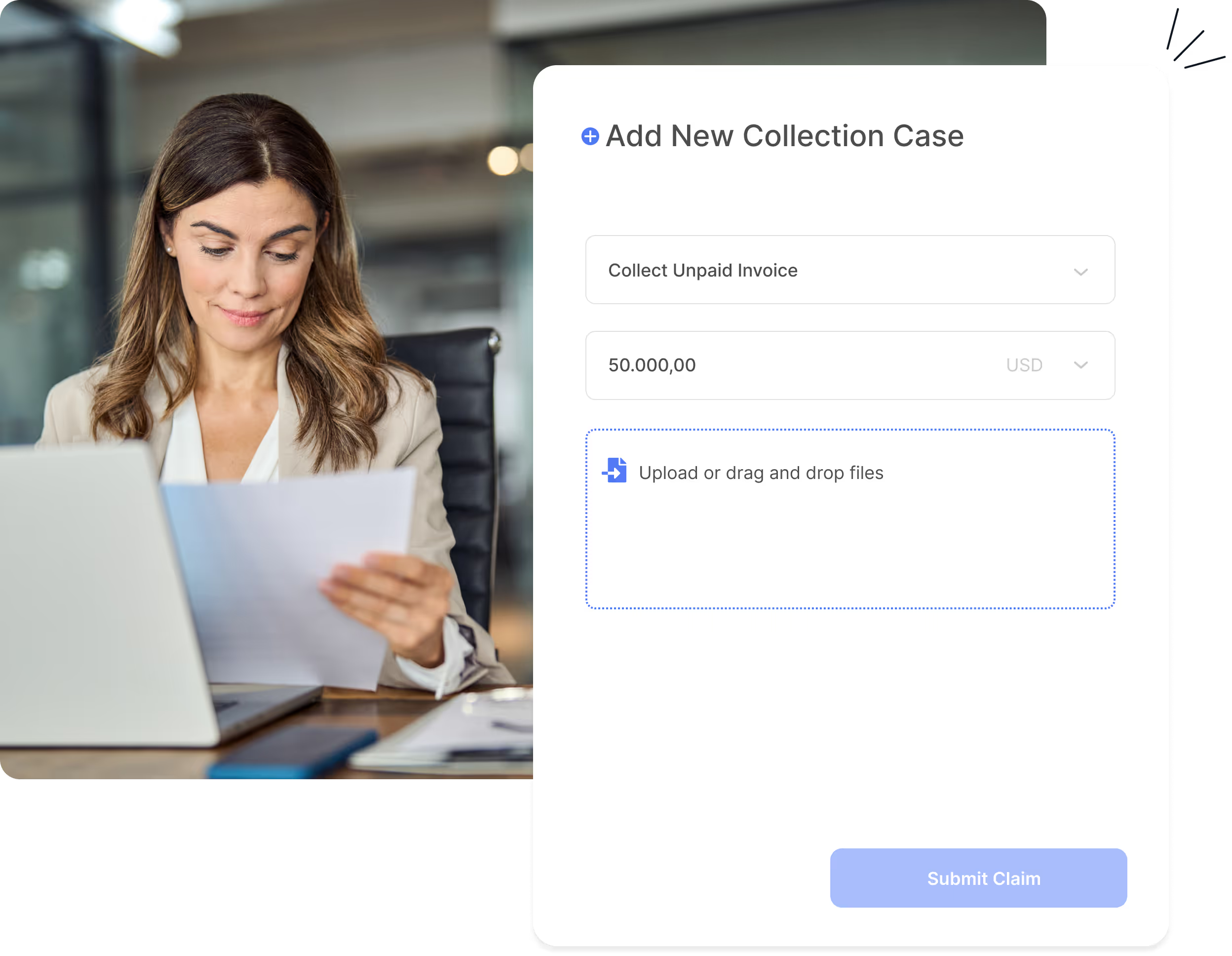
Risk-free debt collection in Nigeria
Debitura recovers unpaid invoices from debtors in Nigeria through our platform: submit your claim, track it in real time, and pay only when money comes in. Debitura is the platform, working with locally registered agencies and law firms in 183 countries; in Nigeria the regulated work is performed by our exclusive local partner, Debtbucks Recoveries Limited, a CAC-registered collections firm in Port Harcourt.
- Preços sem risco: Não paga nada se não tivermos sucesso.
- Configuração rápida: Envie faturas com apenas alguns cliques.
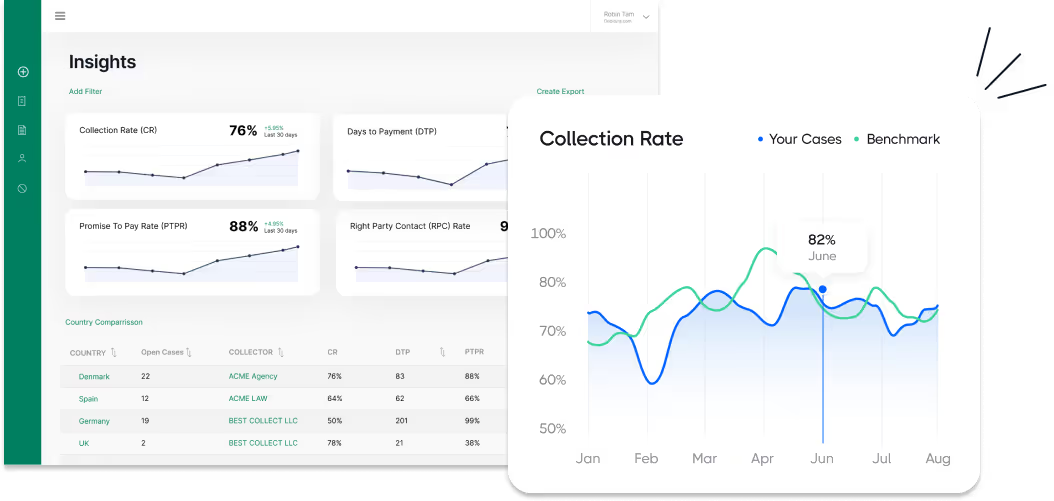
- Real-time tracking: Live status, actions and payments in one portal.
- Compliance: aligned with Nigerian data-protection law, FCCPC conduct standards under the Federal Competition and Consumer Protection Act, and the court-enforcement rules in the Sheriffs and Civil Process Act.

Comece a recuperar os seus créditos nigerianos em 2 minutos
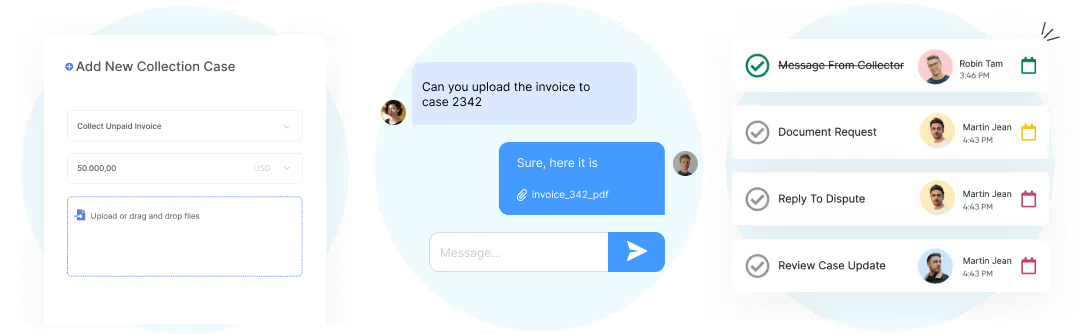
- Submit your claim: Upload your unpaid claim in minutes via the dashboard, REST API, or plug-and-play ERP integrations like QuickBooks Online.
- Local collection begins: We assign the case to Debtbucks Recoveries Limited, who issues the Letter of Demand and negotiates in English. If court action is needed, you choose from 1 to 3 fixed-price legal quotes (for example an Undefended List or Summary Judgment application) before anything proceeds.
- Get paid: Funds are remitted on recovery. If litigation is required, you approve the fixed-price quote first, so there are no surprises.

Preços transparentes e baseados no sucesso
Com a Debitura, você só paga se tivermos sucesso. A cobrança pré-judicial funciona no modelo 'sem sucesso, sem honorários': uma Comissão de sucesso é deduzida dos valores recuperados, faturada localmente pelo seu parceiro. As taxas dependem do país do devedor, não do seu.
- Devedores na Europa (UE, Islândia, Liechtenstein, Noruega, Reino Unido e Suíça): Comissões de sucesso a partir de 6%, dependendo do valor do crédito.
- Devedores no resto do mundo: Comissões de sucesso a partir de 7,5%, dependendo do valor do crédito.
- Créditos mais antigos: uma sobretaxa é aplicada para créditos com 12 a 24 meses de atraso e para créditos com mais de 24 meses.
- Ação judicial é opcional: você aprova orçamentos de preço fixo antes de qualquer gasto judicial.
Consulte a página de preços para a tabela completa de taxas, ou obtenha uma estimativa instantânea ao enviar um pedido de cobrança.
Como funciona a recuperação de crédito na Nigéria?
Debt collection in Nigeria starts with an amicable phase handled locally by Debtbucks Recoveries Limited: reminders and a formal Letter of Demand, aimed at full payment or a written instalment agreement. Most straightforward claims are resolved at this stage. If the debtor still does not pay, escalation is never automatic: your partner assesses the legal route and you approve a quote before any court step.
Os quatro passos da fatura não paga ao dinheiro recuperado
- Step 1 - Amicable collection: reminders, a formal Letter of Demand and negotiation, handled locally by Debtbucks Recoveries Limited. Most undisputed claims are resolved in this phase, without going to court.
- Etapa 2 - Título executivo: se o devedor ainda não pagar, o seu parceiro avalia a via judicial para obter um título executivo e você aprova um orçamento de preço fixo antes que qualquer procedimento avance.
- Step 3 - Enforcement: with a judgment, the Sheriff of the court can seize and sell assets, attach money owed to the debtor by third parties, and examine the debtor's means until the claim is recovered.
- Etapa 4 - Insolvência: se o devedor se revelar insolvente, a sua prova de crédito é apresentada e quaisquer distribuições são monitorizadas em seu nome.
Every step is tracked in your dashboard, and nothing escalates without your approval. The full legal detail for Nigeria, timelines, costs, courts and enforcement, follows in the guide below.

Recuperação de crédito na Nigéria - o guia completo de 2026
Written for creditors, in-house counsel and finance teams recovering money from a debtor in Nigeria, this guide sets out how debt collection in Nigeria works end to end: the federal and state legal framework, who does what, the limitation and interest rules, the fast-track routes to judgment, enforcement under the Sheriffs and Civil Process Act, and corporate insolvency under CAMA 2020. Nigeria is a federal common-law country, so limitation and civil procedure are state law: this guide works through Lagos State and the Federal Capital Territory, Abuja, and flags where your debtor's state may differ.
Nesta página:
Por que você pode confiar neste guia
At Debitura, we uphold the highest standards of impartiality and precision to bring you comprehensive guides on international debt collection. Every guide is written from primary legal sources and reviewed by licensed local experts in the jurisdiction it covers.
Perguntas ou feedback? Envie-nos um e-mail para contact@debitura.com , atualizamos este guia com base na sua contribuição.
Debitura em Números:
- 767 licensed partners - collection agencies and law firms in our network
- 180 countries covered - with cases handled in 174 of them
- 5,306 businesses registered with Debitura
- 33 days median time to first payment on European cases
Liderado por especialistas, validado localmente
Escrito por Lars Holdgaard, Fundador da Debitura (+10 anos em recuperação global de dívidas B2B). Cada página é revista por advogados locais de topo para garantir a precisão legal e passos práticos que pode utilizar.

Especialistas locais contribuintes:
Última atualização:

Debt collection in Nigeria - quick answers
Debt collection in Nigeria turns on one structural fact: limitation and civil procedure are legislated state by state, while company insolvency and consumer-protection conduct rules are federal. The headline rules are below, worked through Lagos State and the Federal Capital Territory.
What is the limitation period for a debt in Nigeria, and does it differ for consumers?
A simple-contract debt is time-barred after 6 years from the date the cause of action accrued, and that same period applies to both commercial and consumer claims. In Lagos State the rule sits in section 8(1)(a) of the Limitation Law (Cap L67, Laws of Lagos State 2015), which also gives 6 years for quasi-contract claims (section 8(1)(b)) and 12 years for a contract under seal (section 12). In the Federal Capital Territory the equivalent is section 7(1)(a) of the Limitation Act (Cap 522, Laws of the Federation of Nigeria, Abuja 1990), applied to the Territory under the Federal Capital Territory Act 1976. Neither statute contains a consumer carve-out: both classify actions by cause of action (contract, quasi-contract, negligence, land, trust), not by whether the parties are businesses or consumers. A written acknowledgement of the debt or a part payment restarts the Lagos clock.
Que via legal devo usar para recuperar uma dívida na Nigéria?
Nigerian civil procedure offers two fast-track routes for a claimant who believes the defendant has no real defence, plus a dedicated small-claims court in some states. Summary Judgment is available for any claim type where no good defence exists; the claimant files the statement of claim, exhibits, witness depositions and a supporting affidavit with the originating process, and the court enters judgment without a full trial if it finds no triable defence. The Undefended List Procedure is narrower and is strictly for a liquidated money demand. In Lagos State, a liquidated money claim up to N5,000,000 can instead go to the Small Claims Court.
| Via | Âmbito |
|---|---|
| Lagos Small Claims Court | Liquidated money demand up to N5,000,000, excluding interest and costs. Counterclaims up to N10,000,000. |
| Processo de Lista Não Contestada | Liquidated money demand only, where no defence is believed to exist. |
| Julgamento Sumário | Any claim type where the defendant is believed to have no good defence. |
| Ação comum | Genuinely disputed claims, and claims above the fast-track thresholds. |
Quanto tempo leva a recuperação de crédito na Nigéria?
The Lagos Small Claims Court is the only route with a published target: the Practice Direction on Small Claims 2023, in force since 28 April 2023, requires a 7-day amicable-settlement window after the Letter of Demand and sets a target of 60 days from filing to judgment. Outside that route, Nigerian courts do not publish case-duration statistics comparable to European judiciaries, so any general day or month count should be treated with caution; your partner gives a case-specific estimate based on the court and the state.
Quais são os Custos da recuperação de crédito na Nigéria?
Pre-legal collection is success-based (No Cure, No Pay), so the amicable phase costs you nothing unless money is recovered. Court fees are state-based rather than national: Lagos State has its own High Court Civil Procedure Rules and fee schedule, the Federal Capital Territory applies its own, and costs are generally at the discretion of the court. No single official fee table covering both was confirmed, so treat any figure quoted elsewhere with caution and have your partner confirm the current fee before you approve a legal step.
Que documentos preciso para recuperar uma dívida na Nigéria?
A Letter of Demand is the practical starting point and is an express precondition in the Lagos Small Claims Court, which requires it before filing and then allows the debtor a 7-day settlement window. Beyond that, assemble the contract, the unpaid invoices and statement of account, proof of delivery or performance, and any written acknowledgement of the debt, since a written acknowledgement also restarts the limitation clock. The precise formal filing requirements vary by state and court, so confirm them with local counsel before filing.
Quem faz o quê na recuperação de crédito na Nigéria?
Recovery in Nigeria involves a collection firm for the amicable phase, lawyers for the court routes, and the Sheriff and court bailiffs for enforcement. Debitura is the platform that routes and tracks your claim; the regulated work in Nigeria is performed by our licensed local partner, Debtbucks Recoveries Limited.
Collection firms in Nigeria
A collection firm manages the amicable phase: tracing and contacting the debtor, issuing the Letter of Demand, negotiating settlement or an instalment plan, and documenting the outcome so the file is court-ready if it escalates. Collection firms are incorporated with the Corporate Affairs Commission (CAC) and operate as ordinary companies; they cannot compel payment, and their conduct is bounded by the federal consumer-protection regime described below rather than by a dedicated debt-collector licensing statute.
Lawyers in Nigeria
A legal practitioner is needed for every court route, since Summary Judgment, the Undefended List Procedure and ordinary suits are all court processes. Counsel also chooses the forum, which matters more in Nigeria than in a unitary jurisdiction: the same claim may sit in a state High Court, a Magistrates' Court or the Lagos Small Claims Court depending on value and state, and the wrong forum costs months.
The Sheriff and court bailiffs in Nigeria
Enforcement is carried out by the Sheriff of the court and court bailiffs under the Sheriffs and Civil Process Act (Cap 407, Laws of the Federation of Nigeria 1990) and the Judgment (Enforcement) Rules, which apply in Lagos State and, under the Federal Capital Territory Act 1976, in the FCT as well. They execute writs, serve process and conduct the sale of seized property. Nigeria has no private bailiff profession, so enforcement moves at the pace of the court.
Que leis e tribunais se aplicam à recuperação de crédito na Nigéria?
Nigeria is a federal common-law jurisdiction. Limitation of actions and civil procedure are legislated separately by each State and by the Federal Capital Territory, while company insolvency and consumer-protection conduct are federal and apply nationwide.
The civil court system in Nigeria
Debt claims start in a Magistrates' Court or a State High Court depending on value and state, with the Federal High Court taking the subject matters the Constitution and federal statutes assign to it, and appeals running to the Court of Appeal and then the Supreme Court. Lagos State also operates a dedicated Small Claims Court for liquidated money demands up to N5,000,000, created by the Chief Judge's Practice Direction on Small Claims 2023 and in force since 28 April 2023. The monetary ceiling of the general Magistrates' Court above that threshold varies by state and the current figure was not confirmed from a primary source for this guide, so confirm it with local counsel before choosing a forum.
Key legislation in Nigeria
- Limitation Law of Lagos State (Cap L67, Laws of Lagos State 2015) and the Limitation Act (Cap 522, LFN Abuja 1990) for the FCT: the 6-year simple-contract period. Each other state has its own equivalent.
- Sheriffs and Civil Process Act (Cap 407, LFN 1990) and the Judgment (Enforcement) Rules: writs of execution, garnishee proceedings and judgment summons.
- Companies and Allied Matters Act 2020 (CAMA 2020): federal company law and corporate insolvency, administered by the Corporate Affairs Commission.
- Federal Competition and Consumer Protection Act and the FCCPC's regulations: the federal consumer-protection and fair-conduct regime.
Debt-collection conduct rules in Nigeria
Nigeria has no single national debt-collection conduct code, but two federal regimes bind large parts of the market and set the standard the rest is measured against.
For banks and other CBN-regulated lenders, the Central Bank of Nigeria's Consumer Protection Regulations (December 2019) require recovery to be transparent, courteous and fair, and free of intimidation, harassment or threats. They ban contact between 9pm and 8am without the customer's consent, ban contacting the debtor's employer, relatives, friends or neighbours except to obtain contact details (unless that person is a guarantor or has consented), make the creditor institution liable for the conduct of its collection agents, and treat foreclosure as a last resort after a 30-day private-sale option.
For digital, electronic and other non-traditional consumer lenders, the Federal Competition and Consumer Protection Commission's DEON Consumer Lending Regulations 2025, in force since 21 July 2025, require registration with the FCCPC and impose fair-treatment and responsible-conduct duties, with recovery practices tied to the fair-lending principles in the Federal Competition and Consumer Protection Act. Penalties reach N50 million for an individual and N100 million or 1% of turnover for a company, plus director disqualification of up to five years.
Passo 1 - Como funciona a recuperação de crédito amigável (pré-legal) na Nigéria?
Pre-legal collection in Nigeria recovers an unpaid invoice without going to court, through reminders, a formal Letter of Demand and negotiation. The Letter of Demand is not just a courtesy: it is an express precondition to filing in the Lagos Small Claims Court, which then gives the debtor a 7-day window to settle before the claim proceeds. A written acknowledgement of the debt or a part payment also restarts the 6-year limitation clock, so a signed settlement or instalment agreement is worth securing even where payment is deferred.
| Fase | Ação |
|---|---|
| Lembrete | Fatura, data de vencimento e detalhes de pagamento. |
| Letter of Demand | States the sum, a deadline and the intent to sue. Required before a Lagos small claim. |
| Settlement window | 7 days in the Lagos Small Claims Court route. |
| Negociação | Settlement or instalment plan, signed so it restarts limitation. |
| Escalação | Small Claims Court, Undefended List or Summary Judgment, depending on value and state. |
Conduct rules in the amicable phase in Nigeria
Nigeria has no dedicated debt-collector licensing statute, but two federal regimes set the conduct standard. Where the creditor is a bank or another CBN-regulated lender, the Central Bank of Nigeria's Consumer Protection Regulations (December 2019) require recovery to be transparent, courteous and fair and free of intimidation or harassment; they ban contact between 9pm and 8am without consent and ban contacting the debtor's employer, relatives, friends or neighbours except to obtain contact details, and the creditor institution stays liable for its agents' conduct. Where the creditor is a digital or other non-traditional consumer lender, the FCCPC's DEON Consumer Lending Regulations 2025 (in force 21 July 2025) add registration, fair-treatment and responsible-conduct duties backed by penalties up to N50 million for an individual and N100 million or 1% of turnover for a company.
When to escalate to court in Nigeria
Escalate when the Letter of Demand lapses, the debtor disputes without substance, or the limitation period approaches. Because the fast-track routes turn on the absence of a real defence, the amicable phase is also where you establish whether one exists: a debtor who raises no substantive objection in correspondence is a strong candidate for the Undefended List or Summary Judgment.
Passo 2 - Como se obtém um título executivo na Nigéria?
Nigerian civil procedure gives a creditor with a clear, documented money claim two ways to avoid a full trial, plus a dedicated small-claims route in some states. Which is available depends on the claim type, the value and the state.
The Lagos Small Claims Court
Lagos State operates a Small Claims Court for a liquidated money demand up to N5,000,000, excluding interest and costs, with counterclaims allowed up to N10,000,000. It was created by the Chief Judge of Lagos State's Practice Direction on Small Claims 2023 and has been in force since 28 April 2023. A Letter of Demand is required first, the debtor gets a 7-day amicable-settlement window, and the court works to a target of 60 days from filing to judgment. Enforcement of a small-claims judgment runs by garnishee under sections 83 and 84 of the Sheriffs and Civil Process Act. This is a state instrument, not a national one: other states have their own arrangements or none.
The Undefended List Procedure and Summary Judgment
Both are fast-track routes for a claimant who believes the defendant has no real defence, and they differ in scope. The Undefended List Procedure is strictly for a liquidated money demand: the creditor files the originating process with a supporting affidavit, and if the defendant cannot show a triable defence, judgment is entered without a full trial. Summary Judgment covers any claim type where no good defence is believed to exist; the claimant files the statement of claim, exhibits, witness depositions and a supporting affidavit alongside the originating process, and the court enters judgment if it finds no good defence. Both are creatures of the applicable state or FCT High Court Civil Procedure Rules, so the rule number differs by court.
Determining the appropriate court in Nigeria
Forum choice is the first strategic decision in a Nigerian debt claim. Value and state determine whether the claim sits in a Magistrates' Court, a State High Court, or the Lagos Small Claims Court, and the general Magistrates' Court ceiling above the small-claims threshold varies by state; the current figure could not be confirmed from a primary source for this guide, so confirm it with local counsel before filing. Where the claim is genuinely disputed on the merits, ordinary civil procedure applies and a full trial may follow, with appeals running to the Court of Appeal and then the Supreme Court.
Passo 3 - Como funciona a execução de dívidas na Nigéria?
Once you hold a judgment, enforcement is carried out by the Sheriff of the court and court bailiffs under the Sheriffs and Civil Process Act (Cap 407, Laws of the Federation of Nigeria 1990) and the Judgment (Enforcement) Rules. The same Act applies in Lagos State and, under the Federal Capital Territory Act 1976, in the FCT, so the enforcement toolkit is broadly consistent even though the courts that issue the judgment are not.
Ways to enforce a claim in Nigeria
- Writ of execution: the Sheriff seizes and sells the judgment debtor's movable and, where the rules allow, immovable property, and the proceeds are applied to the judgment sum.
- Garnishee proceedings: the court attaches money owed to the debtor by a third party, most commonly a bank balance. This is the route the Lagos Small Claims Court itself points to, under sections 83 and 84 of the Act, and in practice it is the fastest way to reach a corporate debtor with a known bank.
- Examination of the judgment debtor: the court can require the debtor to disclose their means, which turns an unenforceable paper judgment into a targeted execution.
- Post-judgment interest: under the Lagos High Court Rules 2019, Order 39 Rule 4, the judge may order interest on the judgment sum at not less than 10% per annum from the date of judgment, so delay by the debtor is not cost-free.
The enforcement process in Nigeria
The creditor applies to the court that gave the judgment for the writ or garnishee order, the Sheriff executes it, and the proceeds are applied to the judgment debt and costs. Certain assets a debtor needs for basic living are protected. Because the Sheriff acts on what the creditor identifies, enforcement moves fastest when the file already names the debtor's bank, receivables or registered assets, which is why asset information gathered during the amicable phase is worth capturing properly.
Passo 4 - Como os processos de insolvência afetam a recuperação de dívidas na Nigéria?
Where a corporate debtor cannot pay, the collective procedure takes over from individual enforcement. Corporate insolvency in Nigeria is federal law and applies nationwide regardless of the debtor's state: it is governed by the Companies and Allied Matters Act 2020 (CAMA 2020) and administered by the Corporate Affairs Commission (CAC).
Routes under CAMA 2020
CAMA 2020 substantially rebuilt Nigeria's insolvency regime and put more weight on business rescue than the law it replaced. A secured creditor or the court may appoint a receiver or manager to realise security over a specific asset; a company may be wound up by the court, voluntarily, or under court supervision; and rescue and restructuring procedures are available as an alternative to liquidation. Insolvency practitioners work within a professional framework represented by the Business Recovery and Insolvency Practitioners Association of Nigeria (BRIPAN).
Priority and what a trade creditor can expect
Distribution in a winding-up follows the statutory ranking in CAMA 2020. A secured creditor is satisfied first from the asset securing its claim, the costs and expenses of the winding-up come next, statutory preferential payments (including employee entitlements and pension contributions) follow, and unsecured creditors share what remains, with equity holders last. An ordinary trade creditor therefore sits near the back of the queue and commonly recovers only part of the debt.
The creditor process in Nigeria
Submit your claim to the liquidator or receiver with the contract, invoices and statement of account, and monitor the proceedings and any distribution. The practical lesson is timing: because a trade creditor's position weakens sharply once a winding-up starts, the value of acting on a Nigerian receivable while garnishee and execution are still available is high.
Taxas, juros e quem paga o quê na Nigéria
- A nossa taxa: baseada no sucesso, sem recuperação, sem pagamento (ver preços).
- Court and enforcement fees: state court fees and Sheriff's charges apply only if the case escalates to legal action. Fees are set state by state rather than nationally, and costs are generally at the court's discretion.
- Statutory debtor items: there is no statutory pre-judgment late-payment interest in Nigeria, so pre-judgment interest has to be pleaded and proved from the contract or trade custom. Post-judgment interest is a different matter, see below.
- Who keeps what: recovered principal is yours; interest and costs follow the contract and the court's order.
Interest on a Nigerian debt
Nigeria has no equivalent of the EU or UK late-payment interest statutes. Pre-judgment interest is recoverable only where your contract provides for it, where it is payable under trade custom, or where a statute supplies it, so an interest clause in your terms of trade is what makes the claim worth making. Post-judgment interest is more favourable: under the High Court of Lagos State (Civil Procedure) Rules 2019, Order 39 Rule 4, the judge may order interest on the judgment sum at a rate not less than 10% per annum, running from the date of judgment. Collection costs are recoverable where the contract specifies them or the court awards them.
Cross-border debt collection in Nigeria
Nigeria has no reciprocal-enforcement arrangement that a foreign creditor can simply invoke. The Foreign Judgments (Reciprocal Enforcement) Act (Cap F35, Laws of the Federation of Nigeria 2004) provides for registration of judgments from countries designated by Gazette order, but no such designating order appears to have been made under Part 1 of the Act, which leaves the modern registration route largely theoretical. In practice, judgments from the United Kingdom and certain other Commonwealth jurisdictions are dealt with under the older Reciprocal Enforcement of Judgments Ordinance, and for everywhere else the fallback is a common-law action on the judgment: the creditor sues in Nigeria on the foreign judgment as a debt, rather than registering it. That is slower and more expensive than registration, so where the debtor's assets are in Nigeria it is usually better to bring the claim in Nigeria in the first place, using the Undefended List or Summary Judgment routes, than to win abroad and then import the judgment. Confirm the current designation position with Nigerian counsel before relying on either route.
Encontre um Advogado de Recuperação de Crédito Local
Precisa de representação judicial? Compartilhe seu Processo uma vez e receba até três propostas de advogados litigantes verificados. Gratuito, rápido e sem compromisso.
- Especialistas verificados
- Orçamentos em 24 horas, sem taxas ocultas
- Taxas justas e pré-negociadas

AAA Chambers é um escritório de advocacia de primeira linha em Ikoyi, que oferece serviços eficazes de Processo de recuperação de crédito na Nigéria, posicionando-se como o parceiro ideal para a recuperação de dívidas, com prêmios como o de Melhor Escritório de Advocacia de Recuperação de Dívidas e Insolvência de 2022 e membro da Alliott Global Alliance e da Ordem dos Advogados da Nigéria.
.webp)
.png)

.png)
Resolution Law Firm é um escritório de advocacia de primeira linha em Ikeja, que oferece serviços eficazes de Processo de recuperação de crédito na Nigéria, reconhecido pela sua experiência desde 2015 e distinguido com prémios no setor imobiliário e de energia, com membros na Ordem dos Advogados da Nigéria e Internacional.

Associated Attorneys é um escritório de advocacia de primeira linha em Lagos, que oferece serviços eficazes de Processo de recuperação de crédito na Nigéria, posicionando-se como o parceiro ideal para a recuperação de dívidas desde 2006, com membros em importantes órgãos profissionais e serviços que se estendem à Ásia, Europa e EUA.
Adeola Oyinlade & Co é um escritório de advocacia de primeira linha em Lagos, que oferece serviços eficazes de Processo de recuperação de crédito na Nigéria, reconhecido como o parceiro ideal para a recuperação de dívidas, com prémios como o de Escritório de Advocacia do Ano da Nigéria em 2024 e membro da INBLF e da Ordem dos Advogados Internacional.

Olympus Law Partnership é um escritório de advocacia de primeira linha em Ikeja Lagos, que oferece serviços eficazes de Processo de recuperação de crédito na NG, posicionando-se como o parceiro ideal para a recuperação de dívidas, com uma fundação em 2015 e reconhecido pelos seus prémios e membros do setor.
Debo Akande LLP é um escritório de advocacia de primeira linha em Lagos, que oferece serviços eficazes de Processo de recuperação de crédito na Nigéria, posicionando-se como o parceiro ideal para a recuperação de dívidas desde 2014, com membros em sociedades internacionais de ADR e serviços que se estendem a outros países africanos.

Blackfriars Solicitors é um escritório de advocacia de primeira linha em Lagos, que oferece serviços eficazes de Processo de recuperação de crédito na Nigéria, fundado em 1994, conhecido pela sua excelência em litígios e membro da Ordem dos Advogados da Nigéria, servindo clientes com uma classificação de satisfação de 4,9/5.
Kabbiz Legal & Advisory é um escritório de advocacia líder em Victoria Island, oferecendo serviços eficazes de Cobrança de Dívidas na Nigéria, posicionando-se como o parceiro ideal para recuperação de dívidas com associações na IP Coster, Lawzana e na International Bar Association.

P. D. Pius & Associates é um escritório de advocacia de primeira linha em Block 2 Flat 4 Mbaise Close, Garki Abuja, que oferece serviços eficazes de Processo de recuperação de crédito na Nigéria, fundado em 2014, operando com um modelo de taxa de recuperação de 10% e membro da Ordem dos Advogados da Nigéria.

YBA & Co. Solicitors é um escritório de advocacia de primeira linha em Lagos, que oferece serviços eficazes de Processo de recuperação de crédito na Nigéria, posicionando-se como o parceiro ideal desde 2009, com membros na Ordem dos Advogados da Nigéria e no Instituto de Secretários e Administradores Certificados da Nigéria, servindo clientes globalmente.

RecovaDebt Limited é uma agência de recuperação de dívidas de primeira linha em Port Harcourt, que oferece serviços eficazes de Processo de recuperação de crédito na Nigéria, posicionando-se como o parceiro ideal para a recuperação de dívidas com um modelo de não recuperação, sem custos e suporte transfronteiriço desde 2016.
DNL Partners é um escritório de advocacia de primeira linha em Lagos Island, que oferece serviços eficazes de Processo de recuperação de crédito na Nigéria, fundado em 2011 e reconhecido pela sua adesão à Ordem dos Advogados da Nigéria, ICMC e ISMN, garantindo soluções jurídicas de primeira qualidade.
A Debtbucks Recoveries Limited é uma agência líder em recuperação de dívidas na Nigéria, oferecendo serviços eficazes e sem risco de Cobrança de Dívidas, reconhecida por uma taxa de sucesso de 99% e por ser membro da BRIPAN, ADRA e IDRPN; como parceiro exclusivo da Debitura, oferece cobrança de dívidas Sem recuperação sem honorários, com base nos termos e Preços padrão sem risco da Debitura.
Perguntas Frequentes
Explore nossas FAQs mais comuns abaixo, ou entre em contato diretamente em contact@debitura.com se precisar de ajuda com um Processo específico.
.svg)

.png)


.png)
.svg)
.svg)