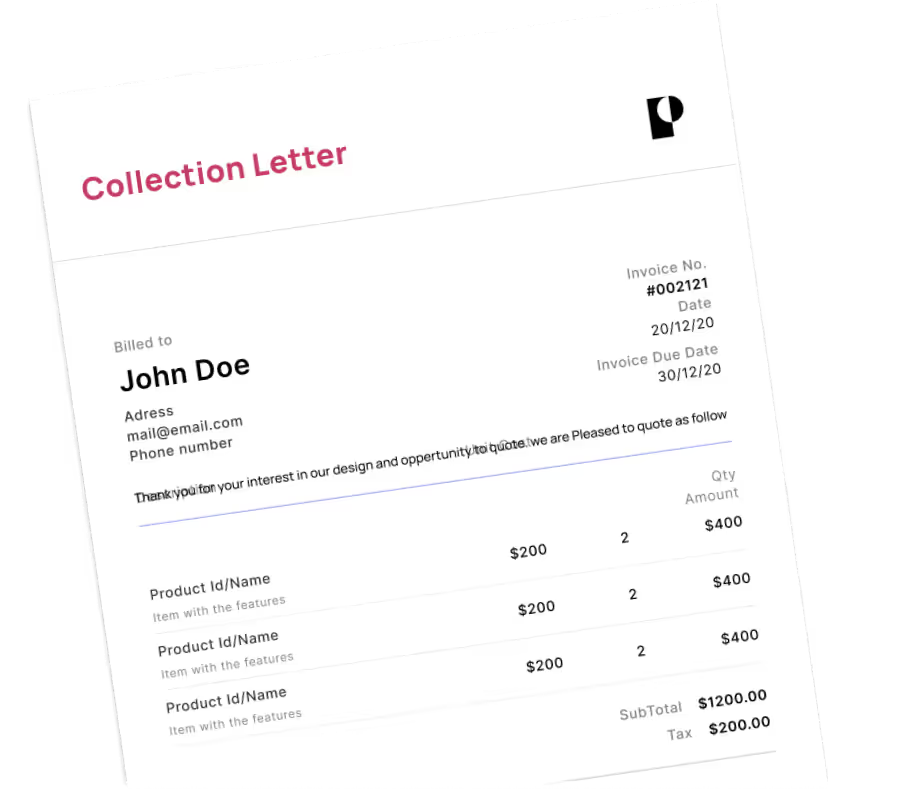
Empresa de cobrança de dívidas na Coreia do Sul - Sem recuperação sem honorários
Your claims are handled exclusively by Barun Law LLC, our licensed South Korean law firm established in 1998, ranked by Chambers and Partners and The Legal 500 for dispute resolution.


Obter aconselhamento especializado grátis
Resposta de um especialista em 24 horas.
A sua vantagem com a Debitura para cobrança de dívidas na Coreia do Sul
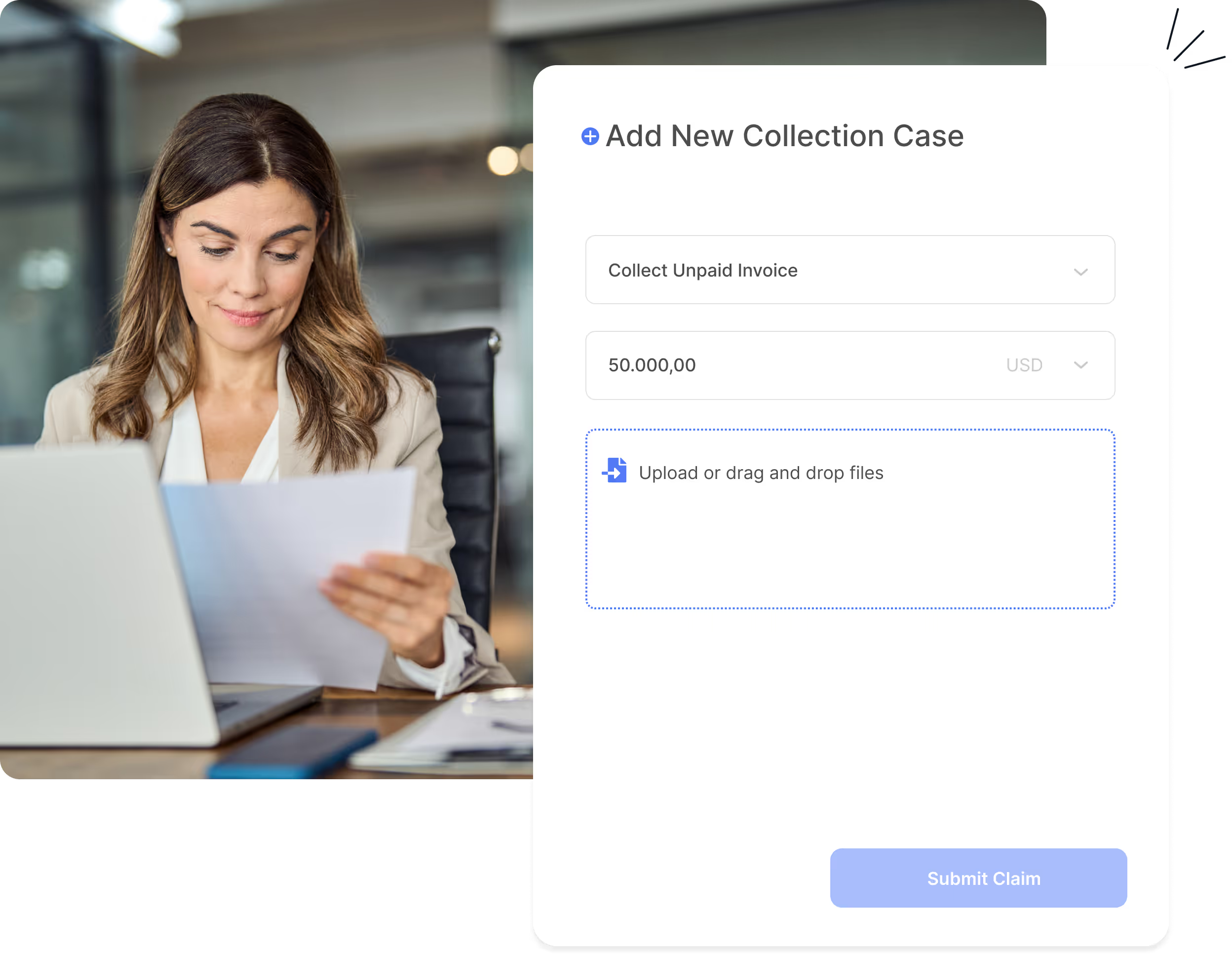
Cobrança de dívidas rápida, simples e sem risco na Coreia do Sul
A Debitura é uma plataforma global de cobrança de dívidas, habilitada por tecnologia, que trabalha com agências e sociedades de advogados licenciadas localmente em 183 países. Na Coreia do Sul, o seu processo é tratado pela Barun Law LLC, advogados licenciados em Seul (fundada em 1998 e classificada pela Chambers e The Legal 500).
- Preços sem risco: Sem custos, a menos que tenhamos sucesso.
- Configuração rápida: Envie faturas com apenas alguns cliques.
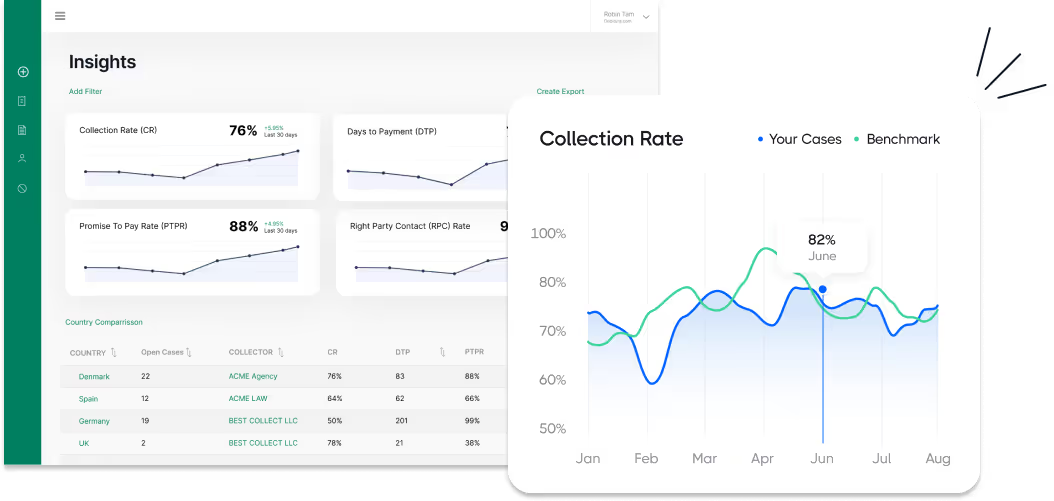
- Acompanhamento em tempo real: Estado, ações e pagamentos em direto num único portal.
- Conformidade: Em conformidade com a Lei de Práticas Justas de Cobrança de Dívidas da Coreia, a Lei de Uso e Proteção de Informações de Crédito e a Lei de Proteção de Informações Pessoais.
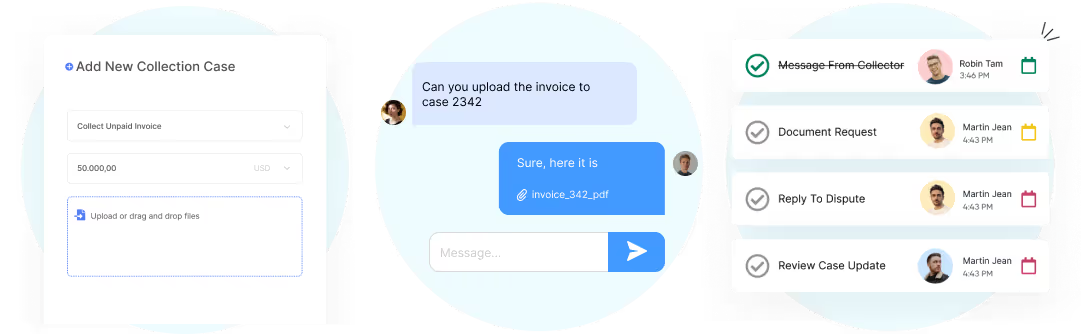
Comece a recuperar os seus créditos coreanos em 2 minutos
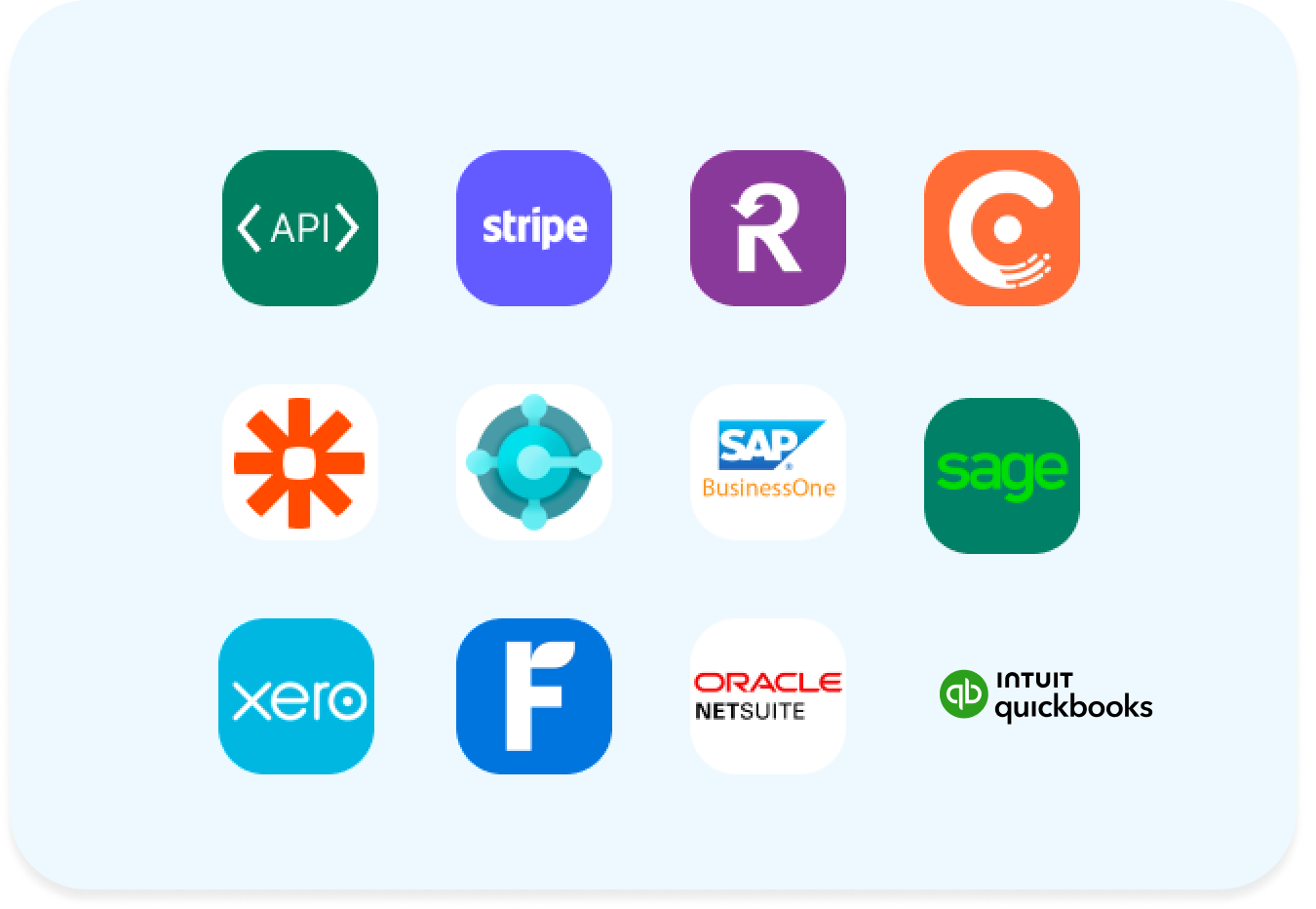
- Envie a sua reclamação: Envie a sua reclamação não paga em minutos através do painel, da API REST ou das integrações ERP plug-and-play, como Douzone WEHAGO / Smart A e YoungLimWon K-System.
- A cobrança local começa: Atribuímos o processo à Barun Law LLC, que entra em contato com o devedor em coreano dentro de 24 horas. Se for necessária uma ação judicial, escolha 1 a 3 orçamentos legais de preço fixo (por exemplo, ordem de pagamento ou ação judicial) antes que algo prossiga.
- Seja pago: Os fundos são remetidos após a recuperação. Se for necessária uma ação judicial, escolha 1 a 3 orçamentos legais de preço fixo antes que algo prossiga.

Preços transparentes e baseados no sucesso
Com a Debitura, você só paga se tivermos sucesso. A cobrança pré-judicial funciona no modelo 'sem sucesso, sem honorários': uma Comissão de sucesso é deduzida dos valores recuperados, faturada localmente pelo seu parceiro. As taxas dependem do país do devedor, não do seu.
- Devedores na Europa (UE, Islândia, Liechtenstein, Noruega, Reino Unido e Suíça): Comissões de sucesso a partir de 6%, dependendo do valor do crédito.
- Devedores no resto do mundo: Comissões de sucesso a partir de 7,5%, dependendo do valor do crédito.
- Créditos mais antigos: uma sobretaxa é aplicada para créditos com 12 a 24 meses de atraso e para créditos com mais de 24 meses.
- Ação judicial é opcional: você aprova orçamentos de preço fixo antes de qualquer gasto judicial.
Consulte a página de preços para a tabela completa de taxas, ou obtenha uma estimativa instantânea ao enviar um pedido de cobrança.
Como funciona a cobrança de dívidas na Coreia do Sul?
Debt collection in South Korea starts with an amicable phase handled locally by Barun Law LLC: reminders and a formal payment demand in Korean, aimed at full payment or a written instalment agreement. Most straightforward claims are resolved at this stage without ever going to court. If the debtor still does not pay, escalation is never automatic - your partner assesses the legal route and you approve a quote before any court step.
- Submit your claim in 2 minutes via the dashboard
- Barun Law LLC takes the local action on your behalf
- No Cure, No Pay: you pay nothing unless we recover
- You approve every legal step before it happens
- Get paid once the claim is recovered
Os quatro passos da fatura não paga ao dinheiro recuperado
- Passo 1 - Cobrança amigável: lembretes, uma notificação formal de pagamento e negociação, tratados localmente por Barun Law LLC. A maioria das dívidas incontestadas é resolvida nesta fase, sem necessidade de recurso judicial.
- Etapa 2 - Título executivo: se o devedor ainda não pagar, o seu parceiro avalia a via judicial para obter um título executivo e você aprova um orçamento de preço fixo antes que qualquer procedimento avance.
- Step 3 - Enforcement: with a legal title, the execution officer (jibaenggwan) can attach wages, bank funds and other assets until the claim is recovered.
- Etapa 4 - Insolvência: se o devedor se revelar insolvente, a sua prova de crédito é apresentada e quaisquer distribuições são monitorizadas em seu nome.
Cada etapa é acompanhada no seu painel de controlo, e nada avança sem a sua aprovação. Todos os detalhes legais para a Coreia do Sul – prazos, custos, tribunais e execução – encontram-se no guia abaixo.

Cobrança de dívidas na Coreia do Sul - o guia completo de 2026
This guide explains how debt collection in South Korea works for a foreign or domestic creditor: the amicable phase, the payment order and litigation routes to an enforceable title, enforcement against a debtor's assets, and what happens if the debtor becomes insolvent.
Nesta página:
Por que você pode confiar neste guia
At Debitura, we uphold the highest standards of impartiality and precision to bring you comprehensive guides on international debt collection. Every guide is written from primary legal sources and reviewed by licensed local experts in the jurisdiction it covers.
Perguntas ou feedback? Envie-nos um e-mail para contact@debitura.com , atualizamos este guia com base na sua contribuição.
Debitura em Números:
- 767 licensed partners - collection agencies and law firms in our network
- 180 countries covered - with cases handled in 174 of them
- 5,306 businesses registered with Debitura
- 33 days median time to first payment on European cases
Liderado por especialistas, validado localmente
Escrito por Lars Holdgaard, Fundador da Debitura (+10 anos em recuperação global de dívidas B2B). Cada página é revista por advogados locais de topo para garantir a precisão legal e passos práticos que pode utilizar.

Especialistas locais contribuintes:
Última atualização:

Cobrança de dívidas na Coreia do Sul - respostas rápidas
How much does debt collection in South Korea cost?
Debitura only charges a fee if the case recovers money, under a No Cure No Pay model, with no upfront cost. If the claim escalates to a court payment order, the creditor's stamp fee is set at 10% of the ordinary litigation cost; further court and enforcement fees apply only if the case proceeds to full litigation or enforcement.
How long does debt collection take in South Korea?
An uncontested payment order can become final and enforceable about 2 weeks after it is served on the debtor, while a contested claim that goes to ordinary litigation generally takes 12 to 18 months at first instance in South Korea's district courts. Supreme Court review of an appealed case can take anywhere from 4 months to several years.
What is the limitation period for a debt in South Korea?
A general civil claim is time-barred 10 years after it falls due under Civil Act Article 162, but most commercial claims between businesses are time-barred after only 5 years under Commercial Act Article 64. Several claim types run shorter still: 3 years for a merchant's goods-sale price claim (Civil Act Article 163(6)), 1 year for hotel or restaurant fees, and 6 months for a seller's warranty claim measured from when the defect was discovered.
| Claim type | Prazo de prescrição |
|---|---|
| General civil claim (Civil Act art. 162) | 10 anos |
| Commercial claim (Commercial Act art. 64) | 5 anos |
| Merchant goods-sale price claim (Civil Act art. 163(6)) | 3 anos |
| Hotel or restaurant fees | 1 year |
| Seller's warranty, from defect discovery | 6 months |
Can I charge interest on an unpaid debt in South Korea?
Yes: a civil claim accrues statutory interest at 5% per annum under Civil Act Article 379, and a commercial claim accrues interest at 6% per annum under Commercial Act Article 54. Filing a payment order or lawsuit, obtaining a court attachment, or getting the debtor to acknowledge the debt in writing interrupts the limitation clock under Civil Act Article 168; a final judgment then resets it to a fresh 10-year period under Civil Act Article 165. An informal demand letter alone only pauses the clock for 6 months, and only if a suit follows within that window (Civil Act Article 174).
What documents do I need to start debt collection in South Korea?
Barun Law LLC needs the underlying contract or invoice, proof of delivery or performance, and a record of any payment demands already sent to the debtor before it can issue a formal demand or file a payment order on your behalf. Additional documents may be requested once the case is reviewed.
Should I use a payment order or file a lawsuit in South Korea?
For an undisputed debt, the Demand for Payment Procedure is faster: the court reviews the paperwork only, holds no hearing, and the order becomes final with the same enforcement effect as a judgment if the debtor does not object within 2 weeks of service. A disputed claim, or one the debtor objects to, converts into ordinary litigation, which generally takes 12 to 18 months at first instance.
| Via | Key feature |
|---|---|
| Demand for Payment Procedure (payment order) | Documents only, no hearing; final if unobjected within 2 weeks |
| Ordinary litigation | Full hearing; first instance generally 12-18 months |
Quem faz o quê na cobrança de dívidas na Coreia do Sul?
The collection partner: Barun Law LLC
Barun Law LLC, a Seoul-based law firm of 263 attorneys established in 1998, handles your case in South Korea end to end for Debitura: it reviews the claim, sends the debtor a formal demand in Korean, negotiates an amicable settlement where possible, and if the debtor still does not pay, files a payment order or lawsuit and pursues enforcement, or a proof of claim in insolvency.
South Korea's Fair Debt Collection Practices Act defines "debt collector" broadly, covering credit-business entities, ordinary creditors of a loan, assignees of a commercial claim, and third-party fee-based collectors and their agents (Article 2). Only an attorney-at-law may take the actual litigation steps for a fee-based third-party collector (Article 8-4), which is why Debitura routes South Korean cases to a licensed law firm rather than a standalone collection agency.
The courts
South Korea's civil courts hear payment orders and litigation. Municipal Courts handle claims up to KRW 30,000,000; District Courts hear larger claims, generally before a single judge, moving to a 3-judge panel once the claim exceeds KRW 500,000,000. Appeals run through the High Courts to the Supreme Court of Korea.
The enforcement authority
Once a payment order or judgment is final, compulsory execution is carried out by an execution officer (jibaenggwan) under the Civil Execution Act, acting under the supervision of the competent District Court, against the debtor's bank accounts, wages, or movable and real property.
Debitura's advantage
Debitura's dashboard gives you a single place to submit the claim, approve a fixed-price quote before any court step, and track the case status; you never need a local entity or a Korean-speaking team of your own.
Quais leis e tribunais se aplicam à cobrança de dívidas na Coreia do Sul?
The civil court system
South Korea runs a civil-law court system under the Supreme Court of Korea, with 6 High Courts, 18 District Courts, and 99 Municipal Courts plus 42 Branch Courts below them. Municipal Courts handle civil disputes up to KRW 30,000,000; larger District Court cases are generally heard by a single judge, moving to a 3-judge panel once the claim exceeds KRW 500,000,000. All proceedings are conducted in Korean.
Legislação fundamental
Contractual and commercial claims are governed by the Civil Act and the Commercial Act: the Civil Act sets a 10-year general limitation period for an ordinary claim (Article 162) and a 5% statutory civil interest rate (Article 379), while the Commercial Act sets a 5-year period for a commercial claim (Article 64), with a 6% statutory commercial interest rate (Article 54). Article 64's own proviso yields to any shorter period fixed elsewhere in the law, and this is where South Korea's most-cited short period comes from: an ordinary invoice for goods sold by a merchant or producer prescribes in just 3 years under Civil Act Article 163, not under the Commercial Act itself. The expedited Demand for Payment Procedure that many creditors use first is a document-only court process with no hearing, under the Civil Procedure Act. Debt collection conduct itself is governed by the Fair Debt Collection Practices Act, enforcement is carried out by an execution officer (jibaenggwan) under the Civil Execution Act, and insolvency is governed by the Debtor Rehabilitation and Bankruptcy Act, which provides both a rehabilitation route and a liquidation route. A typical contested case moves through case analysis, a formal demand notification, provisional seizure of assets where needed, litigation, and compulsory execution once a title is final.
Defesa do consumidor e proteção de dados
The Fair Debt Collection Practices Act (Chaekwon-ui Gongjeonghan Chusim-e Gwanhan Beomnyul) sets out detailed, numbered conduct rules for anyone collecting a debt in South Korea. Before contact starts, the collector must give the debtor written notice of the delegation, including its identity and the debt details (Article 6), and the same debt cannot be delegated to two or more collectors at once (Article 7). Contact by phone or in person is banned at night, defined as 9pm to 8am, if it seriously disturbs the debtor's privacy or peace (Article 9), and once a debtor has appointed a lawyer and notified the collector, most direct debtor contact must stop (Article 8-2). The Act also bans violence, threats, misrepresentation of a debt's validity or of court authority, and disclosure of a debtor's personal or debt information to third parties, and gives an injured debtor a civil damages claim against a collector that breaches it (Article 14). Barun Law LLC's contact with a debtor follows these rules at every stage of the case.
Passo 1 - Como funciona a cobrança de dívidas amigável (pré-judicial) na Coreia do Sul?
Amicable, pre-legal debt collection in South Korea starts with Barun Law LLC reviewing the claim and sending the debtor a formal payment demand in Korean. Most undisputed claims are resolved at this stage without ever going to court, and Debitura only escalates to a legal route once you approve a fixed-price quote.
What happens during the amicable phase
Barun Law LLC verifies the debt and debtor details, then contacts the debtor directly with reminders and a formal demand for payment, aiming for full payment or a written instalment agreement. If the debtor acknowledges the debt in writing during this phase, that acknowledgement interrupts the limitation clock under Civil Act Article 168. An informal demand letter on its own only pauses the clock for 6 months, and only if a suit follows within that window under Civil Act Article 174, so a case that stalls in the amicable phase should not be left open indefinitely.
A typical amicable timeline
| Dia | Ação |
|---|---|
| Day 0 | Claim submitted; Barun Law LLC reviews the debt and debtor details |
| Day 1-7 | Formal payment demand sent to the debtor in Korean |
| Day 7-30 | Negotiation; debtor may propose an instalment agreement |
| Day 30-90 | If unresolved, Barun Law LLC assesses the legal route and prepares a fixed-price quote for your approval |
Quando escalar o caso
Escalation to a payment order or lawsuit is never automatic. Barun Law LLC recommends moving to a legal route once the debtor stops responding, repeatedly breaks a payment promise, or the claim is approaching its limitation period; you then choose whether to proceed on a fixed-price legal quote.
Passo 2 - Como se obtém um título executivo na Coreia do Sul?
An enforceable title is the legal document, either an unobjected payment order or a final court judgment, that lets you move to enforcement in Step 3. For an undisputed debt, Barun Law LLC files South Korea's Demand for Payment Procedure: the court examines the paperwork only, holds no hearing, and the creditor's stamp fee is set at 10% of the ordinary litigation cost. If the debtor does not object within 2 weeks of service, the order becomes final with the same enforcement effect as a court judgment. If the debtor objects, or the claim is disputed from the outset, the case converts into or starts as ordinary litigation.
| Via | Processo | Duração típica |
|---|---|---|
| Demand for Payment Procedure | Documents only, no hearing; final if unobjected | Final about 2 weeks after service if unobjected |
| Ordinary litigation | Full hearing and evidence review | 12-18 months at first instance |
Ordinary litigation
Ordinary civil litigation in South Korea generally takes 12 to 18 months at first instance. A judgment resets the limitation period to a fresh 10 years under Civil Act Article 165, giving the creditor a long window to enforce it. An appeal can go to the High Court and then, on points of law, to the Supreme Court of Korea, where review can take anywhere from about 4 months to several years. Court fees scale with the claim amount; Barun Law LLC confirms the exact court fee for your claim before filing.
Which court hears the claim
Municipal Courts hear civil disputes up to KRW 30,000,000. Larger claims go to a District Court, generally before a single judge; once the claim exceeds KRW 500,000,000, it is usually heard by a 3-judge panel. All proceedings are conducted in Korean, so Barun Law LLC represents you throughout.
Small Claims Litigation
For a claim within the KRW 30,000,000 Municipal Court threshold, South Korea's Small Claims Litigation procedure offers a faster route than ordinary litigation: a single oral-argument hearing is the norm, a spouse, lineal relative or sibling may represent the party without needing the court's permission, and judgment can be pronounced immediately after argument closes. The court may also issue a Recommendation for Performance, which becomes final, with the same effect as a judgment, if the debtor does not object within 2 weeks.
Passo 3 - Como funciona a execução de dívidas na Coreia do Sul?
Once a payment order or court judgment becomes final, enforcement in South Korea is carried out by an execution officer (jibaenggwan) under the Civil Execution Act: creditors can seize a debtor's bank accounts, wages, and movable or real property to satisfy the debt.
Ways to enforce a claim
| Enforcement method | What it targets |
|---|---|
| Bank account seizure | Funds held in the debtor's accounts |
| Wage garnishment | A portion of the debtor's salary |
| Movable property seizure | Vehicles, equipment and other movable assets, sold at auction |
| Real property seizure | Land and buildings, sold at auction through the District Court |
Korean law protects roughly half of a debtor's wages, salary, pension or retirement pay from seizure, with the exact floor and ceiling set by Presidential Decree with reference to the minimum cost of living (Civil Execution Act Article 246(1)).
Protecting assets before judgment
Before a title is final, a creditor who can show that enforcement would otherwise become impossible or considerably difficult can ask the court for a provisional (protective) seizure of the debtor's movable or immovable assets under Civil Execution Act Articles 276 to 279. This freezes assets in place while the underlying claim or payment order proceeds, and jurisdiction lies with the court where the assets are located or the court handling the merits of the claim.
All enforcement is carried out under the supervision of the District Court that issued or recognises the enforceable title, and Barun Law LLC prepares and files the enforcement application on your behalf. Because a final judgment resets the limitation period to a fresh 10 years under Civil Act Article 165, creditors generally have ample time to pursue enforcement once a title is secured.
Execução
A typical case moves through case analysis, a formal demand notification, provisional seizure of assets where needed to prevent the debtor moving them, litigation if the debtor disputes the claim, and compulsory execution once a title is final. If the debtor's assets are unknown, Barun Law LLC can apply to the court for a property clarification order compelling the debtor to disclose assets; the exact penalty for non-compliance is [NEEDS VERIFIED SOURCE].
Conduct rules for the enforcement stage
The Fair Debt Collection Practices Act bans violence, threats, disclosure of a debtor's personal information to third parties, misrepresentation, and other unfair conduct at every stage, including enforcement, with civil liability for a collector that breaches it.
Passo 4 - Como os Processos de insolvência afetam a recuperação de dívidas na Coreia do Sul?
If a debtor in South Korea becomes insolvent, recovery moves from individual enforcement to a collective process under the Debtor Rehabilitation and Bankruptcy Act, which offers two routes: rehabilitation (Hoesaeng), where a viable debtor keeps operating under a court-supervised plan, and bankruptcy (Pasan), where a court-appointed trustee liquidates the debtor's assets and distributes the proceeds to creditors.
Rehabilitation (Hoesaeng)
A debtor may file for rehabilitation where repaying its obligations on schedule would seriously hinder the business, or where bankruptcy is otherwise feared (Debtor Rehabilitation and Bankruptcy Act Article 34); for a stock or limited-liability company, a creditor holding at least one-tenth of its capital can also petition. A court-approved plan must rank claims fairly: public-interest (common-benefit) claims, covering the costs of running the business and the proceedings after filing, rank ahead of all rehabilitation claims (Article 179); within the rehabilitation claims themselves, rehabilitation security rights rank first, then general preferential rehabilitation claims, then ordinary rehabilitation claims, with shareholders paid last (Article 217).
| Priority (rehabilitation plan) | What it covers |
|---|---|
| Public-interest (common-benefit) claims | Business-continuation and procedural costs after filing; rank first |
| Rehabilitation security rights | Claims backed by collateral |
| General preferential rehabilitation claims | Claims with a statutory preference but no security |
| Ordinary rehabilitation claims | Unsecured claims with no preference |
| Shareholders / equity holders | Paid last, from what remains |
Bankruptcy (Pasan)
A debtor is declared bankrupt, on its own application or a creditor's, once it is insolvent; a suspension of payment raises a presumption of inability to pay, and for a company, bankruptcy can be declared on balance-sheet insolvency (liabilities exceeding assets) alone, without a cash-flow test (Articles 305-306). A court-appointed trustee then liquidates the debtor's assets and distributes the proceeds by the same broad priority as a rehabilitation plan, secured claims before unsecured claims.
Discharge and what survives it
Once a bankruptcy case closes, the court grants the debtor a discharge (immunity, myeonchaek) unless bad-faith grounds apply, such as concealing assets or filing a falsified creditor list (Article 564); once final, discharge releases the debtor from the whole of its remaining bankruptcy debt beyond what was actually distributed (Article 565). A short list of claims survives discharge regardless: taxes, fines and criminal-litigation costs, damages from the debtor's own intentional or grossly negligent wrongdoing, and workers' unpaid wages, severance pay and injury compensation (Article 566). A creditor should treat this list, not the general discharge, as the limit of what a Korean bankruptcy can wipe out.
Filing a proof of claim
Barun Law LLC monitors the case once insolvency proceedings open, files your proof of claim within the court-set reporting period, and tracks any distribution on your behalf, whether the case proceeds as a rehabilitation or a liquidation. A claim not reported within that period is not discharged, but it also receives no dividend, so filing promptly is the single most time-sensitive step for a foreign creditor.
Taxas, juros e quem paga o quê na Coreia do Sul
- Nossa taxa: baseada no sucesso - Sem sucesso, sem honorários (ver Preços).
- Court & enforcement fees: state fees apply only if the case escalates to legal action; the Demand for Payment Procedure's stamp fee is 10% of the ordinary litigation cost.
- Statutory debtor items: late-payment interest applies at the statutory rate, 5% per annum for a civil claim (Civil Act Article 379) or 6% per annum for a commercial claim (Commercial Act Article 54); recoverable collection costs are added where the law allows.
- Who keeps what: recovered principal is yours; statutory interest and court costs follow South Korean law.
As of 21 July 2026, the Ministry of Justice's Civil Act amendments, including a variable statutory interest rate, passed Cabinet in December 2025 but await National Assembly passage; the fixed 5% (civil) and 6% (commercial) rates remain in force.
Cross-border debt collection in South Korea
South Korea sits outside the EU and any comparable regional bloc, so no European Payment Order or European Small Claims Procedure applies; a foreign creditor instead uses South Korea's own private-international-law rules.
A foreign court judgment is recognised in South Korea only if it meets four cumulative conditions under Civil Procedure Act Article 217: the foreign court had proper international jurisdiction; the losing defendant was validly served with enough time to defend, or appeared despite defective service; recognition does not offend South Korea's public policy; and, the condition most creditors overlook, mutual guarantee (reciprocity) exists between South Korea and the judgment's country of origin. A Korean court checks these conditions on its own motion.
Recognition alone does not let a creditor seize assets in South Korea. Enforcing a foreign judgment additionally requires a separate lawsuit for a Korean "judgment of execution" (jipaeng panggyeol) at the debtor's forum, under Civil Execution Act Articles 26 and 27; the court does not re-examine the foreign judgment's merits, but dismisses the suit if the judgment is not final or fails Article 217's conditions. For a claim that starts in South Korea rather than abroad, the amicable, payment-order and litigation routes described above apply directly under Korean law.
Encontre um Advogado de Recuperação de Crédito Local
Precisa de representação judicial? Compartilhe seu Processo uma vez e receba até três propostas de advogados litigantes verificados. Gratuito, rápido e sem compromisso.
- Especialistas verificados
- Orçamentos em 24 horas, sem taxas ocultas
- Taxas justas e pré-negociadas
Ahnse Law Offices é um escritório de advocacia de referência em Seul, que oferece serviços eficazes de cobrança de dívidas na Coreia do Sul, estabelecido em 2003, reconhecido pelas suas soluções estratégicas e membro da MSI Global Alliance e da IR Global.
.webp)
.png)

.png)

Law-Win é um escritório de advocacia de referência em Seocho-gu, que oferece serviços eficazes de cobrança de dívidas na Coreia do Sul, posicionando-se como o parceiro ideal para a recuperação de dívidas desde 2016, com prémios como um dos 50 melhores escritórios de advocacia nacionais e serviços a clientes internacionais.

Suojae - Kwon, Park & Rhee é um escritório de advocacia de referência em Seul, que oferece serviços eficazes de cobrança de dívidas na Coreia do Sul, posicionando-se como o parceiro ideal para a recuperação de dívidas com um alcance global em 183 países e membro da rede SCG Legal desde 2018.
Rhee's Law Office é um escritório de advocacia de referência em Paengseong-eup Pyongtaek-si, que oferece serviços eficazes de cobrança de dívidas na Coreia do Sul, conhecido pelos seus 15 anos de experiência, servindo inúmeros clientes internacionais e orgulhosamente afiliado à Ordem dos Advogados da Coreia desde 2010.

SM Credit Information é uma agência de recuperação de dívidas de referência em Seodaemun-gu, que oferece serviços eficazes de cobrança de dívidas na Coreia, estabelecida em 1999, servindo clientes como a Hyundai e a SK, com uma rede em mais de 90 países e membro da ACA International e da IACC.
Barun Law LLC é um escritório de advocacia de referência na Coreia do Sul, que oferece serviços eficazes de cobrança de dívidas sem risco, posicionando o escritório como o parceiro ideal para a recuperação de dívidas no país; estabelecido em 1998, é um parceiro exclusivo da Debitura que oferece cobrança de dívidas Sem recuperação sem honorários com base nos termos e Preços padrão sem risco da Debitura, com prémios da Legal 500 e da Chambers and Partners, e servindo vários países, incluindo os EUA, o Japão e a China.

NICE Credit Information Service Co., Ltd. é uma agência de recuperação de dívidas de referência em Seul, que oferece serviços eficazes de cobrança de dívidas na Coreia do Sul, estabelecida em 1986, reconhecida com o Million Award for Export Performance e servindo mercados adicionais no Vietname, Camboja, Tailândia e Indonésia.
Perguntas Frequentes
Explore nossas FAQs mais comuns abaixo, ou entre em contato diretamente em contact@debitura.com se precisar de ajuda com um Processo específico.
.svg)

.png)


.png)
.svg)
.svg)