.png)


.png)
.svg)
Kostenlos loslegen
Debt Collection Agency in Brazil - No Win, No Fee
Debt collection in Brazil, handled by our exclusive local partner Recover Assessoria Empresarial Ltda. in São Paulo. No Win No Fee, no upfront cost, and a full guide to Brazilian limitation periods, courts and enforcement below.

100 % risikofrei: Sie zahlen nur bei Erfolg
Local debt collection by licensed agency / law firm
Founded 1990 | Registered with the Junta Comercial do Estado de São Paulo | 20 employees

Kostenlose Expertenberatung anfordern
Antwort von einem Spezialisten innerhalb von 24 Stunden.
Vielen Dank! Ihre Anfrage wurde empfangen!
Hoppla! Beim Absenden des Formulars ist etwas schiefgelaufen.
Why Choose Debitura for Debt Collection in Brazil
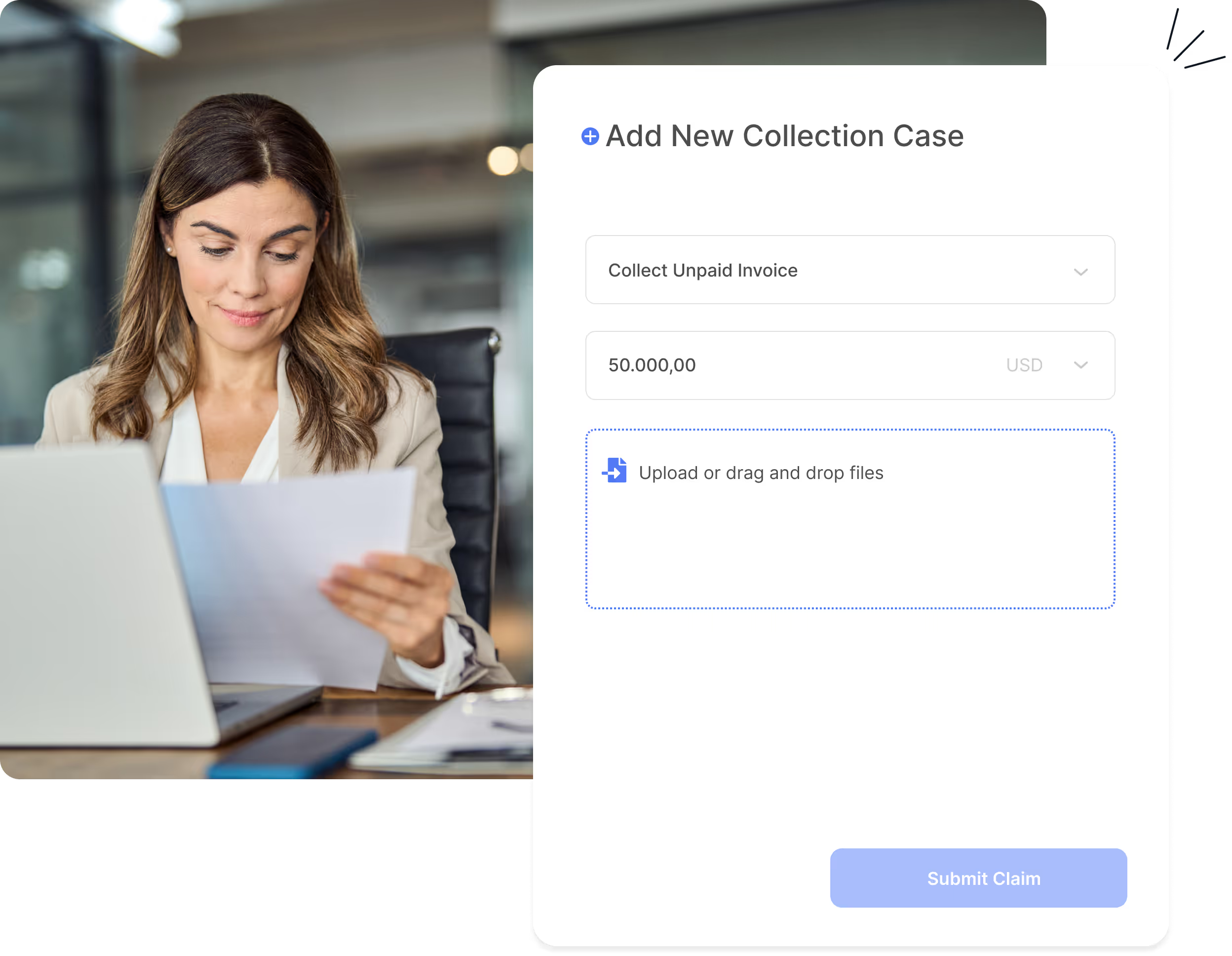
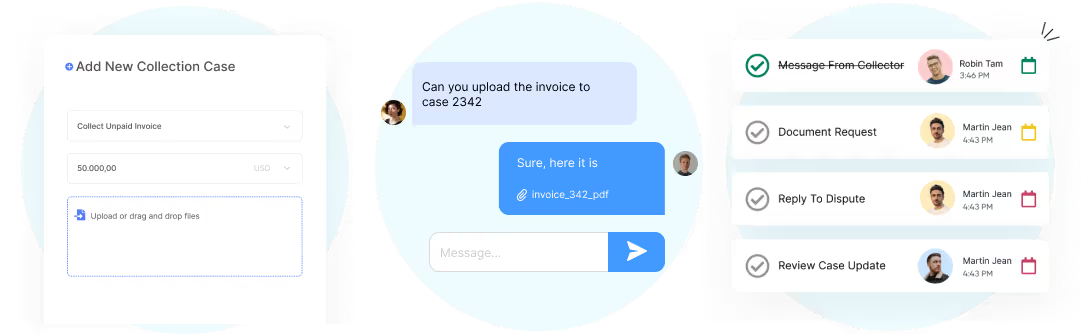
You get paid without paying anything up front. Debitura is a debt collection platform: you submit the claim in a couple of minutes, and a vetted local partner in Brazil takes it from there, working on a No Win No Fee basis so a fee only arises if money is actually recovered.
The regulated collection work in Brazil is carried out by our exclusive local partner, Recover Assessoria Empresarial Ltda., a São Paulo agency founded in 1990 and registered with the Junta Comercial do Estado de São Paulo. Debitura is not a Brazilian collection agency and has no office in Brazil; the partner performs the regulated activity and we run the platform, the case tracking and the commercial terms around it.
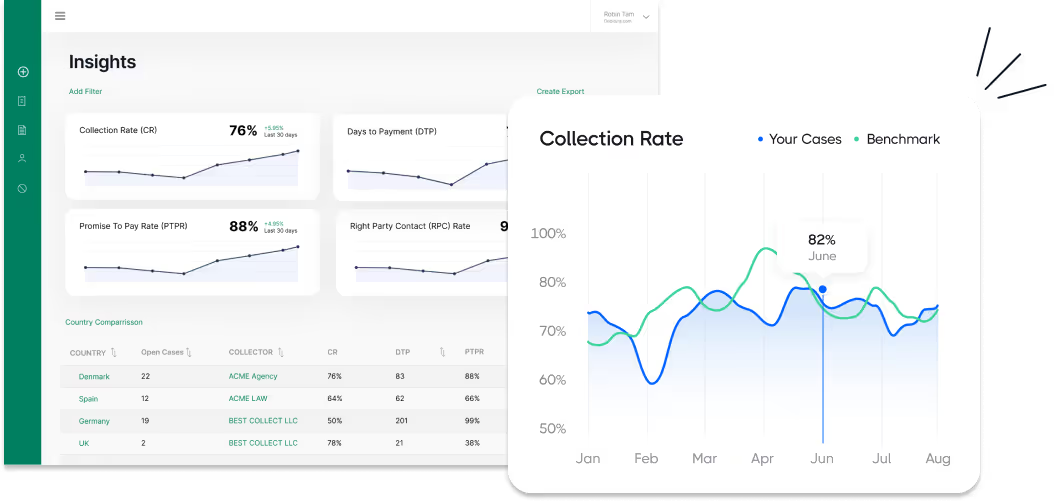
That split is what lets one account cover 183 countries with local execution in each. Across the platform, cases resolve at an 87 per cent recovery rate, and every step in Brazil is visible in your dashboard.

Getting started takes about two minutes and costs nothing.
- Create a free account and upload the claim: the invoice or contract, the debtor's details including the CPF or CNPJ number, and anything showing the debt was acknowledged.
- See the fee before you commit. The exact success fee is shown on screen before you submit, and it follows the debtor's country rather than yours.
- Sign the Power of Attorney digitally so the Brazilian partner can act on your behalf in the amicable phase.
- The partner takes over. Skip tracing, the formal written demand and a multi-channel campaign run across a six-month Collection Period, aimed at full payment or a signed instalment agreement.
- You decide about court. If the amicable phase does not resolve the claim, you receive a priced recommendation for the right Brazilian route, whether that is a direct execution on an extrajudicial title, an ação monitória or a claim in the Juizados Especiais Cíveis. Nothing is filed without your approval.
One thing to do before you upload: check the age of the claim against the five-year limitation period in the guide below. It is the single factor that most often decides whether a Brazilian debt is still recoverable.

Transparente, erfolgsbasierte Preise
Mit Debitura zahlen Sie nur bei Erfolg. Das vorgerichtliche Inkasso erfolgt auf „Kein Erfolg, keine Gebühren“-Basis: eine Erfolgsprovision, die von den eingezogenen Beträgen abgezogen und lokal von Ihrem Partner in Rechnung gestellt wird. Die Gebühren hängen vom Land des Schuldners ab, nicht von Ihrem.
- Schuldner in Europa (EU, Island, Liechtenstein, Norwegen, Großbritannien und der Schweiz): Erfolgsprovisionen ab 6 % je nach Forderungshöhe.
- Schuldner im Rest der Welt: Erfolgsprovisionen ab 7,5 % je nach Forderungshöhe.
- Ältere Forderungen: Für Forderungen, die 12–24 Monate überfällig sind, sowie für Forderungen, die älter als 24 Monate sind, wird ein Aufschlag berechnet.
- Rechtliche Schritte sind optional: Sie genehmigen Festpreisangebote, bevor rechtliche Ausgaben anfallen.
Die vollständige Gebührenübersicht finden Sie auf der Preise-Seite oder erhalten Sie eine sofortige Schätzung, wenn Sie eine Forderung hochladen.
Wie funktioniert das Inkasso in Brasilien?
Das Inkasso in Brasilien beginnt mit einer außergerichtlichen Phase, die von einem lokalen, lizenzierten Partner durchgeführt wird: Mahnungen und eine formelle Zahlungsaufforderung, die auf die vollständige Zahlung oder eine schriftliche Ratenzahlungsvereinbarung abzielen. Die meisten unkomplizierten Forderungen werden in dieser Phase beigelegt. Zahlt der Schuldner weiterhin nicht, ist die Eskalation vor Gericht ein separater, genehmigter Schritt – niemals automatisch.
Wichtige Erkenntnisse
Die vier Schritte von der unbezahlten Rechnung zum eingezogenen Geld
- Schritt 1 - Gütliches Inkasso: Mahnungen, eine formelle Zahlungsaufforderung und Verhandlungen, lokal von einem lokalen, lizenzierten Partner durchgeführt. Die meisten unbestrittenen Forderungen werden in dieser Phase gelöst, ohne dass ein Gerichtsverfahren erforderlich ist.
- Schritt 2 - Vollstreckbarer Titel: Zahlt der Schuldner weiterhin nicht, prüft Ihr Partner den rechtlichen Weg, um einen vollstreckbaren Titel zu erhalten, und Sie genehmigen ein Festpreisangebot, bevor weitere Schritte eingeleitet werden.
- Schritt 3 - Zwangsvollstreckung: Mit einem vollstreckbaren Titel kann die zuständige Vollstreckungsbehörde Löhne, Bankguthaben und andere Vermögenswerte pfänden, bis die Forderung beglichen ist.
- Schritt 4 - Insolvenz: Sollte sich der Schuldner als insolvent erweisen, wird Ihre Forderungsanmeldung eingereicht und eventuelle Ausschüttungen in Ihrem Namen überwacht.
Jeder Schritt wird in Ihrem Dashboard verfolgt, und nichts eskaliert ohne Ihre Zustimmung. Die vollständigen rechtlichen Details für Brasilien – Zeitpläne, Kosten, Gerichte und Zwangsvollstreckung – finden Sie im folgenden Leitfaden.

Kostenlos starten
Keine Einrichtungsgebühr
Zugelassene Experten vor Ort
Kein Erfolg, keine Kosten
Inkasso in Brasilien – der vollständige Leitfaden 2026
This guide covers debt collection in Brazil for creditors, in-house counsel and finance teams: which limitation period applies to your claim, how to obtain an enforceable title, how enforcement works in practice, and what an insolvent debtor means for your recovery. Every figure is sourced to the statute it comes from.
Auf dieser Seite:
Warum Sie dieser Anleitung vertrauen können
At Debitura, we uphold the highest standards of impartiality and precision to bring you comprehensive guides on international debt collection. Every guide is written from primary legal sources and reviewed by licensed local experts in the jurisdiction it covers.
Fragen oder Feedback? Senden Sie uns eine E-Mail an contact@debitura.com , wir aktualisieren diesen Leitfaden basierend auf Ihrem Input.
Debitura in Zahlen:
- 767 licensed partners - collection agencies and law firms in our network
- 180 countries covered - with cases handled in 174 of them
- 5,306 businesses registered with Debitura
- 33 days median time to first payment on European cases
Von Experten geleitet, lokal validiert
Verfasst von Lars Holdgaard, Gründer von Debitura (über 10 Jahre Erfahrung im globalen B2B-Forderungseinzug). Jede Seite wird von führenden lokalen Anwälten überprüft, um die rechtliche Genauigkeit und die Anwendbarkeit der praktischen Schritte zu gewährleisten.

Mitwirkende lokale Experten:
Letzte Aktualisierung:
August 20, 2026

Inkasso in Brasilien – kurze Antworten
The answers below are the figures creditors ask for most often when starting debt collection in Brazil, each tied to the article of Brazilian law that sets it.
How long do you have to collect a debt in Brazil?
Five years, for any debt evidenced by a public or private instrument (Código Civil, Lei 10.406/2002, art. 206, §5º, I). That covers most ordinary collection claims: invoices, signed contracts and written acknowledgements of debt. The five-year period applies to both commercial and consumer claims. The Código Civil sets no separate limitation period for consumer debt anywhere in its Título IV on prescrição, and the five-year period in art. 27 of the Código de Defesa do Consumidor (the Consumer Defence Code) governs a different claim entirely: the consumer's own damages claim against a supplier for a defective product or service, not a supplier's claim to be paid.
| Claim type | Verjährungsfrist |
|---|---|
| Debt evidenced by a public or private instrument (invoice, contract, written acknowledgement) | 5 years (Código Civil art. 206, §5º, I) |
| Claim on a negotiable instrument (título de crédito) | 3 years from maturity, subject to special law (art. 206, §3º, VIII) |
| Residual period, where no shorter one applies | 10 years (art. 205) |
The clock can be interrupted once, and only once (art. 202): by the order for judicial citation, by protest, by presenting the instrument in an insolvency or inventory proceeding, by a judicial act that constitutes the debtor in default, or by any unequivocal act, including an extrajudicial one, in which the debtor acknowledges the right. The full period then restarts from that act.
What does it cost to collect a debt in Brazil?
Debitura charges a success fee only, on a No Cure No Pay basis, so the amicable phase carries no upfront cost. Court costs are separate and arise only if the claim escalates. Two Brazilian rules matter for budgeting: proceedings in the Juizados Especiais Cíveis (Special Civil Courts) carry no court costs at first instance, and an appellant who loses there pays costs plus 10 to 20 per cent in lawyers' fees (Lei 9.099/1995, arts. 54 and 55). Ordinary proceedings carry state-set filing fees that vary by state.
How much interest can you add to an overdue Brazilian debt?
Where no rate is agreed, the statutory rate is the taxa legal defined by Código Civil art. 406 as amended by Lei 14.905/2024: the Selic reference rate less the IPCA-based monetary-correction index, floored at zero when the result is negative. The methodology is set by the Conselho Monetário Nacional and the resulting figure is published by the Banco Central do Brasil, so the applicable percentage changes over time and should be taken from the Banco Central at the moment of calculation rather than assumed. The usury cap in Decreto 22.626/1933 does not apply to contracts between businesses, to obligations evidenced by a credit instrument, or to obligations owed to financial institutions, investment vehicles or leasing companies (Lei 14.905/2024, art. 3), so a validly agreed commercial rate usually stands.
Which route should you use for a Brazilian claim?
It depends on the paperwork you hold and the size of the claim. If your document is an extrajudicial enforceable title, you skip the merits stage and go straight to enforcement. If it is written proof that falls short of that, the ação monitória converts it into a judicial title. If neither applies and the claim is worth up to 40 minimum wages, which is R$64,840 in 2026 at the minimum wage of R$1,621.00 set by Decreto 12.797/2025, the Juizados Especiais Cíveis are the fast route (Lei 9.099/1995, art. 3).
| 2026 threshold | Value |
|---|---|
| Minimum wage (Decreto 12.797/2025, art. 1) | R$1,621.00 per month |
| Juizados Especiais Cíveis ceiling (40 minimum wages) | R$64,840 |
| Lawyer optional below 20 minimum wages | R$32,420 |
| Bankruptcy petition threshold, protested titles (Lei 11.101/2005, art. 94) | Above R$64,840 |
What documents do you need to collect a debt in Brazil?
At minimum, the contract or invoice, evidence that the sum is due, and the debtor's full identification including the CPF or CNPJ number. The document you hold decides the route: a private instrument signed by the debtor and two witnesses, a duplicata, a cheque, a promissory note, a bill of exchange or a public deed is an extrajudicial enforceable title under art. 784 of the Código de Processo Civil, which lets enforcement begin without first proving the debt. Collection documents sent to a consumer must themselves show the supplier's name, address and CPF or CNPJ (Código de Defesa do Consumidor, art. 42-A).
Wer macht was beim Inkasso in Brasilien?
Four actors matter for a Brazilian collection file, and they enter at different points. Knowing which one you need at which stage is what keeps a claim from stalling.
Collection agencies (the pre-legal phase)
Role: contact the debtor, issue the formal demand, negotiate payment or a written instalment agreement. Scope: extrajudicial only. An agency cannot obtain a title, seize an asset or file a claim; those steps belong to the courts and to counsel. Conduct rules: the Código de Defesa do Consumidor (Lei 8.078/1990) binds collection conduct towards consumer debtors, and its art. 71 makes abusive collection a criminal offence punishable by three months to one year of detention plus a fine. Debitura's role: Debitura is the platform. The regulated collection work in Brazil is carried out by our exclusive local partner, Recover Assessoria Empresarial Ltda., registered with the Junta Comercial do Estado de São Paulo since 1990.
Cartório de Protesto (the protest registry)
Role: records the formal protest of an unpaid instrument. Why it matters commercially: a protest is one of the acts that interrupts the limitation period under Código Civil art. 202, and a protested title above 40 minimum wages is itself a ground on which a creditor may petition for the debtor's bankruptcy (Lei 11.101/2005, art. 94). Protest is therefore both a preservation step and a pressure step, and it sits between the amicable phase and litigation rather than inside either.
The courts and the Oficial de Justiça
Role: the Vara Cível or the Juizado Especial Cível decides the claim; the court's own Oficial de Justiça (judicial officer) serves process and carries out seizure on the ground. Scope: Brazil has no independent private bailiff profession comparable to those in parts of Europe. Enforcement acts are ordered by the judge and executed through the court, so enforcement speed is a function of the court, not of a separate service provider you can appoint.
Anwälte
Role: file and run ordinary proceedings, the ação monitória and the enforcement action. When they are compulsory: representation is mandatory in ordinary proceedings, and in the Juizados Especiais Cíveis it is mandatory above 20 minimum wages (R$32,420 in 2026) and optional below that (Lei 9.099/1995, arts. 9 and 41). Debitura's role: where a claim needs court action, you receive a fixed-price quote before anything is filed, and nothing escalates without your approval.
Welche Gesetze und Gerichte gelten für das Inkasso in Brasilien?
Brazilian debt recovery runs on codified federal law. The same statutes apply in every state, while court fees and local court organisation are set at state level.
The civil court system
Ordinary money claims start in a Vara Cível (civil chamber) of the first instance, or in a Juizado Especial Cível where the claim is within the 40-minimum-wage ceiling. Appeals go to the state Tribunal de Justiça, or to the relevant Tribunal Regional Federal where the case falls in the federal branch. Above them sits the Superior Tribunal de Justiça (the Superior Court of Justice), which is the final instance for non-constitutional questions and exists to keep the interpretation of federal law uniform across the country. The Supremo Tribunal Federal (the Federal Supreme Court) is the constitutional apex. In the Juizados Especiais Cíveis an appeal goes instead to a three-judge Turma Recursal within ten days (Lei 9.099/1995, arts. 41 and 42).
Wichtige Rechtsvorschriften
| Instrument | What it governs for a creditor |
|---|---|
| Código Civil (Lei 10.406/2002) | Limitation periods and their interruption (arts. 202, 205, 206), default or mora (art. 397), statutory interest (art. 406) |
| Código de Processo Civil | Extrajudicial enforceable titles (art. 784), the ação monitória (art. 700), enforcement for a sum of money (arts. 824 to 879) |
| Lei 9.099/1995 | The Juizados Especiais Cíveis: jurisdiction, thresholds, costs and appeals |
| Código de Defesa do Consumidor (Lei 8.078/1990) | Collection conduct towards consumers, credit-bureau limits, criminal liability for abusive collection |
| Lei 11.101/2005 | Business bankruptcy (falência) and judicial recovery (recuperação judicial) |
| Lei 14.905/2024 | The current statutory-interest and monetary-correction methodology, amending Código Civil art. 406 |
| Lei 14.181/2021 | Consumer over-indebtedness (superendividamento) and its conciliation route |
Consumer protection and credit reporting
Where the debtor is a consumer, the Código de Defesa do Consumidor sets hard limits. Art. 42 forbids exposing the debtor to ridicule, constraint or threat, and its sole paragraph entitles a consumer charged an excessive sum to repayment of double the excess unless the creditor shows justifiable error. Art. 42-A requires every collection document to state the supplier's name, address and CPF or CNPJ. Art. 71 makes coercion, threats, false statements and unjustified interference with the debtor's work, rest or leisure a criminal offence. On credit reporting, art. 43 caps a negative entry at five years, and its §5º stops a time-barred debt being reported in a way that blocks the debtor's access to new credit. None of these rules bar a legitimate claim; they govern how it is pursued.
Schritt 1 – Wie funktioniert das außergerichtliche (vorgerichtliche) Inkasso in Brasilien?
The amicable phase is where most Brazilian claims are resolved. A licensed local partner contacts the debtor, issues a formal written demand and negotiates either full payment or a written instalment agreement, without any court involvement and without upfront cost to you.
When the debtor is legally in default
For an obligation with a fixed due date, default (mora) arises automatically on that date under Código Civil art. 397: no reminder is needed for interest to start running. Where the obligation has no fixed term, default requires a judicial or extrajudicial notice to the debtor, known as an interpelação. This is the single most important date in a Brazilian file, because it fixes both the interest start point and the practical start of the limitation clock.
What the amicable phase looks like
Debitura's Standard Debt Collection Agreement sets a six-month Collection Period with minimum activity levels that scale with the claim, so a larger claim receives more letters, more contact attempts and deeper skip tracing than a small one. In Brazil the partner runs that campaign, verifies the debtor's CPF or CNPJ and current contact details, and issues the formal demand.
| Phase | What happens, and what it does legally |
|---|---|
| Day 0 | The invoice falls due. For a fixed-term obligation the debtor is in mora automatically (Código Civil art. 397) and statutory interest begins. |
| Case approval and skip tracing | The partner accepts the file, confirms the debtor's identification and current address and phone, and checks the documents against the routes in Step 2. |
| Förmliche Zahlungsaufforderung | A written demand is issued. Where the debtor is a consumer, the document must carry the supplier's name, address and CPF or CNPJ (Código de Defesa do Consumidor art. 42-A). |
| Six-month Collection Period | A multi-channel campaign of letters, email, SMS and calls, aimed at full payment or a signed instalment agreement. |
| Protest (optional, case by case) | Formal protest of the instrument interrupts the limitation period (Código Civil art. 202) and creates a bankruptcy-petition ground above 40 minimum wages (Lei 11.101/2005 art. 94). |
| Entscheidung über die Eskalation | Nothing is filed automatically. You receive a quote and approve the route before any court step. |
Two Brazilian traps in the amicable phase
First, the limitation clock can only be interrupted once (Código Civil art. 202). A part payment or a written acknowledgement obtained during negotiation restarts the full period, which is valuable, but that lever cannot be pulled twice, so it should be used deliberately rather than incidentally.
Second, a debt that has become time-barred cannot be reported to credit bureaux in a way that blocks the debtor's access to credit (Código de Defesa do Consumidor art. 43, §5º). Delay does not merely weaken the claim; it removes the commercial pressure that a negative entry would otherwise apply.
When to escalate
Escalate when the debtor disputes the claim on substance, when an instalment agreement is signed and then broken, when contact stops entirely, or when the limitation period is approaching and no interruption has been secured. Escalation is a separate, priced and approved step, never an automatic consequence of the amicable phase ending.
Schritt 2 – Wie erhalten Sie einen vollstreckbaren Titel in Brasilien?
Brazil offers three routes, and the document you already hold decides which one applies. Choosing correctly is the largest single lever on how long recovery takes.
Route 1: you already hold an extrajudicial title
Some documents are enforceable in themselves and let you skip the merits stage entirely. Under art. 784 of the Código de Processo Civil these include bills of exchange, promissory notes, duplicatas, cheques, public deeds, and a private instrument signed by the debtor and two witnesses. With one of these you file an execution directly (Step 3), not an ordinary claim. This is why the two-witness signature block on a Brazilian contract is worth insisting on at the point of sale.
Route 2: ação monitória, for written proof that falls short
Where you hold written evidence of the debt that is not an art. 784 title, the ação monitória under art. 700 of the Código de Processo Civil converts it into a judicial title. The court issues an order to pay within 15 days. If the debtor neither pays nor opposes, the order becomes an enforceable title and the case moves straight to enforcement. If the debtor opposes, the matter continues as an ordinary claim on the merits.
Route 3: Juizados Especiais Cíveis or ordinary proceedings
Where there is no usable written instrument, the claim is decided on the merits. For claims up to 40 minimum wages, which is R$64,840 in 2026, the Juizados Especiais Cíveis are the faster and cheaper venue (Lei 9.099/1995, art. 3). They also handle the execution of extrajudicial titles up to the same ceiling. They do not handle every subject: alimony, bankruptcy, tax matters, claims involving the Fazenda Pública, work-accident claims and civil-status matters are excluded by art. 3 itself. Above the ceiling, or where the subject matter is excluded, the claim goes to a Vara Cível under the ordinary procedure with mandatory legal representation.
| Feature | Juizados Especiais Cíveis | Ordentliches Verfahren |
|---|---|---|
| Value ceiling | 40 minimum wages (R$64,840 in 2026) | None |
| Lawyer | Optional below 20 minimum wages (R$32,420), mandatory above | Mandatory |
| First-instance court costs | None | State-set filing fees |
| Appeal | Within 10 days to a three-judge Turma Recursal; a losing appellant pays costs plus 10 to 20 per cent in fees | To the Tribunal de Justiça or Tribunal Regional Federal |
Mehr zu Gerichtsverfahren in Brasilien
Which court hears the claim
Venue follows the claim's value and subject matter, and the branch (state or federal) follows the parties and the nature of the dispute. Most private commercial debt sits in the state branch. Where a claim is close to the 40-minimum-wage line, the ceiling is calculated on the minimum wage in force in the year of filing, which changes each January, so a claim that was above the line in one year can fall below it in the next.
How long court proceedings take
No reliable published figure for the duration of a Brazilian debt claim from filing to judgment could be verified for this guide, and none is stated here rather than repeating an estimate. What can be said with confidence is structural: the ação monitória compresses the merits stage into a 15-day order that only becomes contested if the debtor actively opposes it, and an art. 784 title removes the merits stage altogether. Ask your partner for a current, court-specific estimate before choosing a route.
Filing does not stop the clock by itself
It is the order for judicial citation that interrupts the limitation period under Código Civil art. 202, not the act of preparing a claim. Where a period is close to expiring, the practical question is whether the interruption has actually been secured, and whether it has already been used once, since art. 202 allows it only once.
Schritt 3 – Wie funktioniert die Zwangsvollstreckung von Forderungen in Brasilien?
Enforcement in Brazil is an expropriation process run through the court: the debtor's assets are seized (penhora), and then converted into money by adjudication to the creditor, private sale or judicial auction (Código de Processo Civil, arts. 824 to 879). You do not appoint a private enforcement agent. The judge orders the acts and the court's Oficial de Justiça carries them out.
What you need before enforcement starts
An enforceable title. That is either a judicial title, such as a judgment or an unopposed ação monitória order, or an extrajudicial title under art. 784: a cheque, promissory note, bill of exchange, duplicata, public deed, or a private instrument signed by the debtor and two witnesses. With an extrajudicial title you file the execution directly, without a merits stage.
Bank funds first: the Sisbajud attachment
The most effective single measure in Brazilian enforcement is the electronic attachment of bank funds. On the creditor's request the judge orders the debtor's accounts blocked through Sisbajud, the system that connects the judiciary to the banking system, and the debtor then has five business days to challenge the block, for example by showing the funds are impenhoráveis (Código de Processo Civil, art. 854). Because the order can be issued without prior warning to the debtor, timing matters: an execution filed before the debtor has moved funds is worth considerably more than the same execution filed later.
The sequence of an execution
| Phase | What happens |
|---|---|
| Filing | The execution is filed on the title. The debtor is cited to pay within the period the court sets. |
| Penhora | Assets are seized. Bank funds via Sisbajud, and otherwise vehicles, receivables, real property and other assets located for the file. |
| Challenge | The debtor may contest the seizure, including on the ground that a specific asset is protected from seizure. |
| Expropriation | Seized assets are adjudicated to the creditor, sold privately or sold at judicial auction (arts. 824 to 879). |
| Payment | Proceeds are applied to the claim. Any shortfall stays outstanding and can be pursued against further assets. |
What cannot be seized
Brazilian law places certain assets and a minimum level of income outside the reach of penhora. The exempt categories are set by statute and are the debtor's most common line of defence to a seizure, so the practical question in any file is not whether exemptions exist but whether the specific asset you have located falls inside one. Confirm the position for the identified assets with your partner before an enforcement plan is settled, rather than assuming an asset is reachable because it is visible.
Enforcement against a company that has stopped paying
If enforcement is frustrated because no assets can be found, that failure is itself significant. A frustrated execution is one of the grounds on which a creditor may petition for the debtor's bankruptcy under Lei 11.101/2005, art. 94, alongside unpaid protested titles above 40 minimum wages. At that point the file moves from Step 3 to Step 4, and the calculus changes from recovering in full to ranking well among creditors.
Schritt 4 – Wie wirken sich Insolvenzverfahren auf die Beitreibung von Forderungen in Brasilien aus?
Brazil runs two entirely separate insolvency systems, and which one applies turns on what kind of debtor you are chasing. Lei 11.101/2005, the business insolvency statute, applies only to an empresário or sociedade empresária, in other words a business debtor (arts. 1 and 2). A natural-person consumer is outside it altogether and is dealt with under the over-indebtedness regime instead. Getting this distinction right at the outset saves a wasted petition.
Who is covered, and who is excluded
Lei 11.101/2005 covers business debtors, and expressly excludes public and mixed-economy companies, financial institutions, credit cooperatives, pension entities, insurers and health-plan operators (arts. 1 and 2). Those excluded categories have their own sector-specific regimes. If your debtor is a bank, an insurer or a state-owned company, the ordinary bankruptcy route below does not apply to it.
The two business procedures
Falência (bankruptcy) liquidates the debtor. A creditor may petition on one of three grounds under art. 94: protested titles exceeding 40 minimum wages (above R$64,840 in 2026) left unpaid without justification, a frustrated execution, or one of the enumerated fraud-type acts. Recuperação judicial (judicial recovery) is the rescue procedure, available to a debtor that has carried on regular business activity for more than two years and meets four further cumulative conditions, including not being an undischarged bankrupt and not having used a recovery in the previous five years (art. 48).
What filing does to your claim
Filing has two immediate effects that matter to a creditor. It suspends the running of the limitation period on the debtor's covered obligations, and it suspends lawsuits and enforcement actions against the debtor (art. 6). In practice that means an ongoing execution stops, and your recovery route switches from individual enforcement to ranking within the collective proceeding. Your claim is not lost by the suspension, but the timetable is no longer yours to control.
Where an ordinary trade creditor ranks
The distribution order in bankruptcy, as reformed in 2020, places labour and work-accident claims first, with labour claims capped at 150 minimum wages per creditor (R$243,150 in 2026), then claims secured by a real guarantee, then tax claims, then special-privilege claims, then general-privilege claims, then ordinary unsecured claims, and finally contractual penalties (arts. 83 and 84). An unsecured trade supplier therefore sits low in the order, which is the strongest practical argument for securing a claim, or for acting on it, before the debtor's position deteriorates.
| Rank | Claim class |
|---|---|
| 1 | Labour claims (capped at 150 minimum wages per creditor, R$243,150 in 2026) and work-accident claims |
| 2 | Claims secured by a real guarantee |
| 3 | Tax claims |
| 4 | Special-privilege claims |
| 5 | General-privilege claims |
| 6 | Ordinary unsecured claims |
| 7 | Contractual fines and penalties |
If the debtor is a consumer
An over-indebted natural person is handled under the superendividamento regime introduced by Lei 14.181/2021, which amended the Código de Defesa do Consumidor. It works through conciliation, with all of the consumer's creditors called to a hearing and a repayment plan of up to five years agreed or imposed. For a supplier this is a different exercise from a bankruptcy: the objective is a realistic instalment plan rather than a distribution from an estate, and attending the conciliation matters, because a creditor that does not appear can find its claim treated less favourably in the plan.
What to do when you learn of a filing
File the proof of claim within the deadline set in the proceeding, with the underlying contract, invoices and any acknowledgement of the debt. Keep the evidence of protest if a protest was made. Then monitor: a recovery plan can be renegotiated and a bankruptcy estate can produce distributions long after the filing, and a claim that was correctly lodged is the only one that participates.
Gebühren, Zinsen und wer was in Brasilien zahlt
- Our fee: success-based, No Cure No Pay. The rate follows the debtor's country rather than yours, so it is set by where your debtor sits, not by where you invoice from (see pricing).
- Court and enforcement costs: only if the claim escalates. First-instance proceedings in the Juizados Especiais Cíveis carry no court costs (Lei 9.099/1995, art. 54); ordinary proceedings carry state-set filing fees.
- Statutory debtor items: late-payment interest runs from the moment the debtor is in mora, and monetary correction is applied on top under the Código Civil art. 406 methodology.
- Who keeps what: recovered principal is yours. Statutory interest and any recoverable costs follow Brazilian law and the terms of your contract.
Statutory interest and monetary correction
Where the parties have not agreed a rate, Código Civil art. 406 as amended by Lei 14.905/2024 sets the taxa legal at the Selic reference rate less the IPCA-based monetary-correction index, floored at zero if that calculation turns negative. The Conselho Monetário Nacional sets the methodology and the Banco Central do Brasil publishes the resulting figure, so the number in force changes and should be pulled from the Banco Central when the claim is quantified. Two consequences matter commercially. Interest and correction are separate components, so a claim that sat unpaid through a high-inflation period is worth materially more than its face value. And because the usury cap in Decreto 22.626/1933 is disapplied for business-to-business contracts, credit-instrument obligations and obligations to financial institutions (Lei 14.905/2024, art. 3), a rate you agreed in a commercial contract will usually be enforceable as written.
Loser-pays in the fast track
In the Juizados Especiais Cíveis the first instance is free, but the cost picture changes on appeal: a party who appeals and loses pays the costs of the proceeding plus 10 to 20 per cent of the value of the judgment in the other side's lawyers' fees (Lei 9.099/1995, arts. 54 and 55). That asymmetry is worth weighing before appealing a small claim.
Cross-border debt collection in Brazil
A foreign judgment does not enforce itself in Brazil. Before it can be used against a Brazilian debtor's assets, it has to be recognised by the Superior Tribunal de Justiça, the court that holds exclusive competence for the homologação of foreign judgments. Brazil is not part of any regional regime comparable to the European instruments, so there is no automatic recognition and no European Payment Order equivalent.
The practical consequence for a foreign creditor is that suing at home and then taking the judgment to Brazil adds a recognition stage that suing in Brazil does not. Where the debtor's assets are in Brazil and the claim rests on a document that qualifies as an extrajudicial title under art. 784 of the Código de Processo Civil, filing the execution directly in Brazil is usually the shorter path. Where a foreign judgment already exists, the recognition route is the one available, and it should be planned as a distinct phase with its own timetable rather than treated as a formality.
One point applies in both directions: the limitation periods in this guide are Brazilian periods, and they run on Brazilian rules regardless of where the contract was signed or where the creditor sits. A claim that is still live under the law of your own country can be time-barred in Brazil.
Finden Sie einen Rechtsanwalt für Inkasso vor Ort
Benötigen Sie eine gerichtsfeste Vertretung? Teilen Sie uns Ihren Fall einmal mit und erhalten Sie bis zu drei Angebote von geprüften Prozessanwälten. Kostenlos, schnell und unverbindlich.
- Geprüfte Spezialisten
- Angebote in 24 Stunden, keine versteckte Gebühren
- Faire, vorab ausgehandelte Preise
Rua Afonso Bráz 579, conjunto 125
São Paulo, Brasilien
Aronis Advogados
Aronis Advogados ist eine führende Anwaltskanzlei in São Paulo, die effektive Inkassodienstleistungen in Brasilien anbietet und sich seit 1952 als erster Ansprechpartner für die Beitreibung von Forderungen positioniert hat. Sie verfügt über Auszeichnungen und Mitgliedschaften bei IACC, FENCA und mehr und betreut über 30 Länder weltweit.
.webp)
Gerichtsverfahren
gerichtliches Inkasso
Zwangsvollstreckung
.png)
8

1952
.png)
Anwaltskanzlei

Rua José de Alencar, 145, apartamento 43, bairro Cristo rei
Curitiba, Brasilien
Ghellen
Ghellen ist eine führende Inkassofirma in Curitiba, die effektive Inkassodienstleistungen in Brasilien anbietet und sich seit 2013 als erster Ansprechpartner für die Beitreibung von Forderungen positioniert hat, mit einem Ruf, der durch zahlreiche Auszeichnungen und Branchenmitgliedschaften untermauert wird.
Gerichtsverfahren
gerichtliches Inkasso
Zwangsvollstreckung
5
2013
Inkassounternehmen

AbyAzar, Jorgetto & Sá Advogados
AbyAzar, Jorgetto & Sá Advogados ist eine führende Anwaltskanzlei in São Paulo, die effektive Inkassodienstleistungen in Brasilien anbietet und sich seit 2020 als bevorzugter Partner für die Forderungseintreibung etabliert hat, unterstützt durch renommierte Auszeichnungen und Mitgliedschaften.
Gerichtsverfahren
gerichtliches Inkasso
Zwangsvollstreckung
6
2020
Anwaltskanzlei

Recover Assessoria Empresarial Ltda.
Recover Assessoria Empresarial Ltda. ist eine führende Inkassobüro in São Paulo, die effektive Inkassodienstleistungen in Brasilien anbietet. Gegründet 1990, ist sie bekannt für ihren humanisierten Ansatz und sichere Prozesse, die finanzielle Stabilität und organisatorische Gesundheit für Firmenkunden gewährleisten.
Gerichtsverfahren
gerichtliches Inkasso
Zwangsvollstreckung
20
1990
Inkassounternehmen
Häufig gestellte Fragen
Entdecken Sie unsere häufigsten Fragen und Antworten unten, oder kontaktieren Sie uns direkt unter contact@debitura.com, wenn Sie Hilfe bei einem bestimmten Fall benötigen.
Muss ich in Brasilien vor Gericht gehen, um eine Forderung einzutreiben?
.svg)
Usually not. Most Brazilian claims are resolved in the amicable phase, where our local partner issues a formal written demand and negotiates payment or an instalment agreement without any court involvement. Court action is a separate step that you approve and price in advance, and it is only worth taking when the debtor disputes the claim, breaks an agreement or stops responding.
Welche Gerichte sind in Brasilien für Forderungen zuständig?
Claims up to 40 minimum wages, which is R$64,840 in 2026, go to the Juizados Especiais Cíveis, where the first instance carries no court costs and a lawyer is optional below 20 minimum wages. Larger claims go to a Vara Cível under the ordinary procedure with mandatory legal representation. Appeals run to the state Tribunal de Justiça or, in the Juizados, to a three-judge Turma Recursal.
What happens if a Brazilian debtor becomes insolvent?
It depends on whether the debtor is a business or a consumer. Business debtors fall under Lei 11.101/2005, where filing suspends enforcement and your claim is ranked among the creditor classes, with unsecured trade claims sitting below labour, secured and tax claims. Over-indebted consumers are handled instead through the superendividamento conciliation route under Lei 14.181/2021, which produces a repayment plan of up to five years.
How long do you have to collect a debt in Brazil?
Five years for any debt evidenced by a public or private instrument, which covers invoices, signed contracts and written acknowledgements (Código Civil art. 206, §5º, I). The same period applies whether your debtor is a business or a consumer. A claim on a negotiable instrument runs for three years from maturity, and a residual ten-year period applies where nothing shorter fits.
What is an extrajudicial enforceable title in Brazil?
It is a document that lets you go straight to enforcement without first proving the debt in court. Under art. 784 of the Código de Processo Civil the list includes cheques, promissory notes, bills of exchange, duplicatas, public deeds, and a private instrument signed by the debtor and two witnesses. If your Brazilian contract carries two witness signatures, you already hold one.
Can you add interest to an overdue invoice in Brazil?
Yes. Where the contract sets a rate, that rate normally applies, because the usury cap does not reach business-to-business contracts or obligations evidenced by a credit instrument (Lei 14.905/2024, art. 3). Where no rate was agreed, the statutory taxa legal under Código Civil art. 406 applies, calculated as the Selic reference rate less the inflation-based monetary correction and published by the Banco Central do Brasil.
Benötigen Sie zusätzliche Länder?
“Debitura recovered well over 100,000 euros in overdue invoices for us across several countries, all through one contract and one dashboard. Local experts handle each market and we only pay when they actually collect — so our team can spend that time on what we do best: helping our own customers engage smarter with the Manago AI platform.”
Manago AI (formerly SALESmanago)
767
Licensed collection agencies and law firms in our network
180
Countries covered, with cases handled in 174 of them
5,306
Businesses registered with Debitura
.svg)