.png)


.png)
.svg)
Kostenlos loslegen
Inkassounternehmen in Polen - auf Erfolgsbasis
Your claims are handled by EBOF (Europejskie Biuro Ochrony Finansów), our exclusive local partner in Poland: a Wrocław-based debt collection agency (firma windykacyjna) collecting business debts since 2012.

100 % risikofrei: Sie zahlen nur bei Erfolg
Local debt collection by a vetted Polish agency
Founded 2012 | ZPF member | In-house Mediation Bureau

Kostenlose Expertenberatung anfordern
Antwort von einem Spezialisten innerhalb von 24 Stunden.
Vielen Dank! Ihre Anfrage wurde empfangen!
Hoppla! Beim Absenden des Formulars ist etwas schiefgelaufen.
Warum Debitura für das Inkasso in Polen wählen
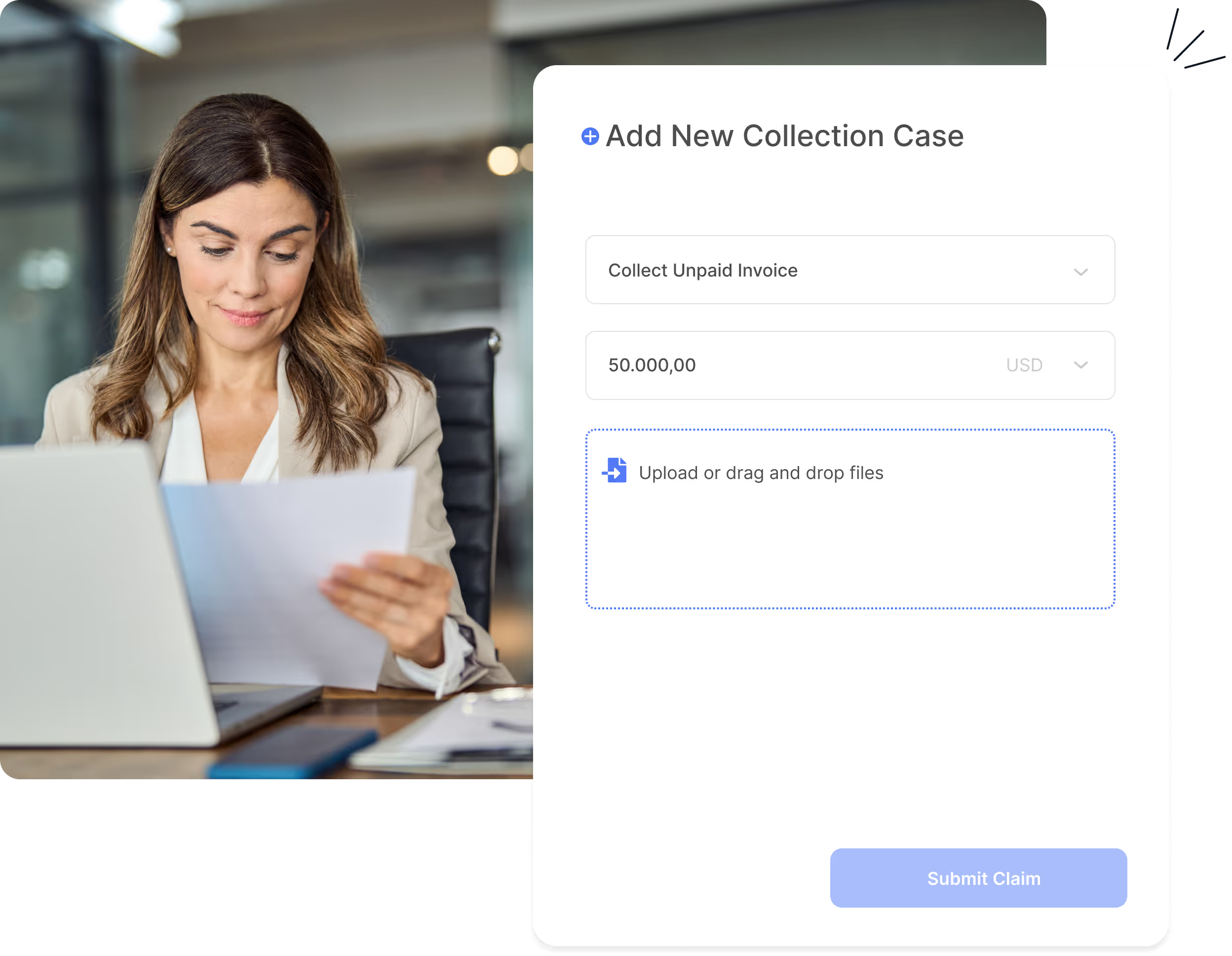
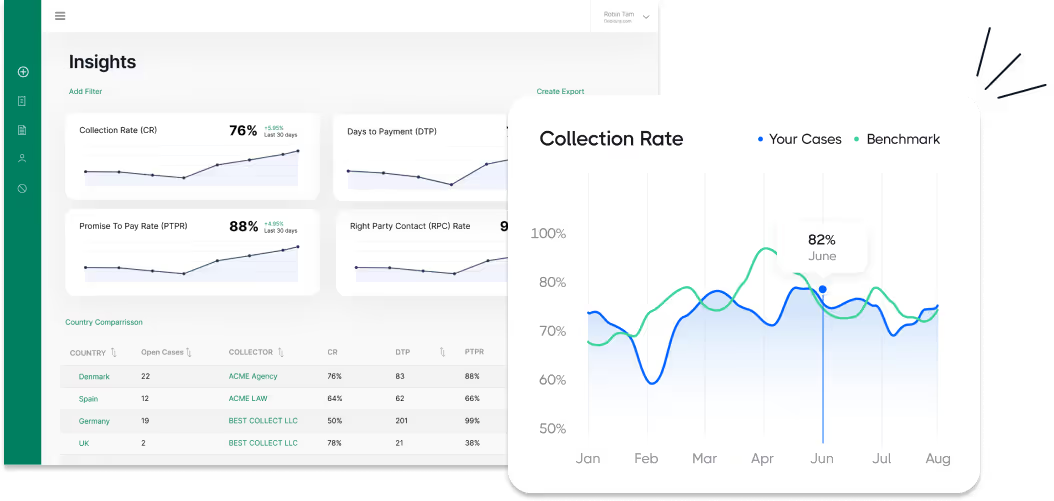
Schnelles, einfaches und risikofreies Inkasso in Polen
Debitura recovers unpaid invoices from debtors in Poland through our platform: submit your claim, and we assign it to our local partner working on a No Cure, No Pay basis while you track progress in real time. Your case is handled by EBOF (Europejskie Biuro Ochrony Finansów), a Wrocław-based debt collection agency (firma windykacyjna) founded in 2012, with its own Mediation Bureau and in-house legal team.
- Risikofrei: Zahlen Sie nur, wenn wir Ihr Geld zurückholen.
- Schnelle Einrichtung: Rechnungen mit wenigen Klicks einreichen.
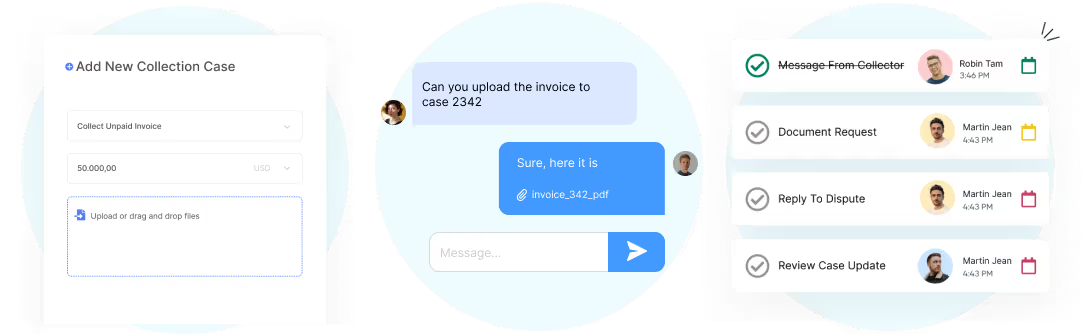
- Echtzeit-Verfolgung: Verfolgen Sie den Fortschritt live in einem Portal.
- Lokales Fachwissen: Polnischsprachige Spezialisten kümmern sich um alles.

So einfach geht's
- Create your free Debitura account and submit your Polish claim with invoice details.
- EBOF reviews and accepts your claim within 48 hours, then sends your debtor a formal payment demand (wezwanie do zapłaty) with a 7-day deadline to pay or propose instalments, and follows up by phone.
- Verfolgen Sie den Fortschritt in Echtzeit in Ihrem Dashboard. Sie zahlen nur, wenn Gelder eingezogen wurden.
Prefer automation? Connect your ERP or accounting software to submit claims automatically.

Transparente, erfolgsbasierte Preise
Mit Debitura zahlen Sie nur bei Erfolg. Das vorgerichtliche Inkasso erfolgt auf „Kein Erfolg, keine Gebühren“-Basis: eine Erfolgsprovision, die von den eingezogenen Beträgen abgezogen und lokal von Ihrem Partner in Rechnung gestellt wird. Die Gebühren hängen vom Land des Schuldners ab, nicht von Ihrem.
- Schuldner in Europa (EU, Island, Liechtenstein, Norwegen, Großbritannien und der Schweiz): Erfolgsprovisionen ab 6 % je nach Forderungshöhe.
- Schuldner im Rest der Welt: Erfolgsprovisionen ab 7,5 % je nach Forderungshöhe.
- Ältere Forderungen: Für Forderungen, die 12–24 Monate überfällig sind, sowie für Forderungen, die älter als 24 Monate sind, wird ein Aufschlag berechnet.
- Rechtliche Schritte sind optional: Sie genehmigen Festpreisangebote, bevor rechtliche Ausgaben anfallen.
Die vollständige Gebührenübersicht finden Sie auf der Preise-Seite oder erhalten Sie eine sofortige Schätzung, wenn Sie eine Forderung hochladen.
Wie funktioniert Inkasso in Polen?
Debt collection in Poland starts with an amicable phase handled locally by EBOF: reminders and a formal payment demand, aimed at full payment or a written settlement. Most undisputed claims resolve at this stage. If the debtor still does not pay, escalation is never automatic. Your partner assesses the legal route and you approve a quote before any court step.
Wichtige Erkenntnisse
- Submit your claim in 2 minutes via the Debitura platform.
- EBOF takes local action on your behalf.
- No Cure, No Pay: you pay nothing unless we recover.
- You stay in control and approve every escalation.
- Track progress until you get paid.
In this video, Piotr Piekarski of EBOF, our partner in Poland, walks through how a Polish case runs, from the first reminder and mediation to court and enforcement.
Die vier Schritte von der unbezahlten Rechnung zum eingezogenen Geld
- Step 1, Amicable collection: reminders, a formal payment demand and negotiation, handled locally by EBOF. Most undisputed claims are resolved here, without going to court.
- Schritt 2, Vollstreckbarer Titel: Zahlt der Schuldner weiterhin nicht, prüft Ihr Partner den rechtlichen Weg zur Erlangung eines vollstreckbaren Titels, und Sie genehmigen ein Festpreisangebot, bevor weitere Schritte eingeleitet werden.
- Step 3, Enforcement: with a title, the court bailiff (komornik sądowy) can seize assets, garnish wages and freeze bank accounts until the claim is recovered.
- Step 4, Insolvency: if the debtor turns out to be insolvent, your proof of claim is filed and any distributions are monitored on your behalf.
Every step is tracked in your dashboard, and nothing escalates without your approval. The full legal detail for Poland, timelines, costs, courts and enforcement, follows in the guide below.

Kostenlos starten
Keine Einrichtungsgebühr
Zugelassene Experten vor Ort
Kein Erfolg, keine Kosten
Inkasso in Polen – der vollständige Leitfaden 2026
Built for creditors, in-house counsel and finance teams, this guide sets out how debt collection in Poland works end to end: the legal framework, who does what, limitation and interest rules, the order-for-payment route (postępowanie nakazowe/upominawcze) to an enforceable title, enforcement by the court bailiff (komornik sądowy), and corporate insolvency under Prawo upadłościowe.
Auf dieser Seite:
Warum Sie dieser Anleitung vertrauen können
At Debitura, we uphold the highest standards of impartiality and precision to bring you comprehensive guides on international debt collection. Every guide is written from primary legal sources and reviewed by licensed local experts in the jurisdiction it covers.
Fragen oder Feedback? Senden Sie uns eine E-Mail an contact@debitura.com , wir aktualisieren diesen Leitfaden basierend auf Ihrem Input.
Debitura in Zahlen:
- 767 licensed partners - collection agencies and law firms in our network
- 180 countries covered - with cases handled in 174 of them
- 5,306 businesses registered with Debitura
- 33 days median time to first payment on European cases
Von Experten geleitet, lokal validiert
Verfasst von Lars Holdgaard, Gründer von Debitura (über 10 Jahre Erfahrung im globalen B2B-Forderungseinzug). Jede Seite wird von führenden lokalen Anwälten überprüft, um die rechtliche Genauigkeit und die Anwendbarkeit der praktischen Schritte zu gewährleisten.

Mitwirkende lokale Experten:
Letzte Aktualisierung:
September 22, 2026

Debt collection in Poland - quick answers
Poland offers a fast, low-cost order-for-payment route for undisputed money claims and an established bailiff-enforcement system. The headline rules are below.
Wie hoch sind die Inkassokosten in Polen?
The standard court fee (opłata stosunkowa) is 5% of the claim value above PLN 20,000, capped at PLN 100,000, under Article 13 of the Ustawa o kosztach sądowych w sprawach cywilnych (the Act on Court Costs in Civil Matters); below PLN 20,000 a banded fixed fee of PLN 30 to PLN 1,000 applies. Court fees are VAT-exempt; legal-representation fees carry the standard 23% VAT. A court bailiff (komornik sądowy) charges the debtor a standard enforcement fee of 10% of the amount recovered (Ustawa o kosztach komorniczych, art. 27). In a B2B claim, the creditor can also add a fixed recovery-cost lump sum without proving costs: EUR 40 for claims under PLN 5,000, EUR 70 for PLN 5,000 to under PLN 50,000, or EUR 100 for PLN 50,000 or more. The lump sum is due for each late-paid transaction, which in practice usually means per invoice (Court of Justice of the EU, case C-585/20).
Wie lange dauert Inkasso in Polen?
Once a nakaz zapłaty (order for payment) is served, the debtor has two weeks to pay or file a sprzeciw (opposition) if service is domestic, one month if served elsewhere in the EU, or three months if served outside the EU (Kodeks postępowania cywilnego, art. 480² §2). An unopposed order has the legal effect of a final judgment and becomes enforceable without further formalities. If a claim goes to ordinary litigation instead, the European Commission estimates that Polish first-instance courts needed about 360 days to resolve a contested civil or commercial case in 2024 (2026 EU Justice Scoreboard).
Wie ist die Verjährungsfrist für Forderungen in Polen?
The general limitation period (przedawnienie) is six years; for periodic payments and claims connected with business activity, it is three years (Kodeks cywilny, art. 118). Special periods apply to some claims: two years for sales made within the seller's business (KC art. 554) and one year for carriage and forwarding claims (KC arts. 792 and 803; Prawo przewozowe, art. 77). The period ends on the last day of the calendar year unless it is shorter than two years, and it runs from the day the claim becomes due (KC art. 120 §1). A 2026 draft from the Civil Law Codification Commission proposes shorter, unified limitation periods; it is under consultation and not yet law. Statutory default interest under KC art. 481 §2 equals the National Bank of Poland (NBP) reference rate plus 5.5 percentage points, currently 9.25% a year from 5 March 2026, capped at twice that rate. A B2B or B2G debt carries a separate, higher commercial late-payment rate of the NBP reference rate plus 10 percentage points, or plus 8 points where the debtor is a public healthcare entity, confirmed at 13.75% and 11.75% respectively for the second half of 2026.
Welche Dokumente benötige ich, um eine Forderung in Polen einzutreiben?
To obtain a nakaz zapłaty, the claim must be proven with documents attached to the statement of claim: an official document, an invoice accepted by the debtor, a written payment demand together with the debtor's written acknowledgment of the debt, or a bank-returned unpaid demand. A promissory note or cheque of undoubted authenticity also qualifies. No mandatory form is required and legal representation is optional.
Welchen rechtlichen Weg sollte ich wählen, um eine Forderung in Polen einzutreiben?
The order-for-payment procedure (postępowanie nakazowe or upominawcze) is available at any claim value, is optional, and needs no mandatory legal representation, but cannot be used if the defendant cannot be served in Poland. Claims for performance up to PLN 20,000 also qualify for the simplified procedure (postępowanie uproszczone, KPC art. 505¹). Where the order-for-payment documents are missing, or an issued order is successfully opposed, the case proceeds as ordinary litigation before the sąd rejonowy (district court) or, for property claims above PLN 100,000, the sąd okręgowy (regional court, KPC art. 17 pkt 4).
Do I need a lawyer to collect a debt in Poland?
No. Legal representation is not mandatory for the order-for-payment procedure or the simplified procedure, and many creditors file these themselves or through EBOF, our local partner. A lawyer (adwokat or radca prawny) becomes practically important once a debtor opposes a claim, the case moves to ordinary litigation, or cross-border service and enforcement are involved.
| Punkt | Rate or threshold |
|---|---|
| Standardgerichtsgebühr | 5% above PLN 20,000, capped at PLN 100,000 |
| Bailiff enforcement fee | 10% of the amount recovered (debtor pays) |
| Statutory (civil) default interest | NBP rate + 5.5pp (9.25% from 5 Mar 2026) |
| B2B-Verzugszinsen | NBP rate + 10pp (13.75% for H2 2026) |
| Sąd okręgowy threshold | Property claims over PLN 100,000 |
Wer ist am Inkasso in Polen beteiligt?
Recovery in Poland involves collection firms for the amicable phase, court bailiffs for enforcement, and lawyers for litigation. Debitura supports you across all stages through EBOF, our local partner.
Collection agencies in Poland
No general licence is currently required to run a private debt-collection business in Poland; sole traders, ordinary commercial companies and banks may all collect debts. A Ministry of Justice draft law (project UD435) proposing a licensing regime for debt collectors and the profession of windykator (debt collector) has been in the pre-parliamentary phase since 2023, with no evidence of further parliamentary progress. Collection firms handle the pre-legal phase: demands, negotiation and settlement agreements, before any legal escalation.
Gerichtsvollzieher in Polen
Court bailiffs (komornicy sądowi) are court-attached enforcement officers, regulated by the Ustawa o komornikach sądowych, with their fees set separately by the Ustawa o kosztach komorniczych. A creditor lodges an enforceable title directly with the bailiff attached to the competent district court to start enforcement. Bailiffs seize movable and immovable property, garnish wages and freeze bank accounts, always subject to statutory debtor exemptions.
Anwälte in Polen
An adwokat (advocate) or radca prawny (legal counsel) represents creditors in ordinary litigation and in disputed or higher-value cases. Legal representation is not mandatory for the order-for-payment procedure, but becomes practically important once a debtor opposes a claim or the case involves cross-border or complex legal questions.
Courts and regulators in Poland
Sądy rejonowe (district courts) handle first-instance civil matters in most cases; sądy okręgowe (regional courts) take first-instance property claims above PLN 100,000 and hear appeals from the rejonowe. UOKiK (the Office of Competition and Consumer Protection) enforces against unfair collection practices affecting consumers, and UODO (the Personal Data Protection Office) oversees debtor data processing under the GDPR and Poland's Ustawa o ochronie danych osobowych.
Welche Gesetze und Gerichte gelten für das Inkasso in Polen?
Debt collection in Poland runs on a codified civil-law system, with EU instruments layered on top for cross-border claims.
The civil court system in Poland
Sądy rejonowe (district courts) hear first-instance civil matters in most cases. Sądy okręgowe (regional courts) hear first-instance property claims above PLN 100,000 (Kodeks postępowania cywilnego, art. 17 pkt 4) and act as the appeal court for sąd rejonowy decisions. Sądy apelacyjne (courts of appeal) hear appeals from sąd okręgowy decisions, and the Sąd Najwyższy (Supreme Court) supervises the ordinary courts for lawfulness and consistency.
Key legislation in Poland
- Kodeks cywilny (the Civil Code): obligations, limitation (art. 118) and statutory interest (art. 481).
- Kodeks postępowania cywilnego (the Code of Civil Procedure): court jurisdiction, the order-for-payment procedure and the simplified procedure.
- Ustawa o kosztach sądowych w sprawach cywilnych (the Act on Court Costs in Civil Matters): court fees.
- Ustawa o komornikach sądowych and the Ustawa o kosztach komorniczych: bailiff organisation and enforcement fees.
- Ustawa o przeciwdziałaniu nadmiernym opóźnieniom w transakcjach handlowych (the Act on Counteracting Excessive Delays in Commercial Transactions): B2B and B2G late-payment interest and recovery costs.
- Prawo upadłościowe (the Bankruptcy Law) and Prawo restrukturyzacyjne (the Restructuring Law): insolvency.
Limitation, suspension and interruption in Poland
Limitation is suspended (paused) during minority against parents, incapacity against guardians, marriage between spouses, force majeure, mediation, and a zawezwanie do próby ugodowej (a formal summons to a settlement attempt) (KC art. 121). It is interrupted by any action before a court, authority or arbitral tribunal pursuing the claim, or by the debtor's acknowledgment of the debt; after interruption, the period restarts (KC arts. 123-124). A claim confirmed by a final judgment or court settlement prescribes in six years even where the underlying claim carried a shorter period (KC art. 125 §1).
Consumer and data protection in Poland
UOKiK (the Office of Competition and Consumer Protection) enforces against collection practices that harm consumers collectively, including cease-and-desist orders and fines. Data protection in debt collection is governed by the GDPR and Poland's Ustawa o ochronie danych osobowych (the Act on the Protection of Personal Data), enforced by UODO (the Personal Data Protection Office).
The role of the Sąd Najwyższy
The Sąd Najwyższy (Supreme Court) does not re-try facts. It hears cassation appeals (skarga kasacyjna) from sąd apelacyjny judgments, reviewing whether the lower courts applied the law correctly, and its rulings on legal questions guide how sądy rejonowe and sądy okręgowe interpret the Kodeks cywilny and the Kodeks postępowania cywilnego in later cases.
Schritt 1 - Wie funktioniert das außergerichtliche (vorgerichtliche) Inkasso in Polen?
Amicable collection in Poland means recovering an unpaid invoice without going to court, through a wezwanie do zapłaty (a payment demand) and negotiation. For a B2B or B2G debt, statutory late-payment interest and a fixed recovery-cost lump sum accrue automatically once the invoice passes its due date, under the Ustawa o przeciwdziałaniu nadmiernym opóźnieniom w transakcjach handlowych, giving the creditor a documented, quantifiable claim before any escalation.
| Phase | Aktion |
|---|---|
| Payment demand (wezwanie do zapłaty) | Formal written demand; a qualifying document for the order-for-payment route if the debtor acknowledges it in writing. |
| Statutory interest and costs | Accrue automatically on a B2B/B2G debt once the default 30 or 60-day payment term passes; the fixed recovery-cost lump sum is due per late-paid invoice. |
| Settlement attempt | A zawezwanie do próby ugodowej (a court-mediated settlement summons) suspends the limitation clock while pending. |
| Eskalation | Apply for a nakaz zapłaty, or file an ordinary suit if the claim is disputed. |
Mediation settlements in Poland
A settlement reached before a mediator (ugoda zawarta przed mediatorem) can be approved by the court, which attaches an enforceability clause where the settlement is enforceable. Once approved, it has the force of a court settlement, and with the clause it is an enforceable title (Kodeks postępowania cywilnego, arts. 183(14) and 183(15)). Limitation is suspended while mediation lasts (KC art. 121 pkt 5), and approving a settlement from contractual mediation carries no court fee (Ustawa o kosztach sądowych w sprawach cywilnych, art. 95). For a creditor, this turns an agreed instalment plan into a title that can go straight to a bailiff if the debtor stops paying, without a full court case.
When to escalate to court in Poland
Escalate when the demand goes unanswered, the debtor disputes the claim without substance, or the limitation period approaches. For a documented, undisputed claim, the order-for-payment procedure is usually the fastest first step.
How EBOF runs the amicable phase
EBOF reviews and accepts a submitted claim within 48 hours. It sends the debtor a reminder, checks the company and its board in public registers such as the Krajowy Rejestr Zadłużonych (KRZ), traces current contact details where needed, and contacts the debtor by phone and in writing with a 7-day deadline to pay or propose instalments. Field collectors can visit the debtor in person. Where a debtor needs an instalment plan, EBOF can secure it with a mediation settlement through its own Mediation Bureau, and it monitors the case until payment is received or the file is referred for legal escalation with your approval.
Schritt 2 - Wie erhalten Sie einen vollstreckbaren Titel in Polen?
To enforce a debt in Poland, you first need an enforceable title. The order-for-payment procedure is the fast track for most claims, with ordinary litigation for disputed or unqualified ones.
The order-for-payment procedure (nakaz zapłaty)
Available at any claim value and issued only on the claimant's request, the nakaz zapłaty needs no mandatory legal representation. Qualifying documents include an official document, an invoice accepted by the debtor, a written demand plus the debtor's written acknowledgment, a bank-returned unpaid demand, or a promissory note or cheque of undoubted authenticity (KPC arts. 480¹-480⁴). The debtor has two weeks to pay or oppose if served domestically, one month if served elsewhere in the EU, or three months if served outside the EU. An unopposed order has the effect of a final judgment.
The electronic order-for-payment procedure (EPU)
A fully electronic variant, the elektroniczne postępowanie upominawcze (EPU), runs through the Ministry of Justice's e-Sąd platform, handled by a single dedicated court (Sąd Rejonowy Lublin-Zachód w Lublinie, VI Wydział Cywilny) for the whole country. It follows the same order-for-payment logic as the paper procedure, filed and served electronically.
The simplified procedure
Claims for performance up to PLN 20,000 qualify for the postępowanie uproszczone (simplified procedure), which uses official forms and routes appeals from sąd rejonowy to sąd okręgowy, or from sąd okręgowy to sąd apelacyjny (KPC art. 505¹).
Ordinary litigation and choosing the court
Ordinary litigation applies where the order-for-payment documents are missing, or an issued order is successfully opposed. Sąd rejonowy (district court) hears claims at or below PLN 100,000; sąd okręgowy (regional court) hears property claims above that value (KPC art. 17 pkt 4). The losing party pays the winning party's necessary litigation costs, including legal representation (KPC art. 98 §1).
Mehr zu Gerichtsverfahren in Polen
Costs of ordinary litigation
A costs order itself carries statutory default interest from the date it becomes final (KPC art. 98 §1¹). Court fees are VAT-exempt; legal-representation fees carry the standard 23% VAT.
Schritt 3 - Wie funktioniert die Zwangsvollstreckung in Polen?
With an enforceable title, a creditor lodges it with a court bailiff (komornik sądowy) attached to the competent district court to start enforcement.
Enforceable titles in Poland
Final or immediately-enforceable court judgments and court settlements, notarial deeds where the debtor has submitted to enforcement, and foreign judgments declared enforceable all qualify as enforceable titles. A first-instance court typically attaches the enforceability clause to its own judgment within days of it becoming final.
Ways to enforce a claim in Poland
- Movable-property seizure and sale: the bailiff seizes and auctions the debtor's movable assets.
- Wage garnishment: the bailiff attaches the debtor's salary, subject to statutory exemptions.
- Bank-account freeze: the bailiff freezes and withdraws funds from the debtor's bank accounts.
- Real-estate seizure and sale: the bailiff seizes, values and auctions the debtor's real property.
- Other property rights: the bailiff can also attach other property rights and claims the debtor holds against third parties.
Debtor exemptions and the bailiff's fee in Poland
Certain items are protected from enforcement, including essential household and subsistence items, one month's food and fuel, work tools other than vehicles, a subsistence-level minimum of livestock, and social-assistance benefits (KPC art. 829). The bailiff charges the debtor a standard proportional fee of 10% of the amount recovered (Ustawa o kosztach komorniczych, art. 27). If the creditor discontinues enforcement, a 5% fee on the unrecovered balance falls on the creditor, shifting to the debtor at a rate of 10% if the debtor pays after one month of the enforcement notice (art. 29).
When enforcement against a company fails
Since 1 December 2021, a bailiff or court enters a debtor whose enforcement was discontinued as ineffective into the public Krajowy Rejestr Zadłużonych (National Register of Debtors, KRZ), where the entry stays visible for 7 years (KRZ Act, art. 2(1)(3)). The KRZ is a state register kept by the Minister of Justice, not to be confused with KRD, a private business-information bureau. If enforcement against a Polish limited-liability company (sp. z o.o.) proves ineffective, its management board members are jointly and severally liable for its debts unless they filed for bankruptcy or restructuring in time or another statutory defence applies (Kodeks spółek handlowych, art. 299). Hiding or disposing of assets to defeat creditors, or frustrating enforcement of a judgment, is a criminal offence (Kodeks karny, arts. 300-302).
Challenging a bailiff's actions in Poland
A bailiff's actions can be challenged by a complaint (skarga) to the competent district court within one week. Enforceability-clause orders and any stay or discontinuance decision are separately appealable.
Schritt 4 - Wie beeinflussen Insolvenzverfahren den Forderungseinzug in Polen?
A Polish debtor is insolvent when unable to pay due monetary obligations, presumed once payment delay exceeds three months; for a legal entity, insolvency also arises when liabilities exceed assets for more than 24 months (Prawo upadłościowe, art. 11).
Two regimes: bankruptcy and restructuring
Bankruptcy (Prawo upadłościowe) liquidates the debtor's assets to satisfy creditors, while attempting to preserve the enterprise where feasible. Restructuring (Prawo restrukturyzacyjne) offers four composition procedures, from a simple composition-approval process to a full remedial procedure, letting a debtor at risk of insolvency reach an agreement with creditors instead of liquidating. The party obliged to file for bankruptcy must do so within 30 days of the grounds arising, on pain of personal liability for the resulting damage (art. 21).
How restructuring pauses enforcement
Restructuring is started by the debtor and can halt a creditor's recovery. In the simplified arrangement-approval procedure (postępowanie o zatwierdzenie układu), the supervisor's announcement of the arrangement day in the KRZ bars new enforcement against the debtor's business assets and suspends pending enforcement; the protection lapses if no approval application reaches the court within 4 months (Prawo restrukturyzacyjne, arts. 226a-226g). In this procedure the debtor chooses and pays the supervisor (art. 35). In the court-run restructuring procedures, enforcement is suspended from the opening of the proceedings until they end (arts. 259, 278 and 312). Watch the KRZ for announcements about your debtor so you can lodge and vote your claim in time.
Creditor priority in Polish bankruptcy
Claims are satisfied in order: employment, farmers' produce-supply and maintenance claims and social-insurance contributions rank first; taxes and other public levies rank second; interest, fines and gift or legacy claims rank third; shareholder or partner-loan claims rank fourth. Secured creditors (mortgage, pledge or registered pledge) are paid in priority from the secured asset's proceeds, ahead of the general ranking.
The creditor process in Poland
A creditor lodges a claim with the bankruptcy administrator within 30 days of the bankruptcy declaration, to be entered in the schedule of claims. A natural-person debtor may request a creditor payment plan within 30 days of the bankruptcy's conclusion; the court typically sets a repayment obligation running 36 to 84 months, with discharge following completion. Discharge excludes maintenance claims, injury compensation and intentionally undisclosed debts, and may be refused if the debtor caused their own insolvency or was discharged within the prior 10 years.
Monitoring an insolvent debtor in Poland
Because full satisfaction from an insolvent estate is rare, a creditor's best position comes from filing early and precisely: lodging the claim within the administrator's deadline, with the underlying contract, invoices and any court judgment attached, then monitoring creditors' meetings and distributions until the case closes.
Gebühren, Zinsen und wer was in Polen zahlt
- Unsere Gebühr: erfolgsbasiert, Kein Erfolg, keine Gebühren (siehe Preise).
- Court & enforcement fees: statutory court and enforcement fees apply only if the case escalates to legal action, and are generally recoverable from the debtor if you win. The standard court fee is 5% of the claim value above PLN 20,000 (capped at PLN 100,000), with fixed banded fees below that threshold.
- Statutory debtor items: civil-law default interest of the NBP reference rate plus 5.5 percentage points (9.25% a year from 5 March 2026) applies automatically, and a B2B or B2G claim also carries the higher commercial late-payment rate (NBP rate plus 10 or 8 percentage points) plus a fixed recovery-cost lump sum of EUR 40 to EUR 100 per invoice, no proof required.
- Enforcement fee: the court bailiff charges the debtor a standard 10% of the amount recovered; if enforcement is discontinued at the creditor's request, a 5% fee on the unrecovered balance falls on the creditor instead.
- Who keeps what: recovered principal is yours; statutory interest and costs follow the contract, the statute and the court's order. Court fees are VAT-exempt; legal-representation fees carry the standard 23% VAT.
Cross-border debt collection in Poland
For a claim against a debtor elsewhere in the EU, the European order for payment (Regulation 1896/2006) offers a uniform, cross-border order-for-payment route with a 30-day opposition window for the defendant, and Poland participates fully in the scheme. The European Small Claims Procedure (Regulation 861/2007, as amended by Regulation 2015/2421) covers civil and commercial claims up to EUR 5,000 excluding expenses, available in every EU country except Denmark; Poland's fixed court fee for this procedure is PLN 100, for both the claim form and an appeal. Within the EU, a judgment from one member state's courts is recognised and enforced in Poland, and vice versa, without a separate declaration of enforceability, under the Brussels I recast Regulation (EU) 1215/2012, subject only to limited grounds of refusal. In practice, a creditor holding a judgment from another EU country, or a European Enforcement Order, applies directly to a Polish bailiff with the judgment and its certificate, with no Polish court clause required (KPC art. 1153(14)); the bailiff may ask for a certified Polish translation of the certificate.
Finden Sie einen Rechtsanwalt für Inkasso vor Ort
Benötigen Sie eine gerichtsfeste Vertretung? Teilen Sie uns Ihren Fall einmal mit und erhalten Sie bis zu drei Angebote von geprüften Prozessanwälten. Kostenlos, schnell und unverbindlich.
- Geprüfte Spezialisten
- Angebote in 24 Stunden, keine versteckte Gebühren
- Faire, vorab ausgehandelte Preise
Dolna 10 lok. 2, 00-774, Warschau, Polen
FGGK Freliszka Gosk-Grodzka Karwowski Adwokaci i Radcowie Prawni sp.p.
FGGK ist eine führende Anwaltskanzlei in Warschau, die effektive Inkassodienstleistungen in Polen anbietet und sich mit über 15 Jahren Erfahrung als der bevorzugte Partner für das Inkasso positioniert. Sie betreut Mandanten in ganz Europa und Asien und ist von Orły Prawa anerkannt.
.webp)
Gerichtsverfahren
gerichtliches Inkasso
Zwangsvollstreckung
.png)
14

2009
.png)
Anwaltskanzlei
ul. Adama Branickiego 15, (02-972) Warschau
BRILLAW Kancelaria Radców Prawnych Mikulski & Partners
BRILLAW Kancelaria Radców Prawnych Mikulski & Partners ist eine führende Anwaltskanzlei in Warschau, die effektive Inkassodienstleistungen in Polen anbietet und sich seit 2000 als der bevorzugte Partner für das Inkasso positioniert, wobei Auszeichnungen und Mitgliedschaften ihren Ruf als vertrauenswürdiges Unternehmen stärken.
Gerichtsverfahren
gerichtliches Inkasso
Zwangsvollstreckung
15
2000
Anwaltskanzlei
.avif)
pl. Porozumienia Gdańskiego 1/21, 80-864 Gdańsk
Kancelaria Adwokacka Adwokat Dawid Suszyński
Kancelaria Adwokacka Adwokat Dawid Suszyński ist eine führende Anwaltskanzlei in Gdańsk, die seit 2017 effektive Inkassodienstleistungen in Polen anbietet. Sie ist von Orły Prawa anerkannt und betreut sowohl nationale als auch internationale Mandanten mit fundiertem Fachwissen.
Gerichtsverfahren
gerichtliches Inkasso
Zwangsvollstreckung
6
2017
Anwaltskanzlei

ul. Kotlarska 6/3, 31-539 Krakau
Kancelaria Adwokacka Maciej Bartnik
Kancelaria Adwokacka Maciej Bartnik ist eine führende Anwaltskanzlei in Krakau, die seit 2008 effektive Inkassodienstleistungen in Polen anbietet. Sie bietet umfassenden Service auf Englisch mit Bürostandorten in Krakau und Warschau und ist auf Rechtsberatung für Ausländer spezialisiert.
Gerichtsverfahren
gerichtliches Inkasso
Zwangsvollstreckung
5
2008
Anwaltskanzlei

Jana Sobieskiego 10/14 street, 31-136 Kraków, POLAND
Tomasz Staszak Kancelaria Adwokacka
Tomasz Staszak Kancelaria Adwokacka ist eine führende Anwaltskanzlei in Krakau, die effektive Inkassodienstleistungen in Polen anbietet und sich seit 2016 als erster Ansprechpartner für Forderungseinzug positioniert, mit einem Ruf für Exzellenz und umfassende juristische Expertise.
Gerichtsverfahren
gerichtliches Inkasso
Zwangsvollstreckung
3
2016
Anwaltskanzlei

ICG sc - International Consulting Group
ICG Sc ist eine führende Inkassofirma in Glogau, die effektive Inkassodienstleistungen in Polen anbietet, die für ihre 20-jährige Erfahrung, die erfolgsabhängige Vergütung und die Tätigkeit in über 50 Ländern bekannt ist und Auszeichnungen wie den Expert's Laurel erhalten hat.
Gerichtsverfahren
gerichtliches Inkasso
Zwangsvollstreckung
4
2002
Inkassounternehmen
RK Legal
RK Legal ist eine führende Anwaltskanzlei in Warschau, die effektive Inkassodienstleistungen in Polen anbietet und sich seit der Gründung im Jahr 2006 als erster Ansprechpartner für Forderungseinzug positioniert, mit einer Mitgliedschaft bei Euro Collect Net Lawyers und Expertise sowohl in B2C- als auch in B2B-Forderungen.
Gerichtsverfahren
gerichtliches Inkasso
Zwangsvollstreckung
140
2006
Anwaltskanzlei

BIERUTOWSKA 57-59, SUITE NO. 5, 1 FLOOR
WROCŁAW, POLAND
EUROPEJSKIE BIURO OCHRONY FINANSÓW Sp. z o.o. Sp. K.
Europejskie Biuro Ochrony Finansów (EBOF) is a Wrocław-based debt collection agency founded in 2012 and Debitura's exclusive partner in Poland. It collects business-to-business debt only, on a No Cure No Pay basis under Debitura's standard terms, and runs its own Mediation Bureau and in-house legal team.
Gerichtsverfahren
gerichtliches Inkasso
Zwangsvollstreckung
25
2012
Inkassounternehmen

ul. Bociana 22
Kraków, Poland
EULEO Debt Collection
EULEO ist eine führende Inkassofirma in Polen, die effektive, risikofreie Inkassodienstleistungen anbietet und sich seit 2001 mit einem Erfolgsmodell, zahlreichen Auszeichnungen und internationaler Reichweite als der bevorzugte Partner für das Inkasso positioniert; EULEO ist ein exklusiver Debitura-Partner in Polen, der erfolgsabhängige Vergütung Inkasso auf der Grundlage der risikofreien Standardbedingungen und Preise von Debitura anbietet.
Gerichtsverfahren
gerichtliches Inkasso
Zwangsvollstreckung
16
2001
Inkassounternehmen
Häufig gestellte Fragen
Entdecken Sie unsere häufigsten Fragen und Antworten unten, oder kontaktieren Sie uns direkt unter contact@debitura.com, wenn Sie Hilfe bei einem bestimmten Fall benötigen.
Wie funktioniert Inkasso in Polen für ausländische Gläubiger?
.svg)
Foreign creditors can collect a debt in Poland through amicable collection or, if needed, court proceedings. EBOF (Europejskie Biuro Ochrony Finansów), our local partner, handles the process in Polish on your behalf, working under Debitura's Standard Debt Collection Agreement. No general licence is currently required to run a debt-collection business in Poland, though a Ministry of Justice draft law (project UD435) has proposed introducing one since 2023. Claims must generally be filed within the 3-year limitation period for business-related debts, or 6 years for other civil claims (Kodeks cywilny, art. 118).
Kann ich Verzugszinsen und Inkassokosten in Polen berechnen?
Yes. Statutory default interest under Article 481 of the Kodeks cywilny equals the NBP reference rate plus 5.5 percentage points, currently 9.25% a year from 5 March 2026. For a B2B or B2G debt, the Act on Counteracting Excessive Delays in Commercial Transactions sets a higher rate, the NBP reference rate plus 10 percentage points, or plus 8 points where the debtor is a public healthcare entity, confirmed at 13.75% and 11.75% for the second half of 2026. A B2B creditor can also claim a fixed recovery-cost lump sum without proving costs: EUR 40, EUR 70 or EUR 100 depending on claim size, due for each late-paid invoice. Interest accrues automatically, no demand letter is required.
Was sind typische Inkassogebühren in Polen, und wie schneidet Debitura im Vergleich ab?
Debitura's fee is success-based: you pay nothing unless we recover your money. Because Poland is a European jurisdiction, our pre-legal success fee follows the European schedule: 20% for claims under USD 1,000, 9.5% for claims from USD 1,000 to 149,999, and 6% for claims of USD 150,000 or more (see pricing at debitura.com/pricing). If the case escalates to legal action, Polish court and enforcement fees apply on top and are generally recoverable from the debtor if you win.
Welche Gerichtsverfahren stehen für das Inkasso in Polen zur Verfügung?
Poland's main route for an undisputed money claim is the nakaz zapłaty (order for payment), available at any claim value with no mandatory legal representation (Kodeks postępowania cywilnego, arts. 480 to 480(4)). Claims up to PLN 20,000 also qualify for the simplified procedure (postępowanie uproszczone). Sąd rejonowy (district court) handles claims at or below PLN 100,000; sąd okręgowy (regional court) handles higher-value property claims (KPC art. 17 pkt 4). If the order-for-payment route is unavailable, or an issued order is opposed, the case proceeds as ordinary litigation.
Was passiert, wenn mein polnischer Schuldner die Rechnung bestreitet?
If the debtor disputes the claim, EBOF investigates the objection and advises on the strength of your case. Many disputes are resolved during amicable negotiation. If a nakaz zapłaty has already been issued, the debtor's opposition (sprzeciw) causes the order to lose its effect and the case proceeds as ordinary litigation. Debitura provides fixed-price quotes from Polish lawyers so you can decide whether to proceed, with full cost transparency.
Wie wird ein polnisches Gerichtsurteil vollstreckt und wie lange dauert dies?
Enforcement in Poland is carried out by a komornik sądowy (court bailiff), a court-attached enforcement officer who seizes wages, bank funds, movable property or real estate under an enforceable title, subject to statutory debtor exemptions (KPC art. 829). The bailiff charges the debtor a standard fee of 10% of the amount recovered (Ustawa o kosztach komorniczych, art. 27). Duration depends on the debtor's assets and cooperation. A Polish judgment generally prescribes after 6 years and is recognised and enforced across other EU member states without a separate declaration of enforceability, under the Brussels I recast Regulation (EU) 1215/2012.
Benötigen Sie zusätzliche Länder?
“Debitura recovered well over 100,000 euros in overdue invoices for us across several countries, all through one contract and one dashboard. Local experts handle each market and we only pay when they actually collect — so our team can spend that time on what we do best: helping our own customers engage smarter with the Manago AI platform.”
Manago AI (formerly SALESmanago)
767
Licensed collection agencies and law firms in our network
180
Countries covered, with cases handled in 174 of them
5,306
Businesses registered with Debitura
.svg)