.png)


.png)
.svg)
Kostenlos loslegen
Debt Collection Agency Colombia - No Win, No Fee
Debitura connects you to a licensed partner in Colombia to recover unpaid invoices. Submit your claim online and pay only if we succeed.

100 % risikofrei: Sie zahlen nur bei Erfolg
Local debt collection by licensed agency / law firm
Founded 2016 | Asociación Colombiana del Ecosistema Crediticio y BPO member | 57 employees, insured

Kostenlose Expertenberatung anfordern
Antwort von einem Spezialisten innerhalb von 24 Stunden.
Vielen Dank! Ihre Anfrage wurde empfangen!
Hoppla! Beim Absenden des Formulars ist etwas schiefgelaufen.
Why Choose Debitura for Debt Collection in Colombia
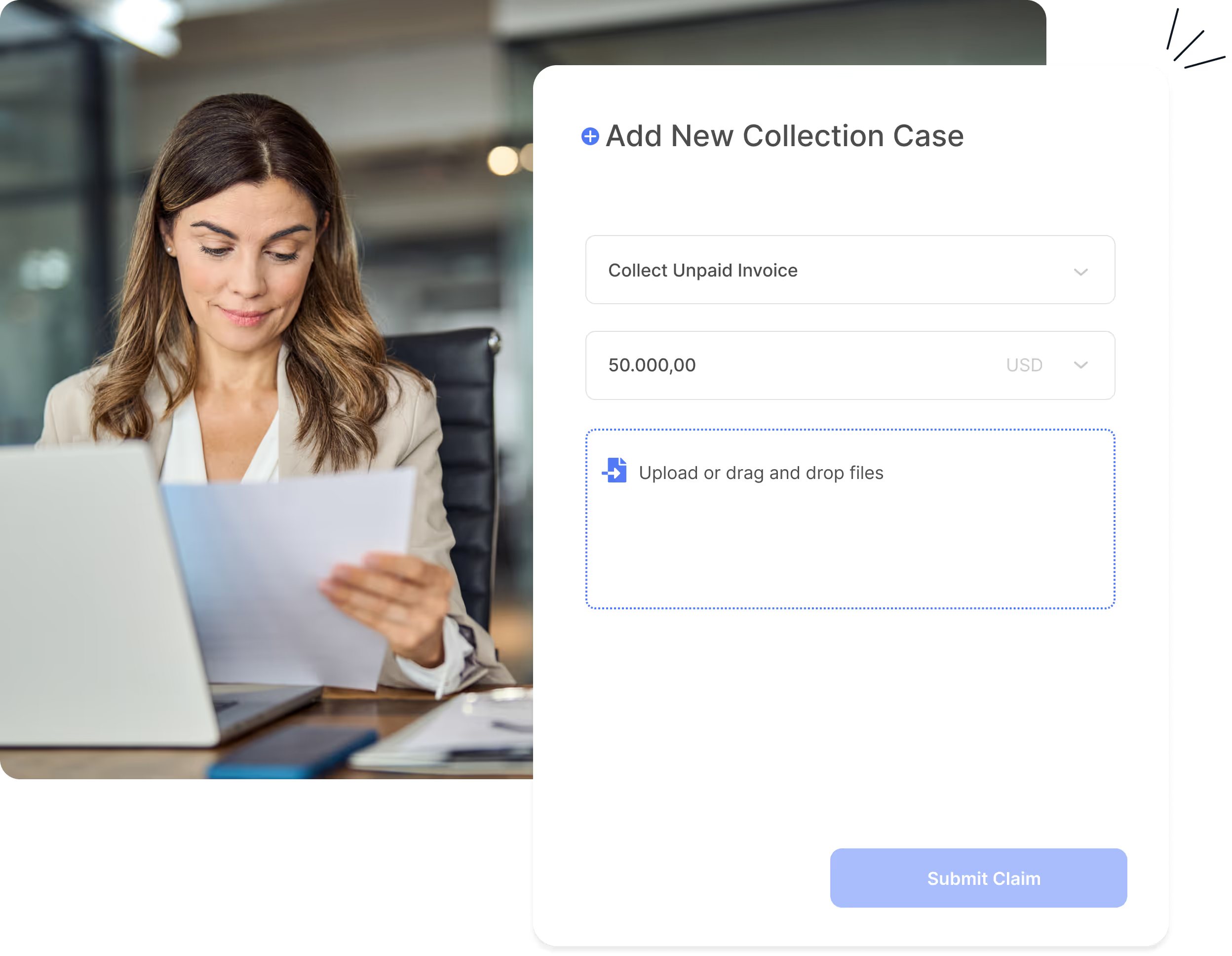
Fast, simple and risk-free debt collection in Colombia
Debitura connects you to a licensed local partner in Colombia and tracks your case from claim to payment. Submit your claim through our platform, and we assign it to Gestión Cartera y Servicios SAS (Gecaser), a Medellín-based debt collection agency registered with the Superintendencia de Industria y Comercio since 2016, with around 57 employees and membership in the Asociación Colombiana del Ecosistema Crediticio y BPO. Your case runs on a No Cure, No Pay basis, and nothing escalates beyond the amicable phase without your approval.
- Risk-free: pay only when we recover your money.
- Quick setup: submit the invoice and debtor details in minutes.
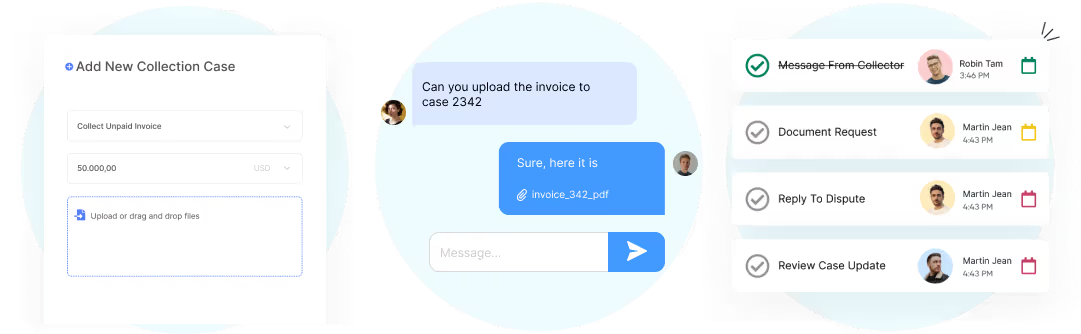
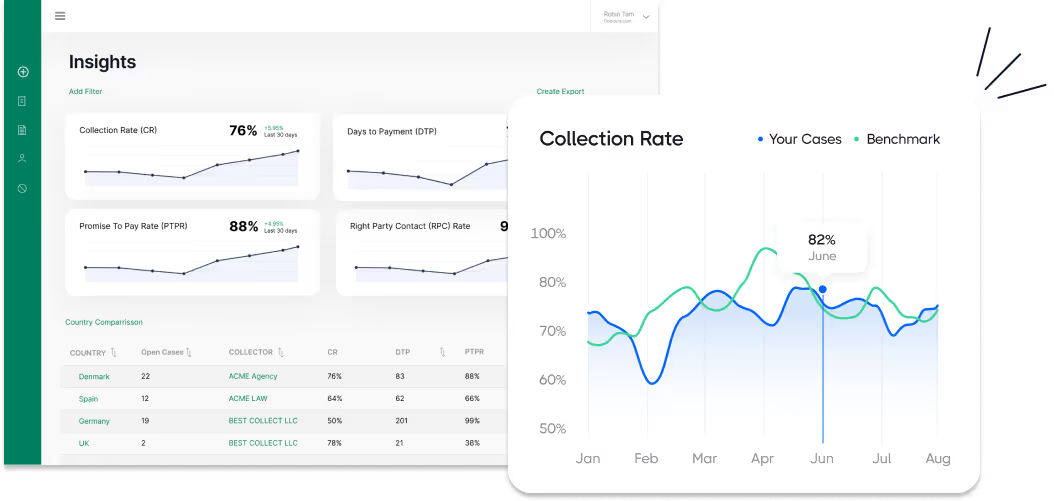
- Real-time tracking: follow every step in your dashboard.
- Local expertise: a licensed Colombian partner handles the case on the ground, in Spanish.
So einfach geht's
- Create a free Debitura account and submit your Colombian claim with the invoice and debtor details.
- Gestión Cartera y Servicios SAS (Gecaser) opens the amicable phase with a formal payment demand to your debtor.
- Track progress in your dashboard and pay only when funds are recovered.
Already using SAP, Oracle, Microsoft Dynamics or another ERP? Connect through our API or Zapier to submit claims automatically.

Transparente, erfolgsbasierte Preise
Mit Debitura zahlen Sie nur bei Erfolg. Das vorgerichtliche Inkasso erfolgt auf „Kein Erfolg, keine Gebühren“-Basis: eine Erfolgsprovision, die von den eingezogenen Beträgen abgezogen und lokal von Ihrem Partner in Rechnung gestellt wird. Die Gebühren hängen vom Land des Schuldners ab, nicht von Ihrem.
- Schuldner in Europa (EU, Island, Liechtenstein, Norwegen, Großbritannien und der Schweiz): Erfolgsprovisionen ab 6 % je nach Forderungshöhe.
- Schuldner im Rest der Welt: Erfolgsprovisionen ab 7,5 % je nach Forderungshöhe.
- Ältere Forderungen: Für Forderungen, die 12–24 Monate überfällig sind, sowie für Forderungen, die älter als 24 Monate sind, wird ein Aufschlag berechnet.
- Rechtliche Schritte sind optional: Sie genehmigen Festpreisangebote, bevor rechtliche Ausgaben anfallen.
Die vollständige Gebührenübersicht finden Sie auf der Preise-Seite oder erhalten Sie eine sofortige Schätzung, wenn Sie eine Forderung hochladen.
Wie funktioniert Inkasso in Kolumbien?
Debt collection in Colombia starts with an amicable phase led by Gestión Cartera y Servicios SAS (Gecaser), our licensed local partner: reminders and a formal payment demand, aimed at full payment or a written instalment plan. Most straightforward claims resolve at this stage. If the debtor still does not pay, escalating to court is a separate step you approve first, never automatic. This keeps costs down and preserves the business relationship wherever possible.
Wichtige Erkenntnisse
- Submit your claim in 2 minutes
- Local action starts fast
- No Cure, No Pay - pay only if we recover
- You stay in control of every step
- Get paid directly, we handle the rest
Die vier Schritte von der unbezahlten Rechnung zum eingezogenen Geld
- Step 1 - Amicable collection: reminders, a formal payment demand and negotiation, handled locally by a licensed partner. Most undisputed claims are resolved in this phase, without going to court.
- Step 2 - Enforceable title: if the debtor still does not pay, your partner assesses the legal route to obtain an enforceable title, and you approve a fixed-price quote before anything proceeds.
- Step 3 - Enforcement: with an enforceable title, the competent court can order attachment of bank funds, wages and other assets until the claim is recovered.
- Schritt 4 - Insolvenz: Sollte sich der Schuldner als insolvent erweisen, wird Ihre Forderungsanmeldung eingereicht und eventuelle Ausschüttungen in Ihrem Namen überwacht.
Jeder Schritt wird in Ihrem Dashboard verfolgt, und nichts eskaliert ohne Ihre Zustimmung. Die vollständigen rechtlichen Details für Kolumbien – Zeitpläne, Kosten, Gerichte und Zwangsvollstreckung – finden Sie im folgenden Leitfaden.

Kostenlos starten
Keine Einrichtungsgebühr
Zugelassene Experten vor Ort
Kein Erfolg, keine Kosten
Inkasso in Kolumbien – der vollständige Leitfaden 2026
This guide explains how debt collection works in Colombia: the amicable phase, the courts and enforceable titles, enforcement of judgments, insolvency, and cross-border recognition, for a creditor or in-house counsel deciding how to recover a debt in Colombia. Original Spanish legal terms are explained in plain English throughout.
Auf dieser Seite:
Warum Sie dieser Anleitung vertrauen können
At Debitura, we uphold the highest standards of impartiality and precision to bring you comprehensive guides on international debt collection. Every guide is written from primary legal sources and reviewed by licensed local experts in the jurisdiction it covers.
Fragen oder Feedback? Senden Sie uns eine E-Mail an contact@debitura.com , wir aktualisieren diesen Leitfaden basierend auf Ihrem Input.
Debitura in Zahlen:
- 767 licensed partners - collection agencies and law firms in our network
- 180 countries covered - with cases handled in 174 of them
- 5,306 businesses registered with Debitura
- 33 days median time to first payment on European cases
Von Experten geleitet, lokal validiert
Verfasst von Lars Holdgaard, Gründer von Debitura (über 10 Jahre Erfahrung im globalen B2B-Forderungseinzug). Jede Seite wird von führenden lokalen Anwälten überprüft, um die rechtliche Genauigkeit und die Anwendbarkeit der praktischen Schritte zu gewährleisten.

Mitwirkende lokale Experten:
Letzte Aktualisierung:
September 22, 2026

Inkasso in Kolumbien – kurze Antworten
How long do I have to collect a debt in Colombia?
An ordinary civil claim prescribes after 10 years from the due date; if you already hold an enforceable title, the executive action prescribes after 5 years and then converts into a further 5-year ordinary action (10 years total), per the Código Civil (the Civil Code), art. 2536. The same 10-year/5-year default applies whether the debtor is a business or a consumer. Negotiable instruments (títulos-valores, bills of exchange and promissory notes) get shorter, instrument-specific periods instead: 3 years for the direct action, 1 year for a holder's recourse action, and 6 months for recourse among prior obligors (Código de Comercio, the Commercial Code, arts. 789-791).
What interest can I charge on a late payment in Colombia?
For a commercial debt with no agreed rate, the default is the interés bancario corriente (IBC, the certified bank reference rate), currently 19.49% effective annual for September 2026, certified monthly by the Superintendencia Financiera de Colombia (SFC). Absent an agreed penalty rate, the statutory ceiling is 1.5x the IBC (29.24% for September 2026); charging above that ceiling forfeits all interest for the creditor (Código de Comercio art. 884). A purely civil, non-commercial debt instead defaults to a flat 6% per annum (Código Civil art. 1617). This split matters in practice: most invoiced trade debt, whether the buyer is a business or a consumer, counts as commercial, so the IBC-linked rate is the one that applies to most claims.
Which court handles my claim in Colombia?
The route depends on the claim value (cuantía), set against the minimum monthly wage (SMLMV) in force when you file. A claim up to 40 SMLMV goes to a juez civil municipal (municipal civil judge) as a single-instance "mínima cuantía" claim, with no appeal; a claim from 40 to 150 SMLMV is "menor cuantía"; above 150 SMLMV, it is "mayor cuantía" (Código General del Proceso, CGP, art. 25). Using the 2026 SMLMV of COP $1,750,905, that is roughly COP 70 million and COP 263 million.
| Claim value (cuantía) | Verfahrensweg |
|---|---|
| Up to 40 SMLMV (approx. COP 70 million) | Mínima cuantía - single instance, no appeal |
| 40-150 SMLMV (approx. COP 70-263 million) | Menor cuantía - first instance, appealable |
| Above 150 SMLMV (approx. COP 263 million+) | Mayor cuantía - first instance, appealable |
What will it cost to go to court in Colombia?
Colombia has no general ad valorem court or filing fee: the one law that tried to create one, Ley 1653 de 2013, was declared entirely unconstitutional by the Constitutional Court (Sentencia C-169-14), and "the administration of justice is free of charge" remains the constitutional baseline. The main cost is each side's own attorney fees, and the losing party additionally pays the winner's court-set "agencias en derecho" allowance under the loser-pays rule (CGP art. 365). Debitura's own success fee follows the debtor's country, not the client's, under a No Cure, No Pay model with no upfront cost.
What documents do I need to start collecting a debt in Colombia?
You need the invoice or contract, proof of delivery or the service performed, and any written acknowledgement of the debt. Where you already hold a document that is express, clear and due and constitutes full proof against the debtor (an accepted invoice or a promissory note), you can skip straight to the executive enforcement process as a "título ejecutivo" (enforceable title) under CGP art. 422, without first winning an ordinary declaratory judgment.
Does Colombia limit how a collector can contact a debtor?
Yes. Ley 2300 de 2023 ("Ley Dejen de Fregar", the Stop Bothering law) limits contact with a consumer debtor to one channel per week and one contact per day once direct contact starts, only Monday to Friday 7am-7pm and Saturday 8am-3pm, never Sundays or holidays. A newer law, Ley 2573 de 2026, in force since 19 May 2026, requires a collector to immediately suspend all collection activity, including interest and costs, the moment a debtor reports suplantación de identidad (identity theft), and to give the debtor 20 business days to file a criminal complaint before collection may resume.
Wer ist am Inkasso in Kolumbien beteiligt?
Inkassobüros
A licensed collection agency such as Gestión Cartera y Servicios SAS (Gecaser) handles the amicable, pre-legal phase: contacting the debtor, negotiating payment or an instalment plan, within the contact-hour and channel limits set by Ley 2300 de 2023. Colombia has no dedicated statutory licensing regime specifically for debt-collection agencies as their own profession; agencies instead operate under the Superintendencia de Industria y Comercio's (SIC) general consumer-protection oversight. Debitura's advantage: we route your case to a vetted, licensed partner and track every step in your dashboard.
Courts
A unified civil-court ladder handles debt claims: jueces civiles municipales (municipal civil judges) for mínima and menor cuantía claims, jueces civiles del circuito (circuit civil judges) for mayor cuantía and specific subject-matters, tribunales superiores de distrito judicial on appeal, and the Corte Suprema de Justicia, Sala de Casación Civil (the Supreme Court of Justice, Civil Cassation Chamber), as the final-instance and cassation court, and the sole forum for recognising foreign judgments (exequátur).
Zwangsvollstreckung
Colombia has no separate private-bailiff profession. The same civil judge who issues the payment order also decrees and directs embargo (attachment), secuestro (judicial sequestration) and remate (public judicial auction), assisted by court-appointed auxiliares de la justicia (secuestres, appraisers and auctioneers) who carry out the practical steps under judicial supervision.
Anwälte
Legal representation becomes necessary once a claim moves to ordinary or executive proceedings. Colombian lawyers draft the enforceable title, file the claim and represent you before the competent court.
Insolvency actors
For traders and companies, the Superintendencia de Sociedades administers Ley 1116 de 2006 insolvency proceedings, with jueces civiles del circuito residually competent. For ordinary natural persons who are not merchants, a conciliation-first regime under CGP Título IV instead runs through conciliation centres, notaries and jueces civiles municipales.
Welche Gesetze und Gerichte gelten für das Inkasso in Kolumbien?
Civil-court system
Colombia runs a unified civil-court ladder, with no separate commercial-court tier. Jueces civiles municipales (municipal civil judges) hear mínima cuantía claims (single instance) and menor cuantía claims (first instance, appealable); jueces civiles del circuito (circuit civil judges) hear mayor cuantía claims and specific subject-matters, including company disputes and insolvency not assigned to the Superintendencia de Sociedades; tribunales superiores de distrito judicial (superior district tribunals) hear appeals; and the Corte Suprema de Justicia, Sala de Casación Civil (Supreme Court of Justice, Civil Cassation Chamber), is the final cassation court and the exclusive forum for recognising foreign judgments (Código General del Proceso, CGP, arts. 17-20).
Wichtige Rechtsvorschriften
The Código Civil (Civil Code) governs general obligations, prescription (art. 2536) and civil legal interest (art. 1617). The Código de Comercio (Commercial Code, Decreto-Ley 410 de 1971) governs commercial obligations, negotiable-instrument prescription (arts. 789-793) and commercial default interest (art. 884). The Código General del Proceso (CGP, Ley 1564 de 2012) governs civil procedure, jurisdiction (arts. 17-26), the executive/enforcement process (arts. 422-425) and personal insolvency (Título IV). Ley 1116 de 2006 governs corporate and business insolvency. Two dedicated statutes govern debt-collection conduct: Ley 2300 de 2023 and the newer Ley 2573 de 2026. Ley 2445 de 2025 recently reformed the personal, non-merchant insolvency regime under CGP art. 538, raising its admission threshold (see Insolvency, Step 4, below).
Verbraucher- und Datenschutz
Ley 1480 de 2011 (Estatuto del Consumidor, the Consumer Statute) is the general consumer-protection law, enforced by the Superintendencia de Industria y Comercio (SIC), the same body that regulates Debitura's exclusive Colombia partner. Ley 1266 de 2008 (the habeas data law) and Ley 1581 de 2012 govern credit-reporting and personal-data protection, and are referenced directly by Ley 2573 de 2026's own principles.
Cross-border note
Colombia is not an EU or EEA member state and has none of the EU's cross-border procedural tools; recognition of foreign judgments instead proceeds through the classic exequátur route before the Corte Suprema de Justicia (see Cross-border debt collection below).
Schritt 1 – Wie funktioniert das außergerichtliche (vorgerichtliche) Inkasso in Kolumbien?
Amicable collection in Colombia starts the moment a claim is overdue. Where a due date was agreed, default (mora) arises automatically on that date: no demand letter is legally required to put the debtor in default (Código Civil art. 1608). A formal judicial demand is required only in the rarer case where no due date was ever fixed.
How contact works
Two statutes shape how a consumer debtor can be contacted. Ley 2300 de 2023 ("Ley Dejen de Fregar", the Stop Bothering law) limits collectors to channels the debtor has authorised, one channel per week and one contact per day once direct contact begins, and only Monday to Friday 7am-7pm and Saturday 8am-3pm, never Sundays or public holidays. References, guarantors and joint debtors get the same protection. Ley 2573 de 2026, in force since 19 May 2026, adds a further safeguard: the moment a debtor reports suplantación de identidad (identity theft), the collector must immediately suspend all collection activity, including accrued interest and costs, and give the debtor 20 business days to file a criminal complaint with the Fiscalía General de la Nación (the Attorney General's Office); if no complaint arrives in time, collection, including the suspended interest and costs, may resume.
| Tag | Typical action |
|---|---|
| Day 0 | Claim submitted; partner reviews the file and debtor details |
| Day 1-15 | First contact and formal payment demand, within the authorised channels and hours |
| Day 15-60 | Negotiation, follow-up contact and, where appropriate, an instalment agreement |
| Tag 60-90 | Case review: if the debtor still has not paid, your partner assesses escalation to court |
When to escalate
Escalation to court is a separate, approved step, never automatic. It becomes worthwhile once the debtor stops responding, repeatedly breaks an agreed instalment plan, or clearly cannot pay without a court order forcing the issue - and once you have a document (an accepted invoice, contract or promissory note) that can serve as an enforceable title.
Schritt 2 – Wie erhält man einen vollstreckbaren Titel in Kolumbien?
Where a claim is undisputed and you already hold a qualifying document - an invoice accepted by the debtor, a signed contract, or a promissory note - you can go straight to the executive process (proceso ejecutivo) via a título ejecutivo (enforceable title, CGP art. 422), skipping an ordinary declaratory claim entirely. Notification of the court's payment order (mandamiento ejecutivo) itself serves as formal notice of default where none existed before (CGP art. 423).
Which route and which court
Where you do not yet hold an enforceable title, the route depends on claim value. A claim up to 40 SMLMV (currently around COP 70 million) goes through the single-instance "proceso verbal sumario" (summary verbal proceeding) before a juez civil municipal, with no appeal (CGP art. 390, parágrafo 1o). A claim from 40 to 150 SMLMV, or above 150 SMLMV, goes through the ordinary, appealable track before the corresponding first-instance court (CGP arts. 17-20, 25).
Costs
Colombia has no general ad valorem court or filing fee: Ley 1653 de 2013, the one law that tried to create one, was declared entirely unconstitutional (Sentencia C-169-14). Litigation cost exposure is mainly each side's own attorney fees, plus the winner's court-set "agencias en derecho" allowance, which the losing party pays under the general loser-pays rule (CGP art. 365). This differs from jurisdictions that charge a percentage-based filing fee: in Colombia the constitutional baseline is that access to justice itself is free, so cost exposure comes only from legal representation and the loser-pays allowance.
Mehr zu Gerichtsverfahren in Kolumbien
Enforceable titles and variable interest
A título ejecutivo can cover both principal and accruing interest at a variable rate without stating the exact percentage in the claim (CGP art. 424), which suits a claim carrying statutory interest that changes month to month.
Prescription as a defence
Prescription in Colombia is never applied by a judge on their own motion. It must be raised by the debtor, whether by action or by exception, and can even be raised by the debtor's own creditors (Código Civil art. 2513). It can be interrupted naturally, when the debtor acknowledges the debt, or civilly, by a judicial demand, in which case the full period restarts (Código Civil art. 2539).
Schritt 3 – Wie funktioniert die Zwangsvollstreckung in Kolumbien?
Colombia runs enforcement through a single judicial track: the same civil judge who issued the payment order also decrees and directs embargo (attachment), secuestro (judicial sequestration) and remate (public judicial auction) of the debtor's assets. Colombia has no separate private-bailiff or enforcement-agent profession; court-appointed auxiliares de la justicia (secuestres, peritos and auctioneers) assist under the judge's supervision but do not independently control the process (CGP art. 467).
Ways to enforce
- Embargo: attachment of bank accounts, wages and income subject to statutory limits, and other assets.
- Secuestro: judicial sequestration, taking custody of movable or immovable assets pending sale.
- Remate: public judicial auction of the sequestered assets, with proceeds applied to the debt.
What answers for the debt
Under the universal-patrimony principle, all of a debtor's present and future movable and immovable assets answer for a personal obligation, except assets the law declares non-seizable (Código Civil art. 2488).
The enforcement authority
The enforcement authority is the ordinary civil court itself, not a separate agency. This differs from jurisdictions with a dedicated bailiff profession: in Colombia, one judge issues the title, orders the seizure and directs the sale, all within the same proceeding.
Costs of enforcement
Enforcement costs include the fees of court-appointed auxiliaries (secuestres, peritos and auctioneers), set case by case rather than as a fixed statutory percentage, and are additional to the litigation costs described in Step 2.
Wages and other income
Colombian law protects a baseline of a debtor's salary and other periodic income from attachment; the exact statutory limit depends on the type of income and the debtor's circumstances, so your partner checks the applicable limit case by case rather than assuming a fixed percentage.
Distribution of proceeds
Proceeds from a remate are distributed among creditors in the order set by the Civil Code's creditor-priority scheme, described in Step 4 below, after covering the costs of the sale itself.
When enforcement does not recover the debt
If a search for seizable assets comes up empty, or the debtor faces multiple enforcement claims from other creditors, the case may move into the insolvency track covered in Step 4 below.
Schritt 4 – Wie wirken sich Insolvenzverfahren auf die Forderungseintreibung in Kolumbien aus?
Colombia runs two separate insolvency regimes, split by debtor type, not by claim size.
Corporate and business insolvency
Traders and companies fall under Ley 1116 de 2006 (mainly the Superintendencia de Sociedades, with jueces civiles del circuito residually competent for insolvency the Superintendencia does not handle). There are two tracks: reorganización (rescue and restructuring) and liquidación judicial (judicial winding-up). A debtor is admitted on cesación de pagos (defaulting for more than 90 days on 2 or more obligations to 2 or more creditors, or facing 2 or more pending enforcement actions from 2 or more creditors, together totalling at least 10% of total liabilities), or on incapacidad de pago inminente (a documented, near-term risk of being unable to pay within 12 months, not available to individual trader-persons).
Excluded from the corporate regime
Certain entities are excluded from the Ley 1116 regime and follow their own specially regulated processes instead: health-sector entities, stock and commodity exchanges, entities supervised by the Superintendencia Financiera or the Superintendencia de Economía Solidaria, and state-owned or public-law entities.
Personal (non-merchant) insolvency
Ordinary natural persons who are not merchants use a different, conciliation-first regime under CGP Título IV, run through conciliation centres, notaries and jueces civiles municipales, not the Superintendencia de Sociedades. Ley 2445 de 2025 recently raised the admission bar: a debtor can access "negociación de deudas" (debt negotiation) when in cesación de pagos, defaulting for more than 90 days on 2 or more obligations to 2 or more creditors (or as guarantor), or facing 2 or more debt-collection, enforcement or lease-eviction proceedings, where the affected obligations represent at least 30% of total liabilities. The debtor's own sworn declaration is enough to prove the situation.
Creditor priority
Both regimes trace back to the Civil Code's general creditor-priority scheme (CGP art. 539 cross-references Código Civil arts. 2488 et seq.). The first class, paid in order, covers judicial costs incurred in creditors' general interest, the debtor's funeral expenses, last-illness expenses, wages and labour-contract entitlements, and tax claims. A second class covers specific possessory liens, such as an innkeeper's or carrier's lien over goods in their possession. Secured creditors generally rank ahead of unsecured ones in the remaining classes.
What this means for your claim
Once insolvency proceedings open, individual enforcement generally pauses and your claim is filed as proof of claim within the relevant regime; recovery then depends on the debtor's assets and where your claim ranks in the priority scheme above.
Gebühren, Zinsen und wer was in Kolumbien bezahlt
- Our fee: success-based - No Cure, No Pay. Fees depend on the debtor's country, not yours: Europe from 6%, rest of world from 7.5% (see pricing).
- Court & enforcement fees: Colombia has no general ad valorem court fee; litigation cost exposure is mainly each side's own attorney fees, applying only if the case escalates to legal action.
- Statutory debtor interest: a commercial debt defaults to the interés bancario corriente (IBC), 19.49% effective annual for September 2026, capped at 1.5x IBC (29.24%) before the creditor forfeits all interest; a civil, non-commercial debt defaults to a flat 6% per annum instead.
- Who keeps what: recovered principal is yours; statutory interest and any court-awarded costs follow the rules above.
- Late-payment compensation: Colombian law does not set a fixed statutory compensation fee for late payment (unlike some other jurisdictions); statutory interest under the rules above is the applicable remedy.
Cross-border debt collection in Colombia
Colombia is not an EU or EEA member state, so none of the EU's cross-border tools apply: no European Payment Order, no European Small Claims Procedure, and no Brussels I Recast automatic recognition of judgments.
Foreign arbitral awards
Colombia acceded to the 1958 New York Convention on the Recognition and Enforcement of Foreign Arbitral Awards on 25 September 1979 (in force 24 December 1979), with no reservation recorded against its entry, so a foreign arbitral award is enforceable in Colombia under the Convention's standard terms.
Foreign court judgments
A foreign court judgment takes effect in Colombia only through the classic exequátur procedure before the Corte Suprema de Justicia, Sala de Casación Civil (Supreme Court of Justice, Civil Cassation Chamber, CGP art. 607), applying whatever reciprocity the foreign country in fact grants Colombian judgments absent an applicable treaty. The court checks, among other things, that the judgment does not conflict with rights over Colombian property or with Colombian public policy, that it is final under its own country's law, and that the original defendant was properly served (CGP arts. 605-606).
Finden Sie einen Rechtsanwalt für Inkasso vor Ort
Benötigen Sie eine gerichtsfeste Vertretung? Teilen Sie uns Ihren Fall einmal mit und erhalten Sie bis zu drei Angebote von geprüften Prozessanwälten. Kostenlos, schnell und unverbindlich.
- Geprüfte Spezialisten
- Angebote in 24 Stunden, keine versteckte Gebühren
- Faire, vorab ausgehandelte Preise
Calle 4 sur # 43A - 195 oficina 208
Medellin, Kolumbien
YEPES GARCES Y ASOCIADOS SAS
YEPES GARCES Y ASOCIADOS SAS ist eine führende Anwaltskanzlei in Medellin, die effektive Inkasso-Dienstleistungen in Kolumbien anbietet und sich als der bevorzugte Partner für das Inkasso positioniert. Sie wurde 2022 gegründet und ist bei der Cámara de Comercio de Medellín para Antioquia registriert.
.webp)
Gerichtsverfahren
gerichtliches Inkasso
Zwangsvollstreckung
.png)
5

2022
.png)
Anwaltskanzlei

CARRERA 88A N 34A 31 INT 501
MEDELLIN, KOLUMBIEN
IBANDCLA
IBANDCLA ist eine führende Anwaltskanzlei in Kolumbien, die effektive Inkasso-Dienstleistungen in CO anbietet und sich als der bevorzugte Partner für das Inkasso positioniert. Sie wurde im Jahr 2020 gegründet und ist für ihre Auszeichnungen und Mitgliedschaften bekannt.
Gerichtsverfahren
gerichtliches Inkasso
Zwangsvollstreckung
6
2020
Anwaltskanzlei
"98th Street No. 22-64, Office 716, Bogota, Colombia
Bogota, Kolumbien
ADALET LEGAL S.A.S
ADALET LEGAL S.A.S ist eine führende Anwaltskanzlei in Bogota, die effektive Inkasso-Dienstleistungen in Kolumbien anbietet und sich als der bevorzugte Partner für das Inkasso positioniert. Sie wurde im Jahr 2010 gegründet und zeichnet sich durch transparente Preise und Mitgliedschaften in führenden juristischen Organisationen aus.
Gerichtsverfahren
gerichtliches Inkasso
Zwangsvollstreckung
15
2010
Anwaltskanzlei
Gestion cartera y servicios sas (gecaser)
Gestion Cartera Y Servicios Sas (Gecaser) ist ein führendes Inkassobüro in Medellin, das effektive Inkassodienstleistungen in Kolumbien anbietet. Es wurde 2016 gegründet und ist Mitglied der Asociación Colombiana del Ecosistema Crediticio y BPO, wodurch vertrauenswürdige und ethische Lösungen gewährleistet werden.
Gerichtsverfahren
gerichtliches Inkasso
Zwangsvollstreckung
57
2016
Inkassounternehmen
Häufig gestellte Fragen
Entdecken Sie unsere häufigsten Fragen und Antworten unten, oder kontaktieren Sie uns direkt unter contact@debitura.com, wenn Sie Hilfe bei einem bestimmten Fall benötigen.
Wer kümmert sich um das Inkasso in Kolumbien?
.svg)
Debitura's exclusive partner in Colombia is Gestión Cartera y Servicios SAS (Gecaser), a licensed collection agency based in Medellín and regulated by the Superintendencia de Industria y Comercio. Gecaser handles the amicable, pre-legal phase; if a case needs court action, a Colombian lawyer takes over, and a civil judge directs any asset seizure, since Colombia has no separate bailiff profession.
How long do I have to collect a debt in Colombia?
An ordinary civil claim in Colombia prescribes after 10 years from the due date, or 5 years for an already-enforceable title, which then converts into a further 5-year ordinary action (Código Civil art. 2536). Negotiable instruments such as promissory notes have shorter, instrument-specific periods of 3 years, 1 year or 6 months.
Was passiert, wenn ein Schuldner in Kolumbien insolvent wird?
A trader or company in financial distress can enter reorganización (restructuring) or liquidación judicial (judicial winding-up) under Ley 1116 de 2006, mainly overseen by the Superintendencia de Sociedades. An ordinary individual instead uses a conciliation-first debt-negotiation process under the Código General del Proceso, run through conciliation centres and notaries rather than the courts.
How much does debt collection cost in Colombia?
Debitura works on a No Cure, No Pay basis: you pay nothing unless we recover your money. Our success fee depends on the debtor's country, not yours, with rates from 7.5% outside Europe. See our pricing page for the full fee schedule.
How often can a debt collector contact me in Colombia?
Ley 2300 de 2023 limits contact with a consumer debtor to one channel per week and one contact per day once direct contact starts, only Monday to Friday 7am to 7pm and Saturday 8am to 3pm, never on Sundays or public holidays.
Brauche ich einen Anwalt, um eine Forderung in Kolumbien einzutreiben?
Not for the amicable phase, which your licensed local partner handles directly. Legal representation becomes necessary once a claim moves to court, whether through the summary or ordinary process, since Colombian civil procedure requires a lawyer to file and argue the case.
Benötigen Sie zusätzliche Länder?
“Debitura recovered well over 100,000 euros in overdue invoices for us across several countries, all through one contract and one dashboard. Local experts handle each market and we only pay when they actually collect — so our team can spend that time on what we do best: helping our own customers engage smarter with the Manago AI platform.”
Manago AI (formerly SALESmanago)
767
Licensed collection agencies and law firms in our network
180
Countries covered, with cases handled in 174 of them
5,306
Businesses registered with Debitura
.svg)