.png)


.png)
.svg)
Kostenlos loslegen
Inkassounternehmen in der Türkei - auf Erfolgsbasis
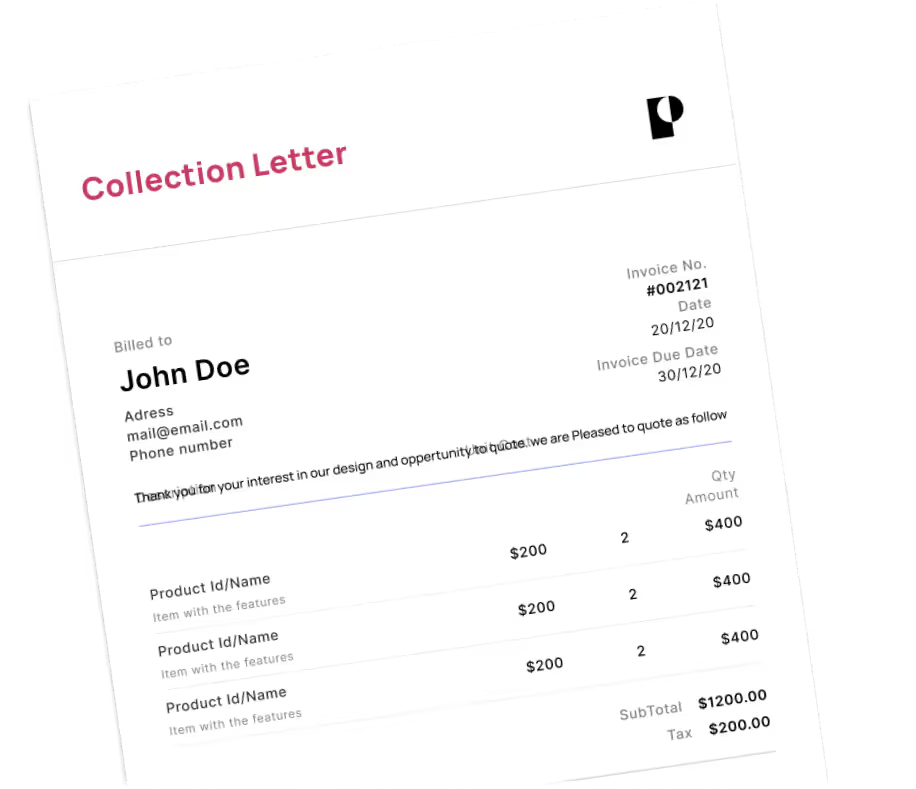
Your claims are handled exclusively by ARS Consultancy, our licensed local partner for debt collection (alacak tahsilatı) in Turkey. Submit your claim in minutes, track progress in real time, and pay only when your money is recovered.

100 % risikofrei: Sie zahlen nur bei Erfolg
Local debt collection by licensed agency / law firm
14+ years expertise | FENCA and ECA member | LIC International board member

Kostenlose Expertenberatung anfordern
Antwort von einem Spezialisten innerhalb von 24 Stunden.
Vielen Dank! Ihre Anfrage wurde empfangen!
Hoppla! Beim Absenden des Formulars ist etwas schiefgelaufen.
Warum Debitura für Inkasso in der Türkei wählen

Risk-free debt collection in Turkey
Debitura recovers unpaid invoices from debtors in Turkey through our platform: submit your claim, track it in real time, and pay only when money comes in. Debitura is the platform; the regulated collection work in Turkey is performed by our exclusive local partner, ARS Consultancy, an Istanbul-based agency and a member of FENCA, ECA and the League International for Creditors, where it holds a board seat.
- Risikofrei: Zahlen Sie nur, wenn wir Ihr Geld erfolgreich zurückholen.
- Schnelle Einrichtung: Rechnungen mit wenigen Klicks einreichen.
- Echtzeit-Verfolgung: Verfolgen Sie den Fortschritt live in einem Portal.
- Local expertise: Turkish professionals handle the demand, the icra dairesi filing and any court step.

So starten Sie mit dem Inkasso in der Türkei
- Upload your claim via Debitura's dashboard in under 2 minutes, with the invoice details and debtor information.
- ARS Consultancy takes over and opens the amicable phase in Turkish, with a formal payment demand stating the statutory default interest.
- Track progress in real time through your dashboard. If the claim needs to escalate to ilamsız icra or to court, you approve a quote first.
Nutzen Sie bereits ein ERP-System? Debitura lässt sich nahtlos in gängige Plattformen integrieren, um die Forderungseinreichung zu erleichtern.

Transparente, erfolgsbasierte Preise
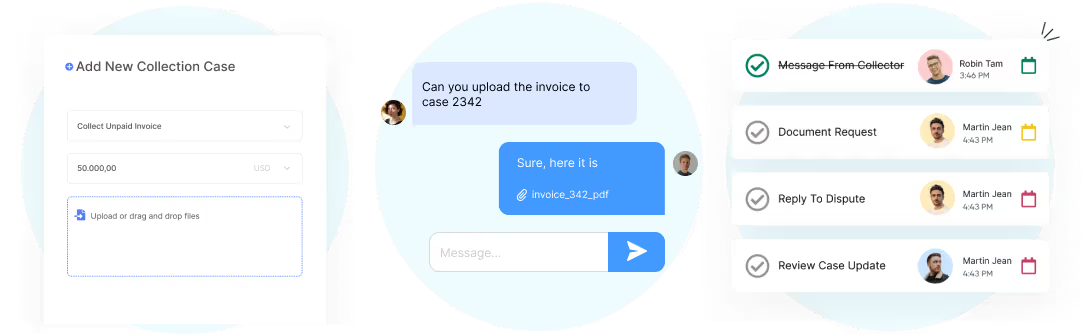
Mit Debitura zahlen Sie nur bei Erfolg. Das vorgerichtliche Inkasso erfolgt auf „Kein Erfolg, keine Gebühren“-Basis: eine Erfolgsprovision, die von den eingezogenen Beträgen abgezogen und lokal von Ihrem Partner in Rechnung gestellt wird. Die Gebühren hängen vom Land des Schuldners ab, nicht von Ihrem.
- Schuldner in Europa (EU, Island, Liechtenstein, Norwegen, Großbritannien und der Schweiz): Erfolgsprovisionen ab 6 % je nach Forderungshöhe.
- Schuldner im Rest der Welt: Erfolgsprovisionen ab 7,5 % je nach Forderungshöhe.
- Ältere Forderungen: Für Forderungen, die 12–24 Monate überfällig sind, sowie für Forderungen, die älter als 24 Monate sind, wird ein Aufschlag berechnet.
- Rechtliche Schritte sind optional: Sie genehmigen Festpreisangebote, bevor rechtliche Ausgaben anfallen.
Die vollständige Gebührenübersicht finden Sie auf der Preise-Seite oder erhalten Sie eine sofortige Schätzung, wenn Sie eine Forderung hochladen.
Wie funktioniert das Inkasso in der Türkei?
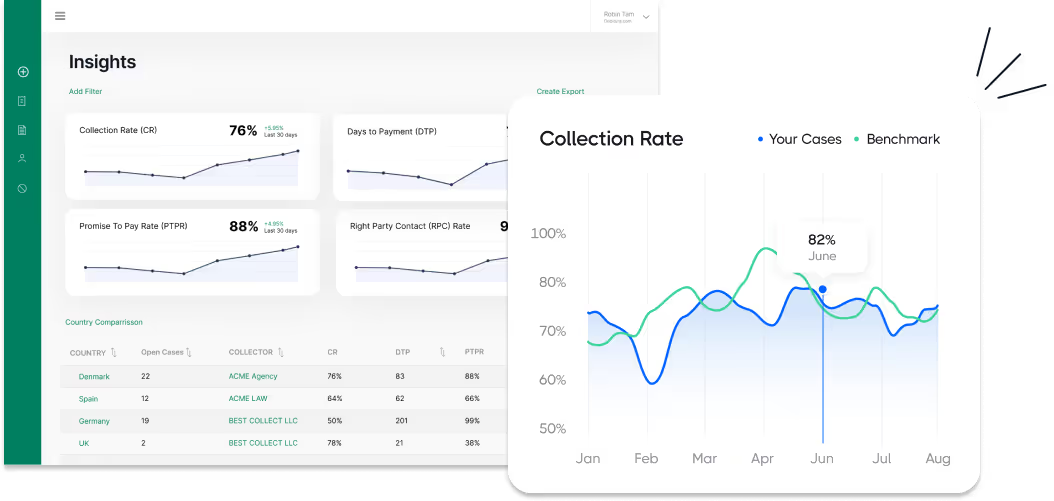
Das Inkasso in der Türkei beginnt mit einer gütlichen Phase, die vor Ort von ARS Consultancy bearbeitet wird: Mahnungen und eine formelle Zahlungsaufforderung, die auf vollständige Zahlung oder eine schriftliche Ratenzahlungsvereinbarung abzielt. Die meisten unkomplizierten Forderungen werden in diesem Stadium gelöst. Zahlt der Schuldner weiterhin nicht, erfolgt eine Eskalation niemals automatisch – Ihr Partner bewertet den rechtlichen Weg und Sie genehmigen ein Angebot, bevor gerichtliche Schritte eingeleitet werden.
Wichtige Erkenntnisse
Die vier Schritte von der unbezahlten Rechnung zum eingezogenen Geld
- Schritt 1 - Gütliches Inkasso: Mahnungen, eine formelle Zahlungsaufforderung und Verhandlungen, die vor Ort von ARS Consultancy bearbeitet werden. Die meisten unbestrittenen Forderungen werden in dieser Phase gelöst, ohne dass es zu einem Gerichtsverfahren kommt.
- Schritt 2 - Vollstreckbarer Titel: Zahlt der Schuldner weiterhin nicht, prüft Ihr Partner den rechtlichen Weg, um einen vollstreckbaren Titel zu erhalten, und Sie genehmigen ein Festpreisangebot, bevor weitere Schritte eingeleitet werden.
- Schritt 3 - Zwangsvollstreckung: Mit einem vollstreckbaren Titel kann die zuständige Vollstreckungsbehörde Löhne, Bankguthaben und andere Vermögenswerte pfänden, bis die Forderung beglichen ist.
- Schritt 4 - Insolvenz: Sollte sich der Schuldner als insolvent erweisen, wird Ihre Forderungsanmeldung eingereicht und eventuelle Ausschüttungen in Ihrem Namen überwacht.
Jeder Schritt wird in Ihrem Dashboard verfolgt, und nichts wird ohne Ihre Zustimmung eskaliert. Die vollständigen rechtlichen Details für die Türkei – Zeitpläne, Kosten, Gerichte und Zwangsvollstreckung – finden Sie im folgenden Leitfaden.

Kostenlos starten
Keine Einrichtungsgebühr
Zugelassene Experten vor Ort
Kein Erfolg, keine Kosten
Inkasso in der Türkei – der vollständige Leitfaden 2026
Written for creditors, in-house counsel and finance teams recovering money from a debtor in Turkey (Türkiye), this guide sets out how debt collection in Turkey works end to end: the governing statutes and courts, who does what, the limitation and statutory-interest rules, the ilamsız icra route to an enforceable outcome, enforcement through the icra dairesi, and insolvency under the İcra ve İflas Kanunu.
Auf dieser Seite:
Warum Sie dieser Anleitung vertrauen können
At Debitura, we uphold the highest standards of impartiality and precision to bring you comprehensive guides on international debt collection. Every guide is written from primary legal sources and reviewed by licensed local experts in the jurisdiction it covers.
Fragen oder Feedback? Senden Sie uns eine E-Mail an contact@debitura.com , wir aktualisieren diesen Leitfaden basierend auf Ihrem Input.
Debitura in Zahlen:
- 767 licensed partners - collection agencies and law firms in our network
- 180 countries covered - with cases handled in 174 of them
- 5,306 businesses registered with Debitura
- 33 days median time to first payment on European cases
Von Experten geleitet, lokal validiert
Verfasst von Lars Holdgaard, Gründer von Debitura (über 10 Jahre Erfahrung im globalen B2B-Forderungseinzug). Jede Seite wird von führenden lokalen Anwälten überprüft, um die rechtliche Genauigkeit und die Anwendbarkeit der praktischen Schritte zu gewährleisten.

Mitwirkende lokale Experten:
Letzte Aktualisierung:
October 5, 2026

Inkasso in der Türkei – schnelle Antworten
Debt collection in Turkey is unusual in one respect that shapes every recovery strategy: a creditor can open enforcement proceedings without a court judgment first. The headline rules are below.
How much does debt collection cost in Turkey?
Pre-legal collection is success-based (No Cure, No Pay), so the amicable phase costs you nothing unless money is recovered. Opening ilamsız icra (enforcement without a prior judgment) at the icra dairesi carries statutory filing and service costs, and a contested claim adds court costs and lawyer's fees. Turkey indexes its judicial monetary thresholds and fee items annually to the tax revaluation rate, set at 25.49% for 2026, so any figure quoted for a previous year is out of date; your partner quotes the current cost for your claim before you approve a legal step.
How long does debt collection take in Turkey?
The enforcement route moves quickly when the debtor does not object: the icra müdürü issues an ödeme emri (payment order) on the takip talebi, and the debtor has 7 days from service to pay or object. If the debtor objects in time, proceedings halt, and the creditor then has 1 year to bring an itirazın iptali (annulment of objection) action or, where the debt rests on a signed or notarised instrument, 6 months to apply for itirazın kesin kaldırılması (definitive removal of the objection). A fully contested claim runs through the Asliye Hukuk Mahkemesi with an istinaf appeal above it.
What is the limitation period for a debt in Turkey, and does it differ for consumers?
The general limitation period (zamanaşımı) is 10 years under Türk Borçlar Kanunu (the Turkish Code of Obligations, Law No. 6098) article 146, and 5 years under article 147 for six specific claim types: rent and other periodic payments, hotel and restaurant bills, small-scale retail and craft-work sales, partnership-internal claims, agency and commission claims, and most construction-contract claims. This framework applies to both commercial and consumer claims: Turkish law sets no separate limitation period for consumer debt. The Tüketicinin Korunması Hakkında Kanun (the Consumer Protection Law, Law No. 6502) contains only two limitation articles, article 12 (2 years for a defective good, 5 years for housing) and article 16 (2 years for a defective service), and both govern the consumer's claim against a seller rather than a creditor collecting a debt from a consumer. Article 147's shorter periods key off the type of claim, not the debtor's merchant or consumer status.
What statutory interest applies to a Turkish debt?
Turkey sets two different default rates, and here the commercial and consumer positions genuinely diverge. Where no contractual rate is agreed, commercial default interest between merchants follows Kanuni Faiz ve Temerrüt Faizine İlişkin Kanun (the Law on Statutory and Default Interest, Law No. 3095) article 2, which tracks the Central Bank of Turkey's avans (short-term advance) rate as at 31 December of the previous year when that is higher than the general rate; the TCMB avans rate has stood at 39.75% per annum since 20 December 2025. General and consumer default interest under article 1 of the same law is 24% per annum where no rate is agreed. Compound interest is banned outright in consumer transactions, even in default (Law No. 6502, article 4(7)), while Türk Ticaret Kanunu (the Turkish Commercial Code, Law No. 6102) article 8 permits it between merchants at intervals of at least three months.
| Thema | Regel |
|---|---|
| Limitation, general | 10 years (TBK art. 146). Same for commercial and consumer claims. |
| Limitation, special categories | 5 years for six claim types (TBK art. 147), by claim type not debtor type. |
| Default interest, B2B | TCMB avans rate, 39.75% p.a. since 20 December 2025 (Law 3095 art. 2). |
| Default interest, general and consumer | 24% p.a. where not agreed (Law 3095 art. 1). No compound interest. |
| Objection window | 7 days from service of the ödeme emri (IIK arts. 60 to 62). |
| Court jurisdiction | Asliye Hukuk Mahkemesi for money claims of any value (HMK art. 2). No small-claims split. |
What documents do I need to collect a debt in Turkey?
Ilamsız icra can be opened on the creditor's own statement, without filing the underlying documents at the outset, which is why the route is fast. What decides the case is what happens after an objection: a signed or notarised instrument (a promissory note, a signed acknowledgement, a notarised contract) unlocks the shorter 6-month itirazın kesin kaldırılması route, while an unsigned invoice trail leaves you with the 1-year itirazın iptali action. Assemble the contract, invoices, statement of account, proof of delivery and any signed acknowledgement before you start.
Which route should my claim take in Turkey?
Most claims start with ilamsız icra, because it puts a payment order in front of the debtor without a court case. If the debtor is a tacir (merchant) or otherwise subject to bankruptcy by special law, the iflas yolu (bankruptcy route) is also available and is often the stronger lever; against an ordinary consumer only haciz (attachment) is possible. A claim that is genuinely disputed on the merits belongs in an ordinary action before the Asliye Hukuk Mahkemesi, which hears money claims regardless of value.
Wer übernimmt welche Aufgaben beim Inkasso in der Türkei?
Recovery in Turkey involves a collection agency or law firm for the amicable phase, the icra dairesi for enforcement, and the civil courts when a claim is contested. Debitura is the platform that routes and tracks your claim; the regulated work in Turkey is performed by our licensed local partner, ARS Consultancy.
Collection agencies in Turkey
A collection agency manages the amicable phase: tracing and contacting the debtor, issuing a formal payment demand, negotiating settlement or an instalment plan, and documenting the outcome. Agencies register with the trade registry and operate as commercial companies; they cannot themselves compel payment, so their value lies in resolving the claim before the statutory machinery is needed and in preparing the file if it is.
The icra dairesi and the icra müdürü in Turkey
The icra dairesi (enforcement office) is the state body that actually enforces. On a takip talebi (enforcement request) the icra müdürü (enforcement director) issues the ödeme emri and, if no timely objection follows, proceeds to haciz (attachment) of the debtor's assets and their sale. Enforcement officers are court-attached public officials, not private bailiffs, and they act on the creditor's application under the İcra ve İflas Kanunu (the Enforcement and Bankruptcy Law, Law No. 2004).
Lawyers in Turkey
An avukat (lawyer) is needed once an objection has to be lifted, since itirazın iptali and itirazın kesin kaldırılması are court actions, and for any ordinary action or bankruptcy petition. For a foreign creditor, Turkish counsel is also the practical route to a valid power of attorney and to representation before the Asliye Hukuk Mahkemesi.
Welche Gesetze und Gerichte gelten für das Inkasso in der Türkei?
Turkish debt recovery runs on a codified civil-law system in which enforcement has its own statute and its own state offices, separate from the courts that decide disputes.
The civil court system in Turkey
Money claims are heard by the Asliye Hukuk Mahkemesi (Civil Court of First Instance), which has general jurisdiction over money and property claims regardless of value under Hukuk Muhakemeleri Kanunu (the Code of Civil Procedure, Law No. 6100) article 2. The Sulh Hukuk Mahkemesi (Civil Court of Peace) takes only the subject matters assigned to it by article 4, defined by subject matter rather than by amount. Turkey therefore has no monetary small-claims court for ordinary debt suits, which is a common misconception in cross-border planning. Above first instance sit the istinaf (regional appeal) and temyiz (cassation) levels; their monetary access thresholds are re-indexed each year to the tax revaluation rate, 25.49% for 2026, so confirm the current figure with counsel before relying on an appeal right.
Key legislation in Turkey
- Türk Borçlar Kanunu (the Turkish Code of Obligations, Law No. 6098): contract and debt, and the limitation regime in articles 146 to 158.
- İcra ve İflas Kanunu (the Enforcement and Bankruptcy Law, Law No. 2004): ilamsız icra, haciz, the iflas (bankruptcy) route and konkordato.
- Hukuk Muhakemeleri Kanunu (the Code of Civil Procedure, Law No. 6100): jurisdiction and civil procedure.
- Türk Ticaret Kanunu (the Turkish Commercial Code, Law No. 6102): merchant status and commercial interest rules.
- Kanuni Faiz ve Temerrüt Faizine İlişkin Kanun (the Law on Statutory and Default Interest, Law No. 3095): the statutory default rates.
- Milletlerarası Özel Hukuk ve Usul Hukuku Hakkında Kanun (the Private International Law and Procedure Act, MÖHUK, Law No. 5718): recognition and enforcement of foreign judgments.
Consumer protection in Turkish debt collection
Tüketicinin Korunması Hakkında Kanun (the Consumer Protection Law, Law No. 6502) does not change the limitation period for consumer debt, but it does change what a creditor may demand and when. A creditor may only accelerate a consumer instalment, credit or housing-finance debt and call in the full remaining balance after at least two consecutive missed instalments and at least 30 days' written notice (articles 19, 28 and 34). Compound interest is prohibited in all consumer transactions, including in default (article 4(7)). Neither protection has an equivalent for ordinary commercial debt between merchants, so a consumer file and a B2B file are worked to different timetables.
Schritt 1 - Wie funktioniert das außergerichtliche (vorgerichtliche) Inkasso in der Türkei?
Pre-legal collection in Turkey recovers an unpaid invoice without opening enforcement or court proceedings, through reminders, a formal payment demand and negotiation. It is worth doing properly, because a written acknowledgement of the debt, a part payment, an interest payment, a pledge or a guarantee all interrupt the limitation period under Türk Borçlar Kanunu articles 154 and 156, and a debt acknowledged in a signed instrument or confirmed by a court or arbitral award then carries a fresh 10-year period under article 158, whatever the original period was.
| Phase | Aktion |
|---|---|
| Mahnung | Invoice, due date and payment details, with the statutory default interest stated. |
| Förmliche Zahlungsaufforderung | States the sum, a deadline and the intention to open ilamsız icra. |
| Verhandlung | Settlement or instalment plan, ideally signed so it restarts limitation at 10 years. |
| Eskalation | File a takip talebi at the icra dairesi, or a bankruptcy petition against a merchant. |
Extra rules when the debtor is a consumer in Turkey
A consumer file is worked to a different timetable. Under Tüketicinin Korunması Hakkında Kanun articles 19, 28 and 34, a creditor may only call in the full remaining balance of a consumer instalment, credit or housing-finance debt after at least two consecutive missed instalments and at least 30 days' written notice. Compound interest may not be charged in any consumer transaction, even in default (article 4(7)). Neither restriction applies to ordinary commercial debt between merchants, so acceleration against a business debtor follows the contract instead.
When to escalate in Turkey
Escalate when the demand lapses, the debtor disputes without substance, or the limitation period approaches. Because ilamsız icra needs no prior judgment, the practical threshold for escalating in Turkey is lower than in most jurisdictions: the question is usually whether the debtor is likely to object, not whether the claim is large enough to litigate.
Schritt 2 - Wie erhalten Sie einen vollstreckbaren Titel in der Türkei?
Turkey lets a creditor start enforcement before obtaining a judgment. The ordinary starting point is therefore not a lawsuit but ilamsız icra, enforcement without a prior judgment, and a court case only becomes necessary if the debtor objects.
Ilamsız icra: enforcement without a judgment
The creditor files a takip talebi (enforcement request) directly with the icra dairesi (enforcement office); no court case is needed, and the request can be based on the creditor's own statement of the debt (İcra ve İflas Kanunu, article 58). The icra müdürü then issues an ödeme emri (payment order) and serves it on the debtor. From service, the debtor has 7 days to pay or to file an objection (articles 60 to 62). If no timely objection arrives, the proceeding becomes final and the creditor can move straight to haciz (attachment).
What happens if the debtor objects
A timely objection halts the proceeding, and the creditor must go to court to lift it. Two routes exist, and which one is open depends entirely on the paperwork:
| Verfahrensweg | Deadline and requirement |
|---|---|
| Itirazın iptali (annulment of objection) | Within 1 year of the objection; an ordinary action on the merits. If the losing party acted in bad faith, the court may award denial-of-debt compensation of at least 20% of the claim. |
| Itirazın kesin kaldırılması (definitive removal) | Within 6 months; available only where the debt rests on a signed or notarised instrument. Faster and narrower. |
The ordinary action and the competent court in Turkey
A claim contested on the merits is heard by the Asliye Hukuk Mahkemesi, which takes money claims regardless of value under Hukuk Muhakemeleri Kanunu article 2. There is no monetary small-claims track for ordinary debt suits, and the Sulh Hukuk Mahkemesi is defined by subject matter rather than by amount (article 4). Above first instance sit istinaf and temyiz, whose monetary access thresholds are re-indexed annually to the tax revaluation rate (25.49% for 2026), so the current figures should be confirmed with counsel rather than taken from a previous year's table.
Schritt 3 - Wie funktioniert die Zwangsvollstreckung von Forderungen in der Türkei?
Enforcement in Turkey is carried out by the icra dairesi, a state enforcement office attached to the courts, rather than by private bailiffs. It begins once the ödeme emri has become final, either because the debtor did not object within the 7-day window or because an objection has been lifted by the court.
Ways to enforce a claim in Turkey
- Haciz (attachment): the creditor asks the icra dairesi to attach the debtor's assets. Bank balances, receivables owed to the debtor by third parties, wages, movables and immovable property can all be reached.
- Sale: attached assets are sold under the enforcement office's supervision and the proceeds are applied to principal, interest and costs, with any surplus returned to the debtor.
- Protected assets: the İcra ve İflas Kanunu exempts assets a debtor needs for basic living and for their trade, and it caps how much of a salary may be attached, so a wage attachment yields a share of net pay rather than the whole.
- Iflas yolu (bankruptcy route): where the debtor is a tacir (merchant) or a person made subject to bankruptcy by a special law, the creditor may pursue bankruptcy instead of attachment (article 43). Against an ordinary consumer, only haciz is available, which makes the debtor's merchant status a strategic question at the outset rather than an afterthought.
The enforcement process in Turkey
The creditor applies to the icra dairesi with the finalised proceeding, the office investigates and attaches assets on the creditor's application, and the sale follows. Because the office acts on what the creditor asks it to attach, an application naming the debtor's known bank relationships, receivables or registered property moves faster than a general request, and asset research done during the amicable phase pays for itself here.
Schritt 4 - Wie wirken sich Insolvenzverfahren auf den Forderungseinzug in der Türkei aus?
Where a debtor cannot pay at all, individual enforcement gives way to a collective procedure under the İcra ve İflas Kanunu. Two routes matter to a creditor: iflas (bankruptcy), which liquidates, and konkordato (composition with creditors), which restructures.
Who can be made bankrupt in Turkey
Bankruptcy is available only against a tacir (merchant) or a person made subject to bankruptcy by a special law (article 43). An ordinary consumer debtor cannot be made bankrupt, and can only be pursued through haciz. For a creditor, this makes the debtor's status the first question: against a company or a registered trader, the threat of a bankruptcy petition is often a stronger lever than attachment, because it puts the whole business at risk rather than one asset.
Konkordato (composition with creditors)
A debtor who cannot pay its debts as they fall due, or who is at risk of that, may petition the competent court for konkordato. The court grants an initial moratorium (mühlet) and appoints a concordat commissioner (komiser) to supervise the debtor and report on the proposal, and creditors are then called to consider it. The moratorium suspends individual enforcement, so a creditor who has attached assets should expect the process to pause. The precise length of the initial moratorium and its extensions are set by the statute and applied by the court, so confirm the current period with Turkish counsel before planning around it.
The creditor process and priority
In a bankruptcy, creditors register their claims with the estate and distribution follows a statutory ranking table (sıra cetveli) drawn up under the İcra ve İflas Kanunu. A rehinli (secured) creditor is satisfied first from the proceeds of the asset securing its claim; where that value falls short, the unpaid balance joins the unsecured creditors, who share what remains of the estate. Ordinary trade creditors therefore sit at the back of the queue and commonly recover only part of the debt, which is the practical argument for acting on a Turkish receivable while attachment is still available.
Fees, interest and who pays what in Turkey
- Unsere Gebühr: erfolgsbasiert, Kein Erfolg, keine Gebühren (siehe Preise).
- Enforcement and court fees: statutory enforcement and court fees apply only if the case escalates, and Turkey re-indexes its judicial fee items annually to the tax revaluation rate (25.49% for 2026). Your partner quotes the current cost before any step is taken.
- Statutory debtor items: default interest runs on the debt at the statutory rate where no rate is agreed, and a court may award denial-of-debt compensation of at least 20% of the claim against a party who objected in bad faith.
- Who keeps what: recovered principal is yours; interest and costs follow the contract, the statute and the court's or the enforcement office's order.
Statutory default interest in Turkey
Where the contract fixes no rate, Kanuni Faiz ve Temerrüt Faizine İlişkin Kanun (Law No. 3095) sets two different defaults. Commercial default interest between merchants follows article 2, tracking the Central Bank of Turkey's avans rate as at 31 December of the previous year when that is higher than the general rate; that rate has stood at 39.75% per annum since 20 December 2025. General and consumer default interest under article 1 is 24% per annum. Compound interest is available between merchants at intervals of at least three months (Türk Ticaret Kanunu article 8) and is prohibited outright in consumer transactions, even in default (Law No. 6502, article 4(7)).
Cross-border debt collection in Turkey
Turkey is not part of the EU judicial-cooperation area, so a foreign judgment is not automatically enforceable and there is no European Payment Order route into Turkey. A creditor holding a foreign judgment must apply for tenfiz (recognition and enforcement) before a Turkish court under Milletlerarası Özel Hukuk ve Usul Hukuku Hakkında Kanun (the Private International Law and Procedure Act, MÖHUK, Law No. 5718). Article 54(1)(a) makes reciprocity a condition: there must be a treaty between Turkey and the state where the judgment was given, or a statutory provision or established practice in that state permitting the enforcement of Turkish judgments. Because reciprocity turns on the particular country, check it before litigating abroad against a Turkish debtor. Where the debtor's assets are in Turkey, opening ilamsız icra directly in Turkey is often faster and cheaper than winning at home and then seeking tenfiz.
Finden Sie einen Rechtsanwalt für Inkasso vor Ort
Benötigen Sie eine gerichtsfeste Vertretung? Teilen Sie uns Ihren Fall einmal mit und erhalten Sie bis zu drei Angebote von geprüften Prozessanwälten. Kostenlos, schnell und unverbindlich.
- Geprüfte Spezialisten
- Angebote in 24 Stunden, keine versteckte Gebühren
- Faire, vorab ausgehandelte Preise

Maslak Mah. Eski Buyukdere Cad. Maslak Is Merkezi No: 37/8 34398 Sariyer/Istanbul
12020 Sunrise Valley Suite 100 Reston VA 20191 USA
ANTROYA DEBT COLLECTION & LAW OFFICE
Antroya Debt Collection & Law Office ist eine führende Anwaltskanzlei in Sarıyer/Istanbul, die effektive Inkassodienstleistungen in der Türkei anbietet. Sie wurde 2005 gegründet und arbeitet auf einer "No Cure – No Pay"-Basis (Erfolgsbasis), mit einer Erfolgsquote von 98 % und Auszeichnungen wie dem CLLA Bronze Champion.
.webp)
Gerichtsverfahren
gerichtliches Inkasso
Zwangsvollstreckung
.png)
12

2005
.png)
Anwaltskanzlei

Büyükdere Cad, Astoria AVM No:127 D:5 B Blok 5. Kat, MGC LEGAL 34394 Şişli/İstanbul
MGC LEGAL
MGC Legal ist eine führende Anwaltskanzlei in Istanbul, die effektive Inkassodienstleistungen in der Türkei anbietet und sich als erster Ansprechpartner für die Beitreibung von Forderungen positioniert. Sie wurde 2013 gegründet und hat Auszeichnungen wie die "Anwaltskanzlei des Jahres" erhalten und ist in 125 Ländern vertreten.
Gerichtsverfahren
gerichtliches Inkasso
Zwangsvollstreckung
70
2013
Anwaltskanzlei

First Avenue AVM, C Block 2nd Floor Number 30 Buyukcekmece Istanbul Turkey
Tenha Law Firm
Tenha Law Firm ist eine führende Anwaltskanzlei in Istanbul, die effektive Inkassodienstleistungen in der Türkei anbietet. Sie wurde 2001 gegründet und ist bekannt für ihre schnelle, technologiegestützte Beitreibung; sie ist Mitglied der Anwaltskammer Istanbul und betreut Mandanten mit maßgeschneiderten Strategien.
Gerichtsverfahren
gerichtliches Inkasso
Zwangsvollstreckung
6
2001
Anwaltskanzlei

Mecidiyekoy Mahallesi, Sair Sabri Sokak, No: 8/7 Mecidiyekoy, Sisli, 34387, İstanbul, Turkey
Bicak Law Firm
Bicak Law Firm ist eine führende Anwaltskanzlei in Ankara, die effektive Inkassodienstleistungen in der Türkei anbietet und sich seit 2002 als erster Ansprechpartner für die Beitreibung von Forderungen positioniert. Sie hat Auszeichnungen wie den Clutch Leader Award erhalten und ist Mitglied der International Law Firms Association, die Länder wie Italien und Spanien betreut.
Gerichtsverfahren
gerichtliches Inkasso
Zwangsvollstreckung
15
2002
Anwaltskanzlei

Balmumcu Mah. Gaziumurpasa Sok Balmumcu Plaza 3 No 34/12 Besiktas Istanbul
HERDEM Attorneys at Law
HERDEM Attorneys at Law ist eine führende Anwaltskanzlei in Besiktas, die effektive Inkassodienstleistungen in der Türkei anbietet und seit 2011 für ihre Exzellenz mit Auszeichnungen wie "Leading Lawyer in Aviation Law" und Mitgliedschaften in der International and American Bar Associations anerkannt ist.
Gerichtsverfahren
gerichtliches Inkasso
Zwangsvollstreckung
17
2011
Anwaltskanzlei

Cumhuriyet Mah. Atatyrk Blv. No:3/A Bey City Residence K:4 D:26 Beylikdyzy/İstanbul
ERGUR LAW FIRM
ERGUR LAW FIRM ist eine führende Anwaltskanzlei in Beylikdüzü, die effektive Inkassodienstleistungen in der Türkei anbietet. Sie wurde 2006 gegründet und ist bekannt für ihren mandantenorientierten Ansatz, wettbewerbsfähige Preise und Mitgliedschaften in der Anwaltskammer Istanbul und Birleşik Arabuluculuk Merkezi A.Ş.
Gerichtsverfahren
gerichtliches Inkasso
Zwangsvollstreckung
5
2006
Anwaltskanzlei

Sahabiye mahallesi buyurkan sok yolgösteren iş merkezi 7 11
Polat Hukuk Bürosu
Polat Hukuk Bürosu ist eine führende Anwaltskanzlei in Kocasinan, die effektive Inkassodienstleistungen in der Türkei anbietet und sich seit 2010 als erster Ansprechpartner für die Beitreibung von Forderungen positioniert. Sie beschäftigt 25 Anwälte und ist Mitglied der Anwaltskammer Kayseri und der Union of Turkish Bar Associations.
Gerichtsverfahren
gerichtliches Inkasso
Zwangsvollstreckung
25
2010
Anwaltskanzlei

Esentepe Mh. Milangaz Cd. No:77 A1 D:82 34860 Kartal, İstanbul, Turkey
Cebeci Bayram Law Firm
Cebeci Bayram Law Firm ist eine führende Anwaltskanzlei in Istanbul, die effektive Inkassodienstleistungen in der Türkei anbietet und sich seit 2019 als erster Ansprechpartner für die Beitreibung von Forderungen positioniert. Sie bietet wettbewerbsfähige Preise und ist Mitglied der Anwaltskammer Istanbul und der Union of Turkish Bar Associations.
Gerichtsverfahren
gerichtliches Inkasso
Zwangsvollstreckung
10
2019
Anwaltskanzlei

Camikebir Mah. Mithat Baysal Sok. No: 21 Kat:3 Daire: 7 PK: 09400 Kuşadası/AYDIN
SUNER LAW OFFICE
SUNER LAW OFFICE ist eine führende Anwaltskanzlei in Kuşadası, die effektive Inkassodienstleistungen in der Türkei anbietet und sich seit ihrer Gründung im Jahr 2015 als erste Anlaufstelle für lokale und ausländische Mandanten mit innovativen juristischen Lösungen positioniert.
Gerichtsverfahren
gerichtliches Inkasso
Zwangsvollstreckung
3
2015
Anwaltskanzlei
Nisbetiye Caddesi No:49/17 Etiler, Besiktas-İstanbul 34335
Guzeloglu Attorneys at Law
Guzeloglu Attorneys at Law ist eine führende Anwaltskanzlei in Istanbul, die effektive Inkassodienstleistungen in der Türkei anbietet. Sie wurde 2015 gegründet und ist bekannt für ihre innovativen Lösungen, ihren kosteneffizienten Ansatz und ihre Mitgliedschaften in der Union der türkischen Anwaltskammern und der Anwaltskammer Istanbul.
Gerichtsverfahren
gerichtliches Inkasso
Zwangsvollstreckung
8
2015
Anwaltskanzlei

Cebeci Caddesi No:24 Beşiktaş, İstanbul
CBC Law Firm
CBC Law Firm ist eine führende Anwaltskanzlei in Besiktas, die effektive Inkassodienstleistungen in der Türkei anbietet. Sie ist anerkannt von Chambers & Partners und The Legal 500, wurde 2020 gegründet und betreut Mandanten in Großbritannien, den USA, Kanada und darüber hinaus.
Gerichtsverfahren
gerichtliches Inkasso
Zwangsvollstreckung
25
2020
Anwaltskanzlei

Dumlupinar Bulvari, Fatih Sultan Mahallesi, 2700. cd. 3/15 Etimesgut Ankara
Gonen Law Office
Gonen Law Office ist eine führende Anwaltskanzlei in Etimesgut, die effektive Inkassodienstleistungen in der Türkei anbietet. Sie wurde 1999 gegründet und ist bekannt für ihre internationale Expertise und anerkannt durch prestigeträchtige Auszeichnungen und Mitgliedschaften, was sie zur ersten Anlaufstelle für Inkasso macht.
Gerichtsverfahren
gerichtliches Inkasso
Zwangsvollstreckung
20
1999
Anwaltskanzlei

Ağaoğlu 1453 Complex C 13 Block, Floor 4, Unit 10
Maslak Mahallesi, Taş Yoncası Sokak,, Turkiye
Kurucuk & Associates Law Firm
Kurucuk & Associates ist eine führende Anwaltskanzlei in Istanbul, die seit 2014 effektive Inkassodienstleistungen in der Türkei anbietet und als erste Anlaufstelle für Inkasso gilt. Sie hat Auszeichnungen wie den Turkey Government Award erhalten und ist Mitglied der Anwaltskammer Istanbul. Das Unternehmen betreut Mandanten in 12 Ländern.
Gerichtsverfahren
gerichtliches Inkasso
Zwangsvollstreckung
6
2014
Anwaltskanzlei
Kazimdirik mah. 284 sk. No:2 Folkart Time Ofis-2 D:303
Bornova, Turkey
Ateskan Law
Ateskan Law ist eine führende Anwaltskanzlei in Bornova, die effektive Inkassodienstleistungen in der Türkei anbietet und sich seit ihrer Gründung im Jahr 2017 als erste Anlaufstelle für Inkasso positioniert. Sie ist Mitglied der İzmir Bar Association und in elf europäischen Ländern tätig.
Gerichtsverfahren
gerichtliches Inkasso
Zwangsvollstreckung
4
2017
Anwaltskanzlei
Häufig gestellte Fragen
Entdecken Sie unsere häufigsten Fragen und Antworten unten, oder kontaktieren Sie uns direkt unter contact@debitura.com, wenn Sie Hilfe bei einem bestimmten Fall benötigen.
Wie funktioniert Inkasso in der Türkei für ausländische Gläubiger?
.svg)
Foreign creditors can recover debts in Turkey without a local presence, through amicable collection first and then formal enforcement (ilamsız icra) if needed. Through Debitura, ARS Consultancy handles all contact with your Turkish debtor in Turkish, states the statutory default interest under Law No. 3095 in the demand, and files the enforcement request at the icra dairesi when the amicable phase does not resolve the claim. Turkey's general limitation period is 10 years under Türk Borçlar Kanunu article 146, with a 5-year period for six specific claim types under article 147, so most commercial claims have ample time. Debitura is the platform; the regulated work is done locally.
Kann ich Zinsen und Inkassokosten für türkische Forderungen berechnen?
Yes. Where your contract fixes no rate, Kanuni Faiz ve Temerrüt Faizine İlişkin Kanun (Law No. 3095) supplies one, and the commercial and consumer rates differ. Commercial default interest between merchants follows article 2, which tracks the Central Bank of Turkey's avans rate as at 31 December of the previous year when that is higher than the general rate; the TCMB avans rate has stood at 39.75% per annum since 20 December 2025. General and consumer default interest under article 1 is 24% per annum. Compound interest is permitted between merchants at intervals of at least three months (Türk Ticaret Kanunu article 8) and is prohibited outright in consumer transactions, even in default (Law No. 6502, article 4(7)).
Was sind typische Inkassogebühren in der Türkei, und wie schneidet Debitura im Vergleich ab?
Fees depend on the debtor's country, not yours, and Turkey is priced on the rest-of-world schedule. With Debitura there are no upfront fees for pre-legal collection: you pay a success fee only if money is recovered, and you see the applicable fee before you proceed. If the claim has to escalate to ilamsız icra or to court, Debitura sources up to three fixed-price quotes from vetted Turkish law firms and you choose whether to move forward. See current rates on our pricing page.
What is the ilamsız icra enforcement procedure in Turkey?
Ilamsız icra is Turkey's enforcement procedure that lets a creditor pursue payment without first obtaining a court judgment. The creditor files a takip talebi (enforcement request) at the local icra dairesi under İcra ve İflas Kanunu article 58, and it can be based on the creditor's own statement of the debt. The icra müdürü then issues an ödeme emri (payment order) and serves it on the debtor, who has 7 days from service to pay or to object (articles 60 to 62). If no timely objection arrives, the proceeding becomes final and the creditor can move to haciz: attachment of bank balances, receivables, wages, movables and immovable property.
Was passiert, wenn ein türkischer Schuldner meine Rechnung bestreitet?
If your debtor files an objection (itiraz) to the ödeme emri, the enforcement proceeding halts and you must go to court to lift it. Two routes exist and the paperwork decides which one is open: an itirazın iptali (annulment of objection) action within 1 year, which is an ordinary action on the merits, or, where the debt rests on a signed or notarised instrument, itirazın kesin kaldırılması (definitive removal of the objection) within 6 months, which is faster and narrower. If the losing party is found to have acted in bad faith, the court may award denial-of-debt compensation of at least 20% of the claim. Debitura sources up to 3 fixed-price quotes from vetted Turkish law firms so you can decide before committing.
Welche Zwangsvollstreckungsoptionen gibt es nach Erhalt eines Urteils in der Türkei?
Enforcement in Turkey is carried out by the icra dairesi, a state enforcement office attached to the courts, rather than by private bailiffs. Once the ödeme emri is final, the creditor applies for haciz (attachment) and the office can reach bank balances, receivables owed to the debtor by third parties, wages, movables and immovable property, then sell them and apply the proceeds to principal, interest and costs. The İcra ve İflas Kanunu protects assets the debtor needs for basic living and for their trade, and caps how much of a salary may be attached. Where the debtor is a tacir (merchant), the bankruptcy route (iflas yolu) is available as an alternative under article 43; against an ordinary consumer, only haciz is possible.
Benötigen Sie zusätzliche Länder?
“Debitura recovered well over 100,000 euros in overdue invoices for us across several countries, all through one contract and one dashboard. Local experts handle each market and we only pay when they actually collect — so our team can spend that time on what we do best: helping our own customers engage smarter with the Manago AI platform.”
Manago AI (formerly SALESmanago)
767
Licensed collection agencies and law firms in our network
180
Countries covered, with cases handled in 174 of them
5,306
Businesses registered with Debitura
.svg)