.png)


.png)
.svg)
Démarrer GRATUITEMENT
Société de recouvrement en Turquie - Sans succès, pas de frais
Your claims are handled exclusively by ARS Consultancy, our licensed local partner for debt collection (alacak tahsilatı) in Turkey. Submit your claim in minutes, track progress in real time, and pay only when your money is recovered.

100 % sans risque : payez uniquement en cas de succès
Local debt collection by licensed agency / law firm
14+ years expertise | FENCA and ECA member | LIC International board member

Obtenir un conseil d’expert gratuit
Réponse d’un spécialiste sous 24 heures.
Merci ! Votre soumission a été reçue !
Oups ! Une erreur s'est produite lors de la soumission du formulaire.
Pourquoi choisir Debitura pour le recouvrement de créances en Turquie

Risk-free debt collection in Turkey
Debitura recovers unpaid invoices from debtors in Turkey through our platform: submit your claim, track it in real time, and pay only when money comes in. Debitura is the platform; the regulated collection work in Turkey is performed by our exclusive local partner, ARS Consultancy, an Istanbul-based agency and a member of FENCA, ECA and the League International for Creditors, where it holds a board seat.
- Sans risque : Ne payez que lorsque nous récupérons votre argent.
- Configuration rapide : Soumettez vos factures en quelques clics.
- Suivi en temps réel : Suivez l'avancement en direct sur une seule plateforme.
- Local expertise: Turkish professionals handle the demand, the icra dairesi filing and any court step.

Démarrer le recouvrement de créances en Turquie
- Upload your claim via Debitura's dashboard in under 2 minutes, with the invoice details and debtor information.
- ARS Consultancy takes over and opens the amicable phase in Turkish, with a formal payment demand stating the statutory default interest.
- Track progress in real time through your dashboard. If the claim needs to escalate to ilamsız icra or to court, you approve a quote first.
Vous utilisez déjà un système ERP ? Debitura s'intègre aux principales plateformes pour une soumission de créances fluide.

Tarifs transparents, basés sur le succès
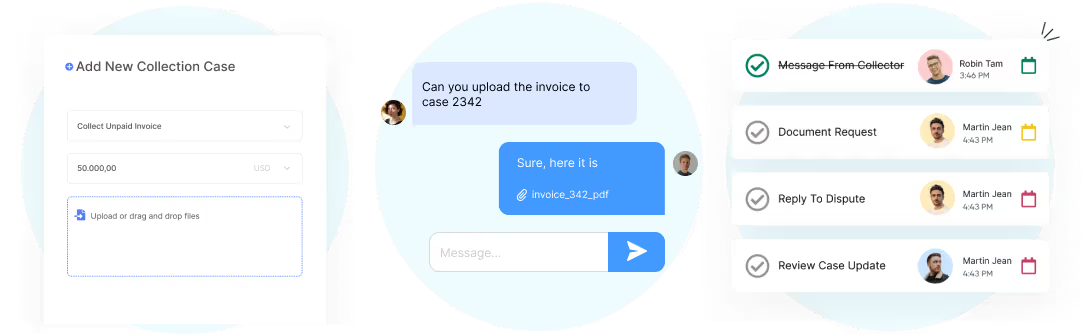
Avec Debitura, vous ne payez que lorsque nous réussissons. Le recouvrement pré-judiciaire est « Pas de recouvrement, pas d'honoraires » : une Commission de succès déduite des montants recouvrés, facturée localement par votre partenaire. Les honoraires dépendent du pays du débiteur, pas du vôtre.
- Débiteurs en Europe (UE, Islande, Liechtenstein, Norvège, Royaume-Uni et Suisse) : Commissions de succès à partir de 6 % selon la taille de la créance.
- Débiteurs dans le reste du monde : Commissions de succès à partir de 7,5 % selon la taille de la créance.
- Créances plus anciennes : une majoration s'applique pour les créances en souffrance depuis 12 à 24 mois et pour les créances de plus de 24 mois.
- L'Action en justice est facultative : vous approuvez les devis à prix fixe avant toute dépense juridique.
Consultez la page Tarifs pour le barème complet des honoraires, ou obtenez une estimation instantanée lorsque vous déposez une créance.
Comment fonctionne le recouvrement de créances en Turquie ?
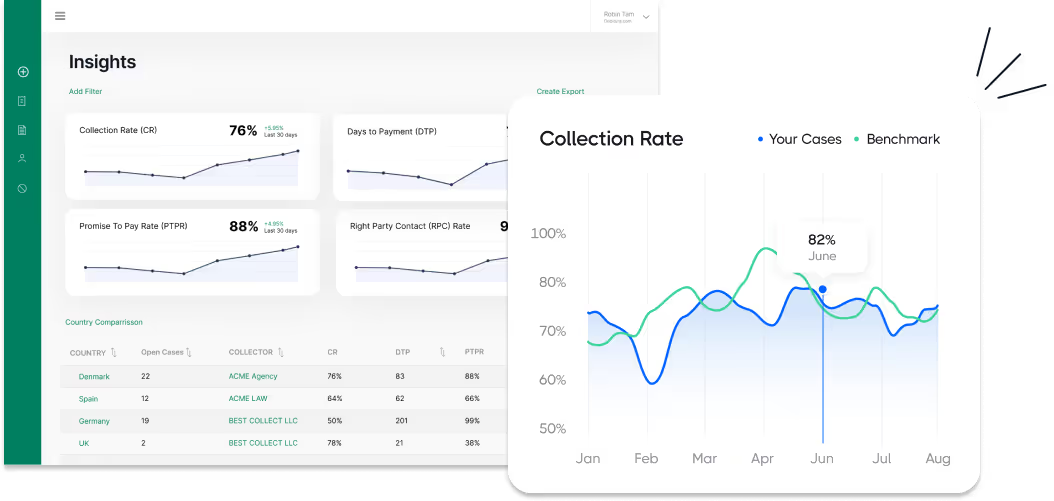
Le recouvrement de créances en Turquie débute par une phase amiable gérée localement par ARS Consultancy : des relances et une mise en demeure formelle, visant un paiement intégral ou un accord d'échelonnement écrit. La plupart des créances simples sont résolues à ce stade. Si le débiteur ne paie toujours pas, l'escalade n'est jamais automatique : votre partenaire évalue la voie légale et vous approuvez un devis avant toute démarche judiciaire.
Principaux points à retenir
Les quatre étapes, de la facture impayée au recouvrement des fonds
- Étape 1 - Recouvrement amiable : relances, une mise en demeure formelle et négociation, gérées localement par ARS Consultancy. La plupart des créances incontestées sont résolues durant cette phase, sans recours aux tribunaux.
- Étape 2 - Titre exécutoire : si le débiteur ne paie toujours pas, votre partenaire évalue la voie légale pour obtenir un titre exécutoire et vous approuvez un devis à prix fixe avant toute procédure.
- Étape 3 - Exécution forcée : avec un titre exécutoire, l'autorité d'exécution compétente peut saisir les salaires, les fonds bancaires et d'autres actifs jusqu'à ce que la créance soit recouvrée.
- Étape 4 - Insolvabilité : si le débiteur s'avère insolvable, votre déclaration de créance est déposée et toute distribution est suivie en votre nom.
Chaque étape est suivie dans votre tableau de bord, et aucune action n'est entreprise sans votre approbation. Tous les détails juridiques pour la Turquie – délais, coûts, tribunaux et exécution forcée – sont présentés dans le guide ci-dessous.

Commencer gratuitement
Pas de frais d'installation
Experts locaux agréés
Pas de résultat, pas de frais
Recouvrement de créances en Turquie - le guide complet 2026
Written for creditors, in-house counsel and finance teams recovering money from a debtor in Turkey (Türkiye), this guide sets out how debt collection in Turkey works end to end: the governing statutes and courts, who does what, the limitation and statutory-interest rules, the ilamsız icra route to an enforceable outcome, enforcement through the icra dairesi, and insolvency under the İcra ve İflas Kanunu.
Sur cette page :
Pourquoi vous pouvez faire confiance à ce guide
At Debitura, we uphold the highest standards of impartiality and precision to bring you comprehensive guides on international debt collection. Every guide is written from primary legal sources and reviewed by licensed local experts in the jurisdiction it covers.
Des questions ou des commentaires ? Écrivez-nous à contact@debitura.com, nous mettons à jour ce guide en fonction de vos retours.
Debitura en chiffres :
- 767 licensed partners - collection agencies and law firms in our network
- 180 countries covered - with cases handled in 174 of them
- 5,306 businesses registered with Debitura
- 33 days median time to first payment on European cases
Rédaction assurée par des experts, validation locale
Rédigé par Lars Holdgaard, Fondateur de Debitura (+10 ans d'expérience en recouvrement de créances B2B international). Chaque page est examinée par des avocats locaux de premier plan afin de garantir l'exactitude juridique et de vous fournir des étapes pratiques.

Experts locaux contributeurs :
Dernière mise à jour :
October 5, 2026

Recouvrement de créances en Turquie - réponses rapides
Debt collection in Turkey is unusual in one respect that shapes every recovery strategy: a creditor can open enforcement proceedings without a court judgment first. The headline rules are below.
How much does debt collection cost in Turkey?
Pre-legal collection is success-based (No Cure, No Pay), so the amicable phase costs you nothing unless money is recovered. Opening ilamsız icra (enforcement without a prior judgment) at the icra dairesi carries statutory filing and service costs, and a contested claim adds court costs and lawyer's fees. Turkey indexes its judicial monetary thresholds and fee items annually to the tax revaluation rate, set at 25.49% for 2026, so any figure quoted for a previous year is out of date; your partner quotes the current cost for your claim before you approve a legal step.
How long does debt collection take in Turkey?
The enforcement route moves quickly when the debtor does not object: the icra müdürü issues an ödeme emri (payment order) on the takip talebi, and the debtor has 7 days from service to pay or object. If the debtor objects in time, proceedings halt, and the creditor then has 1 year to bring an itirazın iptali (annulment of objection) action or, where the debt rests on a signed or notarised instrument, 6 months to apply for itirazın kesin kaldırılması (definitive removal of the objection). A fully contested claim runs through the Asliye Hukuk Mahkemesi with an istinaf appeal above it.
What is the limitation period for a debt in Turkey, and does it differ for consumers?
The general limitation period (zamanaşımı) is 10 years under Türk Borçlar Kanunu (the Turkish Code of Obligations, Law No. 6098) article 146, and 5 years under article 147 for six specific claim types: rent and other periodic payments, hotel and restaurant bills, small-scale retail and craft-work sales, partnership-internal claims, agency and commission claims, and most construction-contract claims. This framework applies to both commercial and consumer claims: Turkish law sets no separate limitation period for consumer debt. The Tüketicinin Korunması Hakkında Kanun (the Consumer Protection Law, Law No. 6502) contains only two limitation articles, article 12 (2 years for a defective good, 5 years for housing) and article 16 (2 years for a defective service), and both govern the consumer's claim against a seller rather than a creditor collecting a debt from a consumer. Article 147's shorter periods key off the type of claim, not the debtor's merchant or consumer status.
What statutory interest applies to a Turkish debt?
Turkey sets two different default rates, and here the commercial and consumer positions genuinely diverge. Where no contractual rate is agreed, commercial default interest between merchants follows Kanuni Faiz ve Temerrüt Faizine İlişkin Kanun (the Law on Statutory and Default Interest, Law No. 3095) article 2, which tracks the Central Bank of Turkey's avans (short-term advance) rate as at 31 December of the previous year when that is higher than the general rate; the TCMB avans rate has stood at 39.75% per annum since 20 December 2025. General and consumer default interest under article 1 of the same law is 24% per annum where no rate is agreed. Compound interest is banned outright in consumer transactions, even in default (Law No. 6502, article 4(7)), while Türk Ticaret Kanunu (the Turkish Commercial Code, Law No. 6102) article 8 permits it between merchants at intervals of at least three months.
| Sujet | Règle |
|---|---|
| Limitation, general | 10 years (TBK art. 146). Same for commercial and consumer claims. |
| Limitation, special categories | 5 years for six claim types (TBK art. 147), by claim type not debtor type. |
| Default interest, B2B | TCMB avans rate, 39.75% p.a. since 20 December 2025 (Law 3095 art. 2). |
| Default interest, general and consumer | 24% p.a. where not agreed (Law 3095 art. 1). No compound interest. |
| Objection window | 7 days from service of the ödeme emri (IIK arts. 60 to 62). |
| Court jurisdiction | Asliye Hukuk Mahkemesi for money claims of any value (HMK art. 2). No small-claims split. |
What documents do I need to collect a debt in Turkey?
Ilamsız icra can be opened on the creditor's own statement, without filing the underlying documents at the outset, which is why the route is fast. What decides the case is what happens after an objection: a signed or notarised instrument (a promissory note, a signed acknowledgement, a notarised contract) unlocks the shorter 6-month itirazın kesin kaldırılması route, while an unsigned invoice trail leaves you with the 1-year itirazın iptali action. Assemble the contract, invoices, statement of account, proof of delivery and any signed acknowledgement before you start.
Which route should my claim take in Turkey?
Most claims start with ilamsız icra, because it puts a payment order in front of the debtor without a court case. If the debtor is a tacir (merchant) or otherwise subject to bankruptcy by special law, the iflas yolu (bankruptcy route) is also available and is often the stronger lever; against an ordinary consumer only haciz (attachment) is possible. A claim that is genuinely disputed on the merits belongs in an ordinary action before the Asliye Hukuk Mahkemesi, which hears money claims regardless of value.
Qui fait quoi dans le recouvrement de créances en Turquie ?
Recovery in Turkey involves a collection agency or law firm for the amicable phase, the icra dairesi for enforcement, and the civil courts when a claim is contested. Debitura is the platform that routes and tracks your claim; the regulated work in Turkey is performed by our licensed local partner, ARS Consultancy.
Collection agencies in Turkey
A collection agency manages the amicable phase: tracing and contacting the debtor, issuing a formal payment demand, negotiating settlement or an instalment plan, and documenting the outcome. Agencies register with the trade registry and operate as commercial companies; they cannot themselves compel payment, so their value lies in resolving the claim before the statutory machinery is needed and in preparing the file if it is.
The icra dairesi and the icra müdürü in Turkey
The icra dairesi (enforcement office) is the state body that actually enforces. On a takip talebi (enforcement request) the icra müdürü (enforcement director) issues the ödeme emri and, if no timely objection follows, proceeds to haciz (attachment) of the debtor's assets and their sale. Enforcement officers are court-attached public officials, not private bailiffs, and they act on the creditor's application under the İcra ve İflas Kanunu (the Enforcement and Bankruptcy Law, Law No. 2004).
Lawyers in Turkey
An avukat (lawyer) is needed once an objection has to be lifted, since itirazın iptali and itirazın kesin kaldırılması are court actions, and for any ordinary action or bankruptcy petition. For a foreign creditor, Turkish counsel is also the practical route to a valid power of attorney and to representation before the Asliye Hukuk Mahkemesi.
Quelles lois et quels tribunaux s'appliquent au recouvrement de créances en Turquie ?
Turkish debt recovery runs on a codified civil-law system in which enforcement has its own statute and its own state offices, separate from the courts that decide disputes.
The civil court system in Turkey
Money claims are heard by the Asliye Hukuk Mahkemesi (Civil Court of First Instance), which has general jurisdiction over money and property claims regardless of value under Hukuk Muhakemeleri Kanunu (the Code of Civil Procedure, Law No. 6100) article 2. The Sulh Hukuk Mahkemesi (Civil Court of Peace) takes only the subject matters assigned to it by article 4, defined by subject matter rather than by amount. Turkey therefore has no monetary small-claims court for ordinary debt suits, which is a common misconception in cross-border planning. Above first instance sit the istinaf (regional appeal) and temyiz (cassation) levels; their monetary access thresholds are re-indexed each year to the tax revaluation rate, 25.49% for 2026, so confirm the current figure with counsel before relying on an appeal right.
Key legislation in Turkey
- Türk Borçlar Kanunu (the Turkish Code of Obligations, Law No. 6098): contract and debt, and the limitation regime in articles 146 to 158.
- İcra ve İflas Kanunu (the Enforcement and Bankruptcy Law, Law No. 2004): ilamsız icra, haciz, the iflas (bankruptcy) route and konkordato.
- Hukuk Muhakemeleri Kanunu (the Code of Civil Procedure, Law No. 6100): jurisdiction and civil procedure.
- Türk Ticaret Kanunu (the Turkish Commercial Code, Law No. 6102): merchant status and commercial interest rules.
- Kanuni Faiz ve Temerrüt Faizine İlişkin Kanun (the Law on Statutory and Default Interest, Law No. 3095): the statutory default rates.
- Milletlerarası Özel Hukuk ve Usul Hukuku Hakkında Kanun (the Private International Law and Procedure Act, MÖHUK, Law No. 5718): recognition and enforcement of foreign judgments.
Consumer protection in Turkish debt collection
Tüketicinin Korunması Hakkında Kanun (the Consumer Protection Law, Law No. 6502) does not change the limitation period for consumer debt, but it does change what a creditor may demand and when. A creditor may only accelerate a consumer instalment, credit or housing-finance debt and call in the full remaining balance after at least two consecutive missed instalments and at least 30 days' written notice (articles 19, 28 and 34). Compound interest is prohibited in all consumer transactions, including in default (article 4(7)). Neither protection has an equivalent for ordinary commercial debt between merchants, so a consumer file and a B2B file are worked to different timetables.
Étape 1 - Comment fonctionne le recouvrement amiable (pré-légal) en Turquie ?
Pre-legal collection in Turkey recovers an unpaid invoice without opening enforcement or court proceedings, through reminders, a formal payment demand and negotiation. It is worth doing properly, because a written acknowledgement of the debt, a part payment, an interest payment, a pledge or a guarantee all interrupt the limitation period under Türk Borçlar Kanunu articles 154 and 156, and a debt acknowledged in a signed instrument or confirmed by a court or arbitral award then carries a fresh 10-year period under article 158, whatever the original period was.
| Étape | Action |
|---|---|
| Rappel | Invoice, due date and payment details, with the statutory default interest stated. |
| Mise en demeure formelle | States the sum, a deadline and the intention to open ilamsız icra. |
| Négociation | Settlement or instalment plan, ideally signed so it restarts limitation at 10 years. |
| Escalade | File a takip talebi at the icra dairesi, or a bankruptcy petition against a merchant. |
Extra rules when the debtor is a consumer in Turkey
A consumer file is worked to a different timetable. Under Tüketicinin Korunması Hakkında Kanun articles 19, 28 and 34, a creditor may only call in the full remaining balance of a consumer instalment, credit or housing-finance debt after at least two consecutive missed instalments and at least 30 days' written notice. Compound interest may not be charged in any consumer transaction, even in default (article 4(7)). Neither restriction applies to ordinary commercial debt between merchants, so acceleration against a business debtor follows the contract instead.
When to escalate in Turkey
Escalate when the demand lapses, the debtor disputes without substance, or the limitation period approaches. Because ilamsız icra needs no prior judgment, the practical threshold for escalating in Turkey is lower than in most jurisdictions: the question is usually whether the debtor is likely to object, not whether the claim is large enough to litigate.
Étape 2 - Comment obtenir un titre exécutoire en Turquie ?
Turkey lets a creditor start enforcement before obtaining a judgment. The ordinary starting point is therefore not a lawsuit but ilamsız icra, enforcement without a prior judgment, and a court case only becomes necessary if the debtor objects.
Ilamsız icra: enforcement without a judgment
The creditor files a takip talebi (enforcement request) directly with the icra dairesi (enforcement office); no court case is needed, and the request can be based on the creditor's own statement of the debt (İcra ve İflas Kanunu, article 58). The icra müdürü then issues an ödeme emri (payment order) and serves it on the debtor. From service, the debtor has 7 days to pay or to file an objection (articles 60 to 62). If no timely objection arrives, the proceeding becomes final and the creditor can move straight to haciz (attachment).
What happens if the debtor objects
A timely objection halts the proceeding, and the creditor must go to court to lift it. Two routes exist, and which one is open depends entirely on the paperwork:
| Voie | Deadline and requirement |
|---|---|
| Itirazın iptali (annulment of objection) | Within 1 year of the objection; an ordinary action on the merits. If the losing party acted in bad faith, the court may award denial-of-debt compensation of at least 20% of the claim. |
| Itirazın kesin kaldırılması (definitive removal) | Within 6 months; available only where the debt rests on a signed or notarised instrument. Faster and narrower. |
The ordinary action and the competent court in Turkey
A claim contested on the merits is heard by the Asliye Hukuk Mahkemesi, which takes money claims regardless of value under Hukuk Muhakemeleri Kanunu article 2. There is no monetary small-claims track for ordinary debt suits, and the Sulh Hukuk Mahkemesi is defined by subject matter rather than by amount (article 4). Above first instance sit istinaf and temyiz, whose monetary access thresholds are re-indexed annually to the tax revaluation rate (25.49% for 2026), so the current figures should be confirmed with counsel rather than taken from a previous year's table.
Étape 3 - Comment fonctionne l'exécution forcée des créances en Turquie ?
Enforcement in Turkey is carried out by the icra dairesi, a state enforcement office attached to the courts, rather than by private bailiffs. It begins once the ödeme emri has become final, either because the debtor did not object within the 7-day window or because an objection has been lifted by the court.
Ways to enforce a claim in Turkey
- Haciz (attachment): the creditor asks the icra dairesi to attach the debtor's assets. Bank balances, receivables owed to the debtor by third parties, wages, movables and immovable property can all be reached.
- Sale: attached assets are sold under the enforcement office's supervision and the proceeds are applied to principal, interest and costs, with any surplus returned to the debtor.
- Protected assets: the İcra ve İflas Kanunu exempts assets a debtor needs for basic living and for their trade, and it caps how much of a salary may be attached, so a wage attachment yields a share of net pay rather than the whole.
- Iflas yolu (bankruptcy route): where the debtor is a tacir (merchant) or a person made subject to bankruptcy by a special law, the creditor may pursue bankruptcy instead of attachment (article 43). Against an ordinary consumer, only haciz is available, which makes the debtor's merchant status a strategic question at the outset rather than an afterthought.
The enforcement process in Turkey
The creditor applies to the icra dairesi with the finalised proceeding, the office investigates and attaches assets on the creditor's application, and the sale follows. Because the office acts on what the creditor asks it to attach, an application naming the debtor's known bank relationships, receivables or registered property moves faster than a general request, and asset research done during the amicable phase pays for itself here.
Étape 4 - Comment les procédures d'insolvabilité affectent-elles le recouvrement de créances en Turquie ?
Where a debtor cannot pay at all, individual enforcement gives way to a collective procedure under the İcra ve İflas Kanunu. Two routes matter to a creditor: iflas (bankruptcy), which liquidates, and konkordato (composition with creditors), which restructures.
Who can be made bankrupt in Turkey
Bankruptcy is available only against a tacir (merchant) or a person made subject to bankruptcy by a special law (article 43). An ordinary consumer debtor cannot be made bankrupt, and can only be pursued through haciz. For a creditor, this makes the debtor's status the first question: against a company or a registered trader, the threat of a bankruptcy petition is often a stronger lever than attachment, because it puts the whole business at risk rather than one asset.
Konkordato (composition with creditors)
A debtor who cannot pay its debts as they fall due, or who is at risk of that, may petition the competent court for konkordato. The court grants an initial moratorium (mühlet) and appoints a concordat commissioner (komiser) to supervise the debtor and report on the proposal, and creditors are then called to consider it. The moratorium suspends individual enforcement, so a creditor who has attached assets should expect the process to pause. The precise length of the initial moratorium and its extensions are set by the statute and applied by the court, so confirm the current period with Turkish counsel before planning around it.
The creditor process and priority
In a bankruptcy, creditors register their claims with the estate and distribution follows a statutory ranking table (sıra cetveli) drawn up under the İcra ve İflas Kanunu. A rehinli (secured) creditor is satisfied first from the proceeds of the asset securing its claim; where that value falls short, the unpaid balance joins the unsecured creditors, who share what remains of the estate. Ordinary trade creditors therefore sit at the back of the queue and commonly recover only part of the debt, which is the practical argument for acting on a Turkish receivable while attachment is still available.
Fees, interest and who pays what in Turkey
- Nos honoraires : au succès, Sans succès pas de frais (voir nos tarifs).
- Enforcement and court fees: statutory enforcement and court fees apply only if the case escalates, and Turkey re-indexes its judicial fee items annually to the tax revaluation rate (25.49% for 2026). Your partner quotes the current cost before any step is taken.
- Statutory debtor items: default interest runs on the debt at the statutory rate where no rate is agreed, and a court may award denial-of-debt compensation of at least 20% of the claim against a party who objected in bad faith.
- Who keeps what: recovered principal is yours; interest and costs follow the contract, the statute and the court's or the enforcement office's order.
Statutory default interest in Turkey
Where the contract fixes no rate, Kanuni Faiz ve Temerrüt Faizine İlişkin Kanun (Law No. 3095) sets two different defaults. Commercial default interest between merchants follows article 2, tracking the Central Bank of Turkey's avans rate as at 31 December of the previous year when that is higher than the general rate; that rate has stood at 39.75% per annum since 20 December 2025. General and consumer default interest under article 1 is 24% per annum. Compound interest is available between merchants at intervals of at least three months (Türk Ticaret Kanunu article 8) and is prohibited outright in consumer transactions, even in default (Law No. 6502, article 4(7)).
Cross-border debt collection in Turkey
Turkey is not part of the EU judicial-cooperation area, so a foreign judgment is not automatically enforceable and there is no European Payment Order route into Turkey. A creditor holding a foreign judgment must apply for tenfiz (recognition and enforcement) before a Turkish court under Milletlerarası Özel Hukuk ve Usul Hukuku Hakkında Kanun (the Private International Law and Procedure Act, MÖHUK, Law No. 5718). Article 54(1)(a) makes reciprocity a condition: there must be a treaty between Turkey and the state where the judgment was given, or a statutory provision or established practice in that state permitting the enforcement of Turkish judgments. Because reciprocity turns on the particular country, check it before litigating abroad against a Turkish debtor. Where the debtor's assets are in Turkey, opening ilamsız icra directly in Turkey is often faster and cheaper than winning at home and then seeking tenfiz.
Trouver un Avocat en recouvrement de créances local
Besoin d'une représentation juridique ? Soumettez votre dossier une seule fois et recevez jusqu'à trois propositions d'avocats spécialisés en contentieux, rigoureusement sélectionnés. Gratuit, rapide et sans engagement.
- Spécialistes vérifiés
- Devis en 24 h, sans Frais cachés
- Tarifs équitables et négociés à l'avance

Maslak Mah. Eski Buyukdere Cad. Maslak Is Merkezi No: 37/8 34398 Sariyer/Istanbul
12020 Sunrise Valley Suite 100 Reston VA 20191 USA
ANTROYA DEBT COLLECTION & LAW OFFICE
Antroya Debt Collection & Law Office est un cabinet d'avocats de premier plan à Sariyer/Istanbul, offrant des services efficaces de recouvrement de créances en Turquie. Fondé en 2005, il opère sur une base "Pas de résultat, pas de frais", avec un taux de réussite de 98 % et des distinctions telles que le CLLA Bronze Champion.
.webp)
Poursuites judiciaires
Recouvrement judiciaire
Exécution forcée
.png)
12

2005
.png)
Cabinet d'avocats

Büyükdere Cad, Astoria AVM No:127 D:5 B Blok 5. Kat, MGC LEGAL 34394 Şişli/İstanbul
MGC LEGAL
MGC Legal est un cabinet d'avocats de premier plan à Istanbul, offrant des services efficaces de recouvrement de créances en Turquie. Il se positionne comme le partenaire incontournable pour le recouvrement de créances depuis sa fondation en 2013, avec des distinctions telles que le titre de cabinet d'avocats de l'année et une présence dans 125 pays.
Poursuites judiciaires
Recouvrement judiciaire
Exécution forcée
70
2013
Cabinet d'avocats

First Avenue AVM, C Block 2nd Floor Number 30 Buyukcekmece Istanbul Turkey
Tenha Law Firm
Tenha Law Firm est un cabinet d'avocats de premier plan à Istanbul, offrant des services efficaces de recouvrement de créances en Turquie. Fondé en 2001, il est reconnu pour son recouvrement rapide et basé sur la technologie. Membre du barreau d'Istanbul, il sert ses clients avec des stratégies sur mesure.
Poursuites judiciaires
Recouvrement judiciaire
Exécution forcée
6
2001
Cabinet d'avocats

Mecidiyekoy Mahallesi, Sair Sabri Sokak, No: 8/7 Mecidiyekoy, Sisli, 34387, İstanbul, Turkey
Bicak Law Firm
Bicak Law Firm est un cabinet d'avocats de premier plan à Ankara, offrant des services efficaces de recouvrement de créances en Turquie. Il se positionne comme le partenaire incontournable pour le recouvrement de créances depuis 2002, avec des distinctions telles que le Clutch Leader Award et son adhésion à l'International Law Firms Association, desservant des pays comme l'Italie et l'Espagne.
Poursuites judiciaires
Recouvrement judiciaire
Exécution forcée
15
2002
Cabinet d'avocats

Balmumcu Mah. Gaziumurpasa Sok Balmumcu Plaza 3 No 34/12 Besiktas Istanbul
HERDEM Attorneys at Law
HERDEM Attorneys at Law est un cabinet d'avocats de premier plan à Besiktas, offrant des services efficaces de recouvrement de créances en Turquie. Il est reconnu pour son excellence avec des distinctions telles que Leading Lawyer in Aviation Law et ses adhésions aux barreaux international et américain depuis 2011.
Poursuites judiciaires
Recouvrement judiciaire
Exécution forcée
17
2011
Cabinet d'avocats

Cumhuriyet Mah. Atatyrk Blv. No:3/A Bey City Residence K:4 D:26 Beylikdyzy/İstanbul
ERGUR LAW FIRM
ERGUR LAW FIRM est un cabinet d'avocats de premier plan à Beylikdüzü offrant des services efficaces de recouvrement de créances en Turquie. Fondé en 2006, il est reconnu pour son approche centrée sur le client, ses Tarifs compétitifs et ses affiliations à l'Association du barreau d'Istanbul et à Birleşik Arabuluculuk Merkezi A.Ş.
Poursuites judiciaires
Recouvrement judiciaire
Exécution forcée
5
2006
Cabinet d'avocats

Sahabiye mahallesi buyurkan sok yolgösteren iş merkezi 7 11
Polat Hukuk Bürosu
Polat Hukuk Bürosu est un cabinet d'avocats de premier plan à Kocasinan, offrant des services efficaces de recouvrement de créances en Turquie. Il se positionne comme le partenaire incontournable pour le recouvrement de créances depuis 2010, avec 25 avocats et ses adhésions au barreau de Kayseri et à l'Union des barreaux turcs.
Poursuites judiciaires
Recouvrement judiciaire
Exécution forcée
25
2010
Cabinet d'avocats
Esentepe Mh. Milangaz Cd. No:77 A1 D:82 34860 Kartal, İstanbul, Turkey
Cebeci Bayram Law Firm
Cebeci Bayram Law Firm est un cabinet d'avocats de premier plan à Istanbul, offrant des services efficaces de recouvrement de créances en Turquie. Il se positionne comme le partenaire incontournable pour le recouvrement de créances depuis 2019, avec des tarifs compétitifs et ses adhésions au barreau d'Istanbul et à l'Union des barreaux turcs.
Poursuites judiciaires
Recouvrement judiciaire
Exécution forcée
10
2019
Cabinet d'avocats

Camikebir Mah. Mithat Baysal Sok. No: 21 Kat:3 Daire: 7 PK: 09400 Kuşadası/AYDIN
SUNER LAW OFFICE
SUNER LAW OFFICE est un cabinet d'avocats de premier plan à Kuşadası offrant des services efficaces de recouvrement de créances en Turquie. Fondé en 2015, il se positionne comme le partenaire incontournable, au service des clients locaux et étrangers avec des Solutions juridiques innovantes.
Poursuites judiciaires
Recouvrement judiciaire
Exécution forcée
3
2015
Cabinet d'avocats
Nisbetiye Caddesi No:49/17 Etiler, Besiktas-İstanbul 34335
Guzeloglu Attorneys at Law
Guzeloglu Attorneys at Law est un cabinet d'avocats de premier plan à Istanbul offrant des services efficaces de recouvrement de créances en Turquie. Fondé en 2015, il est reconnu pour ses Solutions innovantes, son approche rentable et ses affiliations à l'Union des associations du barreau turc et à l'Association du barreau d'Istanbul.
Poursuites judiciaires
Recouvrement judiciaire
Exécution forcée
8
2015
Cabinet d'avocats

Cebeci Caddesi No:24 Beşiktaş, İstanbul
CBC Law Firm
CBC Law Firm est un cabinet d'avocats de premier plan à Besiktas, offrant des services efficaces de recouvrement de créances en Turquie. Reconnu par Chambers & Partners et The Legal 500, il a été fondé en 2020 et sert des clients au Royaume-Uni, aux États-Unis, au Canada et au-delà.
Poursuites judiciaires
Recouvrement judiciaire
Exécution forcée
25
2020
Cabinet d'avocats

Dumlupinar Bulvari, Fatih Sultan Mahallesi, 2700. cd. 3/15 Etimesgut Ankara
Gonen Law Office
Gonen Law Office est un cabinet d'avocats de premier plan à Etimesgut, offrant des services efficaces de recouvrement de créances en Turquie. Fondé en 1999, il est réputé pour son expertise internationale et reconnu par des prix et affiliations prestigieux, ce qui en fait le partenaire idéal pour le recouvrement de créances.
Poursuites judiciaires
Recouvrement judiciaire
Exécution forcée
20
1999
Cabinet d'avocats

Ağaoğlu 1453 Complex C 13 Block, Floor 4, Unit 10
Maslak Mahallesi, Taş Yoncası Sokak,, Turkiye
Kurucuk & Associates Law Firm
Kurucuk & Associates est un cabinet d'avocats de premier plan à Istanbul, offrant des services efficaces de recouvrement de créances en Turquie. Reconnu comme le partenaire de choix pour le recouvrement de créances depuis 2014, il a reçu des distinctions telles que le Turkey Government Award et est membre du barreau d'Istanbul, servant des clients dans 12 pays.
Poursuites judiciaires
Recouvrement judiciaire
Exécution forcée
6
2014
Cabinet d'avocats

Kazimdirik mah. 284 sk. No:2 Folkart Time Ofis-2 D:303
Bornova, Turkey
Ateskan Law
Ateskan Law est un cabinet d'avocats de premier plan à Bornova, offrant des services efficaces de recouvrement de créances en Turquie. Il se positionne comme le partenaire de choix pour le recouvrement de créances, fondé en 2017, membre du barreau d'İzmir et opérant dans onze pays européens.
Poursuites judiciaires
Recouvrement judiciaire
Exécution forcée
4
2017
Cabinet d'avocats
Foire aux questions
Consultez nos questions fréquentes ci-dessous, ou contactez-nous directement à contact@debitura.com si vous avez besoin d'aide pour un dossier spécifique.
Comment fonctionne le recouvrement de créances en Turquie pour les créanciers étrangers ?
.svg)
Foreign creditors can recover debts in Turkey without a local presence, through amicable collection first and then formal enforcement (ilamsız icra) if needed. Through Debitura, ARS Consultancy handles all contact with your Turkish debtor in Turkish, states the statutory default interest under Law No. 3095 in the demand, and files the enforcement request at the icra dairesi when the amicable phase does not resolve the claim. Turkey's general limitation period is 10 years under Türk Borçlar Kanunu article 146, with a 5-year period for six specific claim types under article 147, so most commercial claims have ample time. Debitura is the platform; the regulated work is done locally.
Puis-je facturer des intérêts et des frais de recouvrement sur les créances turques ?
Yes. Where your contract fixes no rate, Kanuni Faiz ve Temerrüt Faizine İlişkin Kanun (Law No. 3095) supplies one, and the commercial and consumer rates differ. Commercial default interest between merchants follows article 2, which tracks the Central Bank of Turkey's avans rate as at 31 December of the previous year when that is higher than the general rate; the TCMB avans rate has stood at 39.75% per annum since 20 December 2025. General and consumer default interest under article 1 is 24% per annum. Compound interest is permitted between merchants at intervals of at least three months (Türk Ticaret Kanunu article 8) and is prohibited outright in consumer transactions, even in default (Law No. 6502, article 4(7)).
Quels sont les frais de recouvrement de créances typiques en Turquie, et comment Debitura se positionne-t-elle ?
Fees depend on the debtor's country, not yours, and Turkey is priced on the rest-of-world schedule. With Debitura there are no upfront fees for pre-legal collection: you pay a success fee only if money is recovered, and you see the applicable fee before you proceed. If the claim has to escalate to ilamsız icra or to court, Debitura sources up to three fixed-price quotes from vetted Turkish law firms and you choose whether to move forward. See current rates on our pricing page.
What is the ilamsız icra enforcement procedure in Turkey?
Ilamsız icra is Turkey's enforcement procedure that lets a creditor pursue payment without first obtaining a court judgment. The creditor files a takip talebi (enforcement request) at the local icra dairesi under İcra ve İflas Kanunu article 58, and it can be based on the creditor's own statement of the debt. The icra müdürü then issues an ödeme emri (payment order) and serves it on the debtor, who has 7 days from service to pay or to object (articles 60 to 62). If no timely objection arrives, the proceeding becomes final and the creditor can move to haciz: attachment of bank balances, receivables, wages, movables and immovable property.
Que se passe-t-il si un débiteur turc conteste ma facture ?
If your debtor files an objection (itiraz) to the ödeme emri, the enforcement proceeding halts and you must go to court to lift it. Two routes exist and the paperwork decides which one is open: an itirazın iptali (annulment of objection) action within 1 year, which is an ordinary action on the merits, or, where the debt rests on a signed or notarised instrument, itirazın kesin kaldırılması (definitive removal of the objection) within 6 months, which is faster and narrower. If the losing party is found to have acted in bad faith, the court may award denial-of-debt compensation of at least 20% of the claim. Debitura sources up to 3 fixed-price quotes from vetted Turkish law firms so you can decide before committing.
Quelles sont les options d'exécution forcée après l'obtention d'un jugement en Turquie ?
Enforcement in Turkey is carried out by the icra dairesi, a state enforcement office attached to the courts, rather than by private bailiffs. Once the ödeme emri is final, the creditor applies for haciz (attachment) and the office can reach bank balances, receivables owed to the debtor by third parties, wages, movables and immovable property, then sell them and apply the proceeds to principal, interest and costs. The İcra ve İflas Kanunu protects assets the debtor needs for basic living and for their trade, and caps how much of a salary may be attached. Where the debtor is a tacir (merchant), the bankruptcy route (iflas yolu) is available as an alternative under article 43; against an ordinary consumer, only haciz is possible.
Besoin d'une Couverture supplémentaire ?
“Debitura recovered well over 100,000 euros in overdue invoices for us across several countries, all through one contract and one dashboard. Local experts handle each market and we only pay when they actually collect — so our team can spend that time on what we do best: helping our own customers engage smarter with the Manago AI platform.”
Manago AI (formerly SALESmanago)
767
Licensed collection agencies and law firms in our network
180
Countries covered, with cases handled in 174 of them
5,306
Businesses registered with Debitura
.svg)