.png)


.png)
.svg)
Kostenlos loslegen
Inkassounternehmen in Irland
Ihre Forderung wird in Irland von Miller James Limited bearbeitet, einem von der FCA zugelassenen Inkassounternehmen. Alle Maßnahmen erfolgen lokal über die irischen Gerichte und die Sheriff-Vollstreckung, während Sie jeden Schritt in einem einzigen Dashboard verfolgen. Keine Vorauszahlungen. Möchten Sie sich zuerst informieren? Lesen Sie den Irland-Leitfaden.

100 % risikofrei: Sie zahlen nur bei Erfolg
Local debt collection by licensed agency / law firm
Über 30 Jahre Erfahrung | FCA-autorisiert | CSA-Mitglied

Kostenlose Expertenberatung anfordern
Antwort von einem Spezialisten innerhalb von 24 Stunden.
Vielen Dank! Ihre Anfrage wurde empfangen!
Hoppla! Beim Absenden des Formulars ist etwas schiefgelaufen.
Ihre Vorteile mit Debitura für Inkasso in Irland

Schnelles, einfaches und risikofreies Inkasso in Irland
Subheadline: Debitura ist eine globale, technologiegestützte Inkasso-Plattform, die mit lokal zugelassenen Inkassounternehmen und Anwaltskanzleien in 183 Ländern zusammenarbeitet. In Irland wird Ihr Fall von Miller James Limited bearbeitet, einem von der FCA zugelassenen Inkassounternehmen in Belfast.
- Risikofreie Preise: Keine Gebühren, es sei denn, wir sind erfolgreich.
- Schnelle Einrichtung: Rechnungen mit wenigen Klicks einreichen.
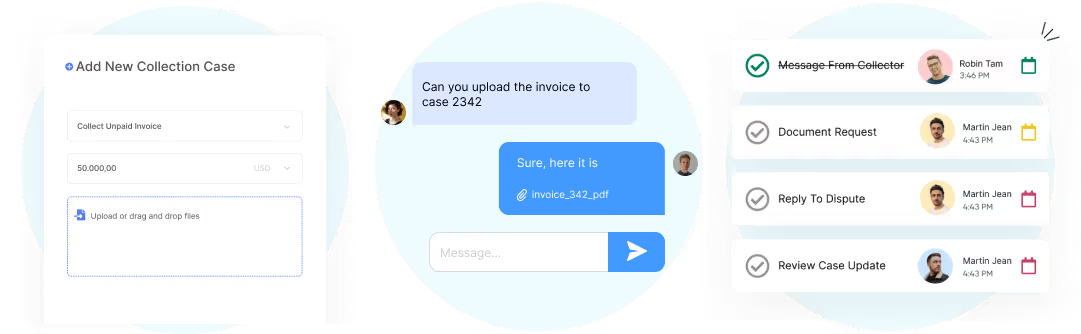
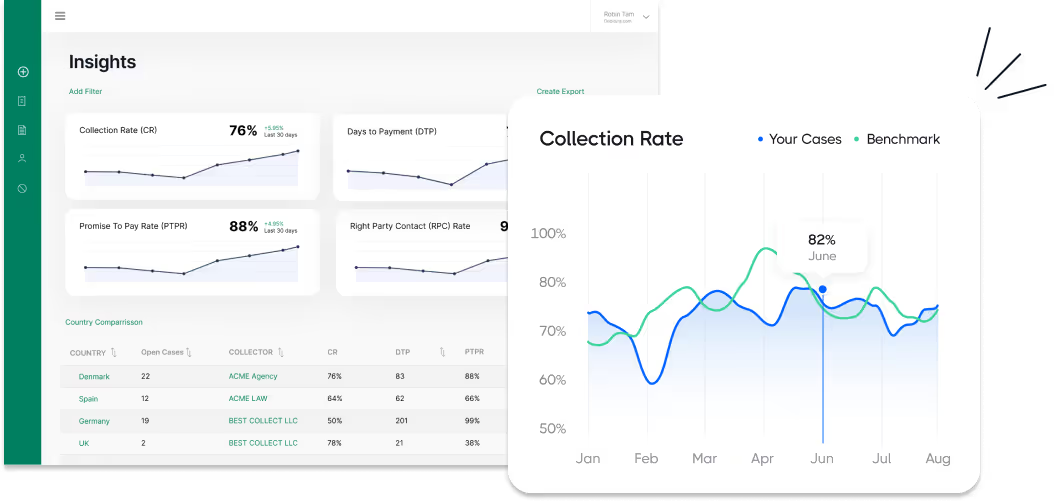
- Echtzeit-Verfolgung: Live-Status, Maßnahmen und Zahlungen in einem Portal.
- Compliance: Entspricht dem Consumer Protection Code 2012 und der DSGVO.

Beginnen Sie in 2 Minuten mit der Beitreibung Ihrer irischen Forderungen
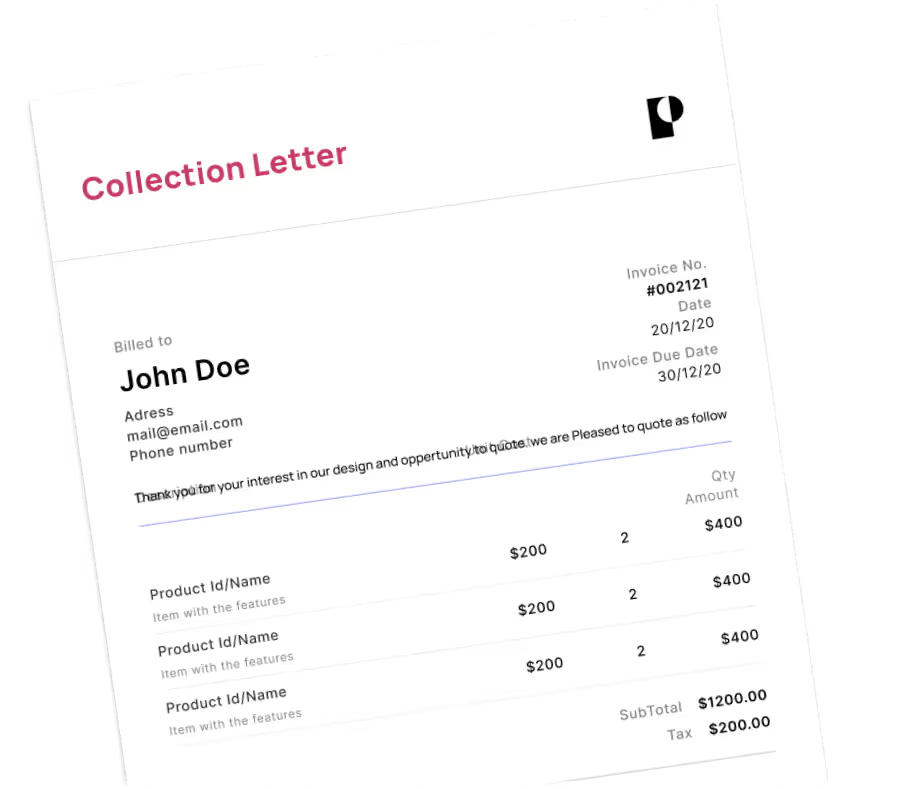
- Reichen Sie Ihre Forderung ein: Laden Sie Ihre unbezahlte Forderung in wenigen Minuten über das Dashboard, die REST API oder Plug-and-Play-ERP-Integrationen wie Xero hoch.
- Lokales Inkasso beginnt: Wir weisen den Fall Miller James Limited zu, der den Schuldner innerhalb von 24 Stunden auf Englisch kontaktiert. Wenn rechtliche Schritte erforderlich sind, können Sie 1–3 Festpreisangebote (z. B. Europäischer Zahlungsbefehl oder eine Klage vor dem Bezirks-/Kreisgericht) auswählen, bevor etwas unternommen wird.
- Bezahlung erhalten: Die Gelder werden nach der Beitreibung überwiesen. Wählen Sie für Rechtsstreitigkeiten aus Festpreisangeboten.

Transparente, erfolgsbasierte Preise
Mit Debitura zahlen Sie nur bei Erfolg. Das vorgerichtliche Inkasso erfolgt auf „Kein Erfolg, keine Gebühren“-Basis: eine Erfolgsprovision, die von den eingezogenen Beträgen abgezogen und lokal von Ihrem Partner in Rechnung gestellt wird. Die Gebühren hängen vom Land des Schuldners ab, nicht von Ihrem.
- Schuldner in Europa (EU, Island, Liechtenstein, Norwegen, Großbritannien und der Schweiz): Erfolgsprovisionen ab 6 % je nach Forderungshöhe.
- Schuldner im Rest der Welt: Erfolgsprovisionen ab 7,5 % je nach Forderungshöhe.
- Ältere Forderungen: Für Forderungen, die 12–24 Monate überfällig sind, sowie für Forderungen, die älter als 24 Monate sind, wird ein Aufschlag berechnet.
- Rechtliche Schritte sind optional: Sie genehmigen Festpreisangebote, bevor rechtliche Ausgaben anfallen.
Die vollständige Gebührenübersicht finden Sie auf der Preise-Seite oder erhalten Sie eine sofortige Schätzung, wenn Sie eine Forderung hochladen.
Wie funktioniert Inkasso in Irland?
Inkasso in Irland beginnt mit einer außergerichtlichen Phase, die lokal von Miller James Limited bearbeitet wird: Mahnungen und eine formelle Zahlungsaufforderung, die auf vollständige Zahlung oder eine schriftliche Ratenzahlungsvereinbarung abzielen. Die meisten unkomplizierten Forderungen werden in diesem Stadium gelöst. Zahlt der Schuldner immer noch nicht, ist eine Eskalation niemals automatisch – Ihr Partner prüft den rechtlichen Weg, und Sie genehmigen ein Angebot, bevor gerichtliche Schritte eingeleitet werden.
Wichtige Erkenntnisse
Die vier Schritte von der unbezahlten Rechnung zum eingezogenen Geld
- Schritt 1 - Außergerichtliches Inkasso: Mahnungen, eine formelle Zahlungsaufforderung und Verhandlungen, lokal bearbeitet von Miller James Limited. Die meisten unbestrittenen Forderungen werden in dieser Phase gelöst, ohne vor Gericht zu gehen.
- Schritt 2 - Vollstreckbarer Titel: Zahlt der Schuldner weiterhin nicht, prüft Ihr Partner den rechtlichen Weg, um einen vollstreckbaren Titel zu erhalten, und Sie genehmigen ein Festpreisangebot, bevor weitere Schritte eingeleitet werden.
- Schritt 3 - Zwangsvollstreckung: Mit einem vollstreckbaren Titel kann die zuständige Vollstreckungsbehörde Löhne, Bankguthaben und andere Vermögenswerte pfänden, bis die Forderung beglichen ist.
- Schritt 4 - Insolvenz: Sollte sich der Schuldner als insolvent erweisen, wird Ihre Forderungsanmeldung eingereicht und eventuelle Ausschüttungen in Ihrem Namen überwacht.
Jeder Schritt wird in Ihrem Dashboard verfolgt, und nichts eskaliert ohne Ihre Zustimmung. Die vollständigen rechtlichen Details für Irland – Zeitpläne, Kosten, Gerichte und Zwangsvollstreckung – finden Sie im folgenden Leitfaden.

Kostenlos starten
Keine Einrichtungsgebühr
Zugelassene Experten vor Ort
Kein Erfolg, keine Kosten
Inkasso in Irland - der vollständige Leitfaden 2026
This guide explains how debt collection works in Ireland: the courts, the governing law, the four-step recovery process and what it costs. It is written for creditors, in-house counsel and finance teams deciding how to recover a debt in Ireland.
Auf dieser Seite:
Warum Sie dieser Anleitung vertrauen können
At Debitura, we uphold the highest standards of impartiality and precision to bring you comprehensive guides on international debt collection. Every guide is written from primary legal sources and reviewed by licensed local experts in the jurisdiction it covers.
Fragen oder Feedback? Senden Sie uns eine E-Mail an contact@debitura.com , wir aktualisieren diesen Leitfaden basierend auf Ihrem Input.
Debitura in Zahlen:
- 767 licensed partners - collection agencies and law firms in our network
- 180 countries covered - with cases handled in 174 of them
- 5,306 businesses registered with Debitura
- 33 days median time to first payment on European cases
Von Experten geleitet, lokal validiert
Verfasst von Lars Holdgaard, Gründer von Debitura (über 10 Jahre Erfahrung im globalen B2B-Forderungseinzug). Jede Seite wird von führenden lokalen Anwälten überprüft, um die rechtliche Genauigkeit und die Anwendbarkeit der praktischen Schritte zu gewährleisten.

Mitwirkende lokale Experten:
Keine Einträge gefunden.
Letzte Aktualisierung:
August 19, 2026

Inkasso in Irland - kurze Antworten
How much does debt collection cost in Ireland?
Pre-legal debt collection in Ireland is typically success-based (No Cure, No Pay), so there is no upfront cost. If a claim escalates to court, the state charges an issue fee that scales with the claim value, and a B2B creditor can add statutory interest and fixed compensation on top of the principal.
| Gericht | Issue fee |
|---|---|
| District Court | EUR 25 (up to EUR 5,000), EUR 70 (over EUR 5,000 to EUR 10,000), EUR 80 (over EUR 10,000) |
| Circuit Court | EUR 90 (up to EUR 45,000), EUR 130 (over EUR 45,000) |
| Small Claims Procedure | EUR 25 flat (excludes business claims) |
All figures are from the Courts Service of Ireland's own published fee schedules. Enforcing a judgment adds a further, instrument-specific fee, covered in Step 3 below.
How long does debt collection take in Ireland?
There is no fixed statutory timeline for the amicable phase; most straightforward claims are resolved through demand letters and negotiation within around three months. In the Small Claims Procedure specifically, a debtor has around 15 days to respond before a disputed claim moves to a District Court hearing, and a debtor generally has 28 days to comply once an order is made, after which an unpaid award is enforced through the Sheriff or County Registrar (Citizens Information). A judgment itself, once obtained through any of Ireland's courts, remains enforceable for twelve years (Statute of Limitations 1957, s.11).
What is the limitation period for a debt claim in Ireland, and can I add interest?
Simple contract debts must be claimed within six years of the due date, while judgment debts and debts under seal (specialty debts) have twelve years (Statute of Limitations 1957, s.11). On business-to-business debts, statutory interest accrues automatically, without needing a reminder, at the ECB main refinancing rate (set each 1 January and 1 July) plus 8 percentage points, alongside fixed compensation for recovery costs (European Communities (Late Payment in Commercial Transactions) Regulations 2012, S.I. No. 580/2012). Further reasonable recovery costs above the fixed amount can also be claimed where justified. For B2C debts, these Regulations do not apply, so interest can only be claimed where it was contractually agreed.
| Debt band | Fixed compensation |
|---|---|
| Up to EUR 1,000 | EUR 40 |
| Over EUR 1,000 to EUR 10,000 | EUR 70 |
| Over EUR 10,000 | EUR 100 |
What documents do I need to collect a debt in Ireland?
Assemble the contract or purchase order, invoices and a statement of account, proof of delivery, and any written correspondence or acknowledgement of the debt. A signed acknowledgement or a part-payment record strengthens both a demand letter and a later court claim, and is worth keeping on file from the moment a claim is first sent to Debitura's partner for the amicable phase. For a Small Claims Procedure filing specifically, keep the underlying contract or receipt to hand, since the claim form is completed at the local District Court office.
Which route should my claim take in Ireland?
A consumer claim up to EUR 2,000 can use the Small Claims Procedure (EUR 25 fee), but the procedure excludes debt claims brought by a business (Citizens Information). Business claims and larger consumer claims are decided by claim value across three ordinary courts.
| Gericht | Rechtsraum |
|---|---|
| District Court | Up to EUR 15,000 |
| Circuit Court | Up to EUR 75,000 (Courts and Civil Law (Miscellaneous Provisions) Act 2013, s.14) |
| High Court | Above EUR 75,000 |
Once a judgment issues from any of these courts, the choice of enforcement instrument (Sheriff execution, Judgment Mortgage, Attachment/Garnishee, Receiver, or an Instalment Order) depends on the debtor's known assets, not on which court granted the judgment; see Step 3 for the full list.
Wer macht was beim Inkasso in Irland?
Debt collection agencies in Ireland
No regulator licenses or supervises private debt collection agencies in Ireland: the Central Bank of Ireland's Consumer Protection Code reaches collection only indirectly, through regulated lenders' outsourced agents, and sets a contact-hours rule of no calls between 9pm and 9am Monday to Saturday, and none on Sundays or public holidays without agreement (Citizens Information). Within that light-touch framework, agencies handle the entire amicable phase: tracing the debtor, sending demand letters, negotiating a payment plan, and applying statutory interest and compensation where a B2B debt qualifies under S.I. No. 580/2012.
The District and Circuit Courts
The District Court hears civil claims up to EUR 15,000 and the Circuit Court up to EUR 75,000; both issue the judgment that becomes the enforceable title once amicable collection fails (courts.ie, Citizens Information). Claims above EUR 75,000 go to the High Court, which has unlimited civil jurisdiction.
Enforcement authorities
Once a judgment is obtained, the Sheriff or County Registrar carries out execution against the debtor's goods, and other instruments such as a Judgment Mortgage, an Attachment/Garnishee order or a court-appointed Receiver are available depending on the debtor's assets (courts.ie's enforcement guide). All of these sit downstream of the court that granted judgment, not the agency that ran the amicable phase.
Solicitors
Once a claim is disputed, or needs to proceed beyond the Small Claims Procedure, a solicitor prepares and files the court claim and, where relevant, advises on enforcement. All debtors, regardless of who is collecting, retain criminal-law protection from harassment or intimidation under s.11 of the Non-Fatal Offences Against the Person Act 1997, which applies equally to agencies, solicitors and creditors acting directly.
Debitura's advantage: one contract and one dashboard connect you to Miller James Limited for the amicable phase and, if escalation is needed, to fixed-price legal quotes for the court and enforcement stages, without you having to manage separate local relationships.
Welche Gesetze und Gerichte gelten für das Inkasso in Irland?
The civil court system
Ireland's civil courts are organised by claim value. The District Court hears civil claims up to EUR 15,000 (courts.ie, Citizens Information); the Circuit Court hears claims up to EUR 75,000 (Courts and Civil Law (Miscellaneous Provisions) Act 2013, s.14); the High Court has unlimited jurisdiction above that.
| Court / procedure | Claim value |
|---|---|
| Small Claims Procedure (consumer only) | Up to EUR 2,000 |
| District Court | Up to EUR 15,000 |
| Circuit Court | Up to EUR 75,000 |
| High Court | Above EUR 75,000 |
Within the District Court, the Small Claims Procedure gives consumers a low-cost route for claims up to EUR 2,000, but it excludes debt claims brought by a business, so most business creditors use the ordinary District, Circuit or High Court route by claim value, and the correct court is fixed by the amount claimed rather than by choice.
Wichtige Rechtsvorschriften
The Statute of Limitations 1957, s.11, sets a six-year limitation period for simple contract debts and twelve years for judgment debts and specialty debts under seal, both running from when the debt fell due. The European Communities (Late Payment in Commercial Transactions) Regulations 2012 (S.I. No. 580/2012) entitles a business creditor to statutory interest at the ECB main refinancing rate plus 8 percentage points, and to fixed compensation for recovery costs, on B2B debts. Where a debtor cannot pay at all, the Companies Act 2014 (winding-up, s.570; examinership, Part 10, s.519) and the Personal Insolvency Act 2012 (Debt Relief Notices, Debt Settlement Arrangements and Personal Insolvency Arrangements) govern the collective insolvency processes covered in Step 4 below.
Verbraucher- und Datenschutz
A debt-collection-specific consumer-protection regime beyond the Central Bank's Consumer Protection Code was not separately confirmed for this guide; the Code's main practical rule for collection is the contact-hours restriction (no calls 9pm to 9am Monday to Saturday, none on Sundays or public holidays without agreement), reaching collectors only indirectly through regulated lenders' outsourced agents. Separately, s.11 of the Non-Fatal Offences Against the Person Act 1997 gives every debtor criminal-law protection from persistent, alarming demands regardless of who is collecting. The General Data Protection Regulation and the Data Protection Act 2018 apply generally to how a creditor or collector processes a debtor's personal data, though this guide did not separately research a debt-collection-specific data-protection regime beyond that general application.
Schritt 1 - Wie funktioniert das außergerichtliche (vorgerichtliche) Inkasso in Irland?
Amicable collection in Ireland begins with tracing the debtor and sending a formal payment demand, followed by negotiation aimed at full payment or a written instalment agreement, all without going to court. Where the debt is a B2B claim, the demand can also state the statutory interest and fixed compensation the creditor is entitled to add under S.I. No. 580/2012, which often encourages faster settlement.
| Tag | Aktion |
|---|---|
| Day 0-7 | Case reviewed, debtor traced, first payment demand sent |
| Day 7-30 | Follow-up contact and negotiation; an instalment plan may be offered |
| Day 30-90 | Further demands; if there is still no payment or agreement, escalation to court is discussed with you |
Throughout this phase, no regulator licenses the agency running collection, but the Central Bank of Ireland's Consumer Protection Code sets a contact-hours rule (no calls 9pm to 9am Monday to Saturday, none Sundays or public holidays without agreement), and s.11 of the Non-Fatal Offences Against the Person Act 1997 protects every debtor from harassment or intimidation regardless of who is collecting.
When to escalate in Ireland
Escalate once the demand lapses without a response, or the debtor disputes the claim without substance. Because the simple-contract limitation period is six years from the due date (Statute of Limitations 1957, s.11), do not let an amicable phase run so long that it puts the limitation period at risk. Escalation is never automatic: your partner assesses the legal route and you approve a quote before any court step, choosing between the Small Claims Procedure, the District Court, the Circuit Court or the High Court by claim value (Step 2 below). A written acknowledgement of the debt, or any part-payment obtained during the amicable phase, is worth keeping on file in case it is needed to support a later court claim.
Schritt 2 - Wie erlangt man einen vollstreckbaren Titel in Irland?
If amicable contact fails, the next step depends on the claim's value and who is claiming. A consumer claim up to EUR 2,000 can use the low-cost Small Claims Procedure; larger or business claims go through the ordinary District, Circuit or High Court route.
The Small Claims Procedure
The Small Claims Procedure is capped at EUR 2,000 and costs EUR 25 to file with the District Court office, but it specifically excludes debt claims brought by a business (Citizens Information). The debtor has around 15 days to respond; a disputed claim moves to a District Court hearing, and a debtor has 28 days to comply once an order is made. Unpaid awards are enforced through the Sheriff or County Registrar, the same as any other District Court judgment.
Determining the court
Outside the Small Claims Procedure, the District Court hears civil claims up to EUR 15,000 (courts.ie, Citizens Information); the Circuit Court hears claims up to EUR 75,000 (Courts and Civil Law (Miscellaneous Provisions) Act 2013, s.14); the High Court has unlimited jurisdiction for claims above that. A business claim for any amount, however small, must use one of these three courts rather than the Small Claims Procedure.
| Gericht | Rechtsraum | Issue fee |
|---|---|---|
| District Court | Up to EUR 15,000 | EUR 25 (up to EUR 5,000), EUR 70 (over EUR 5,000 to EUR 10,000), EUR 80 (over EUR 10,000) |
| Circuit Court | Up to EUR 75,000 | EUR 90 (up to EUR 45,000), EUR 130 (over EUR 45,000) |
An uncontested claim can proceed to judgment without a full hearing; a contested claim requires the debtor to defend, after which the court decides the claim or the parties settle before judgment. Whichever court grants it, the resulting judgment is the enforceable title used in Step 3, and it also starts its own twelve-year limitation period for enforcement (Statute of Limitations 1957, s.11).
Costs beyond the issue fee
Where the claim is a qualifying B2B debt, the statutory interest and fixed compensation described in the fees section below (S.I. No. 580/2012) can be claimed as part of the same court proceedings, on top of the principal and the issue fee. Once judgment issues, choosing which enforcement instrument to use, and whether to combine more than one, is a separate decision covered in Step 3.
Schritt 3 - Wie funktioniert die Zwangsvollstreckung in Irland?
Once a court judgment is final, several enforcement instruments are available depending on the debtor's assets and cooperation (courts.ie's enforcement guide). A judgment debt carries its own twelve-year limitation period from the date of judgment (Statute of Limitations 1957, s.11), so enforcement should not be left indefinitely.
| Instrument | What it does | Fee |
|---|---|---|
| Sheriff execution | The Sheriff or County Registrar seizes and sells the debtor's goods | EUR 19 |
| Instalment Order | District Court orders payment by instalments; breach can lead to a Committal Order | EUR 15 |
| Judgment Mortgage | Registers the judgment as a charge against the debtor's property | EUR 20 plus Property Registration Authority fees |
| Attachment/Garnishee | A third-party debt order attaches money a third party owes the debtor | Court fee applies |
| Receiver | A court-appointed receiver collects income or assets on the creditor's behalf | Court fee applies |
| Bankruptcy petition | Used where the debtor cannot pay at all (see Step 4) | See Step 4 |
Das Zwangsvollstreckung
The creditor selects the instrument that matches the debtor's known assets: Sheriff execution for goods, a Judgment Mortgage for property, an Attachment/Garnishee order for money a third party owes the debtor, or a Receiver over income or assets. An Instalment Order can be used where the debtor can pay only over time, and breach of that order can lead to a Committal Order. Where none of these instruments recovers the debt because the debtor genuinely cannot pay, a bankruptcy petition moves the case into the insolvency process described in Step 4.
Choosing between instruments
These instruments are not mutually exclusive: a creditor can register a Judgment Mortgage against property while separately pursuing an Attachment/Garnishee order against a bank account or third-party debt, and can combine any of them with Sheriff execution where the debtor holds movable goods of value. Which combination makes sense depends on what the creditor already knows about the debtor's assets; enforcement generally moves faster where a bank account or identifiable property is already known, and slower where the creditor must first establish what the debtor owns.
Schritt 4 - Wie beeinflussen Insolvenzverfahren den Forderungseinzug in Irland?
Unternehmensinsolvenz
A creditor owed EUR 10,000 or more can serve a statutory demand at the company's registered office; if it is not satisfied within 21 days, the creditor can petition the High Court to wind up the company (Companies Act 2014, s.570). Alternatively, the company itself, its directors, a creditor, or members holding 10 percent or more of the shares can petition the High Court for examinership, which gives the company an initial 70 days of protection from creditors while an independent accountant reports on its survival prospects; the appointment is notified to the Companies Registration Office on Form E24 within 3 days (Companies Act 2014, Part 10, s.519). Examinership is aimed at rescuing a viable company, so a creditor pursuing a winding-up petition should expect the process to pause if examinership is opened first.
Privatinsolvenz
Ireland has three personal insolvency arrangements below bankruptcy, each under the Personal Insolvency Act 2012, scaled to the debtor's means and the size of the debt.
| Arrangement | Geltungsbereich | Duration |
|---|---|---|
| Debt Relief Notice (DRN) | Debts up to EUR 35,000; net monthly disposable income EUR 60 or less; assets up to EUR 1,500 | 3-year supervision; early discharge once 50 percent or more is repaid |
| Debt Settlement Arrangement (DSA) | Unlimited unsecured debt; needs 65 percent or more creditor approval by value | Up to 5 years, extendable to 6 |
| Personal Insolvency Arrangement (PIA) | Secured debt up to EUR 3 million (extendable with consent), plus unlimited unsecured debt | Up to 6 years, extendable to 7; 70-day protective certificate |
Bankruptcy is available above EUR 20,000 of debt, on petition to the High Court's Examiner's Office, and carries a EUR 200 fee and an automatic discharge after 1 year (citizensinformation.ie). Because the DSA and PIA both require a creditor-approval vote by value, a large creditor's response to the proposal can materially affect whether either arrangement passes.
The creditor process
Once any of these processes opens, a creditor should file proof of the claim promptly and monitor the process; individual enforcement against the debtor generally cannot continue once a personal insolvency arrangement or bankruptcy is in place, and a winding-up or examinership similarly displaces individual creditor action against a company. This guide sets out the confirmed thresholds, durations and outcomes for each process; the detailed ranking and proof-of-claim mechanics within a given Irish insolvency case go beyond what this guide can confirm, so confirm those specifics with Irish counsel once a case arises.
Gebühren, Zinsen und wer was in Irland bezahlt
- Unsere Gebühr: erfolgsbasiert, Kein Erfolg, keine Gebühren (siehe Preise).
- Court & enforcement fees: apply only if the case escalates to legal action.
- Statutory debtor items: on B2B debts, statutory interest accrues automatically at the ECB main refinancing rate plus 8 percentage points, plus fixed compensation depending on the debt band (European Communities (Late Payment in Commercial Transactions) Regulations 2012, S.I. No. 580/2012).
- Who keeps what: recovered principal is yours; statutory interest and recoverable costs follow the rules below and are separate from Debitura's fee.
| Punkt | Amount |
|---|---|
| District Court summons fee | EUR 25 to EUR 80, by claim value |
| Circuit Court civil bill fee | EUR 90 or EUR 130, by claim value |
| Statutory interest (B2B) | ECB main refinancing rate plus 8 percentage points |
| Fixed compensation (B2B) | EUR 40 / EUR 70 / EUR 100, by debt band |
| Enforcement instrument fees | EUR 15 to EUR 20, by instrument (see Step 3) |
All figures are from the Courts Service of Ireland's fee schedules and the official S.I. No. 580 of 2012 statutory instrument (Courts Service of Ireland, irishstatutebook.ie). None of these statutory items are a Debitura fee; they are amounts the law allows a creditor to recover from the debtor, separate from what Debitura charges for the recovery service itself.
Cross-border debt collection in Ireland
Brussels I Recast (Regulation (EU) No. 1215/2012) governs recognition and enforcement of judgments from other EU member states in Ireland; a qualifying judgment is enforced here through the Master of the High Court, without a separate exequatur procedure. A European Enforcement Order (Regulation (EC) No. 805/2004) for an uncontested claim is enforced in Ireland as if it were a High Court judgment (e-justice.europa.eu).
For an uncontested cross-border claim, a creditor can apply for a European Order for Payment (Regulation (EC) No. 1896/2006, transposed by the European Communities (European Order for Payment) Regulations 2008) through the Central Office of the Superior Courts; the procedure is available in every EU member state except Denmark (courts.ie).
For a cross-border claim up to EUR 5,000, the European Small Claims Procedure (Regulation (EC) No. 861/2007) is open to business claims, costs EUR 25 to file, and applies across the EU except Denmark (Citizens Information).
Finden Sie einen Rechtsanwalt für Inkasso vor Ort
Benötigen Sie eine gerichtsfeste Vertretung? Teilen Sie uns Ihren Fall einmal mit und erhalten Sie bis zu drei Angebote von geprüften Prozessanwälten. Kostenlos, schnell und unverbindlich.
- Geprüfte Spezialisten
- Angebote in 24 Stunden, keine versteckte Gebühren
- Faire, vorab ausgehandelte Preise
Keine Einträge gefunden.
Häufig gestellte Fragen
Entdecken Sie unsere häufigsten Fragen und Antworten unten, oder kontaktieren Sie uns direkt unter contact@debitura.com, wenn Sie Hilfe bei einem bestimmten Fall benötigen.
Wie funktioniert Inkasso für ausländische Gläubiger in Irland?
.svg)
Ausländische Gläubiger können Inkasso in Irland über lizenzierte lokale Partner wie Miller James Limited betreiben. Sie reichen Ihre Forderung über das Debitura-Dashboard ein, und Miller James kontaktiert Ihren irischen Schuldner direkt, wobei die gesamte Kommunikation und Verhandlung übernommen wird. Das Verjährungsgesetz von 1957 sieht eine Frist von 6 Jahren für die Geltendmachung einfacher Vertragsforderungen vor, beginnend mit dem Fälligkeitsdatum der Zahlung. B2B-Gläubiger haben gemäß S.I. Nr. 580/2012 automatisch Anspruch auf Verzugszinsen, ohne eine Mahnung senden zu müssen. Scheitert die gütliche Beitreibung, können rechtliche Schritte vor dem District Court (Forderungen bis 15.000 EUR), Circuit Court (bis 75.000 EUR) oder High Court (über 75.000 EUR) eingeleitet werden.
Können Gläubiger in Irland Inkassokosten und Verzugsgebühren berechnen?
Yes, for B2B transactions. The European Communities (Late Payment in Commercial Transactions) Regulations 2012 (S.I. No. 580/2012) entitle creditors to fixed compensation for recovery costs: EUR 40 for debts up to EUR 1,000, EUR 70 for debts between EUR 1,000 and EUR 10,000, and EUR 100 for debts above EUR 10,000, plus further reasonable recovery costs above that amount where justified. Interest accrues automatically at the ECB main refinancing rate plus 8 percentage points per annum, without requiring a reminder. For B2C debts, the Regulations do not apply - you can only claim interest if it was contractually agreed.
Wie hoch sind typische Inkassogebühren in Irland, und wie schneidet Debitura im Vergleich ab?
Debt collection fees in Ireland vary widely depending on the agency and claim complexity. Because your debtor is located in Ireland, a European jurisdiction, Debitura applies the European fee schedule on a No Win, No Fee basis: 20% for claims USD 100-999, 9.5% for claims USD 1,000-149,999, and 6% for claims above USD 150,000. Unlike many agencies that charge upfront fees or monthly retainers, you pay nothing until Miller James Limited successfully recovers your money. Legal escalation is quoted separately: Debitura sources up to three fixed-price quotes from vetted Irish law firms, giving you full cost transparency before deciding to proceed. View detailed pricing at debitura.com/pricing.
Welche Gerichtsverfahren gelten für den Forderungseinzug in Irland?
Ireland uses three ordinary court levels for debt claims, based on the amount claimed. The District Court handles claims up to EUR 15,000, the Circuit Court handles claims up to EUR 75,000 (Courts and Civil Law (Miscellaneous Provisions) Act 2013, s.14), and the High Court has unlimited jurisdiction above that. The Small Claims Procedure is a separate, low-cost route for consumer claims up to EUR 2,000, but it specifically excludes debt claims brought by a business. District Court summons fees range from EUR 25 to EUR 80 and Circuit Court civil bill fees are EUR 90 or EUR 130, depending on the claim value (Courts Service of Ireland fee schedules).
Was passiert, wenn ein irischer Schuldner die Rechnung bestreitet?
When a debtor disputes the invoice, Miller James Limited assesses whether the dispute is genuine or a delaying tactic. If the dispute has merit, you may need to resolve the underlying issue before collection can proceed. If the dispute appears unfounded, Miller James continues amicable collection while documenting the debtor's objections. Should the debtor persist, escalation to court may be necessary: the debtor must then file a formal defence, and if no valid defence is entered, you can seek default judgment. Contested proceedings add time to the case compared with an uncontested claim, though the exact delay depends on the court's list and the complexity of the dispute.
Welche Zwangsvollstreckungsoptionen stehen nach einem Urteil in Irland zur Verfügung?
After obtaining a court judgment in Ireland, several enforcement instruments are available (Courts Service of Ireland enforcement guide). Sheriff execution lets the Sheriff or County Registrar seize and sell the debtor's goods, for a EUR 19 fee. You can also register a Judgment Mortgage against the debtor's property (EUR 20 plus Property Registration Authority fees), apply for an Attachment/Garnishee order to attach money a third party owes the debtor, seek a District Court Instalment Order requiring payment by instalments (EUR 15, with a Committal Order available on breach), or apply for a Receiver over the debtor's assets or income. A judgment debt carries a twelve-year limitation period from the date of judgment (Statute of Limitations 1957, s.11).
Benötigen Sie zusätzliche Länder?
“Debitura recovered well over 100,000 euros in overdue invoices for us across several countries, all through one contract and one dashboard. Local experts handle each market and we only pay when they actually collect — so our team can spend that time on what we do best: helping our own customers engage smarter with the Manago AI platform.”
Manago AI (formerly SALESmanago)
767
Licensed collection agencies and law firms in our network
180
Countries covered, with cases handled in 174 of them
5,306
Businesses registered with Debitura
.svg)