.png)


.png)
.svg)
Kostenlos loslegen
Inkassounternehmen in den VAE – auf Erfolgsbasis
Your claims are handled exclusively by SADAD Aman Debt Collection Services LLC, our licensed local partner in Dubai (tahseel al-duyun), on a No Cure, No Pay basis.

100 % risikofrei: Sie zahlen nur bei Erfolg
Local debt collection by licensed agency / law firm
Dubai DET licence 1166181 | ISO 9001:2015 | ACA member

Kostenlose Expertenberatung anfordern
Antwort von einem Spezialisten innerhalb von 24 Stunden.
Vielen Dank! Ihre Anfrage wurde empfangen!
Hoppla! Beim Absenden des Formulars ist etwas schiefgelaufen.
Warum Debitura für Inkasso in den VAE wählen?
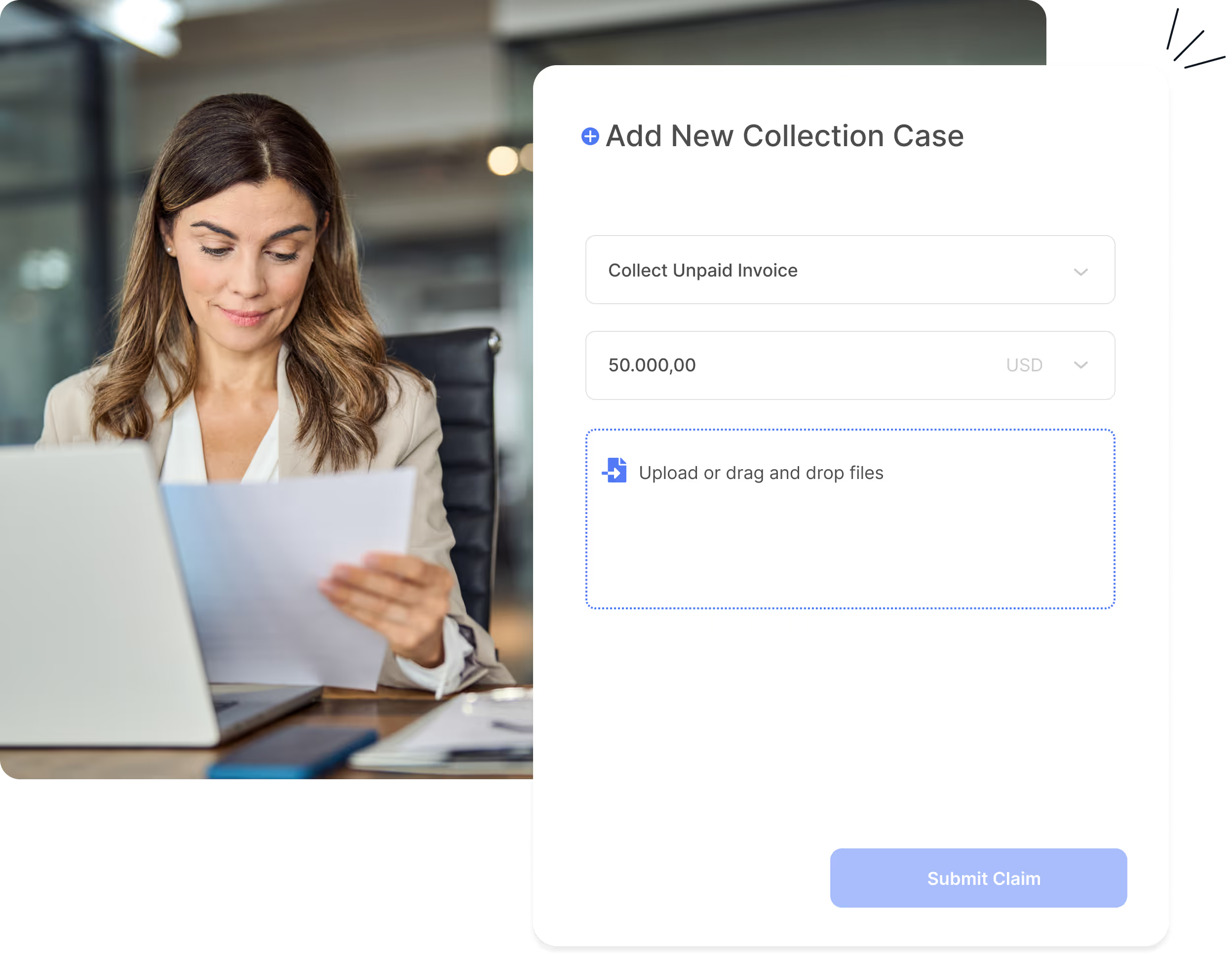
Schnelles, einfaches und risikofreies Inkasso in den VAE
Debitura recovers unpaid invoices from debtors in the UAE through our platform: submit your claim, and we assign it to a licensed local partner working on a No Cure, No Pay basis while you track progress in real time. Your case is handled by SADAD Aman Debt Collection Services LLC, a Dubai agency licensed by the Department of Economy and Tourism (Licence No. 1166181), ISO 9001:2015 certified and a member of ACA International and IACC.
- Risikofrei: Zahlen Sie nur, wenn wir Ihr Geld zurückholen.
- Schnelle Einrichtung: Rechnungen mit wenigen Klicks einreichen.
- Echtzeit-Verfolgung: Verfolgen Sie den Fortschritt live in einem Portal.
- Local expertise: Licensed local professionals run the case on the ground, in Arabic where the courts require it.
For a wider view of payment risk across markets, see Debitura's global late-payment data covering 177 countries.

Erste Schritte mit Inkasso in den VAE
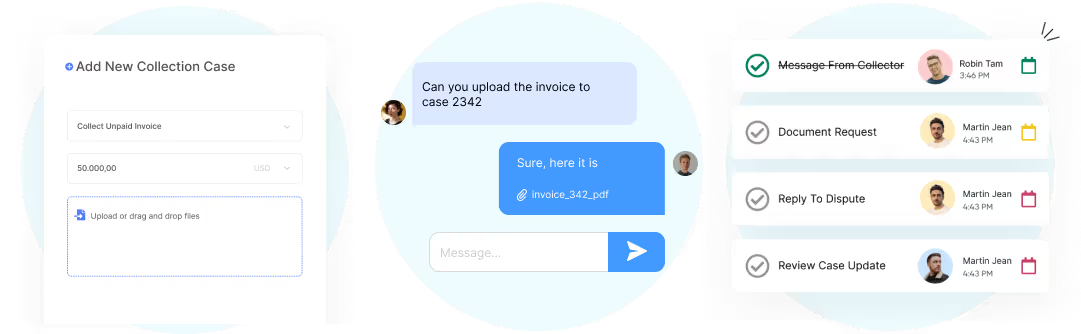
- Laden Sie Ihre Forderung hoch. Geben Sie die Schuldnerdaten an und laden Sie Ihre Rechnung hoch. Dauert weniger als 2 Minuten.
- We assign your case. SADAD Aman Debt Collection Services LLC reviews the file and confirms acceptance, normally within 48 hours.
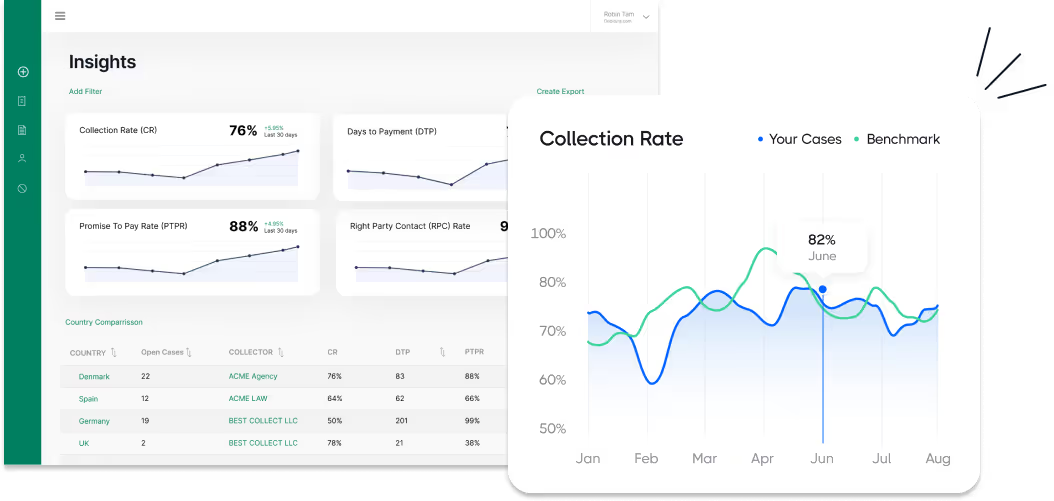
- Verfolgen und eintreiben. Verfolgen Sie jedes Update in Ihrem Dashboard. Zahlen Sie nur, wenn die Gelder zurückgefordert wurden.
Nutzen Sie bereits ein ERP-System? Verbinden Sie sich über API oder Zapier für die automatisierte Forderungseinreichung.

Transparente, erfolgsbasierte Preise
Mit Debitura zahlen Sie nur bei Erfolg. Das vorgerichtliche Inkasso erfolgt auf „Kein Erfolg, keine Gebühren“-Basis: eine Erfolgsprovision, die von den eingezogenen Beträgen abgezogen und lokal von Ihrem Partner in Rechnung gestellt wird. Die Gebühren hängen vom Land des Schuldners ab, nicht von Ihrem.
- Schuldner in Europa (EU, Island, Liechtenstein, Norwegen, Großbritannien und der Schweiz): Erfolgsprovisionen ab 6 % je nach Forderungshöhe.
- Schuldner im Rest der Welt: Erfolgsprovisionen ab 7,5 % je nach Forderungshöhe.
- Ältere Forderungen: Für Forderungen, die 12–24 Monate überfällig sind, sowie für Forderungen, die älter als 24 Monate sind, wird ein Aufschlag berechnet.
- Rechtliche Schritte sind optional: Sie genehmigen Festpreisangebote, bevor rechtliche Ausgaben anfallen.
Die vollständige Gebührenübersicht finden Sie auf der Preise-Seite oder erhalten Sie eine sofortige Schätzung, wenn Sie eine Forderung hochladen.
Wie funktioniert Inkasso in den Vereinigten Arabischen Emiraten?
Debt collection in the United Arab Emirates starts with an amicable phase handled locally by SADAD Aman Debt Collection Services LLC: reminders, a formal demand for payment and, where the debtor is a business, visits to its premises. This phase typically runs 60 to 90 days and resolves most undisputed claims. If the debtor still does not pay, escalation is never automatic; your partner assesses the legal route, and you approve a fixed-price quote before any court step.
Wichtige Erkenntnisse
- Limitation: 5 years between traders (Federal Decree-Law No. 50/2022, Art. 92), 15 years against a consumer (Federal Decree-Law No. 25/2025, Art. 429)
- Amicable phase typically runs 60 to 90 days
- Payment order available for written, due debts, with a decision within 3 business days
- Enforcement via bank attachment, asset seizure, salary garnishment or a travel ban
Die vier Schritte von der unbezahlten Rechnung zum eingezogenen Geld
- Schritt 1, Außergerichtliches Inkasso: Mahnungen, eine formelle Aufforderung und Verhandlungen, lokal bearbeitet von SADAD Aman Debt Collection Services LLC. Die meisten unbestrittenen Forderungen werden hier gelöst, ohne vor Gericht zu gehen.
- Schritt 2, Vollstreckbarer Titel: Zahlt der Schuldner weiterhin nicht, prüft Ihr Partner den rechtlichen Weg zur Erlangung eines vollstreckbaren Titels, und Sie genehmigen ein Festpreisangebot, bevor weitere Schritte eingeleitet werden.
- Schritt 3, Zwangsvollstreckung: Mit einem Titel können die Vollstreckungsbehörden Vermögenswerte pfänden und verkaufen, Bankkonten und Löhne beschlagnahmen und andere Maßnahmen ergreifen, bis die Forderung eingezogen ist.
- Schritt 4, Insolvenz: Kann der Schuldner nicht zahlen, wird Ihr Forderungsnachweis im Insolvenzverfahren eingereicht, und etwaige Ausschüttungen werden in Ihrem Namen überwacht.
Every step is tracked in your dashboard, and nothing escalates without your approval. The full legal detail for the United Arab Emirates follows in the guide below.
Video intro: Muhammed Ajmal Azeez of SADAD Aman, our licensed collection partner in Dubai, walks through how a UAE case actually runs, from the first demand to enforcement.

Kostenlos starten
Keine Einrichtungsgebühr
Zugelassene Experten vor Ort
Kein Erfolg, keine Kosten
Inkasso in den Vereinigten Arabischen Emiraten - der vollständige Leitfaden 2026
Dieser Leitfaden wurde für ausländische und inländische Gläubiger, Unternehmensjuristen und Finanzteams erstellt und erläutert, wie Inkasso in den VAE (einschließlich Dubai und Abu Dhabi) von Anfang bis Ende funktioniert: den rechtlichen Rahmen, Zuständigkeiten, Verjährungs- und Zinsregeln, den Weg des Zahlungsbefehls und den Scheck als direkten Vollstreckungstitel, die Zwangsvollstreckung durch den Vollstreckungsrichter, die Onshore-Gerichte sowie die DIFC- und ADGM-Gerichte und die Insolvenz gemäß dem Gesetz über finanzielle Restrukturierung und Insolvenz von 2023.
Auf dieser Seite:
Warum Sie dieser Anleitung vertrauen können
At Debitura, we uphold the highest standards of impartiality and precision to bring you comprehensive guides on international debt collection. Every guide is written from primary legal sources and reviewed by licensed local experts in the jurisdiction it covers.
Fragen oder Feedback? Senden Sie uns eine E-Mail an contact@debitura.com , wir aktualisieren diesen Leitfaden basierend auf Ihrem Input.
Debitura in Zahlen:
- 767 licensed partners - collection agencies and law firms in our network
- 180 countries covered - with cases handled in 174 of them
- 5,306 businesses registered with Debitura
- 33 days median time to first payment on European cases
Von Experten geleitet, lokal validiert
Verfasst von Lars Holdgaard, Gründer von Debitura (über 10 Jahre Erfahrung im globalen B2B-Forderungseinzug). Jede Seite wird von führenden lokalen Anwälten überprüft, um die rechtliche Genauigkeit und die Anwendbarkeit der praktischen Schritte zu gewährleisten.

Mitwirkende lokale Experten:
Letzte Aktualisierung:
October 7, 2026

Inkasso in den Vereinigten Arabischen Emiraten - schnelle Antworten
Debt collection in the United Arab Emirates runs through onshore civil courts alongside the common-law DIFC and ADGM courts, and since 2022 a bounced cheque is a direct route to enforcement.
Wie hoch sind die Inkassokosten in den VAE?
Pre-legal collection is commonly success-based (No Cure, No Pay), and the main court cost is a filing fee of 6% of the claim value, capped on a sliding scale: AED 20,000 for claims up to AED 500,000, AED 30,000 from AED 500,001 to AED 1,000,000, and AED 40,000 only above AED 1,000,000, with a minimum of AED 500 (Dubai Law No. 21 of 2015 as amended by Law No. 2 of 2019). An appeal costs 50% of the first-instance fee. The larger cost is usually counsel: UAE courts award only a token contribution to the winner's legal fees, so budget your own lawyer's fees as a real cost of the claim.
Wie lange dauert Inkasso in den VAE?
The amicable phase typically runs 60 to 90 days. Where the debt is evidenced by a bounced cheque or another executive instrument, enforcement starts directly before the execution judge and commonly resolves in 4 to 6 months; an ordinary contested civil claim runs 9 to 18 months through the Court of First Instance and Appeal, longer where the court appoints an expert.
What are the limitation periods in the UAE?
A claim between traders is time-barred after five years from the due date (Commercial Transactions Law, Federal Decree-Law No. 50 of 2022, Art. 92), but that rule applies only to obligations of traders against each other. A claim against a consumer runs on the general fifteen-year civil period (Civil Transactions Law, Federal Decree-Law No. 25 of 2025, Art. 429), even where the creditor is a business. In the DIFC and ADGM the period is six years.
Can I charge interest on a UAE debt?
Yes for commercial debts: where no rate is agreed, interest is capped at 9% per annum (Commercial Transactions Law, Arts. 72 and 73), and Art. 84 extends the entitlement to any commercial obligation for a certain sum, which covers ordinary unpaid invoices. Compound interest is prohibited (Art. 88). Dubai's courts currently apply 5% per annum as a matter of judicial practice rather than statute, and other emirates have applied different rates.
| Thema | Regel |
|---|---|
| Limitation, trader against trader | 5 years from the due date (Federal Decree-Law No. 50/2022, Art. 92). |
| Limitation, claim against a consumer | 15 years (Federal Decree-Law No. 25/2025, Art. 429). |
| Limitation, DIFC and ADGM | 6 years. |
| Interest, no rate agreed | Capped at 9% per annum; compounding prohibited. |
| Payment-order court fee | 6% of the claim, capped at AED 20,000 / 30,000 / 40,000 by claim size. |
| Geplatzter Scheck | A direct writ of execution before the execution judge since 2022. |
Welche Dokumente benötige ich, um eine Forderung in den VAE einzutreiben?
Assemble the signed and stamped contract or purchase order, invoices and a statement of account, the local purchase order where one was issued, a signed and stamped delivery note, any cheques or promissory notes, and the email trail. A written acknowledgement of the debt, or a cheque, materially strengthens and speeds up enforcement, and an acknowledgement or part-payment generally restarts the limitation clock.
Welchen Verfahrensweg sollte meine Forderung in den VAE nehmen?
A debt secured by a bounced cheque or another executive instrument goes straight to the execution judge. A documented, undisputed debt uses the order-for-payment procedure, which carries expedited execution. A disputed claim goes to the onshore civil courts, or to the DIFC or ADGM courts where their jurisdiction applies.
Wer ist wofür im Inkasso in den Vereinigten Arabischen Emiraten zuständig?
Der Forderungseinzug in den VAE umfasst Inkassobüros für die außergerichtliche Bearbeitung, zugelassene Anwälte für Gerichtsverfahren und den Vollstreckungsrichter für die Zwangsvollstreckung. Debitura unterstützt Sie in allen Phasen durch SADAD Aman Debt Collection Services LLC.
Inkassobüros in den VAE
Agencies handle the pre-legal phase: tracing, demands, negotiation and settlement, and in commercial cases visits to the debtor's premises during working hours. Debt collection is licensed at emirate level as an ordinary commercial activity, in Dubai by the Department of Economy and Tourism, and is not a Central Bank licensed financial activity. Conduct is governed by the general law: the Penal Code on harassment, intimidation and trespass, and the Personal Data Protection Law on debtor data.
Rechtsanwälte in den VAE
Only registered advocates may appear before the onshore courts, and rights of audience are reserved to UAE nationals under Federal Decree-Law No. 34 of 2022 on the legal profession. That rule applies to every company in the UAE, not just to collection agencies, and it is why litigation is always instructed through a separate licensed law firm rather than run in-house by an agency. Specialist litigators appear before the DIFC and ADGM common-law courts.
Gerichte und der Vollstreckungsrichter in den VAE
The onshore courts (Court of First Instance, Court of Appeal and Court of Cassation) hear civil and commercial claims in each emirate; Dubai and Ras Al Khaimah run their own judicial departments and the remaining emirates sit under the federal judiciary. The Dubai International Financial Centre (DIFC) and Abu Dhabi Global Market (ADGM) operate independent English-language common-law courts. Enforcement of a judgment or an executive instrument is handled by the execution judge (qadi al-tanfidh).
The credit bureau in the UAE
Al Etihad Credit Bureau collects data only from registered institutional providers such as banks, finance companies, telecoms, utilities, courts and government entities. An ordinary trade creditor cannot report a defaulting business debtor to the bureau, which is a common and costly assumption among foreign creditors. Courts are a registered provider, so a judgment can reach the debtor's credit file even though the underlying trade debt cannot.
Welche Gesetze und Gerichte gelten für das Inkasso in den Vereinigten Arabischen Emiraten?
Der Forderungseinzug in den VAE basiert auf föderaler Zivil- und Handelsgesetzgebung, neben den unabhängigen Common-Law-Systemen der Finanzfreizonen DIFC und ADGM.
Das Gerichtssystem in den VAE
Onshore, civil and commercial claims run through the Court of First Instance, the Court of Appeal and the Court of Cassation. Abu Dhabi has operated a dedicated onshore Small Claims Court since 2020 for civil, commercial and labour claims under AED 500,000. Two financial free zones, the DIFC in Dubai and the ADGM in Abu Dhabi, have their own common-law courts and their own small-claims tracks: the DIFC Small Claims Tribunal hears claims up to AED 500,000, or AED 1,000,000 by agreement, and the ADGM Small Claims Division up to USD 100,000.
Wichtige Gesetzgebung in den VAE
- Bundesdekretgesetz Nr. 42 von 2022 (das Zivilprozessrecht): Rechtsstreitigkeiten, das Mahnverfahren und die Zwangsvollstreckung.
- Federal Decree-Law No. 50 of 2022 (the Commercial Transactions Law): commercial obligations, limitation between traders, interest, and the cheque as an executive instrument.
- Federal Decree-Law No. 25 of 2025 (the Civil Transactions Law, the Civil Code): general obligations and the fifteen-year civil limitation period. In force since 1 June 2026, replacing the 1985 Civil Code.
- Bundesdekretgesetz Nr. 51 von 2023 (das Gesetz über Finanzrestrukturierung und Insolvenz): Unternehmensinsolvenz, in Kraft ab dem 1. Mai 2024.
- Federal Decree-Law No. 34 of 2022: the legal profession and who may litigate.
Business claims against consumers
The five-year commercial limitation period applies to obligations of traders against each other. A private individual is not a trader, so a claim against a consumer falls under the general fifteen-year civil period, even where the creditor is a business. This distinction decides whether an older consumer debt is still recoverable and is frequently missed.
Verhalten und Datenschutz in den VAE
Collectors must avoid harassment, intimidation and trespass under the Penal Code (Federal Decree-Law No. 31 of 2021), and debtor data is protected by the Personal Data Protection Law (Federal Decree-Law No. 45 of 2021), now enforced under Cabinet Resolution No. 33 of 2024. Within the free zones the DIFC and ADGM data-protection regimes apply instead. Note that the Central Bank's consumer debt-collection standards bind licensed financial institutions and the agents collecting on their behalf, not an independent agency collecting ordinary trade debt; SADAD Aman applies those standards as a matter of policy in consumer matters.
Schritt 1 - Wie funktioniert das außergerichtliche (vorgerichtliche) Inkasso in den Vereinigten Arabischen Emiraten?
Pre-legal collection recovers an unpaid invoice without a full lawsuit, through reminders, a formal demand and negotiation, and it typically runs 60 to 90 days before a case is either settled or assessed for legal action. A written acknowledgement of the debt, and above all a cheque, greatly strengthens the position, because since 2022 a returned cheque is a direct route to enforcement. The aim is full payment or a written settlement.
| Phase | Aktion |
|---|---|
| Days 0 to 7 | Verify the debtor and trace the right contact; issue the demand with the supporting documents. |
| Days 7 to 30 | Structured follow-up by email and telephone; a visit to the debtor's premises where the debtor is a business. |
| Days 30 to 90 | Negotiation towards full payment, a settlement or an instalment plan, with the creditor approving the terms. |
| After day 90 | Assess the legal route, or close the file where there is no traction. |
Field visits and what they establish
Visiting a business debtor's premises during working hours is lawful and standard practice in UAE commercial collection, subject to the general limits on harassment, intimidation and trespass. The visit confirms that the company is trading and gives a first read on whether it is placed to pay, which is what decides whether funding legal action is worthwhile. There is no requirement for the pre-legal demand to be in Arabic; Arabic translation becomes mandatory at the litigation stage.
The pre-litigation notices in the United Arab Emirates
Between the amicable phase and a court filing sit two escalating formal notices that many creditors never use: a legal notice issued through a law firm, and a court notice issued by the court itself and served on the debtor. Both cost far less than filing a claim, and both signal that the creditor has started spending on the matter.
Wann eine Eskalation in den Vereinigten Arabischen Emiraten angebracht ist
Escalate when the demand lapses or the debtor disputes without substance. Where you hold a bounced cheque, escalation can go straight to the execution judge; otherwise a documented debt can use the order-for-payment route. A genuine, documented dispute over quality or delivery is different: it belongs back with the creditor for a commercial decision, not in an enforcement queue.
Schritt 2 - Wie erhalten Sie einen vollstreckbaren Titel in den Vereinigten Arabischen Emiraten?
Um eine Forderung durchzusetzen, benötigen Sie einen vollstreckbaren Titel oder ein Vollstreckungsinstrument. Die VAE bieten einen direkten Weg für Schecks, einen Zahlungsbefehlsweg für dokumentierte Forderungen und ordentliche Verfahren für bestrittene Forderungen.
Der Scheck als Vollstreckungstitel
Since the 2022 reforms, a cheque returned for insufficient funds is an executive instrument that the beneficiary can take directly to the execution judge, without first obtaining a court judgment. A simple bounce for insufficient funds is no longer a criminal offence, but criminal liability remains where the account was closed or never existed, where the cheque was forged, where payment was stopped in bad faith, and where the cheque formed part of a fraud. Recourse on the cheque itself is time-barred two years after the presentment period expires, and against the drawee bank after three years, but the underlying debt survives that bar and may still be pursued on its own limitation period.
The order-for-payment procedure
For a debt established in writing, due and for a specified sum, the creditor serves a five-day written demand and then applies to the judge, who decides within three business days (Civil Procedure Law, Federal Decree-Law No. 42 of 2022, Arts. 143 to 150). The court fee is 6% of the claim value, capped at AED 20,000 for claims up to AED 500,000, AED 30,000 up to AED 1,000,000 and AED 40,000 above that. The debtor may file a grievance within 15 days for claims under AED 50,000, or appeal within 30 days at or above that figure. The route's main advantage is that execution can proceed while an objection or appeal is pending.
Small claims and the ordinary suit
Abu Dhabi has run a dedicated onshore Small Claims Court since 2020 for civil, commercial and labour claims under AED 500,000, and the DIFC Small Claims Tribunal and ADGM Small Claims Division offer English-language fast tracks up to AED 500,000 and USD 100,000 respectively. Disputed or complex claims otherwise proceed as an ordinary civil suit through the Case Management Office and the Court of First Instance, typically 9 to 18 months including appeal.
Die Bestimmung des zuständigen Gerichtsstands in den Vereinigten Arabischen Emiraten
The forum depends on where the parties and the contract are based and on any jurisdiction clause. Contracts connected to the DIFC or ADGM, or with an opt-in clause, are heard by those common-law courts; otherwise the onshore courts apply. Onshore filings must be in Arabic, translated by a translator licensed by the Ministry of Justice.
Mehr zu Gerichtsverfahren in den Vereinigten Arabischen Emiraten
The court-appointed expert
Where a claim turns on a technical or accounting question, the court appoints an independent expert. The requesting party pays a deposit into the court treasury upfront and the final judgment reallocates it to the losing party. An expert appointment adds materially to both cost and time, and it is the single most common reason a UAE claim runs past a year.
Gerichte des DIFC und ADGM
The DIFC and ADGM courts offer English-language, common-law proceedings with strong, treaty-backed enforcement, and are often chosen for cross-border commercial debts. Their costs regime also differs from onshore practice: in the DIFC costs follow the event, so the losing party pays the winner's costs, and post-judgment interest runs at 9% as a matter of course.
Schritt 3 - Wie funktioniert die Zwangsvollstreckung von Forderungen in den Vereinigten Arabischen Emiraten?
Enforcement of a judgment or an executive instrument is handled by the execution judge (qadi al-tanfidh), who has exclusive supervisory jurisdiction and gives the debtor a short compliance window before coercive measures begin. The creditor selects the measures that match the debtor's known assets, and enforcement commonly runs from two months to two years depending on where those assets sit.
Wege zur Durchsetzung einer Forderung in den Vereinigten Arabischen Emiraten
- Bank-account attachment: the debtor's balances can be frozen and applied to the debt, typically taking effect within about a week of the order.
- Attachment of assets: the execution court attaches movable and immovable property for sale, subject to statutory exemptions for tools of trade and basic household necessities.
- Salary garnishment: a protected subsistence portion of salary is excluded.
- Travel ban: available against an individual debtor for debts of at least AED 10,000 (Civil Procedure Law, Arts. 324 to 326). It applies to the individual: a company's debt does not by itself expose its managers or directors to a ban without a personal guarantee, a personally signed cheque or proven personal liability.
- Scheckvollstreckung: Ein zurückgewiesener Scheck wird direkt als vollstreckbares Instrument vollstreckt.
When directors become personally liable
The limited-liability veil holds by default, but two statutory gateways matter to creditors. Under Art. 84 of the Commercial Companies Law (Federal Decree-Law No. 32 of 2021) a manager or director is personally liable for fraud, abuse of power, breach of the law or the memorandum of association, or gross error. Under Art. 246 of the Bankruptcy Law (Federal Decree-Law No. 51 of 2023) a court can order board members, managers and anyone exercising actual management to cover losses personally for conduct in the two years before the company stopped paying, including undervalue asset disposals, preferential payments and reckless trading.
Imprisonment for debt, in plain terms
You cannot be imprisoned in the UAE simply because you cannot afford to pay a debt: the law presumes debtors are unable to pay, and the creditor must prove otherwise. Imprisonment for debt is not abolished, and a court can still order detention where a creditor proves the debtor has the money or assets and is refusing, or has hidden assets to avoid a judgment. It is a last-resort tool used after bank freezes and asset seizure, not a routine collection step, and statutory exemptions apply, including a minimum debt of AED 10,000.
Der Vollstreckungsprozess in den Vereinigten Arabischen Emiraten
Der Gläubiger eröffnet eine Vollstreckungsakte mit dem Titel oder Instrument, der Vollstreckungsrichter ordnet die Pfändung an, und die Erlöse werden auf die Schuld angerechnet. Urteile des DIFC und ADGM sind im Inland durch die etablierten Protokolle und international durch die Vollstreckungsabkommen der VAE vollstreckbar.
Schritt 4 - Wie wirken sich Insolvenzverfahren auf die Beitreibung von Forderungen in den Vereinigten Arabischen Emiraten aus?
Where the debtor is a company that cannot pay, insolvency under the Financial Restructuring and Bankruptcy Law (Federal Decree-Law No. 51 of 2023, in force from 1 May 2024) becomes the collective route, and individual enforcement generally pauses once it opens. One federal law covers the mainland and every free zone, with two exceptions: the DIFC and the ADGM run independent insolvency regimes through their own courts. The practical question for a creditor is therefore whether the debtor sits inside DIFC or ADGM, not which free zone it is registered in.
You do not have to wait for the debtor
A creditor can petition to open bankruptcy proceedings where the debt is undisputed and due, a formal demand has been served, thirty days have passed without payment, and the debt is at least AED 1,000,000, rising to AED 10,000,000 where the debtor is regulated by the Central Bank or the Securities and Commodities Authority. That threshold was raised from AED 100,000 by Cabinet Resolution No. 94 of 2024. Below it, bankruptcy is simply not an available route, which matters because the threat of forced liquidation is often described as leverage on debts far too small to support it.
Restructuring, bankruptcy and voluntary liquidation
The 2023 law provides for preventive settlement, restructuring and bankruptcy, supervised by a specialised bankruptcy court, with a dedicated Bankruptcy Court established within the Abu Dhabi Court of First Instance in July 2025, and administered by appointed trustees. Solvent voluntary liquidation is a separate, administrative process: on the mainland it requires notice in two local Arabic-language daily newspapers giving creditors a minimum of 45 days to come forward (Commercial Companies Law, Federal Decree-Law No. 32 of 2021). Most free zones apply the same 45-day window administratively, while the DIFC uses a different mechanism without newspaper publication.
Ergebnisse und Rangfolge
Distributions follow a statutory ranking: secured creditors are paid from their collateral first, then privileged debts including judicial costs, government and tax dues and employee wages, and finally ordinary unsecured creditors pro rata. Foreign trade creditors are almost always in that last tier, and partial recovery is the norm rather than the exception.
Das Insolvenzverfahren für Gläubiger in den Vereinigten Arabischen Emiraten
Submit your proof of claim to the trustee with the contract, invoices and statement of account, and monitor the process. The more useful conclusion is about timing rather than procedure: a creditor who obtains a title and enforces against UAE bank accounts before an insolvency filing recovers materially more than one who waits and files a claim in a process where unsecured trade debt ranks last. Speed beats process.
Gebühren, Zinsen und wer was zahlt in den Vereinigten Arabischen Emiraten
- Unsere Gebühr: erfolgsbasiert, Kein Erfolg, keine Gebühren (siehe Preise).
- Court & enforcement fees: statutory court and enforcement fees apply only if the case escalates to legal action. The payment-order and civil filing fee is 6% of the claim value, capped at AED 20,000 up to AED 500,000, AED 30,000 up to AED 1,000,000 and AED 40,000 above that, with a minimum of AED 500; an appeal costs half the first-instance fee.
- Statutory debtor items: where no rate is agreed, commercial interest is capped at 9% per annum and compounding is prohibited; Art. 84 of the Commercial Transactions Law extends the entitlement to ordinary unpaid invoices, not only loans.
- Wer was behält: Der eingetriebene Kapitalbetrag gehört Ihnen; Zinsen und Kosten richten sich nach dem Vertrag, dem Gesetz und der gerichtlichen Anordnung.
Recovering your legal costs in the United Arab Emirates
UAE courts award only a token contribution to the winner's legal fees, commonly in the range of AED 1,000 to 2,000 per stage regardless of what was actually spent. That, rather than the filing fee, is what makes small claims uneconomic. Compensation beyond delay interest is available under Art. 87 of the Commercial Transactions Law only on proof of the debtor's deception or serious error, so it is a fault-based exception rather than a general right to recover collection costs.
The contract clause that changes this
In 2025 the Dubai Court of Cassation awarded a creditor its full documented legal fees where the contract contained an express fee-recovery clause and the creditor produced invoices and proof of payment, while describing the award as the exception rather than the rule. The practical lesson for anyone trading into the UAE is to write a legal-fee recovery clause into the contract and keep the invoices.
Grenzüberschreitendes Inkasso in den Vereinigten Arabischen Emiraten
A foreign creditor has three separate questions in the UAE: how to get its documents accepted, whether to rely on a court judgment or an arbitral award, and whether a UAE judgment can be enforced back home. The answers differ sharply, and the choices made in the contract usually decide the outcome.
The UAE is not an Apostille country
The UAE has not acceded to the Hague Apostille Convention, contrary to a claim that circulates widely online. Full consular legalisation is still required: notarise the document at home, authenticate it with the home foreign ministry, legalise it at the UAE embassy or consulate, attest it at the UAE Ministry of Foreign Affairs on arrival, and have it translated into Arabic by a translator licensed by the Ministry of Justice. Instructing UAE counsel requires a specific power of attorney, not a general one, through the same chain. The DIFC and ADGM operate in English and do not carry the Arabic requirement. Amicable collection is lighter: a simple written authorisation is normally enough, and the legalisation chain applies from the litigation stage.
An arbitration clause beats a foreign-court clause
The UAE has been a party to the New York Convention since 2006 without reservations, so a foreign arbitral award goes to the execution judge and can be granted an enforcement order in a matter of days. Recognition of a foreign court judgment is a heavier route that turns on case-by-case reciprocity and commonly takes months to two years when contested. For contracts with UAE counterparties, name an arbitral institution rather than a foreign court, and name the Dubai International Arbitration Centre (DIAC): the DIFC-LCIA was abolished in 2021, so naming it in a new contract is a drafting error. This only helps prospectively; it cannot be added to an existing dispute.
Recognition of a foreign judgment, by corridor
Recognition runs under Arts. 222 to 225 of the Civil Procedure Law, before the execution court, and treaties take priority over the domestic test. Reciprocity is usually what decides the application.
| Creditor's jurisdiction | Verfahrensweg |
|---|---|
| GCC states | GCC Convention (1996). |
| Arab League states | Riyadh Arab Agreement (1983). |
| France, China, India | Bilateral treaties. |
| Vereinigtes Königreich | No treaty. Reciprocity established through a 2022 Ministry of Justice letter and confirmed by Dubai Cassation; workable but not guaranteed. |
| United States, Canada, most others | Case-by-case reciprocity; recognitions have succeeded but outcomes are unpredictable. |
Enforcing a UAE judgment abroad
This is corridor-dependent, and India is the standout: India declared the UAE a reciprocating territory under section 44A of its Code of Civil Procedure by notification of 18 January 2020, so UAE money judgments, including those of the DIFC and ADGM courts, can be executed directly in India without a fresh lawsuit. Given how many UAE trade debtors are Indian nationals or Indian-owned businesses, that is often the most valuable fact on this page. Other treaty countries generally require a full second proceeding, and non-treaty countries a fresh suit.
Finden Sie einen Rechtsanwalt für Inkasso vor Ort
Benötigen Sie eine gerichtsfeste Vertretung? Teilen Sie uns Ihren Fall einmal mit und erhalten Sie bis zu drei Angebote von geprüften Prozessanwälten. Kostenlos, schnell und unverbindlich.
- Geprüfte Spezialisten
- Angebote in 24 Stunden, keine versteckte Gebühren
- Faire, vorab ausgehandelte Preise

Building 06 - Al Asayel St - Office 201 - Bay Square - Dubai - United Arab Emirates
RAALC Law Firm
RAALC Law Firm ist eine führende Anwaltskanzlei in Dubai, die effektive Inkasso-Dienstleistungen in den Vereinigten Arabischen Emiraten anbietet und seit 2013 für ihre strategische Expertise anerkannt ist, mit Auszeichnungen wie dem Dubai Islamic Bank Best Law Firm Performance Award und Mitgliedschaften in der International Bar Association und der Alliott Global Alliance®.
.webp)
Gerichtsverfahren
gerichtliches Inkasso
Zwangsvollstreckung
.png)
40

2013
.png)
Anwaltskanzlei

World Trade Center, Khalifa Bin Zayed the First Street - Abu Dhabi - United Arab Emirates
Wirestork
Wirestork ist eine führende Inkassobehörde in Abu Dhabi, die effektive Inkasso-Dienstleistungen in den Vereinigten Arabischen Emiraten anbietet. Sie wurde 2017 mit einem Pauschalpreismodell gegründet und ist als Mitglied des Sharjah Research, Technology & Innovation Park anerkannt, das mehrere Länder des Nahen Ostens bedient.
Gerichtsverfahren
gerichtliches Inkasso
Zwangsvollstreckung
50
2017
Inkassounternehmen

21st Floor Al Habtoor Tower
GHI
GHI ist eine führende Anwaltskanzlei in Dubai, die effektive Inkasso-Dienstleistungen in den Vereinigten Arabischen Emiraten anbietet und für ihr britisches Eigentum, ihre in Großbritannien qualifizierten Anwälte und ihre mehr als 50-jährige gemeinsame Erfahrung anerkannt ist und seit 2021 Mandanten im gesamten Nahen Osten betreut.
Gerichtsverfahren
gerichtliches Inkasso
Zwangsvollstreckung
12
2021
Anwaltskanzlei
.avif)
Office No. 3504 Churchill Tower - Emirates National Towers, Al Abraj Street -Business bay, Dubai, United Arab Emirates
Khairallah Advocates & Legal Consultants
Khairallah Advocates & Legal Consultants ist eine führende Anwaltskanzlei in Dubai, die effektive Inkassodienstleistungen in den Vereinigten Arabischen Emiraten anbietet. Sie wurde 2008 gegründet, von über 50 Botschaften anerkannt und als Full-Service Law Firm of the Year 2017 ausgezeichnet.
Gerichtsverfahren
gerichtliches Inkasso
Zwangsvollstreckung
15
2008
Anwaltskanzlei

Amman - Jordanien | King Abdulla II St | 441 Al Khal Center P.O.BOX Amman / Jordanien 11184 - 841105 Tel. +962 6 5854 766
Qattan Law Firm
Qattan Law Firm ist eine führende Anwaltskanzlei in Amman, die effektive Inkassodienstleistungen in Jordanien anbietet. Sie wurde 1976 gegründet und ist bekannt für ihre preisgekrönte Expertise und ihre Mitgliedschaft in der Jordanischen Anwaltskammer. Sie betreut Mandanten in Jordanien und den VAE.
Gerichtsverfahren
gerichtliches Inkasso
Zwangsvollstreckung
8
1976
Anwaltskanzlei

Dubai
Relance Solutions LLC FZ
Relance Solutions LLC FZ ist eine führende Inkassofirma in Dubai, die effektive Inkassodienstleistungen in den Vereinigten Arabischen Emiraten anbietet. Sie positioniert sich als bevorzugter Partner mit einem erfolgsbasierten Modell (No Win No Fee). Das Unternehmen wurde 2015 gegründet und bedient über 60 Länder.
Gerichtsverfahren
gerichtliches Inkasso
Zwangsvollstreckung
45
2015
Inkassounternehmen

Business center Sharjah Publishing City
Sharjah, Vereinigte Arabische Emirate
Resolve Mediation Services
Resolve Mediation Services ist eine führende Inkassofirma in Schardscha, die effektive Inkassodienstleistungen in den Vereinigten Arabischen Emiraten anbietet. Sie wurde 2024 gegründet und nutzt ein Netzwerk von Partnern in über 30 Ländern, um massgeschneiderte, außergerichtliche Lösungen anzubieten.
Gerichtsverfahren
gerichtliches Inkasso
Zwangsvollstreckung
3
2024
Inkassounternehmen
Dubai, Vereinigte Arabische Emirate
Dubai, Vereinigte Arabische Emirate
AARSH INTERNATIONAL LLC
AARSH International LLC ist eine führende Inkassofirma in Dubai, die effektive Inkassodienstleistungen in den VAE anbietet. Sie positioniert sich als bevorzugter Partner mit über 8 Jahren Erfahrung, bedient 50 Länder und stellt über 5.000 Kunden zufrieden.
Gerichtsverfahren
gerichtliches Inkasso
Zwangsvollstreckung
50
2022
Inkassounternehmen
Khalifa Abu Dhabi, Vereinigte Arabische Emirate
Speed Debts Collection
Speed Debts Collection ist eine führende Inkassoagentur in Abu Dhabi, die effektive Inkassodienstleistungen in den Vereinigten Arabischen Emiraten anbietet, seit 2020 vertrauenswürdig mit einem Erfolgshonorar-Modell und einer Beitreibungsquote von 90 %, und betreut auch Kunden in Indien.
Gerichtsverfahren
gerichtliches Inkasso
Zwangsvollstreckung
100
2020
Inkassounternehmen

cloud data debt collections llc
Cloud Data Debt Collections LLC is a premier debt recovery agency in Sharjah offering effective Debt Collection services in the United Arab Emirates, positioning itself as the go-to partner with operations in over 120 countries since its founding in 2021.
Gerichtsverfahren
gerichtliches Inkasso
Zwangsvollstreckung
40
2021
Inkassounternehmen
Häufig gestellte Fragen
Entdecken Sie unsere häufigsten Fragen und Antworten unten, oder kontaktieren Sie uns direkt unter contact@debitura.com, wenn Sie Hilfe bei einem bestimmten Fall benötigen.
Wie funktioniert Inkasso für ausländische Gläubiger in den VAE?
.svg)
Foreign creditors recover UAE debts through a licensed local collection agency, and Debitura routes your claim to SADAD Aman Debt Collection Services LLC in Dubai. The case opens with a formal demand notice (indhar qanuni) and an amicable phase of roughly 60 to 90 days; there is no requirement for the pre-legal demand to be in Arabic, and Arabic translation becomes mandatory only at the litigation stage. For amicable work a simple written authorisation is normally enough, while a legalised specific power of attorney is needed before court proceedings. If the debtor does not pay, a Payment Order (amr al-ada') under Articles 143 to 150 of the Civil Procedure Law is available for written, due debts.
Kann ich Verzugszinsen und Inkassokosten in den VAE geltend machen?
Yes for commercial debts. Where no rate is agreed, interest is capped at 9% per annum under Articles 72 and 73 of the Commercial Transactions Law (Federal Decree-Law No. 50/2022), and Article 84 extends that entitlement to any commercial obligation for a certain sum, which covers ordinary unpaid invoices. Compound interest is prohibited (Article 88). Dubai's courts currently apply 5% per annum where no rate is agreed, but that is judicial practice rather than statute and it binds Dubai's courts only; other emirates have applied different rates. In a consumer loan contract an interest clause is void under Article 714 of the Civil Code while the debt itself remains owed. On costs, compensation beyond delay interest requires proof of the debtor's deception or serious error under Article 87, so there is no general right to recover collection costs and no fixed-sum scheme comparable to the EU Late Payment Directive.
Was sind typische Inkassogebühren in den VAE, und wie schneidet Debitura im Vergleich ab?
Debitura's fee is success-based with no upfront cost, and the rate depends on the debtor's country rather than yours. A debtor in the United Arab Emirates falls under our international schedule, which runs from 30% on the smallest claims down to 7.5% on claims above USD 150,000, tiered by claim size and calculated in USD. Older claims carry a surcharge. UAE market rates for collection services are not publicly regulated, and professional fees in the UAE attract VAT. For the full tier table see debitura.com/pricing.
Was ist das Zahlungsbefehlsverfahren vor Gerichten in den VAE?
The Payment Order (amr al-ada') is a fast-track summary procedure under Articles 143 to 150 of the Civil Procedure Law. It applies where the debt is evidenced in writing, immediately due and for a specified sum. After serving a 5-day written demand the creditor files ex parte and the judge decides within 3 business days. The court fee is 6% of the claim value, capped on a sliding scale: AED 20,000 for claims up to AED 500,000, AED 30,000 from AED 500,001 to AED 1,000,000, and AED 40,000 only above AED 1,000,000, with a minimum of AED 500. The debtor may file a grievance within 15 days for claims under AED 50,000, or appeal within 30 days at or above that figure. Execution may proceed while an appeal is pending.
Was passiert, wenn mein Schuldner die Rechnung in den VAE bestreitet?
If the debtor disputes your claim, the Payment Order route is unavailable and you must pursue ordinary civil procedure through the Case Management Office. Hearings and judgment typically take 9 to 18 months, longer where the court appoints an expert. SADAD Aman Debt Collection Services LLC documents all debtor communications, and if escalation is needed Debitura sources up to 3 fixed-price quotes from vetted UAE law firms. You review the offers and decide whether to proceed, with no obligation.
Welche Zwangsvollstreckungsoptionen stehen nach einem Urteil in den VAE zur Verfügung?
After obtaining a title, the execution judge (qadi al-tanfidh) oversees enforcement. Common measures are bank-account attachment, which often takes effect within about a week, seizure of real property and vehicles, salary garnishment with a protected subsistence portion excluded, and a travel ban against an individual debtor for debts of at least AED 10,000 (Articles 324 to 326, Civil Procedure Law). A company's debt does not by itself expose its directors to a travel ban. Civil detention remains available but is a last resort: the law presumes the debtor cannot pay and the creditor must prove otherwise. Opening an execution file carries a court fee under the local schedule, and enforcement typically takes 2 to 24 months depending on where the assets sit.
Benötigen Sie zusätzliche Länder?
“Debitura recovered well over 100,000 euros in overdue invoices for us across several countries, all through one contract and one dashboard. Local experts handle each market and we only pay when they actually collect — so our team can spend that time on what we do best: helping our own customers engage smarter with the Manago AI platform.”
Manago AI (formerly SALESmanago)
767
Licensed collection agencies and law firms in our network
180
Countries covered, with cases handled in 174 of them
5,306
Businesses registered with Debitura
.svg)