.png)


.png)
.svg)
Démarrer GRATUITEMENT
Debt Collection in Egypt: Fast, Compliant, and Risk-Free
Our 2026 guide for DIY debt collection in Egypt follows below, or upload your claim directly through Debitura's platform for swift recovery with zero upfront fees.

100 % sans risque : payez uniquement en cas de succès
Local debt collection by licensed agency / law firm
Fondée en 1986 | opère dans 14 pays

Obtenir un conseil d’expert gratuit
Réponse d’un spécialiste sous 24 heures.
Merci ! Votre soumission a été reçue !
Oups ! Une erreur s'est produite lors de la soumission du formulaire.
Pourquoi choisir Debitura pour le recouvrement de créances en Égypte ?
Besoin d'une Société de recouvrement en Égypte ? Démarrez sans risque dès aujourd'hui
Facing challenges with debt collection in Egypt? Debitura connects you directly to RIME Information Bureau Ltd, our licensed partner for Egypt, within 24 hours - fully compliant with Egyptian laws and business practices.
- Pas de succès, pas de frais : Zéro frais initiaux ; les commissions de succès s'appliquent uniquement en cas de recouvrement réussi.
- Fast, Coordinated Action: Prompt handling aligned with Egypt's amicable recovery procedures.
- Regional Expertise: A specialist recovery team with experience across Egypt and the wider MENA region.
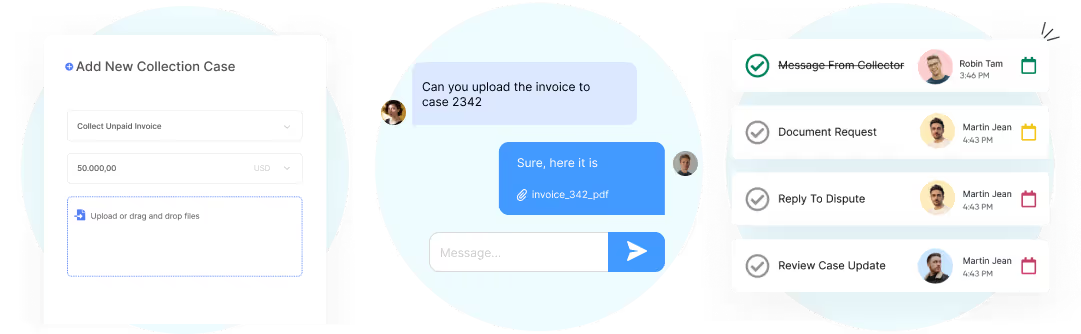
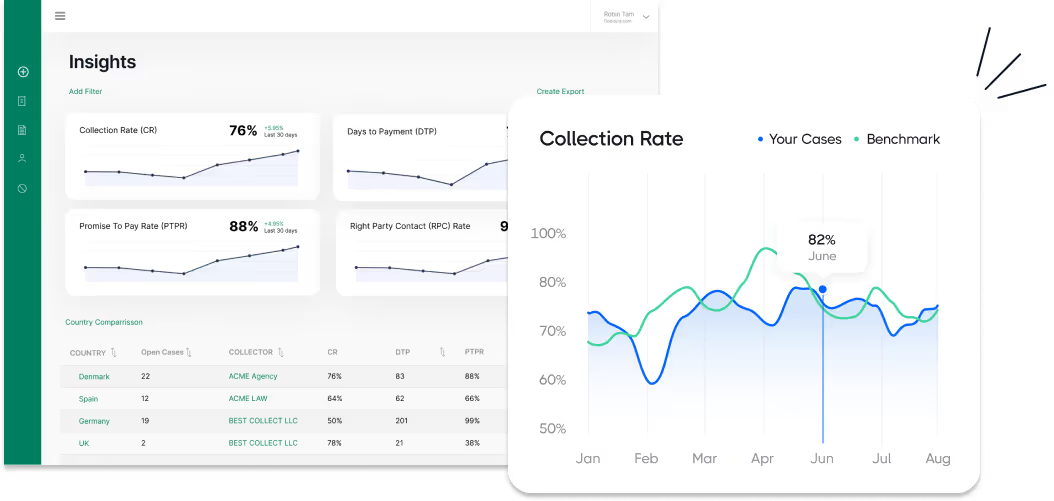
- Mises à jour en temps réel : Suivez facilement vos dossiers sur notre tableau de bord en direct.

Commencez à recouvrer vos créances en Égypte en quelques minutes.
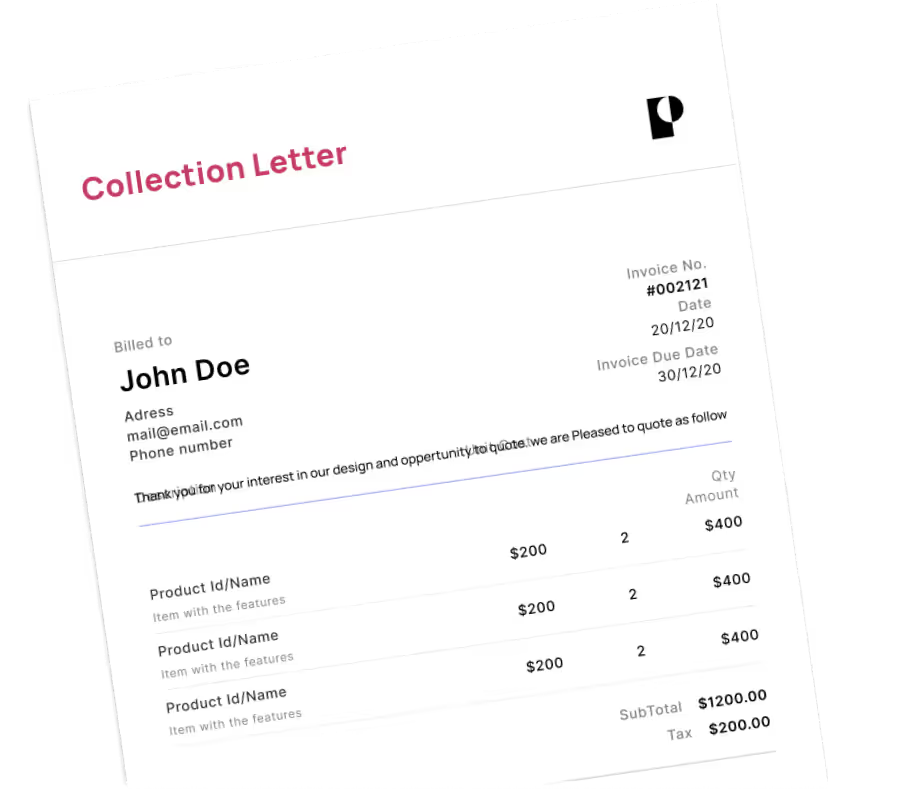
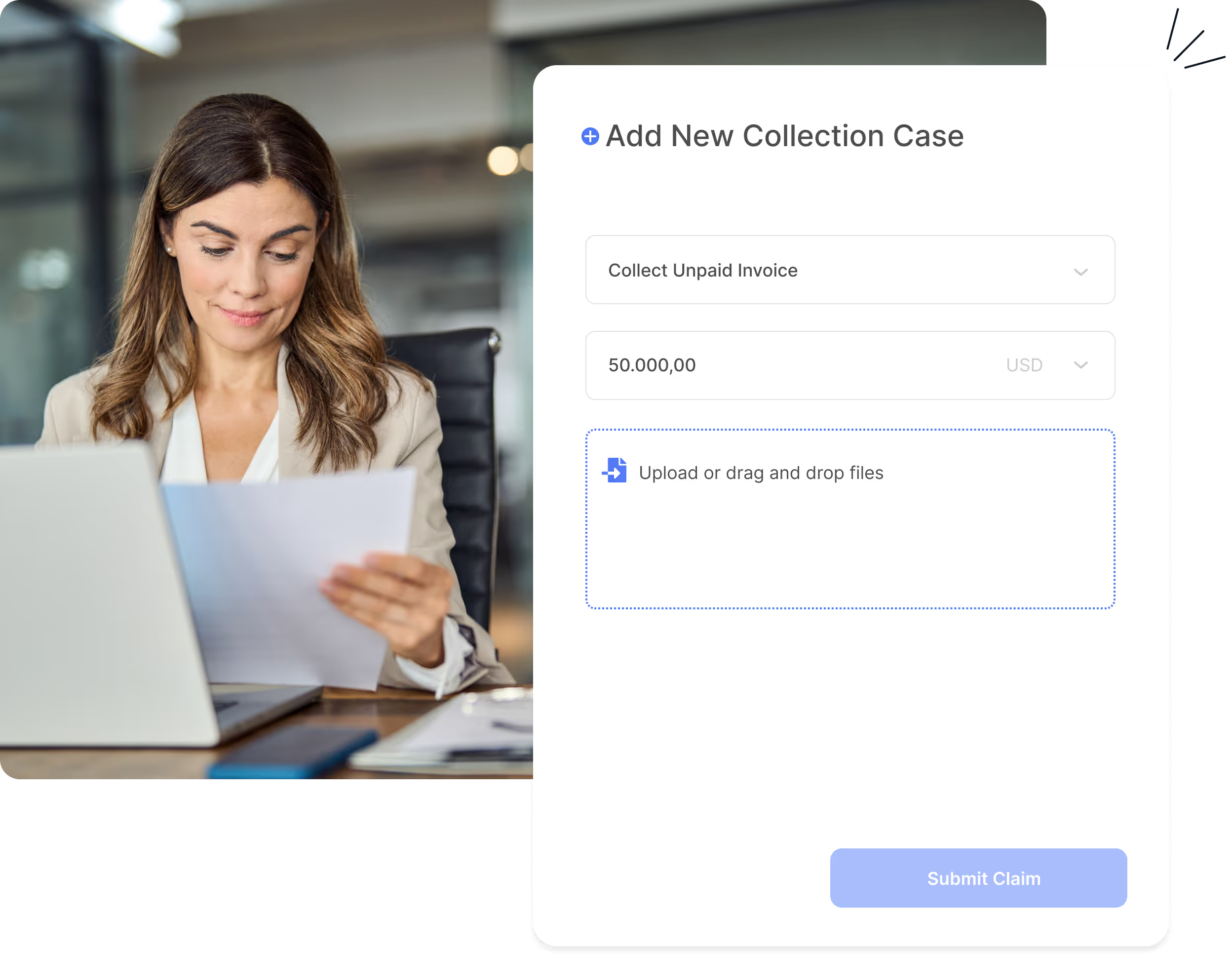
- Déposez votre créance : Téléchargez votre facture impayée via le tableau de bord Debitura, l'API REST, ou une intégration ERP prête à l'emploi telle que Xero ou QuickBooks. Ajoutez les documents justificatifs en quelques clics, sans paperasse ni frais d'installation.
- Collection begins: Your case is assigned to RIME Information Bureau Ltd, who starts amicable contact with the debtor on your behalf. If court action is ever needed later, you choose from fixed-price legal quotes before anything proceeds, so nothing is spent without your consent.
- Suivez votre dossier et soyez payé : Suivez chaque mise à jour en temps réel sur votre tableau de bord, du premier rappel au paiement final, avec une notification à chaque étape clé. Les fonds recouvrés vous sont reversés dès qu'ils sont disponibles, et vous ne payez qu'en cas de succès.

Tarifs transparents, basés sur le succès
Avec Debitura, vous ne payez que lorsque nous réussissons. Le recouvrement pré-judiciaire est « Pas de recouvrement, pas d'honoraires » : une Commission de succès déduite des montants recouvrés, facturée localement par votre partenaire. Les honoraires dépendent du pays du débiteur, pas du vôtre.
- Débiteurs en Europe (UE, Islande, Liechtenstein, Norvège, Royaume-Uni et Suisse) : Commissions de succès à partir de 6 % selon la taille de la créance.
- Débiteurs dans le reste du monde : Commissions de succès à partir de 7,5 % selon la taille de la créance.
- Créances plus anciennes : une majoration s'applique pour les créances en souffrance depuis 12 à 24 mois et pour les créances de plus de 24 mois.
- L'Action en justice est facultative : vous approuvez les devis à prix fixe avant toute dépense juridique.
Consultez la page Tarifs pour le barème complet des honoraires, ou obtenez une estimation instantanée lorsque vous déposez une créance.
Comment fonctionne le recouvrement de créances en Égypte ?
Debt collection in Egypt begins with an amicable phase run by RIME Information Bureau Ltd, Debitura's exclusive partner for Egypt: a Cyprus-domiciled specialist covering Egypt and the wider MENA region (RIME is also Algeria's exclusive partner under the same cross-border model), rather than a firm with its own Cairo office. The team sends formal reminders and a demand letter aimed at full payment or a written instalment agreement. Most straightforward claims resolve at this stage. If the debtor still does not pay, escalation to court is a separate step you approve, never automatic.
Principaux points à retenir
Les quatre étapes, de la facture impayée au recouvrement des fonds
- Étape 1 - Recouvrement amiable : rappels, une demande de paiement formelle et négociation, gérés localement par un partenaire local agréé. La plupart des créances incontestées sont résolues durant cette phase, sans passer par les tribunaux.
- Étape 2 - Titre exécutoire : si le débiteur ne paie toujours pas, votre partenaire évalue la voie légale pour obtenir un titre exécutoire et vous approuvez un devis à prix fixe avant toute procédure.
- Étape 3 - Exécution forcée : avec un titre exécutoire, l'autorité d'exécution compétente peut saisir les salaires, les fonds bancaires et d'autres actifs jusqu'à ce que la créance soit recouvrée.
- Étape 4 - Insolvabilité : si le débiteur s'avère insolvable, votre déclaration de créance est déposée et toute distribution est suivie en votre nom.
Chaque étape est suivie dans votre tableau de bord, et aucune action n'est entreprise sans votre approbation. Les détails juridiques complets pour l'Égypte – délais, coûts, tribunaux et exécution forcée – sont présentés dans le guide ci-dessous.

Commencer gratuitement
Pas de frais d'installation
Experts locaux agréés
Pas de résultat, pas de frais
Recouvrement de créances en Égypte — le guide complet 2026
This guide covers Egypt's debt-recovery process: the applicable law under the Civil Code and Commercial Code, the ordinary courts and specialised Economic Courts that hear claims, and the path from amicable contact to enforcement under the Code of Civil and Commercial Procedure (Law No. 13 of 1968).
Sur cette page :
Pourquoi vous pouvez faire confiance à ce guide
At Debitura, we uphold the highest standards of impartiality and precision to bring you comprehensive guides on international debt collection. Every guide is written from primary legal sources and reviewed by licensed local experts in the jurisdiction it covers.
Des questions ou des commentaires ? Écrivez-nous à contact@debitura.com, nous mettons à jour ce guide en fonction de vos retours.
Debitura en chiffres :
- 767 licensed partners - collection agencies and law firms in our network
- 180 countries covered - with cases handled in 174 of them
- 5,306 businesses registered with Debitura
- 33 days median time to first payment on European cases
Rédaction assurée par des experts, validation locale
Rédigé par Lars Holdgaard, Fondateur de Debitura (+10 ans d'expérience en recouvrement de créances B2B international). Chaque page est examinée par des avocats locaux de premier plan afin de garantir l'exactitude juridique et de vous fournir des étapes pratiques.

Experts locaux contributeurs :
Dernière mise à jour :
September 16, 2026

Recouvrement de créances en Égypte — réponses rapides
Quel est le Coût du recouvrement de créances en Égypte ?
Debitura's fee is success-based, No Cure, No Pay (see pricing). If a claim escalates, attorney fees, court costs and bailiff execution costs apply, and statutory interest on a commercial debt follows the Central Bank of Egypt's policy rate under Commercial Code Article 50(3), capped at the amount of the principal debt under Article 64. Court filing fees and bailiff execution costs are not published in a single consolidated schedule and vary with claim value; your legal representative confirms current costs before any court step goes ahead.
Combien de temps prend le recouvrement de créances en Égypte ?
Timelines depend on how quickly the debtor engages during the amicable phase; if a claim escalates, litigation timelines depend on the court's caseload and the case's complexity. As historical context, the World Bank's last published Doing Business report (2020, the series was discontinued in 2021) ranked Egypt 166th of 190 economies for Enforcing Contracts, with an average of 1,010 days and a cost of 26.2% of the claim value - a past benchmark, not a current guarantee.
Quel est le délai de prescription et le taux d'intérêt pour les créances en Égypte ?
Under Commercial Code Article 68, obligations between traders (B2B) prescribe seven years from the date they fall due, and a final court judgment on such an obligation prescribes after ten years. A separate, shorter prescription applies to liability-type (tort) claims arising from a commercial relationship: Article 67(5) sets three years from when the harmed party learns of the damage, capped at fifteen years from the date of the wrongful act - a distinct rule from the seven-year contractual prescription above. Consumer-facing and other civil claims fall under a separate, general Civil Code limitation period; confirm the exact figure with local counsel before relying on it. Interest on commercial debts tracks the Central Bank of Egypt's rate and is capped at the principal amount (Articles 50(3) and 64).
Quels documents sont nécessaires pour recouvrer une créance en Égypte ?
Egyptian courts expect clear documentary evidence: the underlying contract, signed invoices or delivery receipts, and a formal notice (Inzar) to the debtor, typically issued by an Egyptian attorney before or alongside filing a claim. Where the underlying deal involved a promissory note or a post-dated cheque, these commercial instruments strengthen the claim further.
Quel tribunal gère les Dossiers de recouvrement de créances en Égypte ?
Commercial and financial disputes are often routed to the specialised Economic Courts (established under Law No. 120 of 2008, amended by Law No. 156 of 2024), while other civil claims go through the ordinary court system; claim size and type determine which tier hears a case, so confirm the current threshold before filing. Within the ordinary system, the Courts of First Instance include smaller-claims circuits for lower-value civil disputes, though the exact monetary cut-off between circuits is not publicly confirmed.
What happens if my debtor is insolvent in Egypt?
As historical context, the World Bank's final Doing Business report (2020) ranked Egypt 104th of 190 economies for Resolving Insolvency, with an average process length of 2.5 years, a cost of 22.0% of the estate, and a recovery rate of 23.3 cents on the dollar. Egypt's Restructuring, Preventive Composition and Bankruptcy Law (Law No. 11 of 2018) now gives a distressed debtor a restructuring or preventive-composition route through the Economic Courts before full bankruptcy; see Step 4 below for how this affects your claim.
| Point clé | Égypte |
|---|---|
| B2B commercial limitation period | 7 years from due date; judgment prescribes after 10 years (Commercial Code Art. 68) |
| Liability/tort claim prescription | 3 years from discovery of harm, capped at 15 years from the act (Commercial Code Art. 67(5)) |
| Interest on commercial debts | Central Bank of Egypt policy rate; capped at the principal amount (Commercial Code Arts. 50(3), 64) |
| Voie de recours pour les créances commerciales | Economic Courts (Law 120/2008, amended by Law 156/2024) |
| Enforcing Contracts (World Bank, 2020, historical) | Rank 166/190; 1,010 days; 26.2% of claim value |
| Resolving Insolvency (World Bank, 2020, historical) | Rank 104/190; 2.5 years; 22.0% of estate; 23.3¢/$ recovery |
Qui fait quoi dans le recouvrement de créances en Égypte ?
Debt recovery in Egypt runs through a mix of specialist recovery partners, lawyers, the court system and, for insolvency matters, the courts rather than a financial regulator.
Debitura's partner in Egypt
A Debitura case for Egypt is handled by RIME Information Bureau Ltd, our exclusive partner for the market: a Cyprus-domiciled specialist covering Egypt and the wider MENA region. RIME manages amicable contact with the debtor and coordinates any escalation to court.
Courts, including the Economic Courts
Commercial and financial disputes are often heard by the specialised Economic Courts (Law No. 120 of 2008, amended by Law No. 156 of 2024), while other civil matters proceed through the ordinary Courts of First Instance, Courts of Appeal and the Court of Cassation.
Avocats
Lawyers draft the formal notice (Inzar), represent creditors in negotiations and in court, and are required for legal representation in ordinary proceedings under the Code of Civil and Commercial Procedure (Law No. 13 of 1968).
The Financial Regulatory Authority (FRA)
Egypt's FRA regulates non-bank financial markets, covering the capital market, futures exchanges, insurance, mortgage finance, financial leasing, factoring and securitisation, but its remit does not extend to bankruptcy or insolvency administration; insolvency cases run through the courts under Law No. 11 of 2018.
The Consumer Protection Authority
Created under Title 3 of the Consumer Protection Law (Law No. 181 of 2018), this authority investigates consumer complaints, can file civil suits, and can impose precautionary measures such as suspending the sale of a product pending a court decision. It prohibits misleading behaviour by suppliers and voids contract clauses that attempt to bypass a supplier's duties, but it has no debt-collection-specific enforcement role and applies only where the debtor is a private consumer.
No dedicated debt-collection regulator
No Egypt-specific statute equivalent to an EU-style Fair Debt Collection Practices Act was found. Amicable-phase conduct instead rests on general Civil Code good-faith principles, together with the Consumer Protection Law's misleading-practice ban where the debtor is a private consumer rather than a business.
Quelles lois et quels tribunaux s'appliquent au recouvrement de créances en Égypte ?
Debt collection in Egypt sits within a civil-law system built on the Civil Code and the Commercial Code, with disputes heard by a combination of ordinary and specialised courts.
Egypt's civil court structure
Debt claims are heard through a tiered court system: Courts of First Instance handle initial civil and commercial cases; Courts of Appeal review lower-court decisions; the Court of Cassation is the highest court for civil matters. The Courts of First Instance also include smaller-claims circuits for lower-value civil matters, though the exact monetary threshold separating these tiers is not publicly confirmed. Specialised Economic Courts (established under Law No. 120 of 2008, amended by Law No. 156 of 2024, which entered into force 11 July 2024) handle company, investment, banking, capital-markets and other commercial disputes, including many debt claims. Claim size and type determine which tier a case is heard in; confirm the current thresholds before filing.
Key legislation governing debt collection in Egypt
The Civil Code (Law No. 131 of 1948, promulgated 16 July 1948 and in force from 15 October 1949) sets the general framework for contractual obligations, torts and remedies. The Commercial Code (Law No. 17 of 1999, in force since 1 October 1999) governs commercial transactions, including the limitation period, interest rules and prescription of judgments between traders. It also sets a separate, shorter prescription for liability-type (tort) claims: three years from when the harmed party learns of the damage, capped at fifteen years from the wrongful act (Article 67(5)), distinct from the seven-year rule for ordinary trader obligations (Article 68). The Code of Civil and Commercial Procedure (Law No. 13 of 1968, issued 7 May 1968) governs litigation and the enforcement of judgments.
Company and investment legislation
Many commercial debtors operate as companies formed under the Companies Law (Law No. 159 of 1981) or, where foreign investment is involved, under the Investment Law (Law No. 72 of 2017). These statutes govern corporate form and investment incentives rather than debt collection itself, but they sit behind the corporate debtors a creditor is most likely to pursue.
Protection des consommateurs et des données
The Consumer Protection Law (Law No. 181 of 2018) established a Consumer Protection Authority, which can investigate complaints, take legal action and impose precautionary measures. It does not contain debt-collection-specific conduct rules; general consumer-protection principles apply, but no dedicated collections code was found in the primary sources reviewed.
Étape 1 - Comment fonctionne le recouvrement de créances à l'amiable (pré-judiciaire) en Égypte ?
In Egypt, amicable recovery is the standard first step: it is faster, cheaper and preserves the business relationship, before any legal proceedings under the Civil and Commercial Procedures Law become necessary.
How amicable debt collection works in Egypt
Formal notice (Inzar): the process typically opens with a formal Arabic-language notice, drafted by an Egyptian attorney, setting out the amount owed and a deadline to pay.
Negotiation: your partner, RIME Information Bureau Ltd, pursues direct contact with the debtor to agree full payment or a written instalment plan.
Commercial instruments: where the underlying relationship involved a promissory note or post-dated cheque, these instruments can support the negotiation and, if unresolved, the later legal route.
Conduct standard: no Egypt-specific debt-collection-conduct statute exists; amicable contact instead operates under general Civil Code good-faith principles and, where the debtor is a private consumer rather than a business, the Consumer Protection Law's ban on misleading practices.
Escalation: if the debtor still does not respond or pay, the case is assessed for the legal route; you approve a fixed-price quote before anything proceeds, so escalation is never automatic.
| Typical Debitura workflow | What happens |
|---|---|
| Jour 0 | Claim submitted; case assigned to RIME Information Bureau Ltd |
| Day 0-7 | Formal Inzar notice sent to the debtor |
| Day 7-30 | Negotiation window; debtor responds or a payment plan is agreed |
| Jours 30-60 | Follow-up and, where needed, a further demand |
| Jours 60-90 | If still unpaid, the case is assessed for the legal route and you receive a fixed-price quote |
These stages describe Debitura's typical workflow rather than a statutory deadline; actual timing depends on the debtor's response.
Étape 2 - Comment obtenir un titre exécutoire en Égypte ?
If amicable collection does not resolve the claim, the next step is a court judgment (an enforceable title) under the Code of Civil and Commercial Procedure (Law No. 13 of 1968).
Which court hears the claim
Commercial and financial disputes are often routed to the specialised Economic Courts (Law No. 120 of 2008, amended by Law No. 156 of 2024), while other civil claims proceed through the ordinary Courts of First Instance. Claim size and type determine which tier hears a case; confirm the current threshold before filing rather than assuming a fixed cut-off. Within the ordinary courts, lower-value civil claims may fall to smaller-claims circuits inside the Courts of First Instance, though the specific monetary cut-off is not publicly confirmed.
What the process looks like
The creditor files a claim supported by documentary evidence (the underlying contract, invoices or delivery receipts, and the formal notice already sent to the debtor). The court holds hearings, and legal representation is generally required. Once satisfied, the court issues a judgment ordering the debtor to pay.
Choosing the right legal basis
A straightforward unpaid commercial invoice prescribes under the Commercial Code's seven-year rule for obligations between traders (Article 68). Where the claim instead rests on a liability or tort theory arising from the same commercial relationship, a separate three-year prescription applies, capped at fifteen years from the wrongful act (Article 67(5)) - a distinction your legal representative should confirm before filing.
Plus d'informations sur les procédures judiciaires en Égypte
Egypt's judicial tradition
Egypt's civil procedure reflects a civil-law tradition, and cases can move from the Court of First Instance through the Courts of Appeal up to the Court of Cassation, Egypt's highest civil court, if a party appeals.
Practical considerations
As illustrative, order-of-magnitude context, the World Bank's final Doing Business report (2020, before the series was discontinued in 2021) put the average time to obtain and enforce a judgment through Egypt's courts at 1,010 days, at a cost of 26.2% of the claim's value - a historical benchmark, not a guarantee for any individual case. Given the potential length of Egyptian court proceedings, creditors should keep clear records of every interaction and rely on experienced local legal representation to manage the process end to end. Once a judgment is issued, it becomes the enforceable title that carries the case into Step 3.
Étape 3 - Comment fonctionne l'exécution forcée des créances en Égypte ?
Once a court issues a final judgment, the creditor can move to enforcement under the Code of Civil and Commercial Procedure (Law No. 13 of 1968, issued 7 May 1968).
The general enforcement process
The judgment creditor applies to an execution (enforcement) judge at the Court of First Instance, who directs a court bailiff to carry out enforcement measures against the debtor. Egyptian legal practice refers to this court-appointed bailiff by the transliterated term mohdir, the officer responsible for formally serving judgments and carrying out enforcement measures on the ground. The bailiff formally serves the judgment on the debtor before any seizure step proceeds, giving the debtor an opportunity to comply voluntarily.
- Bailiff-led execution: the mohdir serves the judgment and carries out enforcement steps such as asset seizure and wage garnishment.
- Asset seizure: movable and immovable assets can be identified, seized and sold, typically through public auction, to satisfy the debt.
- Wage garnishment: a portion of the debtor's income can be redirected to the creditor, subject to protections for the debtor's basic needs.
- Debtor protections: debtors can contest enforcement measures before the execution judge, and certain essential assets are protected from seizure.
Working with your legal representative
As historical, order-of-magnitude context, the World Bank's final Doing Business report (2020, discontinued in 2021) put the average time to enforce a contract through Egypt's courts, including this enforcement stage, at 1,010 days, at a cost of 26.2% of the claim's value - a pre-2021 benchmark, not a guarantee for any individual case today. Because enforcement is a court-supervised process, creditors typically instruct a local attorney to liaise with the execution judge and mohdir on their behalf, track each enforcement step, and respond to any debtor challenge. Exact enforcement timelines and fees are not standardised in the sources reviewed for this guide; confirm current figures with your legal representative once a case reaches this stage.
Étape 4 - Comment les procédures d'insolvabilité affectent-elles le recouvrement de créances en Égypte ?
Insolvency in Egypt is governed by the Restructuring, Preventive Composition and Bankruptcy Law (Law No. 11 of 2018), which replaced the earlier Commercial Code bankruptcy provisions with a modernised framework built around restructuring and preventive composition ahead of full bankruptcy.
How the framework is structured
The 2018 law gives a distressed debtor more than one route through the Economic Courts: a restructuring track and a preventive-composition track, both intended to keep a viable business operating and its creditors better off than an immediate liquidation would leave them. Liquidation remains available as a later stage where restructuring or composition is not possible or does not succeed. Insolvency is not administered by Egypt's Financial Regulatory Authority (FRA), whose remit covers non-bank financial-market segments such as capital markets, insurance and leasing rather than bankruptcy administration; Law No. 11 of 2018 proceedings instead run entirely through the court system.
Filing thresholds, the exact priority order between creditor classes, and discharge timelines are not fully documented in the primary sources reviewed for this guide; confirm current detail with local insolvency counsel before relying on it rather than assuming a fixed figure.
Which businesses this applies to
Distressed debtors are commonly companies formed under the Companies Law (Law No. 159 of 1981) or, where foreign investment is involved, operating under the Investment Law (Law No. 72 of 2017). Law No. 11 of 2018 governs the bankruptcy and restructuring process itself rather than corporate form, so a debtor's company type does not change which insolvency track applies.
Ce que cela signifie pour les créanciers
If your debtor enters an insolvency proceeding, your claim moves into that collective process rather than being pursued through individual enforcement against the debtor's assets. In practice this means submitting proof of the claim within the process the court has opened, and any recovery then depends on the debtor's remaining assets, the track chosen (restructuring, composition or liquidation), and the proceeding's outcome rather than on individual creditor action.
As historical context, the World Bank's last published Doing Business report (2020, discontinued in 2021) ranked Egypt 104th of 190 economies for Resolving Insolvency, with an average process length of 2.5 years, a cost of 22.0% of the estate, and a recovery rate of 23.3 cents on the dollar - a past benchmark from before the 2018 law's full effect, not a current guarantee.
Frais, intérêts et qui paie quoi en Égypte
- Nos honoraires : au succès, Sans succès pas de frais (voir nos tarifs).
- Court & enforcement fees: attorney fees, court costs and bailiff execution costs for asset seizure or wage garnishment apply only if the case escalates to the Economic Courts or ordinary proceedings under the Civil and Commercial Procedures Law No. 13 of 1968. Egypt does not publish a single consolidated schedule of court filing or bailiff fees; ask your legal representative for a current quote once a case is assessed for the legal route.
- Statutory debtor items: under the Commercial Code, interest on a commercial debt follows the Central Bank of Egypt's policy rate rather than a fixed percentage (Article 50(3)), and total recoverable interest is capped at the amount of the principal debt (Article 64). This cap applies regardless of whether the claim resolves amicably, before the Economic Courts, or through ordinary proceedings.
- Répartition des sommes : le principal recouvré vous revient ; les intérêts et les frais suivent le contrat, la loi et la décision du tribunal.
Trouver un Avocat en recouvrement de créances local
Besoin d'une représentation juridique ? Soumettez votre dossier une seule fois et recevez jusqu'à trois propositions d'avocats spécialisés en contentieux, rigoureusement sélectionnés. Gratuit, rapide et sans engagement.
- Spécialistes vérifiés
- Devis en 24 h, sans Frais cachés
- Tarifs équitables et négociés à l'avance
9 Elmatba Buildibgs, 1er étage, Bureau 4, Derrière l'université Ain Shams, Abbasiya, Le Caire, Égypte
Le cabinet d'avocats égyptien
Le cabinet d'avocats égyptien est un cabinet de premier plan au Caire, offrant des services efficaces de recouvrement de créances en Égypte, se positionnant comme le partenaire incontournable pour le recouvrement de créances avec une fondation en 2000 et des adhésions à l'Association des avocats européens et à Eurojuris International.
.webp)
Poursuites judiciaires
Recouvrement judiciaire
Exécution forcée
.png)
9

2000
.png)
Cabinet d'avocats

46, rue El-Thawra – Héliopolis – Le Caire – Égypte
Andersen Égypte
Andersen Égypte est un cabinet d'avocats de premier plan au Caire, offrant des services efficaces de recouvrement de créances en Égypte, réputé pour son expertise depuis 1986 et reconnu par des prix tels que The Lawyers Global Annual Global Legal Awards 2024, tout en servant des clients à l'international grâce au réseau d'Andersen Global.
Poursuites judiciaires
Recouvrement judiciaire
Exécution forcée
50
1986
Cabinet d'avocats
5D/5 New Maadi, Le Caire - Égypte
Al Bedeawi & PArtners Law Office
Al Bedeawi & Partners Law Office est un cabinet d'avocats de premier plan au Caire, offrant des services efficaces de recouvrement de créances en Égypte, positionnant le cabinet comme le partenaire incontournable pour le recouvrement de créances depuis 2008, avec une réputation soutenue par des distinctions de l'industrie et des adhésions estimées.
Poursuites judiciaires
Recouvrement judiciaire
Exécution forcée
10
2008
Cabinet d'avocats

Appartement n° 805, Tour C, Tours Elmamoura, Septième district, Nasr City, Le Caire, Égypte.
Sadany & Khalifa
Sadany & Khalifa est un cabinet d'avocats de premier plan à Nasr City, offrant des services efficaces de recouvrement de créances en Égypte, se positionnant comme le partenaire incontournable pour le recouvrement de créances depuis 2017, avec des adhésions aux barreaux égyptien et international et des opérations en Arabie saoudite.
Poursuites judiciaires
Recouvrement judiciaire
Exécution forcée
35
2017
Cabinet d'avocats
Le Caire, Égypte
H&Z Law Firm
H&Z Law Firm est un cabinet d'avocats de premier plan au Caire, offrant des services efficaces de recouvrement de créances en Égypte. Il se positionne comme le partenaire incontournable pour le recouvrement de créances, fort d'une fondation en 2020 et d'une réputation renforcée par des prix et des affiliations.
Poursuites judiciaires
Recouvrement judiciaire
Exécution forcée
10
2020
Cabinet d'avocats

33 Abd El Khalek Tharwat - Abdeen - Le Caire
Al-Tarek Law Firm
Al-Tarek Law Firm est un cabinet d'avocats de premier plan au Caire, offrant des services efficaces de recouvrement de créances en Égypte. Il se positionne comme le partenaire incontournable pour le recouvrement de créances, avec 40 ans d'expérience, une licence de l'Association du Barreau Égyptien et des opérations couvrant l'Égypte, les ÉAU et le Qatar.
Poursuites judiciaires
Recouvrement judiciaire
Exécution forcée
10
1985
Cabinet d'avocats

Rez-de-chaussée - Bâtiment 73 - Localité 2 - Deuxième district
Obour City, Qalyubia, Grand Caire, Égypte
Essam Salem Law Firm
Essam Salem Law Firm est un cabinet d'avocats de premier plan à Obour City, offrant des services efficaces de recouvrement de créances en Égypte. Fondé en 1998 et réputé pour son engagement professionnel et éthique, il sert des clients dans tous les tribunaux égyptiens avec une équipe de 38 personnes.
Poursuites judiciaires
Recouvrement judiciaire
Exécution forcée
38
1998
Cabinet d'avocats
4 D, Al-Jazeera Street, Zamalek, Le Caire
Le Caire, Égypte
Ali&Co
Ali & Co est un cabinet d'avocats de premier plan au Caire, offrant des services efficaces de recouvrement de créances en Égypte. Il est reconnu pour son expertise en matière de litiges stratégiques et d'arbitrage, fondé en 2014, avec des distinctions telles que le prix du cabinet d'avocats de l'année – Arbitrage et des affiliations à Chambers & Partners et à l'African Arbitration Association.
Poursuites judiciaires
Recouvrement judiciaire
Exécution forcée
30
2014
Cabinet d'avocats

462 Al Banafseg Buildings - First Settlement
Le Caire, Égypte
Emara & Soliman International Law Firm
Emara & Soliman International Law Firm est un cabinet d'avocats de premier plan au Caire, offrant des services efficaces de recouvrement de créances en Égypte. Il se positionne comme le partenaire incontournable pour le recouvrement de créances, avec une présence dans plus de 30 pays depuis sa fondation en 2018.
Poursuites judiciaires
Recouvrement judiciaire
Exécution forcée
4
2018
Cabinet d'avocats

35 (B) Abol Feda Street, Zamalek, Le Caire, Égypte.
Le Caire, Égypte
Tahoun Law Firm
Tahoun Law Firm est un cabinet d'avocats de premier plan au Caire, offrant des services efficaces de recouvrement de créances en Égypte. Il se positionne comme le partenaire incontournable pour le recouvrement de créances, avec plus de 30 ans d'expérience, une expertise primée et une affiliation à l'International Society of Primerus Law Firms.
Poursuites judiciaires
Recouvrement judiciaire
Exécution forcée
30
1990
Cabinet d'avocats

One Kattameya, bâtiment 116 unité 13, Le Caire, Égypte
Le Caire, Égypte
Elayouby & awadallah law firm
Elayouby & Awadallah est un cabinet d'avocats de premier plan au Caire, offrant des services efficaces de recouvrement de créances en Égypte. Il est reconnu comme le cabinet d'avocats de l'année en matière de contrôle des fusions, et est membre de The Legal 500 et IFLR1000 depuis 2015.
Poursuites judiciaires
Recouvrement judiciaire
Exécution forcée
67
2015
Cabinet d'avocats

Dash Law for Advocacy and Legal Consultations
Dash Law for Advocacy and Legal Consultations est un cabinet d'avocats de premier plan au Caire, offrant des services efficaces de recouvrement de créances en Égypte. Fondé en 1985 avec plus de 40 avocats spécialisés, il dessert également les ÉAU et les États-Unis, et est membre de l'Association du Barreau Égyptien.
Poursuites judiciaires
Recouvrement judiciaire
Exécution forcée
40
1985
Cabinet d'avocats

Andersen in Egypt
Andersen in Egypt est un cabinet d'avocats de premier plan au Caire, offrant des services efficaces de recouvrement de créances en Égypte. Reconnu pour son expertise juridique depuis 2018, le cabinet est membre d'Andersen Global, servant des clients dans 170 pays, et détient des distinctions d'ITR World Tax et de The Lawyers Global.
Poursuites judiciaires
Recouvrement judiciaire
Exécution forcée
200
2018
Cabinet d'avocats

RIME Information Bureau Ltd
RIME Information Bureau Ltd est une agence de recouvrement de créances de premier plan à Nicosie, offrant des services efficaces de recouvrement de créances à Chypre. Elle se positionne comme le partenaire de référence pour le recouvrement de créances depuis 1986, avec des opérations dans 14 pays et des adhésions à LIC, FENCA et FEBIS.
Poursuites judiciaires
Recouvrement judiciaire
Exécution forcée
80
1986
Société de recouvrement
Foire aux questions
Consultez nos questions fréquentes ci-dessous, ou contactez-nous directement à contact@debitura.com si vous avez besoin d'aide pour un dossier spécifique.
Comment puis-je recouvrer une créance en Égypte ?
.svg)
Start by sending an official legal notice (Inzar), typically drafted in Arabic by a licensed attorney. Through Debitura, your case is routed to RIME Information Bureau Ltd, our exclusive partner for Egypt, who manages the amicable settlement process. Monitor progress in real time through your dashboard.
Est-il judicieux de faire appel à une Société de recouvrement en Égypte ?
Yes. Egypt's legal and business practices differ from many Western jurisdictions, and outstanding invoices are often backed by promissory notes or post-dated cheques. An experienced partner such as Debitura's RIME Information Bureau Ltd helps you navigate local procedure, aims to maximize recovery, and reduces the administrative burden on your team.
Quelle est la Procédure de recouvrement de créances en Égypte ?
Debt collection in Egypt typically follows three stages. First, amicable settlement: a formal Arabic-language notice (Inzar) followed by negotiation. Second, if that fails, legal action through the Courts of First Instance or the specialised Economic Courts, resulting in a court judgment. Third, enforcement: a court-appointed bailiff carries out asset seizure or wage garnishment under the Civil and Commercial Procedures Law.
Combien facturent les sociétés de recouvrement de créances en Égypte ?
Debt collection costs in Egypt vary with claim size, complexity, and whether the case stays amicable or needs court and bailiff involvement. Debitura operates on a No Cure, No Pay basis: you pay nothing upfront, and a success fee applies only once the debt is recovered. See debitura.com/pricing for details.
Quelle est la meilleure Société de recouvrement en Égypte ?
The right debt collection partner for Egypt combines deep knowledge of Egyptian civil and commercial law, access to licensed local attorneys, and a transparent platform. Debitura connects you to RIME Information Bureau Ltd, our exclusive partner for Egypt, and gives you full visibility through a live dashboard, including formal notices (Inzar) and, where needed, the specialised Economic Courts.
Quels types de créances peuvent être recouvrées en Égypte ?
Most commercial debts are recoverable in Egypt, including unpaid invoices, cheques, promissory notes, and court-ordered obligations. Clear documentation, such as a signed contract and formal invoices, significantly strengthens the creditor's position.
Besoin d'une Couverture supplémentaire ?
“Debitura recovered well over 100,000 euros in overdue invoices for us across several countries, all through one contract and one dashboard. Local experts handle each market and we only pay when they actually collect — so our team can spend that time on what we do best: helping our own customers engage smarter with the Manago AI platform.”
Manago AI (formerly SALESmanago)
767
Licensed collection agencies and law firms in our network
180
Countries covered, with cases handled in 174 of them
5,306
Businesses registered with Debitura
.svg)