.png)


.png)
.svg)
Démarrer GRATUITEMENT
Société de recouvrement en Irlande
Votre Dossier est géré en Irlande par Miller James Limited, une Société de recouvrement agréée par la FCA. Toutes les actions sont menées localement par le biais des tribunaux irlandais et de l'Exécution forcée par un huissier, tandis que vous suivez chaque étape sur un tableau de bord unique. Pas de frais initiaux. Vous préférez d'abord vous informer ? Consultez le guide de l'Irlande.

100 % sans risque : payez uniquement en cas de succès
Local debt collection by licensed agency / law firm
Plus de 30 ans d'expertise | Agréé par la FCA | Membre de la CSA

Obtenir un conseil d’expert gratuit
Réponse d’un spécialiste sous 24 heures.
Merci ! Votre soumission a été reçue !
Oups ! Une erreur s'est produite lors de la soumission du formulaire.
Vos avantages avec Debitura pour le recouvrement de créances en Irlande

Recouvrement de créances rapide, simple et sans risque en Irlande
Sous-titre : Debitura est une plateforme mondiale de recouvrement basée sur la technologie, qui travaille avec des agences et des cabinets d'avocats agréés localement dans 183 pays. En Irlande, votre Dossier est géré par Miller James Limited, une Société de recouvrement agréée par la FCA à Belfast.
- Tarifs sans risque : pas de frais, sauf en cas de succès.
- Configuration rapide : Soumettez vos factures en quelques clics.
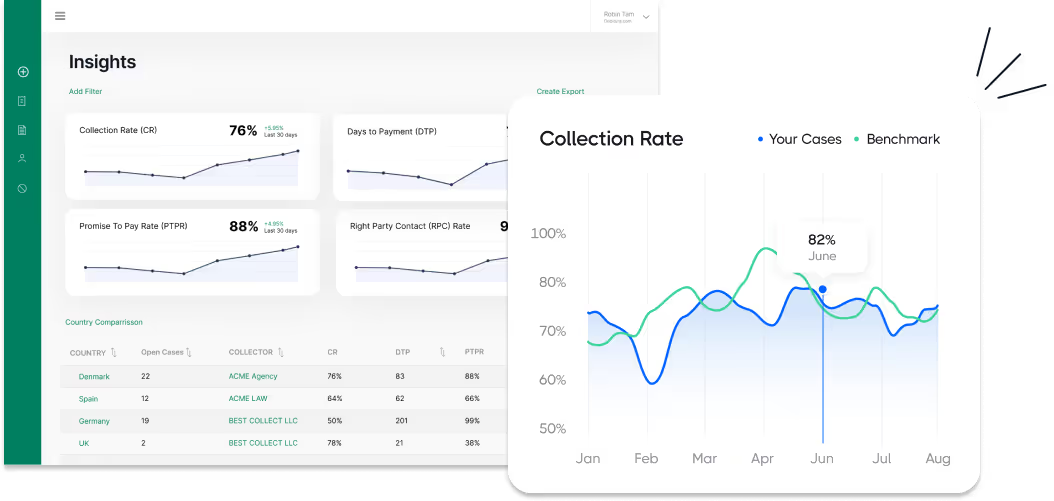
- Suivi en temps réel : statut en direct, actions et paiements sur un seul portail.
- Conformité : alignement sur le Consumer Protection Code 2012 et le RGPD.

Commencez à recouvrer vos créances irlandaises en 2 minutes
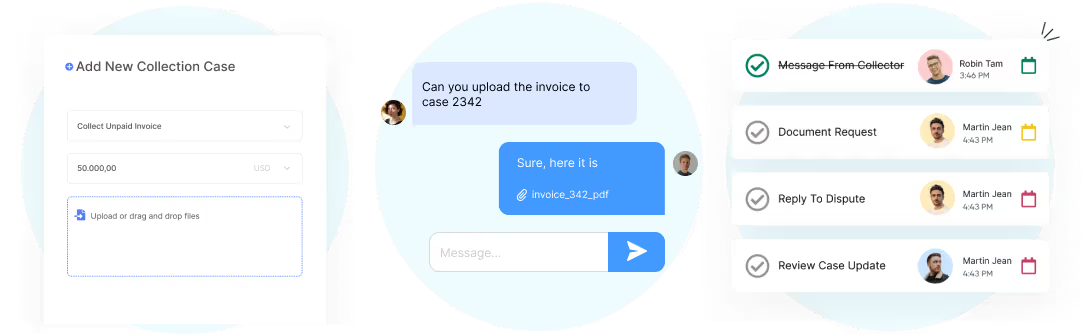
- Soumettez votre créance : téléchargez votre créance impayée en quelques minutes via le tableau de bord, l'API REST ou les intégrations ERP prêtes à l'emploi comme Xero.
- Le recouvrement local commence : nous attribuons le Dossier à Miller James Limited, qui contacte le débiteur en anglais dans les 24 heures. Si une Action en justice est nécessaire, vous pouvez choisir 1 à 3 devis juridiques à prix fixe (par exemple, une ordonnance européenne de paiement ou une réclamation auprès du tribunal de district/circuit) avant que quoi que ce soit ne se produise.
- Soyez payé : les fonds sont versés lors du recouvrement. Pour les litiges, choisissez parmi des devis à prix fixe

Tarifs transparents, basés sur le succès
Avec Debitura, vous ne payez que lorsque nous réussissons. Le recouvrement pré-judiciaire est « Pas de recouvrement, pas d'honoraires » : une Commission de succès déduite des montants recouvrés, facturée localement par votre partenaire. Les honoraires dépendent du pays du débiteur, pas du vôtre.
- Débiteurs en Europe (UE, Islande, Liechtenstein, Norvège, Royaume-Uni et Suisse) : Commissions de succès à partir de 6 % selon la taille de la créance.
- Débiteurs dans le reste du monde : Commissions de succès à partir de 7,5 % selon la taille de la créance.
- Créances plus anciennes : une majoration s'applique pour les créances en souffrance depuis 12 à 24 mois et pour les créances de plus de 24 mois.
- L'Action en justice est facultative : vous approuvez les devis à prix fixe avant toute dépense juridique.
Consultez la page Tarifs pour le barème complet des honoraires, ou obtenez une estimation instantanée lorsque vous déposez une créance.
Comment fonctionne le recouvrement de créances en Irlande ?
Le recouvrement de créances en Irlande commence par une phase amiable gérée localement par Miller James Limited : des relances et une demande de paiement formelle, visant au paiement intégral ou à un accord d'échelonnement écrit. La plupart des créances simples sont résolues à ce stade. Si le débiteur ne paie toujours pas, l'escalade n'est jamais automatique : votre partenaire évalue la voie légale et vous approuvez un devis avant toute démarche judiciaire.
Principaux points à retenir
Les quatre étapes, de la facture impayée au recouvrement des fonds
- Étape 1 - Recouvrement amiable : relances, demande de paiement formelle et négociation, gérées localement par Miller James Limited. La plupart des créances incontestées sont résolues durant cette phase, sans passer par les tribunaux.
- Étape 2 - Titre exécutoire : si le débiteur ne paie toujours pas, votre partenaire évalue la voie légale pour obtenir un titre exécutoire et vous approuvez un devis à prix fixe avant toute procédure.
- Étape 3 - Exécution forcée : avec un titre exécutoire, l'autorité d'exécution compétente peut saisir les salaires, les fonds bancaires et d'autres actifs jusqu'à ce que la créance soit recouvrée.
- Étape 4 - Insolvabilité : si le débiteur s'avère insolvable, votre déclaration de créance est déposée et toute distribution est suivie en votre nom.
Chaque étape est suivie dans votre tableau de bord, et rien n'est porté devant les tribunaux sans votre approbation. Tous les détails juridiques pour l'Irlande — délais, coûts, tribunaux et Exécution forcée — sont présentés dans le guide ci-dessous.

Commencer gratuitement
Pas de frais d'installation
Experts locaux agréés
Pas de résultat, pas de frais
Recouvrement de créances en Irlande — le guide complet 2026
This guide explains how debt collection works in Ireland: the courts, the governing law, the four-step recovery process and what it costs. It is written for creditors, in-house counsel and finance teams deciding how to recover a debt in Ireland.
Sur cette page :
Pourquoi vous pouvez faire confiance à ce guide
At Debitura, we uphold the highest standards of impartiality and precision to bring you comprehensive guides on international debt collection. Every guide is written from primary legal sources and reviewed by licensed local experts in the jurisdiction it covers.
Des questions ou des commentaires ? Écrivez-nous à contact@debitura.com, nous mettons à jour ce guide en fonction de vos retours.
Debitura en chiffres :
- 767 licensed partners - collection agencies and law firms in our network
- 180 countries covered - with cases handled in 174 of them
- 5,306 businesses registered with Debitura
- 33 days median time to first payment on European cases
Rédaction assurée par des experts, validation locale
Rédigé par Lars Holdgaard, Fondateur de Debitura (+10 ans d'expérience en recouvrement de créances B2B international). Chaque page est examinée par des avocats locaux de premier plan afin de garantir l'exactitude juridique et de vous fournir des étapes pratiques.

Experts locaux contributeurs :
Aucun élément trouvé.
Dernière mise à jour :
August 19, 2026

Recouvrement de créances en Irlande — réponses rapides
How much does debt collection cost in Ireland?
Pre-legal debt collection in Ireland is typically success-based (No Cure, No Pay), so there is no upfront cost. If a claim escalates to court, the state charges an issue fee that scales with the claim value, and a B2B creditor can add statutory interest and fixed compensation on top of the principal.
| Tribunal | Issue fee |
|---|---|
| Tribunal de grande instance | EUR 25 (up to EUR 5,000), EUR 70 (over EUR 5,000 to EUR 10,000), EUR 80 (over EUR 10,000) |
| Circuit Court | EUR 90 (up to EUR 45,000), EUR 130 (over EUR 45,000) |
| Small Claims Procedure | EUR 25 flat (excludes business claims) |
All figures are from the Courts Service of Ireland's own published fee schedules. Enforcing a judgment adds a further, instrument-specific fee, covered in Step 3 below.
How long does debt collection take in Ireland?
There is no fixed statutory timeline for the amicable phase; most straightforward claims are resolved through demand letters and negotiation within around three months. In the Small Claims Procedure specifically, a debtor has around 15 days to respond before a disputed claim moves to a District Court hearing, and a debtor generally has 28 days to comply once an order is made, after which an unpaid award is enforced through the Sheriff or County Registrar (Citizens Information). A judgment itself, once obtained through any of Ireland's courts, remains enforceable for twelve years (Statute of Limitations 1957, s.11).
What is the limitation period for a debt claim in Ireland, and can I add interest?
Simple contract debts must be claimed within six years of the due date, while judgment debts and debts under seal (specialty debts) have twelve years (Statute of Limitations 1957, s.11). On business-to-business debts, statutory interest accrues automatically, without needing a reminder, at the ECB main refinancing rate (set each 1 January and 1 July) plus 8 percentage points, alongside fixed compensation for recovery costs (European Communities (Late Payment in Commercial Transactions) Regulations 2012, S.I. No. 580/2012). Further reasonable recovery costs above the fixed amount can also be claimed where justified. For B2C debts, these Regulations do not apply, so interest can only be claimed where it was contractually agreed.
| Debt band | Fixed compensation |
|---|---|
| Up to EUR 1,000 | EUR 40 |
| Over EUR 1,000 to EUR 10,000 | EUR 70 |
| Over EUR 10,000 | EUR 100 |
What documents do I need to collect a debt in Ireland?
Assemble the contract or purchase order, invoices and a statement of account, proof of delivery, and any written correspondence or acknowledgement of the debt. A signed acknowledgement or a part-payment record strengthens both a demand letter and a later court claim, and is worth keeping on file from the moment a claim is first sent to Debitura's partner for the amicable phase. For a Small Claims Procedure filing specifically, keep the underlying contract or receipt to hand, since the claim form is completed at the local District Court office.
Which route should my claim take in Ireland?
A consumer claim up to EUR 2,000 can use the Small Claims Procedure (EUR 25 fee), but the procedure excludes debt claims brought by a business (Citizens Information). Business claims and larger consumer claims are decided by claim value across three ordinary courts.
| Tribunal | Juridiction |
|---|---|
| Tribunal de grande instance | Up to EUR 15,000 |
| Circuit Court | Up to EUR 75,000 (Courts and Civil Law (Miscellaneous Provisions) Act 2013, s.14) |
| High Court | Above EUR 75,000 |
Once a judgment issues from any of these courts, the choice of enforcement instrument (Sheriff execution, Judgment Mortgage, Attachment/Garnishee, Receiver, or an Instalment Order) depends on the debtor's known assets, not on which court granted the judgment; see Step 3 for the full list.
Qui fait quoi en matière de recouvrement de créances en Irlande ?
Debt collection agencies in Ireland
No regulator licenses or supervises private debt collection agencies in Ireland: the Central Bank of Ireland's Consumer Protection Code reaches collection only indirectly, through regulated lenders' outsourced agents, and sets a contact-hours rule of no calls between 9pm and 9am Monday to Saturday, and none on Sundays or public holidays without agreement (Citizens Information). Within that light-touch framework, agencies handle the entire amicable phase: tracing the debtor, sending demand letters, negotiating a payment plan, and applying statutory interest and compensation where a B2B debt qualifies under S.I. No. 580/2012.
The District and Circuit Courts
The District Court hears civil claims up to EUR 15,000 and the Circuit Court up to EUR 75,000; both issue the judgment that becomes the enforceable title once amicable collection fails (courts.ie, Citizens Information). Claims above EUR 75,000 go to the High Court, which has unlimited civil jurisdiction.
Enforcement authorities
Once a judgment is obtained, the Sheriff or County Registrar carries out execution against the debtor's goods, and other instruments such as a Judgment Mortgage, an Attachment/Garnishee order or a court-appointed Receiver are available depending on the debtor's assets (courts.ie's enforcement guide). All of these sit downstream of the court that granted judgment, not the agency that ran the amicable phase.
Solicitors
Once a claim is disputed, or needs to proceed beyond the Small Claims Procedure, a solicitor prepares and files the court claim and, where relevant, advises on enforcement. All debtors, regardless of who is collecting, retain criminal-law protection from harassment or intimidation under s.11 of the Non-Fatal Offences Against the Person Act 1997, which applies equally to agencies, solicitors and creditors acting directly.
Debitura's advantage: one contract and one dashboard connect you to Miller James Limited for the amicable phase and, if escalation is needed, to fixed-price legal quotes for the court and enforcement stages, without you having to manage separate local relationships.
Quelles lois et quels tribunaux s'appliquent au recouvrement de créances en Irlande ?
Le système judiciaire civil
Ireland's civil courts are organised by claim value. The District Court hears civil claims up to EUR 15,000 (courts.ie, Citizens Information); the Circuit Court hears claims up to EUR 75,000 (Courts and Civil Law (Miscellaneous Provisions) Act 2013, s.14); the High Court has unlimited jurisdiction above that.
| Court / procedure | Montant de l'indemnisation |
|---|---|
| Small Claims Procedure (consumer only) | Up to EUR 2,000 |
| Tribunal de grande instance | Up to EUR 15,000 |
| Circuit Court | Up to EUR 75,000 |
| High Court | Above EUR 75,000 |
Within the District Court, the Small Claims Procedure gives consumers a low-cost route for claims up to EUR 2,000, but it excludes debt claims brought by a business, so most business creditors use the ordinary District, Circuit or High Court route by claim value, and the correct court is fixed by the amount claimed rather than by choice.
Législation clé
The Statute of Limitations 1957, s.11, sets a six-year limitation period for simple contract debts and twelve years for judgment debts and specialty debts under seal, both running from when the debt fell due. The European Communities (Late Payment in Commercial Transactions) Regulations 2012 (S.I. No. 580/2012) entitles a business creditor to statutory interest at the ECB main refinancing rate plus 8 percentage points, and to fixed compensation for recovery costs, on B2B debts. Where a debtor cannot pay at all, the Companies Act 2014 (winding-up, s.570; examinership, Part 10, s.519) and the Personal Insolvency Act 2012 (Debt Relief Notices, Debt Settlement Arrangements and Personal Insolvency Arrangements) govern the collective insolvency processes covered in Step 4 below.
Protection des consommateurs et des données
A debt-collection-specific consumer-protection regime beyond the Central Bank's Consumer Protection Code was not separately confirmed for this guide; the Code's main practical rule for collection is the contact-hours restriction (no calls 9pm to 9am Monday to Saturday, none on Sundays or public holidays without agreement), reaching collectors only indirectly through regulated lenders' outsourced agents. Separately, s.11 of the Non-Fatal Offences Against the Person Act 1997 gives every debtor criminal-law protection from persistent, alarming demands regardless of who is collecting. The General Data Protection Regulation and the Data Protection Act 2018 apply generally to how a creditor or collector processes a debtor's personal data, though this guide did not separately research a debt-collection-specific data-protection regime beyond that general application.
Étape 1 — Comment fonctionne le recouvrement amiable (pré-légal) de créances en Irlande ?
Amicable collection in Ireland begins with tracing the debtor and sending a formal payment demand, followed by negotiation aimed at full payment or a written instalment agreement, all without going to court. Where the debt is a B2B claim, the demand can also state the statutory interest and fixed compensation the creditor is entitled to add under S.I. No. 580/2012, which often encourages faster settlement.
| Jour | Action |
|---|---|
| Day 0-7 | Case reviewed, debtor traced, first payment demand sent |
| Day 7-30 | Follow-up contact and negotiation; an instalment plan may be offered |
| Day 30-90 | Further demands; if there is still no payment or agreement, escalation to court is discussed with you |
Throughout this phase, no regulator licenses the agency running collection, but the Central Bank of Ireland's Consumer Protection Code sets a contact-hours rule (no calls 9pm to 9am Monday to Saturday, none Sundays or public holidays without agreement), and s.11 of the Non-Fatal Offences Against the Person Act 1997 protects every debtor from harassment or intimidation regardless of who is collecting.
When to escalate in Ireland
Escalate once the demand lapses without a response, or the debtor disputes the claim without substance. Because the simple-contract limitation period is six years from the due date (Statute of Limitations 1957, s.11), do not let an amicable phase run so long that it puts the limitation period at risk. Escalation is never automatic: your partner assesses the legal route and you approve a quote before any court step, choosing between the Small Claims Procedure, the District Court, the Circuit Court or the High Court by claim value (Step 2 below). A written acknowledgement of the debt, or any part-payment obtained during the amicable phase, is worth keeping on file in case it is needed to support a later court claim.
Étape 2 — Comment obtenir un titre exécutoire en Irlande ?
If amicable contact fails, the next step depends on the claim's value and who is claiming. A consumer claim up to EUR 2,000 can use the low-cost Small Claims Procedure; larger or business claims go through the ordinary District, Circuit or High Court route.
The Small Claims Procedure
The Small Claims Procedure is capped at EUR 2,000 and costs EUR 25 to file with the District Court office, but it specifically excludes debt claims brought by a business (Citizens Information). The debtor has around 15 days to respond; a disputed claim moves to a District Court hearing, and a debtor has 28 days to comply once an order is made. Unpaid awards are enforced through the Sheriff or County Registrar, the same as any other District Court judgment.
Determining the court
Outside the Small Claims Procedure, the District Court hears civil claims up to EUR 15,000 (courts.ie, Citizens Information); the Circuit Court hears claims up to EUR 75,000 (Courts and Civil Law (Miscellaneous Provisions) Act 2013, s.14); the High Court has unlimited jurisdiction for claims above that. A business claim for any amount, however small, must use one of these three courts rather than the Small Claims Procedure.
| Tribunal | Juridiction | Issue fee |
|---|---|---|
| Tribunal de grande instance | Up to EUR 15,000 | EUR 25 (up to EUR 5,000), EUR 70 (over EUR 5,000 to EUR 10,000), EUR 80 (over EUR 10,000) |
| Circuit Court | Up to EUR 75,000 | EUR 90 (up to EUR 45,000), EUR 130 (over EUR 45,000) |
An uncontested claim can proceed to judgment without a full hearing; a contested claim requires the debtor to defend, after which the court decides the claim or the parties settle before judgment. Whichever court grants it, the resulting judgment is the enforceable title used in Step 3, and it also starts its own twelve-year limitation period for enforcement (Statute of Limitations 1957, s.11).
Costs beyond the issue fee
Where the claim is a qualifying B2B debt, the statutory interest and fixed compensation described in the fees section below (S.I. No. 580/2012) can be claimed as part of the same court proceedings, on top of the principal and the issue fee. Once judgment issues, choosing which enforcement instrument to use, and whether to combine more than one, is a separate decision covered in Step 3.
Étape 3 — Comment fonctionne l'exécution forcée des dettes en Irlande ?
Once a court judgment is final, several enforcement instruments are available depending on the debtor's assets and cooperation (courts.ie's enforcement guide). A judgment debt carries its own twelve-year limitation period from the date of judgment (Statute of Limitations 1957, s.11), so enforcement should not be left indefinitely.
| Instrument | Fonctionnalités | Frais |
|---|---|---|
| Sheriff execution | The Sheriff or County Registrar seizes and sells the debtor's goods | EUR 19 |
| Instalment Order | District Court orders payment by instalments; breach can lead to a Committal Order | EUR 15 |
| Judgment Mortgage | Registers the judgment as a charge against the debtor's property | EUR 20 plus Property Registration Authority fees |
| Attachment/Garnishee | A third-party debt order attaches money a third party owes the debtor | Court fee applies |
| Receiver | A court-appointed receiver collects income or assets on the creditor's behalf | Court fee applies |
| Bankruptcy petition | Used where the debtor cannot pay at all (see Step 4) | See Step 4 |
Exécution forcée
The creditor selects the instrument that matches the debtor's known assets: Sheriff execution for goods, a Judgment Mortgage for property, an Attachment/Garnishee order for money a third party owes the debtor, or a Receiver over income or assets. An Instalment Order can be used where the debtor can pay only over time, and breach of that order can lead to a Committal Order. Where none of these instruments recovers the debt because the debtor genuinely cannot pay, a bankruptcy petition moves the case into the insolvency process described in Step 4.
Choosing between instruments
These instruments are not mutually exclusive: a creditor can register a Judgment Mortgage against property while separately pursuing an Attachment/Garnishee order against a bank account or third-party debt, and can combine any of them with Sheriff execution where the debtor holds movable goods of value. Which combination makes sense depends on what the creditor already knows about the debtor's assets; enforcement generally moves faster where a bank account or identifiable property is already known, and slower where the creditor must first establish what the debtor owns.
Étape 4 — Comment les procédures d'insolvabilité affectent-elles le recouvrement de créances en Irlande ?
Insolvabilité des entreprises
A creditor owed EUR 10,000 or more can serve a statutory demand at the company's registered office; if it is not satisfied within 21 days, the creditor can petition the High Court to wind up the company (Companies Act 2014, s.570). Alternatively, the company itself, its directors, a creditor, or members holding 10 percent or more of the shares can petition the High Court for examinership, which gives the company an initial 70 days of protection from creditors while an independent accountant reports on its survival prospects; the appointment is notified to the Companies Registration Office on Form E24 within 3 days (Companies Act 2014, Part 10, s.519). Examinership is aimed at rescuing a viable company, so a creditor pursuing a winding-up petition should expect the process to pause if examinership is opened first.
Insolvabilité des particuliers
Ireland has three personal insolvency arrangements below bankruptcy, each under the Personal Insolvency Act 2012, scaled to the debtor's means and the size of the debt.
| Arrangement | Portée | Duration |
|---|---|---|
| Debt Relief Notice (DRN) | Debts up to EUR 35,000; net monthly disposable income EUR 60 or less; assets up to EUR 1,500 | 3-year supervision; early discharge once 50 percent or more is repaid |
| Debt Settlement Arrangement (DSA) | Unlimited unsecured debt; needs 65 percent or more creditor approval by value | Up to 5 years, extendable to 6 |
| Personal Insolvency Arrangement (PIA) | Secured debt up to EUR 3 million (extendable with consent), plus unlimited unsecured debt | Up to 6 years, extendable to 7; 70-day protective certificate |
Bankruptcy is available above EUR 20,000 of debt, on petition to the High Court's Examiner's Office, and carries a EUR 200 fee and an automatic discharge after 1 year (citizensinformation.ie). Because the DSA and PIA both require a creditor-approval vote by value, a large creditor's response to the proposal can materially affect whether either arrangement passes.
The creditor process
Once any of these processes opens, a creditor should file proof of the claim promptly and monitor the process; individual enforcement against the debtor generally cannot continue once a personal insolvency arrangement or bankruptcy is in place, and a winding-up or examinership similarly displaces individual creditor action against a company. This guide sets out the confirmed thresholds, durations and outcomes for each process; the detailed ranking and proof-of-claim mechanics within a given Irish insolvency case go beyond what this guide can confirm, so confirm those specifics with Irish counsel once a case arises.
Frais, intérêts et qui paie quoi en Irlande
- Nos honoraires : au succès, Sans succès pas de frais (voir nos tarifs).
- Court & enforcement fees: apply only if the case escalates to legal action.
- Statutory debtor items: on B2B debts, statutory interest accrues automatically at the ECB main refinancing rate plus 8 percentage points, plus fixed compensation depending on the debt band (European Communities (Late Payment in Commercial Transactions) Regulations 2012, S.I. No. 580/2012).
- Who keeps what: recovered principal is yours; statutory interest and recoverable costs follow the rules below and are separate from Debitura's fee.
| Élément | Amount |
|---|---|
| District Court summons fee | EUR 25 to EUR 80, by claim value |
| Circuit Court civil bill fee | EUR 90 or EUR 130, by claim value |
| Statutory interest (B2B) | ECB main refinancing rate plus 8 percentage points |
| Fixed compensation (B2B) | EUR 40 / EUR 70 / EUR 100, by debt band |
| Enforcement instrument fees | EUR 15 to EUR 20, by instrument (see Step 3) |
All figures are from the Courts Service of Ireland's fee schedules and the official S.I. No. 580 of 2012 statutory instrument (Courts Service of Ireland, irishstatutebook.ie). None of these statutory items are a Debitura fee; they are amounts the law allows a creditor to recover from the debtor, separate from what Debitura charges for the recovery service itself.
Cross-border debt collection in Ireland
Brussels I Recast (Regulation (EU) No. 1215/2012) governs recognition and enforcement of judgments from other EU member states in Ireland; a qualifying judgment is enforced here through the Master of the High Court, without a separate exequatur procedure. A European Enforcement Order (Regulation (EC) No. 805/2004) for an uncontested claim is enforced in Ireland as if it were a High Court judgment (e-justice.europa.eu).
For an uncontested cross-border claim, a creditor can apply for a European Order for Payment (Regulation (EC) No. 1896/2006, transposed by the European Communities (European Order for Payment) Regulations 2008) through the Central Office of the Superior Courts; the procedure is available in every EU member state except Denmark (courts.ie).
For a cross-border claim up to EUR 5,000, the European Small Claims Procedure (Regulation (EC) No. 861/2007) is open to business claims, costs EUR 25 to file, and applies across the EU except Denmark (Citizens Information).
Trouver un Avocat en recouvrement de créances local
Besoin d'une représentation juridique ? Soumettez votre dossier une seule fois et recevez jusqu'à trois propositions d'avocats spécialisés en contentieux, rigoureusement sélectionnés. Gratuit, rapide et sans engagement.
- Spécialistes vérifiés
- Devis en 24 h, sans Frais cachés
- Tarifs équitables et négociés à l'avance
Aucun élément trouvé.
Foire aux questions
Consultez nos questions fréquentes ci-dessous, ou contactez-nous directement à contact@debitura.com si vous avez besoin d'aide pour un dossier spécifique.
Comment fonctionne le recouvrement de créances pour les créanciers étrangers en Irlande ?
.svg)
Les créanciers étrangers peuvent poursuivre le recouvrement de créances en Irlande par l'intermédiaire de partenaires locaux agréés comme Miller James Limited. Vous soumettez votre demande via le tableau de bord Debitura, et Miller James contacte directement votre débiteur irlandais, gérant toutes les communications et négociations. La Loi de 1957 sur la prescription prévoit une fenêtre de 6 ans pour réclamer des dettes contractuelles simples, à compter de la date d'échéance du paiement. Les créanciers B2B ont automatiquement droit à des intérêts de retard en vertu du S.I. n° 580/2012, sans avoir besoin d'envoyer un rappel. Si le recouvrement amiable échoue, des procédures judiciaires peuvent être engagées devant le Tribunal de district (créances jusqu'à 15 000 EUR), le Tribunal de circuit (jusqu'à 75 000 EUR) ou la Haute Cour (au-delà de 75 000 EUR).
Les créanciers peuvent-ils facturer des frais de recouvrement et des frais de retard de paiement en Irlande ?
Yes, for B2B transactions. The European Communities (Late Payment in Commercial Transactions) Regulations 2012 (S.I. No. 580/2012) entitle creditors to fixed compensation for recovery costs: EUR 40 for debts up to EUR 1,000, EUR 70 for debts between EUR 1,000 and EUR 10,000, and EUR 100 for debts above EUR 10,000, plus further reasonable recovery costs above that amount where justified. Interest accrues automatically at the ECB main refinancing rate plus 8 percentage points per annum, without requiring a reminder. For B2C debts, the Regulations do not apply - you can only claim interest if it was contractually agreed.
Quels sont les frais de recouvrement de créances typiques en Irlande, et comment Debitura se positionne-t-elle ?
Debt collection fees in Ireland vary widely depending on the agency and claim complexity. Because your debtor is located in Ireland, a European jurisdiction, Debitura applies the European fee schedule on a No Win, No Fee basis: 20% for claims USD 100-999, 9.5% for claims USD 1,000-149,999, and 6% for claims above USD 150,000. Unlike many agencies that charge upfront fees or monthly retainers, you pay nothing until Miller James Limited successfully recovers your money. Legal escalation is quoted separately: Debitura sources up to three fixed-price quotes from vetted Irish law firms, giving you full cost transparency before deciding to proceed. View detailed pricing at debitura.com/pricing.
Quelles procédures judiciaires s'appliquent au recouvrement de créances en Irlande ?
Ireland uses three ordinary court levels for debt claims, based on the amount claimed. The District Court handles claims up to EUR 15,000, the Circuit Court handles claims up to EUR 75,000 (Courts and Civil Law (Miscellaneous Provisions) Act 2013, s.14), and the High Court has unlimited jurisdiction above that. The Small Claims Procedure is a separate, low-cost route for consumer claims up to EUR 2,000, but it specifically excludes debt claims brought by a business. District Court summons fees range from EUR 25 to EUR 80 and Circuit Court civil bill fees are EUR 90 or EUR 130, depending on the claim value (Courts Service of Ireland fee schedules).
Que se passe-t-il si un débiteur irlandais conteste la facture ?
When a debtor disputes the invoice, Miller James Limited assesses whether the dispute is genuine or a delaying tactic. If the dispute has merit, you may need to resolve the underlying issue before collection can proceed. If the dispute appears unfounded, Miller James continues amicable collection while documenting the debtor's objections. Should the debtor persist, escalation to court may be necessary: the debtor must then file a formal defence, and if no valid defence is entered, you can seek default judgment. Contested proceedings add time to the case compared with an uncontested claim, though the exact delay depends on the court's list and the complexity of the dispute.
Quelles options d'exécution forcée sont disponibles après l'obtention d'un jugement en Irlande ?
After obtaining a court judgment in Ireland, several enforcement instruments are available (Courts Service of Ireland enforcement guide). Sheriff execution lets the Sheriff or County Registrar seize and sell the debtor's goods, for a EUR 19 fee. You can also register a Judgment Mortgage against the debtor's property (EUR 20 plus Property Registration Authority fees), apply for an Attachment/Garnishee order to attach money a third party owes the debtor, seek a District Court Instalment Order requiring payment by instalments (EUR 15, with a Committal Order available on breach), or apply for a Receiver over the debtor's assets or income. A judgment debt carries a twelve-year limitation period from the date of judgment (Statute of Limitations 1957, s.11).
Besoin d'une Couverture supplémentaire ?
“Debitura recovered well over 100,000 euros in overdue invoices for us across several countries, all through one contract and one dashboard. Local experts handle each market and we only pay when they actually collect — so our team can spend that time on what we do best: helping our own customers engage smarter with the Manago AI platform.”
Manago AI (formerly SALESmanago)
767
Licensed collection agencies and law firms in our network
180
Countries covered, with cases handled in 174 of them
5,306
Businesses registered with Debitura
.svg)