.png)


.png)
.svg)
Démarrer GRATUITEMENT
Société de recouvrement en Corée du Sud - Sans succès, pas de frais
Your claims are handled exclusively by Barun Law LLC, our licensed South Korean law firm established in 1998, ranked by Chambers and Partners and The Legal 500 for dispute resolution.

100 % sans risque : payez uniquement en cas de succès
Local debt collection by licensed agency / law firm
Plus de 27 ans d'expertise | Classé par Chambers | 263 avocats

Obtenir un conseil d’expert gratuit
Réponse d’un spécialiste sous 24 heures.
Merci ! Votre soumission a été reçue !
Oups ! Une erreur s'est produite lors de la soumission du formulaire.
Vos avantages avec Debitura pour le recouvrement de créances en Corée du Sud
Recouvrement de créances rapide, simple et sans risque en Corée du Sud
Debitura est une plateforme mondiale de recouvrement basée sur la technologie, qui travaille avec des agences et des cabinets d'avocats agréés localement dans 183 pays. En Corée du Sud, votre dossier est géré par Barun Law LLC, un cabinet d'avocats agréé à Séoul (fondé en 1998 et classé par Chambers et The Legal 500).
- Tarifs sans risque : Pas de frais en cas d'échec.
- Configuration rapide : Soumettez vos factures en quelques clics.
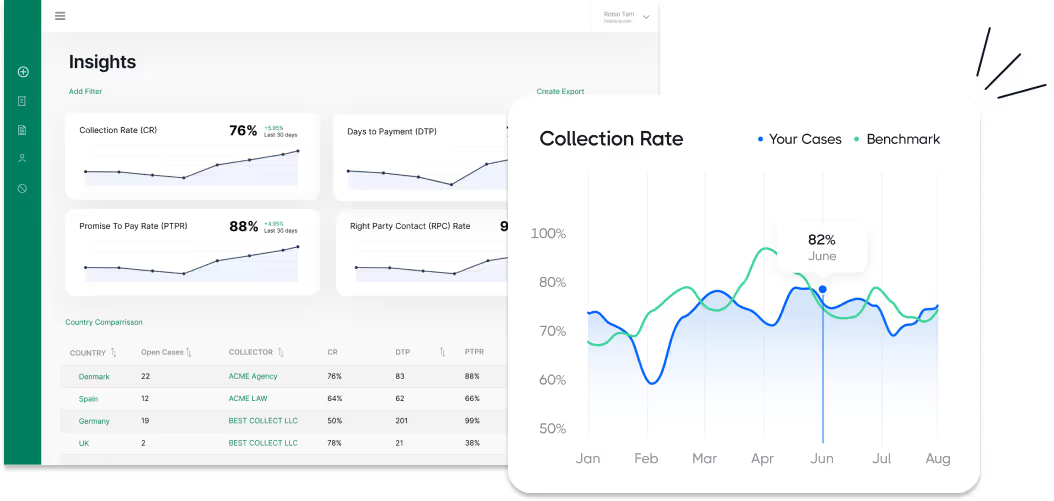
- Suivi en temps réel : Statut en direct, actions et paiements sur un seul portail.
- Conformité : Conforme à la loi coréenne sur les pratiques équitables en matière de recouvrement de créances, à la loi sur l'utilisation et la protection des informations de crédit et à la loi sur la protection des informations personnelles.

Commencez à recouvrer vos créances coréennes en 2 minutes
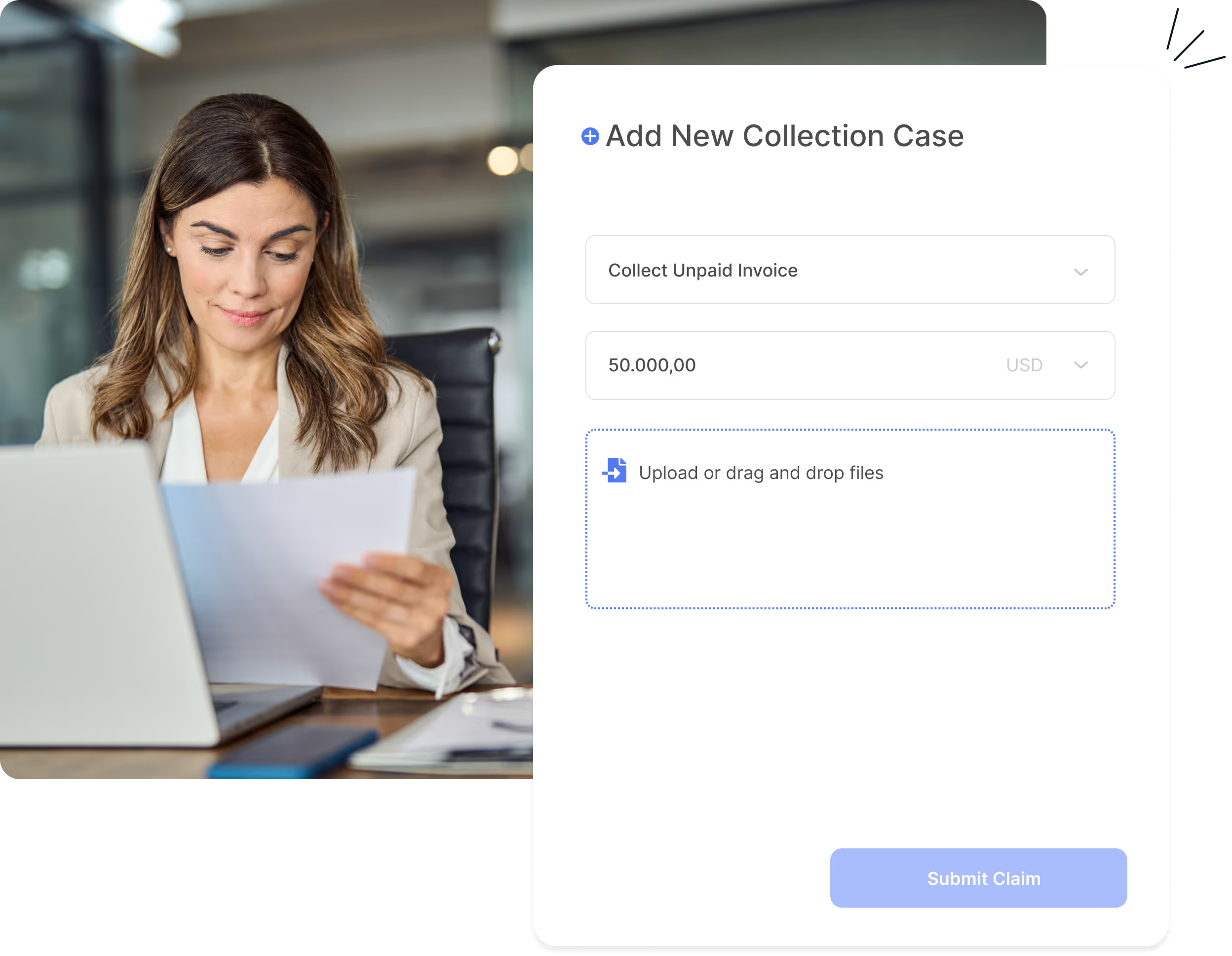
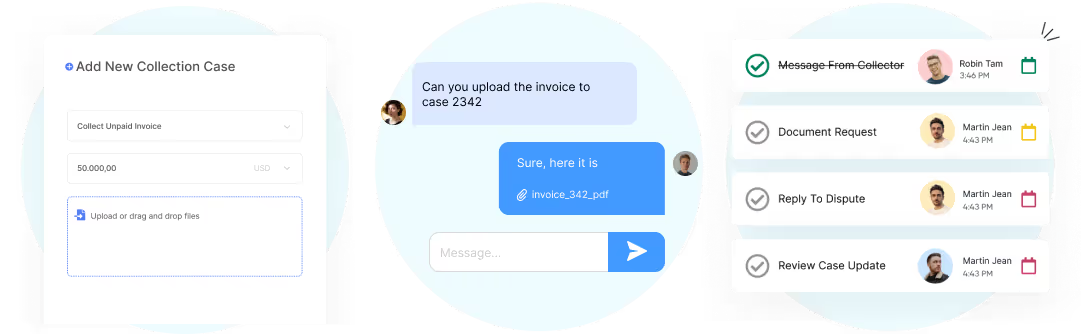
- Soumettez votre dossier : Téléchargez votre créance impayée en quelques minutes via le tableau de bord, l'API REST ou les intégrations ERP prêtes à l'emploi comme Douzone WEHAGO / Smart A et YoungLimWon K-System.
- Le recouvrement local commence : Nous confions le dossier à Barun Law LLC, qui contacte le débiteur en coréen dans les 24 heures. Si une action en justice est nécessaire, choisissez 1 à 3 devis à prix fixe (par exemple, une injonction de payer ou une action en justice) avant de poursuivre.
- Soyez payé : Les fonds sont versés lors du recouvrement. Si une action en justice est nécessaire, choisissez 1 à 3 devis à prix fixe avant de poursuivre.

Tarifs transparents, basés sur le succès
Avec Debitura, vous ne payez que lorsque nous réussissons. Le recouvrement pré-judiciaire est « Pas de recouvrement, pas d'honoraires » : une Commission de succès déduite des montants recouvrés, facturée localement par votre partenaire. Les honoraires dépendent du pays du débiteur, pas du vôtre.
- Débiteurs en Europe (UE, Islande, Liechtenstein, Norvège, Royaume-Uni et Suisse) : Commissions de succès à partir de 6 % selon la taille de la créance.
- Débiteurs dans le reste du monde : Commissions de succès à partir de 7,5 % selon la taille de la créance.
- Créances plus anciennes : une majoration s'applique pour les créances en souffrance depuis 12 à 24 mois et pour les créances de plus de 24 mois.
- L'Action en justice est facultative : vous approuvez les devis à prix fixe avant toute dépense juridique.
Consultez la page Tarifs pour le barème complet des honoraires, ou obtenez une estimation instantanée lorsque vous déposez une créance.
Comment fonctionne le recouvrement de créances en Corée du Sud ?
Debt collection in South Korea starts with an amicable phase handled locally by Barun Law LLC: reminders and a formal payment demand in Korean, aimed at full payment or a written instalment agreement. Most straightforward claims are resolved at this stage without ever going to court. If the debtor still does not pay, escalation is never automatic - your partner assesses the legal route and you approve a quote before any court step.
Principaux points à retenir
- Submit your claim in 2 minutes via the dashboard
- Barun Law LLC takes the local action on your behalf
- No Cure, No Pay: you pay nothing unless we recover
- You approve every legal step before it happens
- Get paid once the claim is recovered
Les quatre étapes, de la facture impayée au recouvrement des fonds
- Étape 1 - Recouvrement amiable : relances, mise en demeure formelle et négociation, gérées localement par Barun Law LLC. La plupart des créances incontestées sont résolues à ce stade, sans passer par les tribunaux.
- Étape 2 - Titre exécutoire : si le débiteur ne paie toujours pas, votre partenaire évalue la voie légale pour obtenir un titre exécutoire et vous approuvez un devis à prix fixe avant toute procédure.
- Step 3 - Enforcement: with a legal title, the execution officer (jibaenggwan) can attach wages, bank funds and other assets until the claim is recovered.
- Étape 4 - Insolvabilité : si le débiteur s'avère insolvable, votre déclaration de créance est déposée et toute distribution est suivie en votre nom.
Chaque étape est suivie sur votre tableau de bord, et aucune action n'est entreprise sans votre approbation. Tous les détails juridiques pour la Corée du Sud – délais, coûts, tribunaux et Exécution forcée – sont présentés dans le guide ci-dessous.

Commencer gratuitement
Pas de frais d'installation
Experts locaux agréés
Pas de résultat, pas de frais
Recouvrement de créances en Corée du Sud – le guide complet 2026
This guide explains how debt collection in South Korea works for a foreign or domestic creditor: the amicable phase, the payment order and litigation routes to an enforceable title, enforcement against a debtor's assets, and what happens if the debtor becomes insolvent.
Sur cette page :
Pourquoi vous pouvez faire confiance à ce guide
At Debitura, we uphold the highest standards of impartiality and precision to bring you comprehensive guides on international debt collection. Every guide is written from primary legal sources and reviewed by licensed local experts in the jurisdiction it covers.
Des questions ou des commentaires ? Écrivez-nous à contact@debitura.com, nous mettons à jour ce guide en fonction de vos retours.
Debitura en chiffres :
- 767 licensed partners - collection agencies and law firms in our network
- 180 countries covered - with cases handled in 174 of them
- 5,306 businesses registered with Debitura
- 33 days median time to first payment on European cases
Rédaction assurée par des experts, validation locale
Rédigé par Lars Holdgaard, Fondateur de Debitura (+10 ans d'expérience en recouvrement de créances B2B international). Chaque page est examinée par des avocats locaux de premier plan afin de garantir l'exactitude juridique et de vous fournir des étapes pratiques.

Experts locaux contributeurs :
Dernière mise à jour :
September 22, 2026

Recouvrement de créances en Corée du Sud – réponses rapides
How much does debt collection in South Korea cost?
Debitura only charges a fee if the case recovers money, under a No Cure No Pay model, with no upfront cost. If the claim escalates to a court payment order, the creditor's stamp fee is set at 10% of the ordinary litigation cost; further court and enforcement fees apply only if the case proceeds to full litigation or enforcement.
How long does debt collection take in South Korea?
An uncontested payment order can become final and enforceable about 2 weeks after it is served on the debtor, while a contested claim that goes to ordinary litigation generally takes 12 to 18 months at first instance in South Korea's district courts. Supreme Court review of an appealed case can take anywhere from 4 months to several years.
What is the limitation period for a debt in South Korea?
A general civil claim is time-barred 10 years after it falls due under Civil Act Article 162, but most commercial claims between businesses are time-barred after only 5 years under Commercial Act Article 64. Several claim types run shorter still: 3 years for a merchant's goods-sale price claim (Civil Act Article 163(6)), 1 year for hotel or restaurant fees, and 6 months for a seller's warranty claim measured from when the defect was discovered.
| Claim type | Délai de prescription |
|---|---|
| General civil claim (Civil Act art. 162) | 10 ans |
| Commercial claim (Commercial Act art. 64) | 5 ans |
| Merchant goods-sale price claim (Civil Act art. 163(6)) | 3 ans |
| Hotel or restaurant fees | 1 year |
| Seller's warranty, from defect discovery | 6 months |
Can I charge interest on an unpaid debt in South Korea?
Yes: a civil claim accrues statutory interest at 5% per annum under Civil Act Article 379, and a commercial claim accrues interest at 6% per annum under Commercial Act Article 54. Filing a payment order or lawsuit, obtaining a court attachment, or getting the debtor to acknowledge the debt in writing interrupts the limitation clock under Civil Act Article 168; a final judgment then resets it to a fresh 10-year period under Civil Act Article 165. An informal demand letter alone only pauses the clock for 6 months, and only if a suit follows within that window (Civil Act Article 174).
What documents do I need to start debt collection in South Korea?
Barun Law LLC needs the underlying contract or invoice, proof of delivery or performance, and a record of any payment demands already sent to the debtor before it can issue a formal demand or file a payment order on your behalf. Additional documents may be requested once the case is reviewed.
Should I use a payment order or file a lawsuit in South Korea?
For an undisputed debt, the Demand for Payment Procedure is faster: the court reviews the paperwork only, holds no hearing, and the order becomes final with the same enforcement effect as a judgment if the debtor does not object within 2 weeks of service. A disputed claim, or one the debtor objects to, converts into ordinary litigation, which generally takes 12 to 18 months at first instance.
| Voie | Key feature |
|---|---|
| Demand for Payment Procedure (payment order) | Documents only, no hearing; final if unobjected within 2 weeks |
| Ordinary litigation | Full hearing; first instance generally 12-18 months |
Qui fait quoi dans le recouvrement de créances en Corée du Sud ?
The collection partner: Barun Law LLC
Barun Law LLC, a Seoul-based law firm of 263 attorneys established in 1998, handles your case in South Korea end to end for Debitura: it reviews the claim, sends the debtor a formal demand in Korean, negotiates an amicable settlement where possible, and if the debtor still does not pay, files a payment order or lawsuit and pursues enforcement, or a proof of claim in insolvency.
South Korea's Fair Debt Collection Practices Act defines "debt collector" broadly, covering credit-business entities, ordinary creditors of a loan, assignees of a commercial claim, and third-party fee-based collectors and their agents (Article 2). Only an attorney-at-law may take the actual litigation steps for a fee-based third-party collector (Article 8-4), which is why Debitura routes South Korean cases to a licensed law firm rather than a standalone collection agency.
The courts
South Korea's civil courts hear payment orders and litigation. Municipal Courts handle claims up to KRW 30,000,000; District Courts hear larger claims, generally before a single judge, moving to a 3-judge panel once the claim exceeds KRW 500,000,000. Appeals run through the High Courts to the Supreme Court of Korea.
The enforcement authority
Once a payment order or judgment is final, compulsory execution is carried out by an execution officer (jibaenggwan) under the Civil Execution Act, acting under the supervision of the competent District Court, against the debtor's bank accounts, wages, or movable and real property.
Debitura's advantage
Debitura's dashboard gives you a single place to submit the claim, approve a fixed-price quote before any court step, and track the case status; you never need a local entity or a Korean-speaking team of your own.
Quelles lois et quels tribunaux s'appliquent au recouvrement de créances en Corée du Sud ?
Le système judiciaire civil
South Korea runs a civil-law court system under the Supreme Court of Korea, with 6 High Courts, 18 District Courts, and 99 Municipal Courts plus 42 Branch Courts below them. Municipal Courts handle civil disputes up to KRW 30,000,000; larger District Court cases are generally heard by a single judge, moving to a 3-judge panel once the claim exceeds KRW 500,000,000. All proceedings are conducted in Korean.
Législation clé
Contractual and commercial claims are governed by the Civil Act and the Commercial Act: the Civil Act sets a 10-year general limitation period for an ordinary claim (Article 162) and a 5% statutory civil interest rate (Article 379), while the Commercial Act sets a 5-year period for a commercial claim (Article 64), with a 6% statutory commercial interest rate (Article 54). Article 64's own proviso yields to any shorter period fixed elsewhere in the law, and this is where South Korea's most-cited short period comes from: an ordinary invoice for goods sold by a merchant or producer prescribes in just 3 years under Civil Act Article 163, not under the Commercial Act itself. The expedited Demand for Payment Procedure that many creditors use first is a document-only court process with no hearing, under the Civil Procedure Act. Debt collection conduct itself is governed by the Fair Debt Collection Practices Act, enforcement is carried out by an execution officer (jibaenggwan) under the Civil Execution Act, and insolvency is governed by the Debtor Rehabilitation and Bankruptcy Act, which provides both a rehabilitation route and a liquidation route. A typical contested case moves through case analysis, a formal demand notification, provisional seizure of assets where needed, litigation, and compulsory execution once a title is final.
Protection des consommateurs et des données
The Fair Debt Collection Practices Act (Chaekwon-ui Gongjeonghan Chusim-e Gwanhan Beomnyul) sets out detailed, numbered conduct rules for anyone collecting a debt in South Korea. Before contact starts, the collector must give the debtor written notice of the delegation, including its identity and the debt details (Article 6), and the same debt cannot be delegated to two or more collectors at once (Article 7). Contact by phone or in person is banned at night, defined as 9pm to 8am, if it seriously disturbs the debtor's privacy or peace (Article 9), and once a debtor has appointed a lawyer and notified the collector, most direct debtor contact must stop (Article 8-2). The Act also bans violence, threats, misrepresentation of a debt's validity or of court authority, and disclosure of a debtor's personal or debt information to third parties, and gives an injured debtor a civil damages claim against a collector that breaches it (Article 14). Barun Law LLC's contact with a debtor follows these rules at every stage of the case.
Étape 1 – Comment fonctionne le recouvrement amiable (pré-légal) en Corée du Sud ?
Amicable, pre-legal debt collection in South Korea starts with Barun Law LLC reviewing the claim and sending the debtor a formal payment demand in Korean. Most undisputed claims are resolved at this stage without ever going to court, and Debitura only escalates to a legal route once you approve a fixed-price quote.
What happens during the amicable phase
Barun Law LLC verifies the debt and debtor details, then contacts the debtor directly with reminders and a formal demand for payment, aiming for full payment or a written instalment agreement. If the debtor acknowledges the debt in writing during this phase, that acknowledgement interrupts the limitation clock under Civil Act Article 168. An informal demand letter on its own only pauses the clock for 6 months, and only if a suit follows within that window under Civil Act Article 174, so a case that stalls in the amicable phase should not be left open indefinitely.
A typical amicable timeline
| Jour | Action |
|---|---|
| Jour 0 | Claim submitted; Barun Law LLC reviews the debt and debtor details |
| Day 1-7 | Formal payment demand sent to the debtor in Korean |
| Day 7-30 | Negotiation; debtor may propose an instalment agreement |
| Day 30-90 | If unresolved, Barun Law LLC assesses the legal route and prepares a fixed-price quote for your approval |
Quand faire remonter l'information
Escalation to a payment order or lawsuit is never automatic. Barun Law LLC recommends moving to a legal route once the debtor stops responding, repeatedly breaks a payment promise, or the claim is approaching its limitation period; you then choose whether to proceed on a fixed-price legal quote.
Étape 2 – Comment obtenir un titre exécutoire en Corée du Sud ?
An enforceable title is the legal document, either an unobjected payment order or a final court judgment, that lets you move to enforcement in Step 3. For an undisputed debt, Barun Law LLC files South Korea's Demand for Payment Procedure: the court examines the paperwork only, holds no hearing, and the creditor's stamp fee is set at 10% of the ordinary litigation cost. If the debtor does not object within 2 weeks of service, the order becomes final with the same enforcement effect as a court judgment. If the debtor objects, or the claim is disputed from the outset, the case converts into or starts as ordinary litigation.
| Voie | Processus | Durée typique |
|---|---|---|
| Demand for Payment Procedure | Documents only, no hearing; final if unobjected | Final about 2 weeks after service if unobjected |
| Ordinary litigation | Full hearing and evidence review | 12-18 months at first instance |
Ordinary litigation
Ordinary civil litigation in South Korea generally takes 12 to 18 months at first instance. A judgment resets the limitation period to a fresh 10 years under Civil Act Article 165, giving the creditor a long window to enforce it. An appeal can go to the High Court and then, on points of law, to the Supreme Court of Korea, where review can take anywhere from about 4 months to several years. Court fees scale with the claim amount; Barun Law LLC confirms the exact court fee for your claim before filing.
Which court hears the claim
Municipal Courts hear civil disputes up to KRW 30,000,000. Larger claims go to a District Court, generally before a single judge; once the claim exceeds KRW 500,000,000, it is usually heard by a 3-judge panel. All proceedings are conducted in Korean, so Barun Law LLC represents you throughout.
Small Claims Litigation
For a claim within the KRW 30,000,000 Municipal Court threshold, South Korea's Small Claims Litigation procedure offers a faster route than ordinary litigation: a single oral-argument hearing is the norm, a spouse, lineal relative or sibling may represent the party without needing the court's permission, and judgment can be pronounced immediately after argument closes. The court may also issue a Recommendation for Performance, which becomes final, with the same effect as a judgment, if the debtor does not object within 2 weeks.
Étape 3 – Comment fonctionne l'Exécution forcée des créances en Corée du Sud ?
Once a payment order or court judgment becomes final, enforcement in South Korea is carried out by an execution officer (jibaenggwan) under the Civil Execution Act: creditors can seize a debtor's bank accounts, wages, and movable or real property to satisfy the debt.
Ways to enforce a claim
| Enforcement method | What it targets |
|---|---|
| Bank account seizure | Funds held in the debtor's accounts |
| Wage garnishment | A portion of the debtor's salary |
| Movable property seizure | Vehicles, equipment and other movable assets, sold at auction |
| Real property seizure | Land and buildings, sold at auction through the District Court |
Korean law protects roughly half of a debtor's wages, salary, pension or retirement pay from seizure, with the exact floor and ceiling set by Presidential Decree with reference to the minimum cost of living (Civil Execution Act Article 246(1)).
Protecting assets before judgment
Before a title is final, a creditor who can show that enforcement would otherwise become impossible or considerably difficult can ask the court for a provisional (protective) seizure of the debtor's movable or immovable assets under Civil Execution Act Articles 276 to 279. This freezes assets in place while the underlying claim or payment order proceeds, and jurisdiction lies with the court where the assets are located or the court handling the merits of the claim.
All enforcement is carried out under the supervision of the District Court that issued or recognises the enforceable title, and Barun Law LLC prepares and files the enforcement application on your behalf. Because a final judgment resets the limitation period to a fresh 10 years under Civil Act Article 165, creditors generally have ample time to pursue enforcement once a title is secured.
Exécution forcée
A typical case moves through case analysis, a formal demand notification, provisional seizure of assets where needed to prevent the debtor moving them, litigation if the debtor disputes the claim, and compulsory execution once a title is final. If the debtor's assets are unknown, Barun Law LLC can apply to the court for a property clarification order compelling the debtor to disclose assets; the exact penalty for non-compliance is [NEEDS VERIFIED SOURCE].
Conduct rules for the enforcement stage
The Fair Debt Collection Practices Act bans violence, threats, disclosure of a debtor's personal information to third parties, misrepresentation, and other unfair conduct at every stage, including enforcement, with civil liability for a collector that breaches it.
Étape 4 – Comment les Procédures collectives affectent-elles le recouvrement de créances en Corée du Sud ?
If a debtor in South Korea becomes insolvent, recovery moves from individual enforcement to a collective process under the Debtor Rehabilitation and Bankruptcy Act, which offers two routes: rehabilitation (Hoesaeng), where a viable debtor keeps operating under a court-supervised plan, and bankruptcy (Pasan), where a court-appointed trustee liquidates the debtor's assets and distributes the proceeds to creditors.
Rehabilitation (Hoesaeng)
A debtor may file for rehabilitation where repaying its obligations on schedule would seriously hinder the business, or where bankruptcy is otherwise feared (Debtor Rehabilitation and Bankruptcy Act Article 34); for a stock or limited-liability company, a creditor holding at least one-tenth of its capital can also petition. A court-approved plan must rank claims fairly: public-interest (common-benefit) claims, covering the costs of running the business and the proceedings after filing, rank ahead of all rehabilitation claims (Article 179); within the rehabilitation claims themselves, rehabilitation security rights rank first, then general preferential rehabilitation claims, then ordinary rehabilitation claims, with shareholders paid last (Article 217).
| Priority (rehabilitation plan) | What it covers |
|---|---|
| Public-interest (common-benefit) claims | Business-continuation and procedural costs after filing; rank first |
| Rehabilitation security rights | Claims backed by collateral |
| General preferential rehabilitation claims | Claims with a statutory preference but no security |
| Ordinary rehabilitation claims | Unsecured claims with no preference |
| Shareholders / equity holders | Paid last, from what remains |
Bankruptcy (Pasan)
A debtor is declared bankrupt, on its own application or a creditor's, once it is insolvent; a suspension of payment raises a presumption of inability to pay, and for a company, bankruptcy can be declared on balance-sheet insolvency (liabilities exceeding assets) alone, without a cash-flow test (Articles 305-306). A court-appointed trustee then liquidates the debtor's assets and distributes the proceeds by the same broad priority as a rehabilitation plan, secured claims before unsecured claims.
Discharge and what survives it
Once a bankruptcy case closes, the court grants the debtor a discharge (immunity, myeonchaek) unless bad-faith grounds apply, such as concealing assets or filing a falsified creditor list (Article 564); once final, discharge releases the debtor from the whole of its remaining bankruptcy debt beyond what was actually distributed (Article 565). A short list of claims survives discharge regardless: taxes, fines and criminal-litigation costs, damages from the debtor's own intentional or grossly negligent wrongdoing, and workers' unpaid wages, severance pay and injury compensation (Article 566). A creditor should treat this list, not the general discharge, as the limit of what a Korean bankruptcy can wipe out.
Dépôt d'une déclaration de créance
Barun Law LLC monitors the case once insolvency proceedings open, files your proof of claim within the court-set reporting period, and tracks any distribution on your behalf, whether the case proceeds as a rehabilitation or a liquidation. A claim not reported within that period is not discharged, but it also receives no dividend, so filing promptly is the single most time-sensitive step for a foreign creditor.
Frais, intérêts et répartition des paiements en Corée du Sud
- Nos honoraires : basés sur le succès - Sans succès pas de frais (voir Tarifs).
- Court & enforcement fees: state fees apply only if the case escalates to legal action; the Demand for Payment Procedure's stamp fee is 10% of the ordinary litigation cost.
- Statutory debtor items: late-payment interest applies at the statutory rate, 5% per annum for a civil claim (Civil Act Article 379) or 6% per annum for a commercial claim (Commercial Act Article 54); recoverable collection costs are added where the law allows.
- Who keeps what: recovered principal is yours; statutory interest and court costs follow South Korean law.
As of 21 July 2026, the Ministry of Justice's Civil Act amendments, including a variable statutory interest rate, passed Cabinet in December 2025 but await National Assembly passage; the fixed 5% (civil) and 6% (commercial) rates remain in force.
Cross-border debt collection in South Korea
South Korea sits outside the EU and any comparable regional bloc, so no European Payment Order or European Small Claims Procedure applies; a foreign creditor instead uses South Korea's own private-international-law rules.
A foreign court judgment is recognised in South Korea only if it meets four cumulative conditions under Civil Procedure Act Article 217: the foreign court had proper international jurisdiction; the losing defendant was validly served with enough time to defend, or appeared despite defective service; recognition does not offend South Korea's public policy; and, the condition most creditors overlook, mutual guarantee (reciprocity) exists between South Korea and the judgment's country of origin. A Korean court checks these conditions on its own motion.
Recognition alone does not let a creditor seize assets in South Korea. Enforcing a foreign judgment additionally requires a separate lawsuit for a Korean "judgment of execution" (jipaeng panggyeol) at the debtor's forum, under Civil Execution Act Articles 26 and 27; the court does not re-examine the foreign judgment's merits, but dismisses the suit if the judgment is not final or fails Article 217's conditions. For a claim that starts in South Korea rather than abroad, the amicable, payment-order and litigation routes described above apply directly under Korean law.
Trouver un Avocat en recouvrement de créances local
Besoin d'une représentation juridique ? Soumettez votre dossier une seule fois et recevez jusqu'à trois propositions d'avocats spécialisés en contentieux, rigoureusement sélectionnés. Gratuit, rapide et sans engagement.
- Spécialistes vérifiés
- Devis en 24 h, sans Frais cachés
- Tarifs équitables et négociés à l'avance
5th Floor, 115 Seosomun-ro, Jung-gu, Seoul, Republic of Korea 04517
Ahnse Law Offices
Ahnse Law Offices est un cabinet d'avocats de premier plan à Séoul, offrant des services efficaces de recouvrement de créances en Corée du Sud. Fondé en 2003, il est reconnu pour ses Solutions stratégiques et est membre de MSI Global Alliance et IR Global.
.webp)
Poursuites judiciaires
Recouvrement judiciaire
Exécution forcée
.png)
15

2002
.png)
Cabinet d'avocats

269 Seocho-daero, Seocho-gu, Seoul, 06596, Republic of Korea
Cabinet d'avocats, Law-Win
Law-Win est un cabinet d'avocats de premier plan à Seocho-gu, offrant des services efficaces de recouvrement de créances en Corée du Sud, se positionnant comme le partenaire incontournable pour le recouvrement de créances depuis 2016, avec des distinctions comme faisant partie des 50 meilleurs cabinets d'avocats nationaux et pour ses services à la clientèle internationale.
Poursuites judiciaires
Recouvrement judiciaire
Exécution forcée
150
2016
Cabinet d'avocats

Suojae - Kwon, Park & Rhee
Suojae - Kwon, Park & Rhee est un cabinet d'avocats de premier plan à Séoul, offrant des services efficaces de recouvrement de créances en Corée du Sud, se positionnant comme le partenaire incontournable pour le recouvrement de créances avec une portée mondiale dans 183 pays et membre du réseau SCG Legal depuis 2018.
Poursuites judiciaires
Recouvrement judiciaire
Exécution forcée
25
2018
Cabinet d'avocats
Rhee's Law Office
Rhee's Law Office est un cabinet d'avocats de premier plan à Paengseong-eup Pyongtaek-si, offrant des services efficaces de recouvrement de créances en Corée du Sud, reconnu pour ses 15 années d'expérience, servant de nombreux clients internationaux et fièrement affilié à l'Association du barreau coréen depuis 2010.
Poursuites judiciaires
Recouvrement judiciaire
Exécution forcée
3
2010
Cabinet d'avocats

8th Floor, 53, Chungjeong-ro
Seodaemun-gu, Korea
SM Credit Information
SM Credit Information est une Société de recouvrement de créances de premier plan à Seodaemun-gu, offrant des services efficaces de recouvrement de créances en Corée. Fondée en 1999, elle sert des clients tels que Hyundai et SK, avec un réseau dans plus de 90 pays et des adhésions à ACA International et IACC.
Poursuites judiciaires
Recouvrement judiciaire
Exécution forcée
1174
1999
Société de recouvrement
Barun Law Building, 7 Teheranro 92 gil, Gangnam-gu
Seoul, South Korea
Barun Law LLC
Barun Law LLC est un cabinet d'avocats de premier plan en Corée du Sud, offrant des services efficaces de recouvrement de créances sans risque, positionnant le cabinet comme le partenaire incontournable pour le recouvrement de créances dans le pays ; fondé en 1998, il est un partenaire exclusif de Debitura offrant un recouvrement de créances Sans recouvrement pas de frais basé sur les conditions générales et les Tarifs standard sans risque de Debitura, avec des distinctions de Legal 500 et Chambers and Partners, et servant plusieurs pays, dont les États-Unis, le Japon et la Chine.
Poursuites judiciaires
Recouvrement judiciaire
Exécution forcée
512
1998
Cabinet d'avocats

22 Kyonggidae-ro, Seodaemun-gu
Seoul, South Korea
NICE Credit Information Service Co., Ltd.
NICE Credit Information Service Co., Ltd. est une Société de recouvrement de créances de premier plan à Séoul, offrant des services efficaces de recouvrement de créances en Corée du Sud. Fondée en 1986, elle a été récompensée par le Million Award for Export Performance et dessert des marchés supplémentaires au Vietnam, au Cambodge, en Thaïlande et en Indonésie.
Poursuites judiciaires
Recouvrement judiciaire
Exécution forcée
1477
1986
Société de recouvrement
Foire aux questions
Consultez nos questions fréquentes ci-dessous, ou contactez-nous directement à contact@debitura.com si vous avez besoin d'aide pour un dossier spécifique.
Comment fonctionne le recouvrement de créances pour les créanciers étrangers en Corée du Sud ?
.svg)
Foreign creditors can pursue debt collection in South Korea through licensed local representatives. Debitura routes your claim to Barun Law LLC, a Seoul-based law firm with 27 years of experience, which handles all debtor contact in Korean, from initial demand letters through court proceedings if needed. The Civil Act and Commercial Act govern contractual obligations: general civil claims prescribe after 10 years (Civil Act Article 162), and most commercial claims after 5 years (Commercial Act Article 64), but Article 64 yields to shorter statutes, so an ordinary merchant's goods-sale invoice, the most common creditor claim, prescribes in just 3 years under Civil Act Article 163. Collection conduct itself is governed by the Fair Debt Collection Practices Act.
Puis-je facturer des intérêts et des frais de recouvrement en Corée du Sud ?
Yes, you can recover statutory interest on unpaid debts in South Korea. Commercial claims accrue interest at 6% per annum under Commercial Act Article 54, while civil, non-commercial claims accrue at 5% per annum under Civil Act Article 379. Collection costs may also be recoverable where South Korean law allows, subject to proof.
Quels sont les frais de recouvrement de créances typiques en Corée du Sud, et comment se positionne Debitura ?
Debt collection fees in South Korea vary significantly by provider and claim size, and many agencies charge a percentage of the amount recovered, sometimes with an upfront retainer. Debitura works on a No Cure No Pay basis: you pay nothing unless Barun Law LLC recovers your money, and there is no upfront cost. See current rates at debitura.com/pricing.
Qu'est-ce qu'une injonction de payer et comment cela fonctionne-t-il en Corée du Sud ?
A payment order, South Korea's Demand for Payment Procedure, is an expedited debt collection route under the Civil Procedure Act. The court reviews documentation only, with no hearing, and issues an order for the debtor to pay. The creditor's stamp fee is only 10% of ordinary litigation costs. If the debtor does not object within 2 weeks of service, the order becomes final with the same effect as a court judgment, allowing enforcement. If the debtor objects, the case converts to ordinary litigation. This fast-track route suits undisputed commercial debts.
Que se passe-t-il si un débiteur coréen conteste la facture ?
If your debtor disputes the claim, Barun Law LLC evaluates the grounds and advises on next steps. For a payment order, the debtor has 2 weeks to object; if they do, the case converts to ordinary litigation, which generally takes 12 to 18 months at first instance in South Korea. For disputed matters, Debitura can source up to 3 fixed-price quotes from vetted law firms so you can decide whether to pursue full litigation.
Comment un jugement du tribunal est-il exécuté contre un débiteur en Corée du Sud ?
Enforcement in South Korea is carried out through the competent District Court once a payment order or judgment becomes final. Common methods include seizure of bank account funds, seizure and auction of movable or real property, and wage garnishment. If the debtor's assets are unknown, the creditor can apply to the court for a property clarification order compelling disclosure. A final judgment resets the limitation period to a fresh 10-year enforcement window under Civil Act Article 165.
Besoin d'une Couverture supplémentaire ?
“Debitura recovered well over 100,000 euros in overdue invoices for us across several countries, all through one contract and one dashboard. Local experts handle each market and we only pay when they actually collect — so our team can spend that time on what we do best: helping our own customers engage smarter with the Manago AI platform.”
Manago AI (formerly SALESmanago)
767
Licensed collection agencies and law firms in our network
180
Countries covered, with cases handled in 174 of them
5,306
Businesses registered with Debitura
.svg)