.png)


.png)
.svg)
Kostenlos loslegen
Inkassounternehmen in China - auf Erfolgsbasis
Ihre Forderungen werden ausschließlich von Ningbo Esteem Consulting (NB Esteem) bearbeitet, unserem lizenzierten lokalen Partner für Inkasso (zhai wu cui shou) in China. Mit über 12 Jahren Erfahrung und einer Mitgliedschaft bei LIC International ist Ihr Inkasso in sicheren Händen. Reichen Sie Ihre Forderung in wenigen Minuten ein, verfolgen Sie den Fortschritt in Echtzeit und zahlen Sie nur, wenn Ihr Geld erfolgreich eingezogen wurde.

100 % risikofrei: Sie zahlen nur bei Erfolg
Local debt collection by licensed agency / law firm
Über 12 Jahre Erfahrung | Mitglied bei LIC International | Zweisprachig EN/CN

Kostenlose Expertenberatung anfordern
Antwort von einem Spezialisten innerhalb von 24 Stunden.
Vielen Dank! Ihre Anfrage wurde empfangen!
Hoppla! Beim Absenden des Formulars ist etwas schiefgelaufen.
Warum Debitura für Inkasso in China wählen

Risk-free debt collection in China
Debitura recovers unpaid invoices from debtors in China through our platform: submit your claim, track it in real time, and pay only when money comes in. Debitura is the platform; the regulated work in China is performed by our exclusive local partner, Ningbo Esteem Consulting (NB Esteem), a Ningbo-based consulting firm with 12+ years of expertise and a member of LIC International, working alongside licensed Chinese law firms so demands carry law-firm letterhead.
- Risikofrei: Sie zahlen nur, wenn wir Ihr Geld einziehen.
- Schnelle Einrichtung: Reichen Sie Rechnungen mit wenigen Klicks ein.
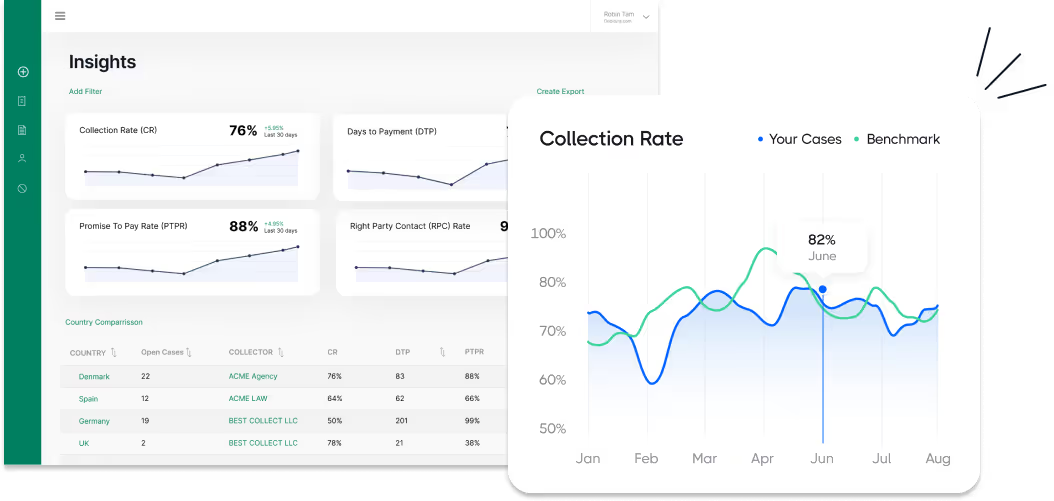
- Echtzeit-Verfolgung: Verfolgen Sie den Fortschritt live in einem Portal.
- Lokale Expertise: Zweisprachiges Team kümmert sich um alles in Englisch und Chinesisch.

So starten Sie Inkasso in China
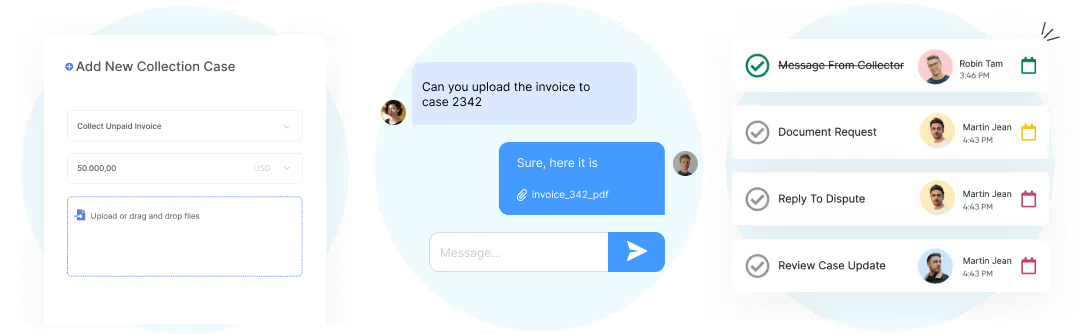
- Forderung hochladen: Geben Sie Schuldnerdaten ein und laden Sie Rechnungen über das Debitura-Dashboard, die API oder die ERP-Integration hoch. Dauert weniger als 2 Minuten.
- NB Esteem übernimmt: Unser lokaler Partner kontaktiert Ihren Schuldner innerhalb von 24 Stunden auf Chinesisch, unter Anwendung bewährter Verhandlungsstrategien.
- Zahlung verfolgen und erhalten: Verfolgen Sie den Fortschritt in Echtzeit. Wenn Gelder eingezogen wurden, erhalten Sie die Zahlung abzüglich der Erfolgsprovision.
Nutzen Sie bereits SAP, Oracle oder Microsoft Dynamics? Verbinden Sie sich über unsere ERP-Integrationen für die automatisierte Forderungseinreichung.

Transparente, erfolgsbasierte Preise
Mit Debitura zahlen Sie nur bei Erfolg. Das vorgerichtliche Inkasso erfolgt auf „Kein Erfolg, keine Gebühren“-Basis: eine Erfolgsprovision, die von den eingezogenen Beträgen abgezogen und lokal von Ihrem Partner in Rechnung gestellt wird. Die Gebühren hängen vom Land des Schuldners ab, nicht von Ihrem.
- Schuldner in Europa (EU, Island, Liechtenstein, Norwegen, Großbritannien und der Schweiz): Erfolgsprovisionen ab 6 % je nach Forderungshöhe.
- Schuldner im Rest der Welt: Erfolgsprovisionen ab 7,5 % je nach Forderungshöhe.
- Ältere Forderungen: Für Forderungen, die 12–24 Monate überfällig sind, sowie für Forderungen, die älter als 24 Monate sind, wird ein Aufschlag berechnet.
- Rechtliche Schritte sind optional: Sie genehmigen Festpreisangebote, bevor rechtliche Ausgaben anfallen.
Die vollständige Gebührenübersicht finden Sie auf der Preise-Seite oder erhalten Sie eine sofortige Schätzung, wenn Sie eine Forderung hochladen.
Wie funktioniert Inkasso in China?
Das Inkasso in China beginnt mit einer außergerichtlichen Phase, die vor Ort von Ningbo Esteem Consulting Co., Ltd. bearbeitet wird: Mahnungen und eine formelle Zahlungsaufforderung, die auf eine vollständige Zahlung oder eine schriftliche Anerkennung der Schuld abzielt. Die meisten unbestrittenen Forderungen werden in diesem Stadium beigelegt. Sollte der Schuldner dennoch nicht zahlen, erfolgt eine Eskalation niemals automatisch; Ihr Partner bewertet den rechtlichen Weg, und Sie genehmigen ein Festpreisangebot, bevor gerichtliche Schritte eingeleitet werden.
Wichtige Erkenntnisse
Die vier Schritte von der unbezahlten Rechnung zum eingezogenen Geld
- Step 1, Amicable collection: reminders, a formal demand and negotiation, handled locally by Ningbo Esteem Consulting Co., Ltd. Most undisputed claims are resolved here, without going to court.
- Schritt 2, Vollstreckbarer Titel: Zahlt der Schuldner weiterhin nicht, prüft Ihr Partner den rechtlichen Weg zur Erlangung eines vollstreckbaren Titels, und Sie genehmigen ein Festpreisangebot, bevor weitere Schritte eingeleitet werden.
- Step 3, Enforcement: with a title, the people's courts can freeze and transfer bank deposits, withhold income, and seal up, auction or sell property until the claim is recovered.
- Schritt 4, Insolvenz: Kann der Schuldner nicht zahlen, wird Ihr Forderungsnachweis im Insolvenzverfahren eingereicht, und etwaige Ausschüttungen werden in Ihrem Namen überwacht.
Jeder Schritt wird in Ihrem Dashboard verfolgt, und nichts eskaliert ohne Ihre Zustimmung. Die vollständigen rechtlichen Details für China finden Sie im folgenden Leitfaden.

Kostenlos starten
Keine Einrichtungsgebühr
Zugelassene Experten vor Ort
Kein Erfolg, keine Kosten
Inkasso in China – der vollständige Leitfaden 2026
Dieser Leitfaden wurde für ausländische und inländische Gläubiger, Unternehmensjuristen und Finanzteams erstellt und beschreibt, wie das Inkasso in China (Festland-VR China) von Anfang bis Ende funktioniert: den rechtlichen Rahmen und die Gerichte, wer was tut, die Verjährungs- und Zinsregeln, den Mahnverfahrensweg (zhifu ling) zu einem vollstreckbaren Ergebnis, die Zwangsvollstreckung durch die Volksgerichte und die Unternehmensinsolvenz nach dem Gesetz über die Unternehmensinsolvenz (Enterprise Bankruptcy Law).
Auf dieser Seite:
Warum Sie dieser Anleitung vertrauen können
At Debitura, we uphold the highest standards of impartiality and precision to bring you comprehensive guides on international debt collection. Every guide is written from primary legal sources and reviewed by licensed local experts in the jurisdiction it covers.
Fragen oder Feedback? Senden Sie uns eine E-Mail an contact@debitura.com , wir aktualisieren diesen Leitfaden basierend auf Ihrem Input.
Debitura in Zahlen:
- 767 licensed partners - collection agencies and law firms in our network
- 180 countries covered - with cases handled in 174 of them
- 5,306 businesses registered with Debitura
- 33 days median time to first payment on European cases
Von Experten geleitet, lokal validiert
Verfasst von Lars Holdgaard, Gründer von Debitura (über 10 Jahre Erfahrung im globalen B2B-Forderungseinzug). Jede Seite wird von führenden lokalen Anwälten überprüft, um die rechtliche Genauigkeit und die Anwendbarkeit der praktischen Schritte zu gewährleisten.

Mitwirkende lokale Experten:
Letzte Aktualisierung:
August 30, 2026

Inkasso in China – schnelle Antworten
Debt collection in China, and debt recovery for foreign creditors in particular, runs on a fast semi-judicial order-for-payment route for clear debts and a court-run enforcement system with strong pressure tools. The headline rules are below.
Wie hoch sind die Inkassokosten in China?
Pre-legal collection is commonly success-based (No Cure, No Pay), so the amicable phase costs you nothing unless money is recovered. Court action adds a case-acceptance fee scaled to the amount in dispute, and the unsuccessful party generally bears the litigation costs the court awards. China does not publish a single consolidated national fee table in English, so your partner quotes the court fee for your claim value before you approve any legal step.
Wie lange dauert das Inkasso in China?
The order-for-payment route is the fastest: the court decides within five days whether to accept the application, issues the order within fifteen days if the claim is clear and lawful, and the debtor then has fifteen days to pay or object. A contested claim runs through a first-instance trial with one right of appeal. The small-claims procedure concludes within two months (extendable by one month) and the ordinary summary procedure within three months (extendable by one month).
What is the limitation period for a debt in China, and does it differ for consumers?
The limitation period is three years and it applies to both commercial and consumer claims, running from the date the creditor knew or should have known of the debt and of the debtor's identity, with an absolute twenty-year long-stop (Civil Code of the PRC, article 188). Chinese law sets no separate consumer limitation period: article 188 sits in Book One of the Civil Code, the general provisions, and the Supreme People's Court's Interpretation on the General Part of the Civil Code (24 February 2022) confirms it is the default for all civil-rights claims, displaced only by a more specific statute and never by a business-versus-consumer distinction. The period is suspended during its last six months for the causes listed in article 194, and it restarts when the creditor demands performance, the debtor acknowledges the debt, or suit or arbitration is filed (article 195).
What interest can I charge on a Chinese debt?
Two separate mechanisms apply and should not be conflated. In private-lending cases (individual-to-individual and other non-institutional lending), courts protect contractual interest only up to four times the one-year Loan Prime Rate in force at contract formation, under Supreme People's Court provisions effective 20 August 2020; the one-year LPR stood at 3.00% per annum in August 2026, putting that cap at roughly 12.00% per annum. Ordinary commercial and trade debt instead relies on the contractual interest clause, plus delayed-performance interest at the LPR after judgment, doubled if the debtor still has not paid by the deadline the court sets.
| Thema | Regel |
|---|---|
| Limitation (commercial and consumer) | 3 years from knowledge; 20-year long-stop (Civil Code art. 188). No consumer-specific period. |
| Mahnverfahren | Basic people's court; order within 15 days; 15-day debtor objection window; no monetary threshold. |
| Small claims | Below 50% of the province's average annual employee salary; single final instance; 2 months. |
| Private-lending interest cap | 4x the one-year LPR (3.00% p.a. in August 2026, so approx. 12.00% p.a.). |
| Zwangsvollstreckung | People's courts freeze deposits, withhold income, and seal up, auction or sell property. |
Welche Dokumente benötige ich, um eine Schuld in China einzutreiben?
Assemble the contract, the unpaid invoices and statement of account, proof of delivery or performance, and any written acknowledgement of the debt or negotiable instrument. A clear, undisputed documentary record is what makes the order-for-payment route available, and a written acknowledgement also restarts the three-year limitation period.
Welchen Weg sollte mein Fall in China nehmen?
A clear, undisputed money debt suits the order-for-payment procedure (zhifu ling) at the basic people's court, which carries no monetary threshold. A disputed claim goes to an ordinary first-instance action. A low-value claim below 50% of the relevant province's average annual employee salary may use the small-claims procedure, decided at a single, final instance; the parties can jointly opt into that procedure for claims up to 200% of the threshold.
Wer macht was beim Inkasso in China?
Recovery in China involves professional support for the amicable phase, lawyers for court proceedings, and the people's courts for enforcement. Debitura is the platform that routes your claim and tracks it; the regulated work in China is performed by our licensed local partner, Ningbo Esteem Consulting Co., Ltd.
Inkassounternehmen in China
No national statute licenses or supervises debt-collection agencies in mainland China, and the industry has no single regulator, so third-party collection firms hold an ambiguous and restricted position. Amicable recovery is therefore best pursued through lawyers and licensed professionals, focused on a formal demand, negotiation and a written settlement or acknowledgement of the debt.
Anwälte in China
Lawyers (lushi) represent creditors in the order-for-payment procedure, in ordinary actions and in enforcement, and are governed by the Law on Lawyers of the PRC. For an overseas creditor, a local lawyer is the practical route into the court system, and demand letters issued on law-firm letterhead carry more weight in the amicable phase.
Gerichte und Zwangsvollstreckung in China
Enforcement is carried out by the people's courts rather than by private bailiffs. The basic and intermediate people's courts may set up dedicated execution organs that locate assets and apply the statutory enforcement measures, and the same courts operate the Dishonest Judgment Debtor list that restricts a defaulting debtor's travel and spending.
Welche Gesetze und Gerichte gelten für das Inkasso in China?
Chinese debt recovery runs on a codified civil-code and civil-procedure system, enforced through a four-tier court hierarchy.
Das Zivilgerichtssystem in China
Ordinary first-instance civil cases are heard by the basic people's courts, with the intermediate people's courts, the higher people's courts and the Supreme People's Court above them. China operates a two-instance system, so a first-instance judgment can be appealed once and the second-instance judgment is final and enforceable. The order-for-payment procedure and the small-claims procedure are both handled at basic people's court level.
Wichtige Gesetzgebung in China
- Civil Code of the PRC (adopted 28 May 2020, in force 1 January 2021): the substantive debt rules and the limitation regime (article 188).
- Civil Procedure Law of the PRC: the order-for-payment procedure, the small-claims and summary procedures, and court enforcement. Amended on 24 December 2021 (in force 1 January 2022, which formalised the Small Claim Procedure) and again in 2023 (in force 1 January 2024, rewriting the foreign-related litigation chapter).
- Enterprise Bankruptcy Law of the PRC (2006, in force 1 June 2007): corporate reorganisation, conciliation and liquidation.
Conduct rules and data protection in China
No unified national statute licenses or supervises debt-collection agencies in mainland China, and the industry has no single supervising regulator, so legitimate recovery normally runs through licensed lawyers and law firms. Collection conduct is bounded by criminal law: Criminal Law Amendment (XI), in force 1 March 2021, created a specific offence of collecting unlawful debt through threats, stalking or harassment, punishable by up to three years' imprisonment where the circumstances are serious. Handling a debtor's personal data must comply with the Personal Information Protection Law (PIPL), adopted on 20 August 2021 and in force since 1 November 2021, which is China's first comprehensive personal-data statute and reaches processing outside China.
Schritt 1 - Wie funktioniert das außergerichtliche (vorgerichtliche) Inkasso in China?
Pre-legal collection recovers an unpaid invoice without a full lawsuit, through reminders, a formal demand and negotiation. China has no statutory pre-action dunning regime, so the amicable phase is a commercial process aimed at full payment or a written acknowledgement of the debt. A written acknowledgement also restarts the three-year limitation period under Civil Code article 195, which is why it is worth securing even when payment is deferred.
| Phase | Aktion |
|---|---|
| Mahnung | Rechnung, Fälligkeitsdatum und Zahlungsdetails. |
| Förmliche Zahlungsaufforderung | Nennt die Summe, eine Frist und die Absicht, den Fall zu eskalieren. |
| Verhandlung | Vergleich oder Ratenzahlungsplan, idealerweise schriftlich bestätigt. |
| Eskalation | Beantragen Sie einen Zahlungsbefehl oder reichen Sie eine ordentliche Klage ein, falls die Forderung bestritten wird. |
Conduct rules in the amicable phase in China
There is no licensing regime for debt-collection agencies in mainland China and no single supervising regulator, which is why recovery is normally run by or with licensed lawyers. The conduct boundary is criminal rather than administrative: Criminal Law Amendment (XI), in force 1 March 2021, makes it an offence to collect unlawful debt by threats, stalking or harassment, with up to three years' imprisonment where the circumstances are serious. A demand-letter process run through a law firm keeps the pressure lawful and preserves the evidence you need if the claim escalates.
Wann man in China gerichtlich vorgehen sollte
Eine Eskalation ist angebracht, wenn die Mahnung wirkungslos bleibt, der Schuldner unbegründet widerspricht oder die Verjährungsfrist naht. Für eine klare, unbestrittene Geldforderung ist das Mahnverfahren in der Regel der schnellste erste Schritt.
Schritt 2 - Wie erhalten Sie einen vollstreckbaren Titel in China?
Um eine Forderung gerichtlich durchzusetzen, benötigen Sie ein vollstreckbares Ergebnis. Chinas schneller Weg für unbestrittene Forderungen ist das Zahlungsbefehlsverfahren, für bestrittene Forderungen ist es eine ordentliche Klage.
Das Zahlungsbefehlsverfahren (zhifu ling)
The creditor applies to the basic people's court with jurisdiction, provided the money claim is clear, there is no other debt dispute between the parties, and the order can be served on the debtor. The court tells the creditor within five days whether it accepts the application; if it does and the rights and obligations are clear and lawful, it issues the order within fifteen days. The debtor then has fifteen days from receipt to pay or file a written objection. If the debtor does neither, the creditor may apply for enforcement. There is no monetary threshold for this route.
Ordentliche Klagen und Klagen geringen Streitwerts
A timely written objection voids the order and ends the procedure, and the creditor brings an ordinary action instead, heard at first instance with one right of appeal. A claim below 50% of the relevant province's average annual employee salary may instead use the Small Claim Procedure, formalised by the 24 December 2021 amendment to the Civil Procedure Law and in force since 1 January 2022; the threshold was raised from 30% to 50% of that salary, the parties may jointly opt in up to 200% of it, and the judgment is single-instance and final with no appeal. The Small Claim Procedure concludes within two months, extendable by one; the ordinary Summary Procedure, for simple facts and clear rights before a single judge, concludes within three months, extendable by one.
Bestimmung des zuständigen Gerichts in China
Die Zuständigkeit richtet sich in der Regel nach dem Wohnsitz des Beklagten oder dem Erfüllungsort, vorbehaltlich einer gültigen Gerichtsstandsvereinbarung. Die Klage muss innerhalb der dreijährigen Verjährungsfrist erhoben werden.
Mehr zu Gerichtsverfahren in China
Das Zwei-Instanzen-System
China operates a two-instance system: a first-instance judgment can be appealed once to the next court up, and the second-instance judgment is final and enforceable. The Small Claim Procedure is the exception, since it is decided at a single, final instance.
Citing Civil Procedure Law article numbers
The Supreme People's Court's official English text of the Civil Procedure Law has not been updated past an earlier article-numbering scheme, and the consolidated current English text is not freely published. The procedures set out above are stable current law; where an exact current article number matters for a filing, confirm it with your local counsel rather than relying on an English translation online.
Schritt 3 - Wie funktioniert die Zwangsvollstreckung von Forderungen in China?
Enforcement is carried out by the people's courts once you hold an enforceable outcome. The court applies the measures that match the debtor's known assets, and the creditor does not deal with private bailiffs.
Möglichkeiten zur Zwangsvollstreckung einer Forderung in China
- Bank deposits: the court can inquire into, freeze and transfer the debtor's bank deposits, within the scope of the obligation.
- Income: the court can withhold or withdraw part of the debtor's income, leaving the necessary living expenses.
- Property: the court can seal up, distrain, freeze, auction or sell off the debtor's property, leaving the necessities of life.
- Statutory penalty interest: a debtor who has not paid by the deadline set in the judgment owes double interest on the delayed debt.
- Pressure tools: the courts run a public Dishonest Judgment Debtor list under Supreme People's Court provisions of 1 July 2013 (amended 2017), published through the China Enforcement Information Online portal. Listing carries travel and high-consumption restrictions and adverse credit reporting, and it is often what moves a solvent but unwilling debtor to pay.
Der Zwangsvollstreckungsprozess in China
The creditor applies to the court with the enforceable outcome, the court investigates and attaches assets, and proceeds are applied to principal, interest and costs, with any surplus returned to the debtor. Because enforcement runs entirely through the court, asset tracing and the choice of measure are decisions the court takes on the creditor's application, so a well-evidenced application naming known bank relationships or assets moves faster.
Schritt 4 - Wie wirken sich Insolvenzverfahren auf die Beitreibung von Forderungen in China aus?
Wenn ein Unternehmensschuldner nicht zahlen kann, wird die Insolvenz nach dem Unternehmensinsolvenzgesetz (2006) zum kollektiven Weg, und die individuelle Zwangsvollstreckung endet in der Regel mit Eröffnung des Verfahrens. Das Gesetz sieht drei Wege vor: Reorganisation, Vergleich und Insolvenzliquidation.
Eröffnung der Insolvenz und Anmeldung Ihrer Forderung
Das Verfahren wird vom Gericht auf Antrag des Schuldners oder eines Gläubigers eröffnet, und ein gerichtlich bestellter Verwalter (guanli ren) übernimmt die Kontrolle über die Insolvenzmasse. Gläubiger melden ihre Forderungen innerhalb der vom Gericht in seiner Annahmeerklärung festgelegten Frist beim Verwalter an.
Ergebnisse und Rangfolge
Gemäß der gesetzlichen Rangfolge (Artikel 113) werden nach den Insolvenzkosten und Masseverbindlichkeiten die Vermögenswerte zuerst zur Begleichung von Arbeitnehmerlöhnen und bestimmten Arbeitnehmeransprüchen verwendet, dann für ausstehende Sozialversicherungsbeiträge und Steuern und schließlich für gewöhnliche Insolvenzforderungen. Ungesicherte Handelsgläubiger stehen an letzter Stelle und erhalten oft nur einen Teil der Forderung zurück.
Das Insolvenzverfahren für Gläubiger in China
Melden Sie Ihre Forderung fristgerecht beim Verwalter an, zusammen mit dem Vertrag, den Rechnungen und dem Kontoauszug; verfolgen Sie die Gläubigerversammlungen und etwaige Ausschüttungen. Beachten Sie, dass China kein landesweites Gesetz zur Privatinsolvenz hat: Das einzige Regime für Privatinsolvenz ist das Pilotprojekt in Shenzhen, das seit dem 1. März 2021 in Kraft ist.
Gebühren, Zinsen und wer was zahlt in China
- Unsere Gebühr: erfolgsbasiert, Kein Erfolg, keine Gebühren (siehe Preise).
- Court and enforcement fees: statutory court and enforcement fees apply only if the case escalates to legal action. A case-acceptance fee is scaled to the amount in dispute, and the unsuccessful party generally bears the litigation costs the court awards.
- Statutory debtor items: interest runs at the rate agreed in the contract, subject to the caps described below; once a judgment is unpaid past the court's deadline, delayed-performance interest is charged at the Loan Prime Rate and doubled as a statutory penalty.
- Wer was behält: Der eingetriebene Kapitalbetrag gehört Ihnen; Zinsen und Kosten richten sich nach dem Vertrag, dem Gesetz und der gerichtlichen Anordnung.
Interest caps in China
Chinese law treats private lending and ordinary commercial debt differently. In private-lending cases, courts protect contractual interest only up to four times the one-year Loan Prime Rate in force when the contract was made, under Supreme People's Court provisions effective 20 August 2020. The one-year LPR stood at 3.00% per annum in August 2026, so that ceiling was around 12.00% per annum. Ordinary commercial and trade debt is not subject to that cap: it relies on the contractual interest clause, so state the rate clearly in the contract.
Internationales Inkasso in China
A foreign court judgment is recognised and enforced in China on the basis of a treaty or the principle of reciprocity under the Civil Procedure Law, and the 2023 amendment, in force since 1 January 2024, substantially rewrote the foreign-related civil litigation chapter, including the jurisdiction and recognition rules for foreign judgments. China signed the Hague Choice of Court Agreements Convention (2005) on 12 September 2017 but has not ratified it, so it does not yet provide a route. Foreign arbitral awards are generally easier to enforce than foreign court judgments, because the New York Convention (1958) has been in force for China since 1987, subject to the standard reciprocity and commercial reservations. For a cross-border supply contract with a Chinese counterparty, a well-drafted arbitration clause is therefore often the stronger enforcement position.
Finden Sie einen Rechtsanwalt für Inkasso vor Ort
Benötigen Sie eine gerichtsfeste Vertretung? Teilen Sie uns Ihren Fall einmal mit und erhalten Sie bis zu drei Angebote von geprüften Prozessanwälten. Kostenlos, schnell und unverbindlich.
- Geprüfte Spezialisten
- Angebote in 24 Stunden, keine versteckte Gebühren
- Faire, vorab ausgehandelte Preise
Style Mansion 205, Huanghe Road, Nankai District, Tianjin, China
Tianjin Bozhuan Law Firm
Tianjin Bozhuan Law Firm ist eine führende Anwaltskanzlei in Tianjin, die effektive Inkassodienstleistungen in China anbietet und sich als der bevorzugte Partner für Inkasso positioniert. Sie wurde 2017 gegründet und vom chinesischen Justizministerium ausgezeichnet und ist Mitglied der Tianjin Lawyers Association.
.webp)
Gerichtsverfahren
gerichtliches Inkasso
Zwangsvollstreckung
.png)
12

2017
.png)
Anwaltskanzlei

Building 4, Qingdao Soft Park, No. 288 Ningxia Road, Shinan District
Qingdao, China
GladTrust Management Co., Ltd.
GladTrust Management Co., Ltd. ist eine führende Inkassofirma in Qingdao, die effektive Inkassodienstleistungen in China anbietet, die seit 2006 für ihre innovativen Lösungen bekannt ist, auf der Basis "keine Beitreibung, keine Gebühr" arbeitet und über 200 Länder mit namhaften Auszeichnungen und Branchenmitgliedschaften bedient.
Gerichtsverfahren
gerichtliches Inkasso
Zwangsvollstreckung
622
2006
Inkassounternehmen

Zimmer 203, No. 18 Jinhui West Road, Yinzhou Bezirk
Ningbo, China
NB Wertschätzung
Ningbo Esteem Consulting Co., Ltd. ist eine führende Inkassofirma in China, die effektive, risikofreie Inkassodienstleistungen anbietet, die 2013 gegründet wurde; als exklusiver Debitura-Partner bietet sie Inkasso auf erfolgsabhängige Vergütung auf der Grundlage der risikofreien Standardbedingungen und Preise von Debitura an und bedient internationale Kunden mit zweisprachigen Fähigkeiten und wird von der League International for Creditors anerkannt.
Gerichtsverfahren
gerichtliches Inkasso
Zwangsvollstreckung
10
2013
Inkassounternehmen

Aurora Compass Advisory LLC
Aurora Compass Advisory LLC ist ein führendes Inkassounternehmen in Sacramento, das effektive Inkassodienstleistungen in den Vereinigten Staaten anbietet. Es positioniert sich seit 2025 als bevorzugter Partner mit einem starken Netzwerk und Expertise und betreut Kunden präzise und professionell.
Gerichtsverfahren
gerichtliches Inkasso
Zwangsvollstreckung
4
2025
Inkassounternehmen
Wukun (Kevin) Ke
Wukun (Kevin) Ke is a seasoned litigator and debt collection attorney based in Shenzhen City, practicing at Haipai Law Firm (Shenzhen). With over a decade of experience and an LL.M. from the University of Manchester, he specializes in dispute resolution, cross-border matters, and debt recovery across China.
Gerichtsverfahren
gerichtliches Inkasso
Zwangsvollstreckung
1
2017
Attorney
Häufig gestellte Fragen
Entdecken Sie unsere häufigsten Fragen und Antworten unten, oder kontaktieren Sie uns direkt unter contact@debitura.com, wenn Sie Hilfe bei einem bestimmten Fall benötigen.
Wie funktioniert Inkasso für ausländische Gläubiger in China?
.svg)
Foreign creditors collect debt in China through a licensed local partner who handles all communication and legal steps on their behalf, so no Chinese legal presence is required. Mainland China has no national statute licensing debt-collection agencies and no single industry regulator, so legitimate recovery normally runs through licensed lawyers and law firms; Criminal Law Amendment (XI), in force since 1 March 2021, makes collecting unlawful debt by threats, stalking or harassment a criminal offence. Through Debitura, your claim is handled by NB Esteem, our exclusive partner in Ningbo, who contacts your debtor in Chinese, negotiates payment and escalates to court where necessary. Debitura is the platform; the regulated collection work is done locally.
Kann ich Zinsen und Inkassokosten meinem chinesischen Schuldner in Rechnung stellen?
Yes, within limits, and China applies two different interest rules that should not be conflated. For private lending (individual-to-individual and other non-institutional lending), courts protect contractual interest only up to four times the one-year Loan Prime Rate in force when the contract was made, under Supreme People's Court provisions effective 20 August 2020; the one-year LPR was 3.00% per annum in August 2026, putting that cap at roughly 12.00%. Ordinary commercial and trade debt relies on the rate agreed in your contract, and after judgment delayed-performance interest runs at the LPR and is doubled if the debtor misses the deadline the court sets. Collection costs are recoverable only where your contract provides for them, so include an interest and cost-recovery clause when trading with Chinese buyers.
Was sind typische Inkassogebühren in China, und wie schneidet Debitura im Vergleich ab?
Die Inkassogebühren in China hängen von der Forderungshöhe ab und davon, ob der Fall außergerichtlich bleibt oder ein Gerichtsverfahren erfordert. Mit Debitura fallen für das vorgerichtliche Inkasso keine Vorabgebühren an – Sie zahlen eine Erfolgsprovision nur, wenn Geld eingezogen wird, und Sie sehen die anfallende Gebühr, bevor Sie fortfahren. Wenn rechtliche Schritte erforderlich sind, kann Debitura bis zu drei Festpreisangebote von geprüften chinesischen Anwaltskanzleien einholen, und Sie entscheiden, ob Sie fortfahren möchten. Aktuelle Preisdetails finden Sie auf unserer Preise-Seite.
What is the order-for-payment procedure (zhifu ling) in China?
The order-for-payment procedure (zhifu ling) is a fast-track court route for clear, undisputed money debts in China, and it carries no monetary threshold. The creditor applies to the competent Basic People's Court; the court decides within 5 days whether to accept the application and issues the order within 15 days if the claim is clear and lawful. The debtor then has 15 days from receipt to pay or file a written objection. A timely objection voids the order and ends the procedure, and the creditor must bring an ordinary action instead. For a well-documented commercial debt this is usually the quickest route to an enforceable outcome.
Was passiert, wenn ein chinesischer Schuldner meine Rechnung bestreitet?
If a Chinese debtor disputes your invoice, NB Esteem first tries to resolve it by negotiation, reviewing your contract, invoices and delivery documentation. If it cannot be settled, the claim goes to court, because a timely written objection ends the order-for-payment route. A disputed claim with simple facts and clear rights can be heard under the Summary Procedure, which concludes within 3 months and is extendable by one month; a claim below 50% of the relevant province's average annual employee salary may use the Small Claim Procedure, decided at a single final instance within 2 months. Debitura can source up to three fixed-price quotes from vetted Chinese law firms before you commit to litigation.
Welche Zwangsvollstreckungsoptionen stehen nach einem Gerichtsurteil in China zur Verfügung?
After a Chinese court judgment, enforcement is carried out by the people's courts themselves, since China has no private bailiffs. The court can inquire into, freeze and transfer the debtor's bank deposits, withhold or withdraw part of the debtor's income while leaving necessary living expenses, and seal up, distrain, freeze, auction or sell the debtor's property while leaving the necessities of life. A debtor who has still not paid by the deadline set in the judgment owes double interest on the delayed debt as a statutory penalty. The courts also publish a Dishonest Judgment Debtor list through the China Enforcement Information Online portal, under Supreme People's Court provisions of 1 July 2013 as amended in 2017, which brings travel and high-consumption restrictions and adverse credit reporting.
Benötigen Sie zusätzliche Länder?
“Debitura recovered well over 100,000 euros in overdue invoices for us across several countries, all through one contract and one dashboard. Local experts handle each market and we only pay when they actually collect — so our team can spend that time on what we do best: helping our own customers engage smarter with the Manago AI platform.”
Manago AI (formerly SALESmanago)
767
Licensed collection agencies and law firms in our network
180
Countries covered, with cases handled in 174 of them
5,306
Businesses registered with Debitura
.svg)