Debt Collection Agency in Kenya: No Win, No Fee
Need a debt collection agency in Kenya? For unpaid invoices from business customers in Kenya, we match your case to a licensed local partner under one contract, and you only pay when money is recovered.


Questions about your case?
Write to us, we reply by email.

Why choose Debitura for debt collection in Kenya

Getting started is simple
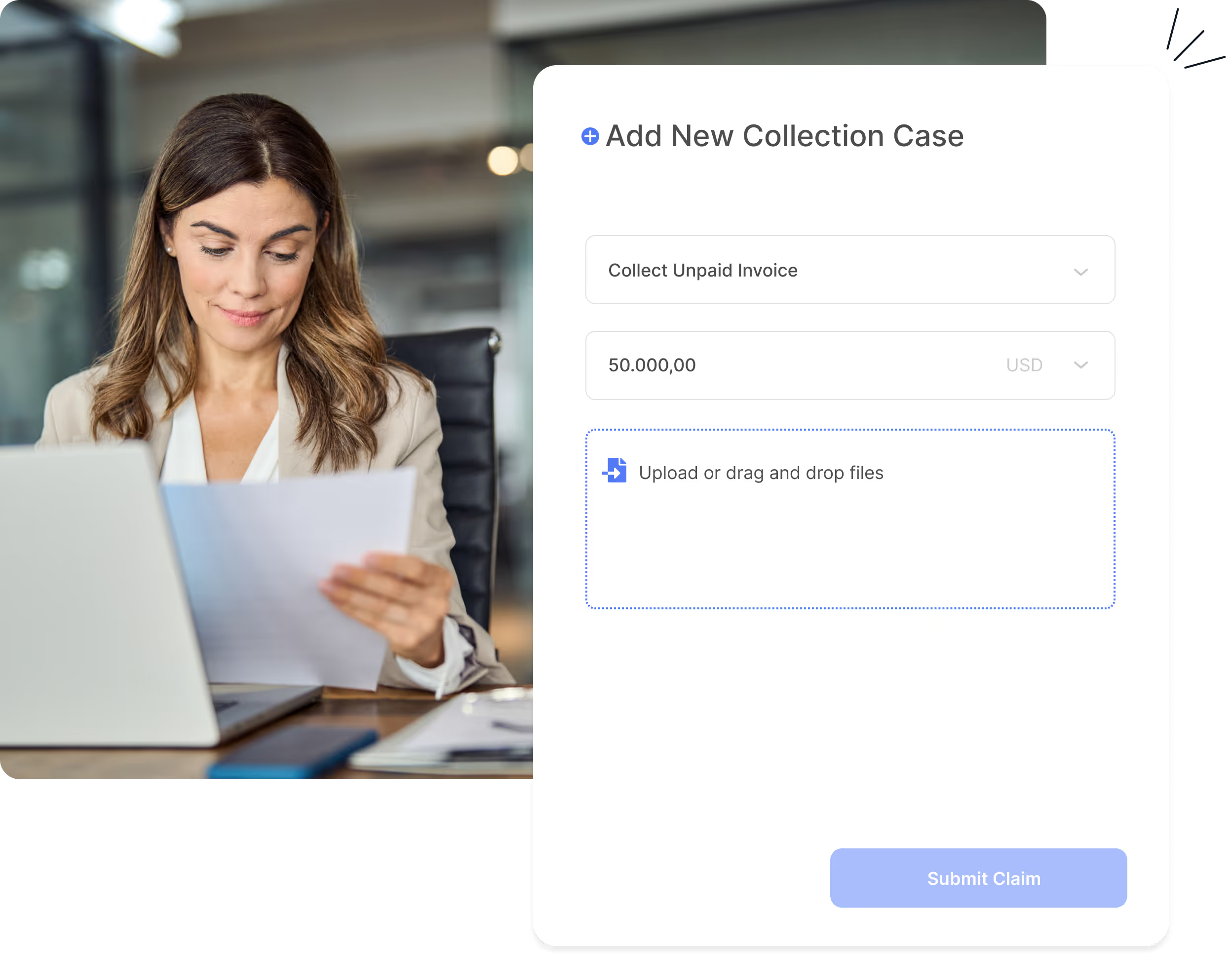
- Create your free Debitura account and submit your Kenya claim with invoice details.
- Clay & Associates Advocates reviews your documents, calls your debtor and sends a demand letter if needed.
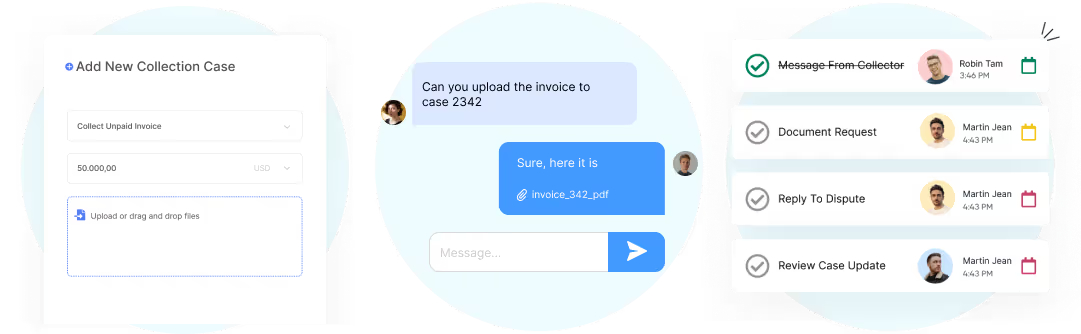
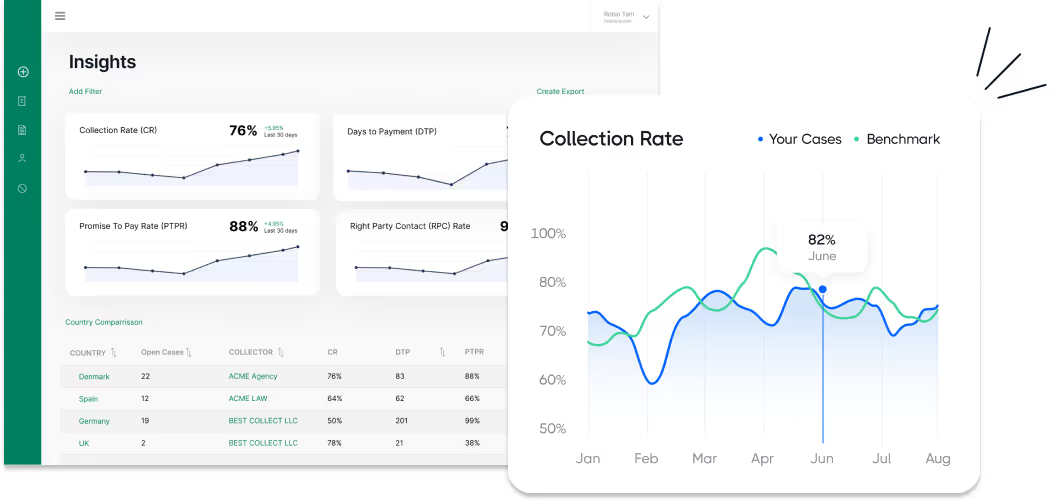
- Track real-time progress in your dashboard. Pay only when funds are recovered.
Prefer automation? Import by CSV or connect QuickBooks Online, Zoho Books, Stripe or KashFlow, or use Zapier, the REST API or our MCP server.
Transparent, success-based pricing
With Debitura you pay a success fee only when money is recovered. Pre-legal collection is No Cure, No Pay: a success fee deducted from recovered amounts, invoiced locally by your partner. Fees depend on the debtor's country, not yours.
- Debtors in Europe (EU, Iceland, Liechtenstein, Norway, the UK and Switzerland): success fees from 6% depending on claim size.
- Debtors in the rest of the world: success fees from 7.5% depending on claim size.
- Older claims: a surcharge applies for claims 12 to 24 months overdue and for claims older than 24 months.
- Legal action is optional: you approve a legal quote, with court costs stated separately, before any legal spend.
See the pricing page for the full fee schedule, or get an instant estimate when you upload a claim.
How does debt collection work in Kenya?
Debt collection in Kenya starts with a call, a written demand and negotiation. Through Debitura, Clay & Associates Advocates in Nairobi handles the amicable stage: Clay Odari or his colleague Sarah Susan calls the debtor first, sends a demand letter if needed (normally one, at most three), and records any deal in a settlement agreement signed by both sides. If the debtor does not pay, the claim goes to court. A contract claim is time-barred 6 years after the cause of action arose (Limitation of Actions Act, Cap. 22, s.4(1)(a)).
- Call and demand letter. A call to agree a way forward, then a written demand with a clear deadline.
- Settlement agreement. A written, signed acknowledgement or a part payment restarts the limitation period (Limitation of Actions Act, ss.23 and 24).
- Small Claims Court. Claims up to KES 1 million, decided within 60 days. Since January 2026 its decrees can no longer be enforced by civil jail.
- Larger or disputed claims. The Magistrates' Courts or the High Court, where your partner first assesses the legal route and quotes the cost.
In this video, Clay Odari, Managing Partner of Clay & Associates Advocates in Nairobi, explains how debt collection works in Kenya, from the first call to enforcement and foreign judgments.
The four steps from unpaid invoice to recovered cash
- Amicable collection: reminders, a formal payment demand and negotiation, handled locally by a local, licensed partner. Most undisputed claims are resolved in this phase, without going to court.
- Enforceable title: if the debtor still does not pay, your partner assesses the legal route to obtain an enforceable title and you approve a legal quote, with court costs stated separately, before anything proceeds.
- Enforcement: with a legal title, the competent enforcement authority can attach wages, bank funds and other assets until the claim is recovered.
- Insolvency: if the debtor turns out to be insolvent, recovery depends on the local insolvency proceedings and is often uncertain. Any step in those proceedings is quoted separately and only starts if you accept.
Every step is tracked in your dashboard, and nothing escalates without your approval. The full legal detail for Kenya - timelines, costs, courts and enforcement - follows in the guide below.
Debt collection in Kenya - the complete 2026 guide
Untangling the intricacies of Kenyan debt collection, whether local or international, can be an uphill task. Debitura simplifies it for you, blending local acumen with expansive global experience. This comprehensive guide equips you to adeptly address any debt collection hurdles in Kenya.
On this page:
Why you can trust this guide
Written from primary legal sources and reviewed by licensed local experts in this jurisdiction.
Questions or feedback? Email us at contact@debitura.com , we update this guide based on your input.
Debitura By the Numbers:
- 180 countries covered - each case handled by a local partner
- More than 5,000 businesses registered with Debitura
- 33 days median time to first payment on European cases
About the author
Written by Lars Holdgaard, Founder of Debitura (+10 years in global B2B debt recovery).

Contributing local experts:
Last updated:

Debt collection in Kenya - quick answers
- Start: collection starts amicably, with a call to the debtor and a written demand. Through Debitura, Clay & Associates Advocates in Nairobi handles this stage.
- Regulation: Kenya has no licence for debt collection agencies. Collectors must follow the Data Protection Act 2019, and Central Bank rules ban threats, harassment and debt shaming by digital lenders and their agents (Digital Credit Providers Regulations 2022, reg. 20).
- Limitation period: 6 years for contract claims (Limitation of Actions Act, Cap. 22, s.4(1)(a)). A written, signed acknowledgement or a part payment restarts it (ss.23 and 24).
- Courts: the Small Claims Court up to KES 1 million, the Magistrates' Courts up to KES 20 million depending on the magistrate's rank, and the High Court above that (Magistrates' Courts Act 2015, s.7).
- Interest: there is no statutory late-payment rate. Interest follows your contract; in a judgment the court sets the rate, and a decree that is silent carries 6% a year after judgment (Civil Procedure Act, s.26).
- Enforcement: court-ordered attachment and sale are carried out by auctioneers licensed under the Auctioneers Act 1996. Arrest and civil jail of up to six months are possible for money decrees, after a court hearing (Civil Procedure Act, ss.38 and 42).
- Foreign judgments: judgments from the UK, Australia, Malawi, Seychelles, Tanzania, Uganda, Zambia and Rwanda can be registered (Cap. 43); judgments from other countries need a new suit in Kenya.
- Insolvency: bankruptcy and company insolvency follow the Insolvency Act 2015.
Who does what in Kenya debt collection?
Three kinds of professional take part in recovering a debt in Kenya: collectors and law firms in the amicable stage, advocates in court, and licensed auctioneers when a court order is enforced.
Debt collectors and law firms in the amicable stage
Kenya has no licence or register for debt collection agencies. Agencies and law firms contact debtors by phone, letter and email, negotiate payment plans and record settlements, but they cannot seize anything without a court order. Their conduct is still regulated: the Data Protection Act 2019 governs how debtor data is used, and the Central Bank's Digital Credit Providers Regulations 2022 ban threats, obscene language, messages to a borrower's phone contacts and public shaming by digital lenders and their agents. Credit bureau reports are only available to banks, microfinance banks and SACCOs, their appointed recovery agents, and anyone with the debtor's written consent (Credit Reference Bureau Regulations 2020).
Advocates in court
A creditor is represented in court by an advocate of the High Court of Kenya. Each advocate holds a personal practising certificate that expires at the end of every year (Advocates Act, ss.21 and 24); law firms as such are not licensed. Advocates file the claim, apply for summary judgment where the debtor files no defence to a liquidated claim (Civil Procedure Rules, Order 36), and apply for execution once a judgment is obtained.
Auctioneers in enforcement
Court-ordered attachment and sale of a debtor's property are carried out by auctioneers licensed under the Auctioneers Act 1996. They act on a court warrant, give the owner notice to redeem and sell by public auction under the Auctioneers Rules 1997.
Which laws and courts apply to debt collection in Kenya?
The civil courts
- Small Claims Court: civil claims up to KES 1 million, decided within 60 days of filing (Small Claims Court Act 2016, ss.12(3) and 34).
- Magistrates' Courts: civil claims up to KES 20 million before a Chief Magistrate, with lower limits for other ranks: KES 15 million (Senior Principal), 10 million (Principal), 7 million (Senior Resident) and 5 million (Resident) (Magistrates' Courts Act 2015, s.7).
- High Court: unlimited original civil jurisdiction (Constitution, Art. 165), so it hears the largest claims, as well as appeals from the lower courts.
- Court of Appeal and Supreme Court: further appeals.
Key legislation
- Civil Procedure Act (Cap. 21) and Civil Procedure Rules 2010: how claims are filed, summary judgment (Order 36), interest on decrees (s.26), court-annexed mediation (ss.59A to 59D) and execution, including attachment and civil jail (ss.38 to 43, Order 22).
- Limitation of Actions Act (Cap. 22): six years for contract claims, restarted by a written acknowledgement or a part payment.
- Auctioneers Act 1996: licenses the auctioneers who carry out court-ordered attachment and sale. It does not regulate debt collection agencies.
- Foreign Judgments (Reciprocal Enforcement) Act (Cap. 43): registration of judgments from reciprocating countries.
- Insolvency Act 2015: bankruptcy and company insolvency.
- Debts (Summary Recovery) Act (Cap. 42): a summary procedure only for sums that another Act declares recoverable summarily. It is not a route for ordinary commercial debts.
Rules on how debtors are treated
- Data Protection Act 2019: collectors process debtor data as controllers or processors and need a lawful basis; the Data Protection Commissioner has fined a lender for messaging borrowers' contacts.
- Digital Credit Providers Regulations 2022: ban threats, harassment and debt shaming by digital lenders and their collection agents.
- Consumer Protection Act 2012: covers consumer credit agreements; it has no specific rules for debt collection.
Step 1 - How does amicable (pre-legal) debt collection work in Kenya?
Amicable collection means getting paid without going to court: calls, a written demand and negotiation. It suits undisputed claims and keeps the business relationship intact.
Who contacts your debtor in Kenya
In Kenya, Debitura does not contact your debtor itself. Your claim is matched to a vetted local partner, a licensed collection agency or law firm, which identifies the debtor, sends reminders and formal notices and negotiates payment. Debitura provides the contract, the platform and the case tracking, so you can follow every step in your dashboard.
How Clay & Associates Advocates works a case
The firm reviews your documents first and asks you to fill any gaps. Clay Odari or Sarah Susan then calls the debtor before any letter goes out, which makes the first contact less adversarial. If the call does not work, a demand letter follows. The debtor either pays in full or proposes a payment plan, which you accept or counter, and the deal is written up as a settlement agreement. Calls stop if the debtor explicitly asks, and the firm avoids pressure that would damage a relationship you may want to keep.
What makes a Kenyan case easier
Verification matters most. Before you extend credit, check that the customer exists, has a bank account and has paid you before, because contact details from an online form are sometimes the only correct data. Keep the contract, the invoices and the correspondence, so a dispute can be answered with documents. A local bank account that debtors can pay by bank transfer or M-Pesa also removes the friction of paying in US dollars.
When to move to court
If the debtor does not respond, breaks payment promises or disputes the claim without grounds, your partner recommends the next step and quotes any legal action for your approval.
Step 2 - How do you obtain an enforceable title in Kenya?
If the debtor does not pay or settle, your partner assesses the route to a court judgment, called a decree in Kenya, and quotes the cost before anything is filed. Which court hears the claim depends on its value.
Small Claims Court
The Small Claims Court hears civil claims up to KES 1 million and must decide each case within 60 days of filing (Small Claims Court Act 2016). On 22 January 2026 the High Court struck down the rule that let its decrees be enforced by arrest and civil jail; attachment and garnishee orders remain. Clay & Associates Advocates told us that, for now, it is moving away from the Small Claims Court for debt collection.
Ordinary proceedings
Larger claims go to the Magistrates' Courts (up to KES 20 million, depending on the magistrate's rank) or the High Court. Proceedings follow the Civil Procedure Act and the Civil Procedure Rules 2010. Where the debtor appears but files no defence to a liquidated claim, the creditor can apply for summary judgment (Order 36). Clay & Associates Advocates has debtors sign a settlement agreement early, because a written acknowledgement restarts the limitation period and makes the claim easier to prove in court.
Mediation and arbitration
Courts can refer a case to court-annexed mediation. If it succeeds, the court adopts the settlement as an order or decree that is enforced like a judgment (Court-Annexed Mediation Rules 2022, r.36); if it fails, the case goes back to the judge. Where the contract has an arbitration clause, the award is enforced on application to the High Court (Arbitration Act 1995, s.36).
The criminal route
Obtaining goods or money by false pretences and issuing a bad cheque are criminal offences (Penal Code, ss.313 and 316A). A complaint hands control of the case to the police and the prosecutor, and a conviction does not cancel the debt: the criminal court can order compensation, and a civil claim continues for anything not covered (Criminal Procedure Code, s.175).
Step 3 - How does debt enforcement work in Kenya?
A judgment is not payment. Clay & Associates Advocates calls winning in court the easy part: every execution step has to follow the rules exactly, and debtors can challenge the manner of execution or appeal. With a decree, the creditor applies to the court for one or more of the following.
- Attachment of movable property: vehicles, equipment and furniture, seized and sold by a licensed auctioneer under a court warrant.
- Attachment of land and buildings: a prohibitory order is registered against the title (Civil Procedure Rules, Order 22 r.48). A sale cannot take place until 30 days after the sale notice (r.58), and the auctioneer must give the owner 45 days' notice to redeem (Auctioneers Rules 1997, r.15). In Clay & Associates Advocates' experience the notices take three to six months in practice.
- Garnishee orders: money owed to the debtor, such as a bank balance, is paid to the creditor instead (Order 23).
- Arrest and civil jail: a debtor who can pay and refuses, or who is hiding assets, can be arrested and, after a hearing, detained for up to six months for a money decree (Civil Procedure Act, ss.38 and 42). The creditor pays the debtor's upkeep in advance at a rate the court sets (s.41), and the court may release a debtor who falls ill (s.43). Since January 2026 this route is not available for Small Claims Court decrees.
- Interest on the decree: the court sets interest in its judgment; if the decree is silent, interest after judgment runs at 6% a year (Civil Procedure Act, s.26).
Enforcing a foreign judgment in Kenya
Judgments from the United Kingdom, Australia, Malawi, Seychelles, Tanzania, Uganda, Zambia and Rwanda can be registered in the High Court under the Foreign Judgments (Reciprocal Enforcement) Act (Cap. 43) and then enforced like a Kenyan decree. A judgment from any other country is enforced by filing a new suit in Kenya on the judgment, which the Kenyan court examines before it gives its own decree.
Costs
Court fees, auctioneers' charges and advocates' fees depend on the claim and the steps taken. Your partner quotes legal and enforcement steps in the Debitura portal, and nothing proceeds without your approval.
Step 4 - How do insolvency procedures affect debt recovery in Kenya?
In situations where a debtor in Kenya becomes insolvent, unable to fulfil financial obligations, the conventional recourse of asset seizure becomes ineffective. Such circumstances necessitate the exploration of bankruptcy proceedings as a valuable recuperative tool. These structured legal procedures aim to methodically liquidate the debtor's assets, providing the final opportunity to recoup any potential compensation for pending claims.
- Legal Framework: Governed by the Insolvency Act of 2015, offering structured procedures for individual and company insolvency.
- Types of Procedures: Includes Bankruptcy, Individual Voluntary Arrangement, No-Asset Procedure, and Summary Installment Order for individuals.
- Filing Threshold: No-Asset Procedure targeted for debtors with no assets and debts between Kshs. 100,000 and Kshs. 4,000,000.
- Duration for Discharge: Bankrupt individuals may be discharged after three years, subject to compliance with proceedings.
- Creditor Initiation: Creditors can initiate bankruptcy proceedings if the debtor fails to meet debt obligations.
- Priority Rules: Insolvency proceedings prioritize claims based on the hierarchy outlined in the Insolvency Act of 2015.
- Cost Implications: Costs vary based on the chosen insolvency procedure and include legal, trustee, and court fees.
- Expected Recovery: Recovery depends on the debtor's assets and the efficacy of the insolvency process, potentially allowing full or partial debt recovery.
- Court Involvement: Courts play a significant role in overseeing insolvency proceedings, ensuring compliance with legal procedures.
- Secure vs Unsecured Creditors: Secured creditors have priority over assets, whereas unsecured creditors may face limited recovery.
Insolvency Framework in Kenya: A Path to Financial Resolution
Kenya's approach to insolvency is designed to offer a balanced mechanism for addressing circumstances where parties are unable to fulfil their financial commitments. Governed by the Insolvency Act of 2015, Kenya provides a well-defined legal structure that navigates the complexities of insolvency, prioritizing fair treatment and the possibility of rehabilitation for debtors, alongside transparent and equitable recovery avenues for creditors. The Act delineates various procedures such as Bankruptcy, Individual Voluntary Arrangement, No-Asset Procedure, and Summary Installment Order, catering to different scenarios and stakeholder needs. Each process requires precise engagement from both debtors and creditors, emphasizing the significance of informed participation and timely action in insolvency cases.
Strategic Protection and Claim Hierarchy for Creditors
Kenya’s insolvency regime underscores the vital importance of creditor involvement and the safeguarding of their rights. Creditors are urged to comprehend the categorization and prioritization of claims, which is critical for maximizing recovery outcomes. The Insolvency Act specifies the order of priority among creditors, distinguishing between secured and unsecured claims. Engaging actively in the process, for instance through creditor committees or by influencing the drafting of reorganization plans, significantly enhances the prospects of recovery. Moreover, creditors must diligently adhere to procedural requirements, including the submission of claims within the designated periods, to ensure their interests are adequately represented.
Navigating Costs and Understanding Timelines
The journey through insolvency proceedings encompasses various financial and temporal considerations. Stakeholders should anticipate a range of associated costs, including administrative fees, court charges, and expenses for professional legal advice, which are typically settled from the debtor's estate prior to the disbursement of funds to creditors. The timeline of insolvency procedures can vary greatly, influenced by the intricacies of the debtor’s financial landscape, the extent of creditor claims, and the potential for disputations. This variability necessitates a strategic approach from creditors and debtors alike, preparing them for a process that may span extensive durations and impact recovery timelines.
Fees, interest and who pays what in Kenya
- Our fee: success-based - No Cure, No Pay (see pricing).
- Court & enforcement fees: state fees apply only if the case escalates to legal action.
- Interest and costs: Kenya has no statutory late-payment rate, so interest follows your contract. Interest and costs beyond the contract are recovered through a court judgment.
- Who keeps what: recovered principal is yours; statutory costs and interest follow local rules.
Partners in our network
These firms are partners in our network for this country. Open a profile to learn more about each one. If court action is needed on your case, your partner sends a quote on the platform; nothing starts until you accept it.
- Verified specialists
- Nothing starts until you accept the quote
- Fair, pre-negotiated rates
Mwamuye Mzungu Solomon Advocates LLP is a premier law firm in Nairobi offering effective Debt Collection services in Kenya, renowned as the Best Corporate Law Firm and Most Reliable Legal Advisory Firm, with memberships in the Law Society of Kenya and the International Bar Association.


MA Law Africa is a premier law firm in Nairobi offering effective Debt Collection services in Kenya, positioning itself as the go-to partner for debt recovery with a foundation in 2020 and recognized for its awards and memberships.
CS Advocates LLP is a premier law firm in Nairobi offering effective Debt Collection services in Kenya, positioning itself as the go-to partner for debt recovery with a foundation in 2021, transparent pricing, and memberships in the Law Society of Kenya and the East Africa Law Society.
Ong'anya Ombo Advocates LLP is a premier law firm in Nairobi offering effective Debt Collection services in Kenya, recognized by Leaders League and the African Legal Awards, and a member of ALFA International, serving clients across 13 countries since 2018.
Munyao-Kayugira & Co., Advocates is a premier law firm in Nairobi offering effective Debt Collection services in Kenya, established in 2013, recognized among the Top 50 Law Firms by The Lawyer, and a member of the Law Society of Kenya.
Tropical Law Advocates is a premier law firm in Kampala offering effective Debt Collection services in Uganda, established in 2007, serving Uganda and Kenya, and a proud member of the Uganda Law Society and East Africa Law Society.
OLM Law Advocates LLP is a premier law firm in Nairobi offering effective Debt Collection services in Kenya, recognized since 2021 with accolades from The Lawyers Global and memberships in IR Global and Global Referral Network, ensuring reliable and award-winning legal solutions.
Mwale Law Advocates LLP is a premier law firm in Nairobi offering effective Debt Collection services in Kenya, positioning itself as the go-to partner for debt recovery since 2013, with memberships in the Law Society of Kenya and the United Nations Global Compact.
KAZI Advocates LLP is a premier law firm in Nairobi offering effective Debt Collection services in Kenya, renowned for its professionalism since 2016, with membership in the Law Society of Kenya and East Africa Law Society, serving both local and international clients.

Bond Advocates LLP is a premier law firm in Nairobi offering effective Debt Collection services in Kenya, recognized as the Most Trusted Litigation & Commercial Law Firm in East Africa, founded in 2022, and a proud member of HG Legal.
Nzamba Kitonga Advocates LLP is a premier law firm in Nairobi offering effective Debt Collection services in Kenya, established in 1980 and renowned for its comprehensive legal expertise, esteemed accolades, and distinguished membership in professional legal bodies.

Gilchery Limited is a premier debt recovery agency in Nairobi offering effective Debt Collection services in Kenya, established in 2016 and operating on a "No Collection – No Fees" model, with membership in the Association of Debt Recovery Agents (ADRA Kenya).

Wacu Mureithi & Co. Advocates is a premier law firm in Nairobi offering effective Debt Collection services in Kenya, positioning the firm as the go-to partner for debt recovery since 2024, recognized for innovation, integrity, and inclusiveness.

Clay & Associates Advocates is a Nairobi law firm founded in 2019 and led by Clay Odari, an advocate of the High Court of Kenya since 2018. As Debitura's partner in Kenya, it handles debt collection for local and foreign creditors on a No Cure, No Pay basis under Debitura's standard terms and pricing.
Frequently Asked Questions
Explore our most common FAQs below, or reach out directly at contact@debitura.com if you need help with a specific case.